
Brian Suters AM honoured for architectural legacy

An architectural legacy that spans more than half a century has earned Brian Suters AM the city’s highest honour.

The award-winning architect has been named a Freeman of the City in recognition of his significant contribution to Newcastle’s built form and enduring commitment to mentoring the next generation.
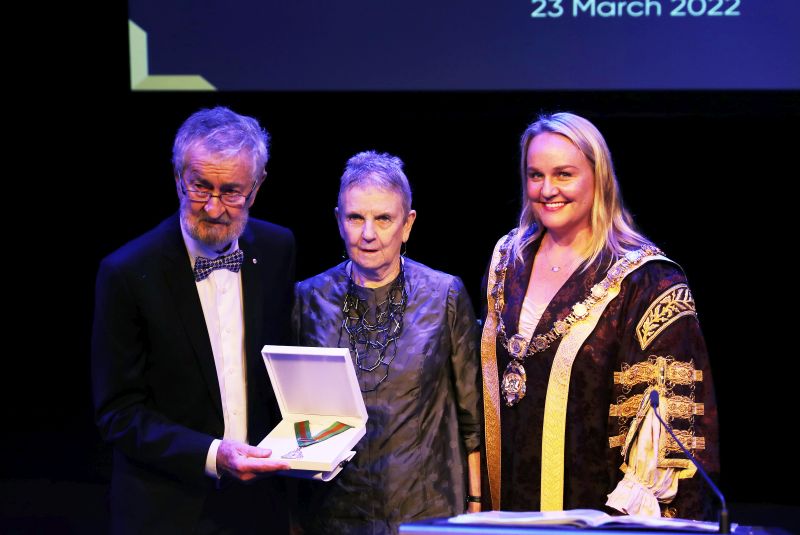
Brian Suters and his wife Kay following the presentation of the Freeman of the City medal by Newcastle Lord Mayor Nuatali Nelmes

Fittingly, the honour was conferred within the walls of the updated Civic Playhouse, which Brian designed for City of Newcastle in 2004.

Newcastle Lord Mayor Nuatali Nelmes said Brian’s work had helped shape the way we see Newcastle today and would continue to be appreciated for generations to come.

“The mark Brian has left on our built form, and our cultural landscape, has quite literally defined part of the city’s look and feel,” Cr Nelmes said.

“His legacy is evident throughout the city, from our striking Brutalist former City Administration Centre, which has recently been reborn as Newcastle’ first five-star hotel, to the modern surrounds of the Civic Playhouse and the remarkable Bauhaus-influence design of his own former family home on Wolfe Street, which won the prestigious Blacket Award for Architecture in 1980.

“Naming Brian a Freeman of the City is a well-deserved honour that recognised the significance of his many architectural contributions to Newcastle and his ongoing commitment to mentoring younger generations of architects.”

Born in Sydney in 1937, Brian and his family returned to his mother’s home city of Newcastle during World War II when he was aged five.

Educated at Hamilton Primary School and Newcastle Boys High School, he later studied at Newcastle Technical College and graduated from the University of NSW, having been awarded the University Medal on the completion of his architecture studies.

After winning the Byera Hadley Travelling Scholarship, he moved overseas with his wife Kay and lived in London and Europe for two-and-a-half years before returning to Newcastle to pursue his architecture career.
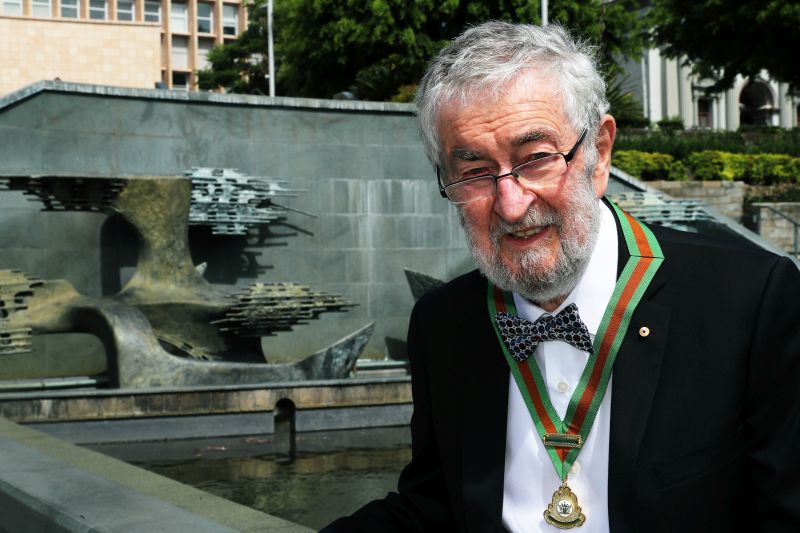
Brian Suters' career took off with the architectural work on the Civic Fountain

Brian acknowledged the role City of Newcastle played in his career and said he was thrilled, more than half a century later, to be honoured as a Freeman of the City.

“Newcastle has been the main spring of my success as an architect and the basis of my community participation,” Brian said.

“Back in 1964 when I returned to Australia from living overseas, my wife and I chose to return to Newcastle to pursue our careers and family life. It was a critical decision and now this honour vindicates that decision.

“My career took off with the architectural work on the Civic Fountain where I worked with the competition winner, sculptor Margel Hinder and her artist husband Frank Hinder.

“He strongly emphasised the need in architecture for collaboration – from concept to completion.

“It marked the beginning of a long period of major works for City of Newcastle and on the back of this our practice acquired many other significant commissions.

“At the time of my retirement in 2010, Suters Architects had offices in Sydney, Melbourne, Brisbane and Cairns, and associations with international practices in Malaysia, UK and France.

“Our practice would not have achieved this recognition without my beloved Newcastle, so I am honoured and delighted to be named a Freeman of the City.”

Brian joins an esteemed list of 14 other Novocastrians to be awarded the City’s highest honour including writer, philanthropist and historian Vera Deacon, community volunteer Howard Mole and Surfest co-founder Warren Smith.

Small Business Support Program extended

Small businesses hit hardest by the Omicron wave have been handed a further lifeline, with the Small Business Support Program extended to a new closing date of 29 April 2022.
 
The financial support package has assisted businesses, workers and the performing arts across NSW with cash flow and to continue trading.
 
Treasurer Matt Kean said the four-week extension was important to ensure small businesses have the resources they need to survive COVID-19 and bounce back.
 
“This extension will allow more businesses to apply, and takes into account potential application delays for businesses from flood-affected areas,” Mr Kean said.
 
“The pandemic and floods have been tough for so many over the past couple of months. But this targeted support helps place our economy in a resilience and recovery phase.”
 
Small Business Minister Eleni Petinos said that due to the crucial role played by the 800,000 small businesses across NSW in providing essential goods, services and jobs, the Government wanted to ensure sufficient time was provided for as many to apply as possible.
 
“Many of these businesses experienced challenges due to the Omicron wave of the pandemic, and we understand the pressures they face,” Ms Petinos said.
 
“This targeted program will support impacted small businesses and help them bounce back after a challenging start to the year.”
 
The Small Business Support Program provides eligible businesses a lump sum payment of 20 per cent of weekly payroll with a minimum payment of $500 per week and a maximum payment of $5,000 per week. Businesses with an annual turnover of between $75,000 and $50 million that experienced a decline in turnover of at least 40 per cent in January 2022 and the start of February 2022 are eligible.
 
For more information please visit nsw.gov.au/.

One of Sydney’s oldest ports to be transformed in world first project

NSW will be home to the world’s first 100 per cent renewable energy shore powered shipping precinct, at the Bays Port in the heart of Sydney.
 
Minister for Transport and Veterans David Elliott said Bays Port, which includes Glebe Island and White Bay, will be the first bulk shipping precinct fully supplied by shore power. The White Bay Cruise Terminal will also be the first shore powered cruise berth in the Southern Hemisphere.
 
“Our Government is creating the ports of the future and in doing so transforming the communities in which they continue to operate,” Mr Elliott said.
 
“The first berth is set to come online in 2024, and will allow shore power capable ships to cut their diesel generators, and thereby reducing emissions, air pollution and noise levels whilst at port.
 
“Shore power is cleaner and quieter, minimising the impact of ships on neighbouring areas and ensuring our last remaining deep water harbour berths continue to operate sustainably into the future,” Mr Elliott said.
 
In the Bays Port area alone, renewable shore power will remove up to 14,000 tonnes of carbon dioxide from entering the atmosphere over 12 months, the equivalent of taking over 4,000 cars off our roads every year.
 
The Port Authority of NSW CEO, Captain Philip Holliday, announced the net zero and shore power plan with the support of bulk shipping and cruise industry leaders.
 
“This is an historic partnership with the Port Authority of NSW investing over $60 million to deliver this infrastructure as the first step, with port users already pledging to retrofit and build ships to take advantage of this technology,” Captain Holliday said.
 
“Delivering Shore Power will drive us even further than our already ambitious NSW net zero targets, of a 75 per cent emissions reduction by 2030 and be net zero by 2040.”

NSW government commits to a circular economy

Sustainable, economically viable and environmentally friendly projects have received NSW Government funding through a program which is fostering innovation through the state’s world-leading researchers and companies.
 
Minister for Science, Innovation and Technology Alister Henskens said the Circular Economy Challenge Program will help to remove barriers and build new sustainable supply chains that minimise or eliminate waste as well as generate jobs and investment in new circular industries.
 
“The Circular Economy refers to a model of production and consumption which aims to eliminate waste by keeping products and materials in use through innovative methods,” Mr Henskens said.
 
“This funding is supporting exciting ways for businesses and people to participate in the new zero-carbon, zero-waste circular economy, ensuring NSW stays at the forefront of innovation and research in this area.”
 
The funding was announced today, coinciding with Minister Henskens addressing the Australia Circular Economy Forum hosted by NSW Circular.
 
Minister for Environment James Griffin said the projects are focused on solving the greatest environmental challenges through innovation.
 
“The circular economy is already in action in NSW, through programs including our wildly successful Return and Earn scheme, which has had more than 7 billion plastic containers returned,” Mr Griffin said.
 
“I’m focused on boosting the circular economy even more to help support our environment through the NSW Waste and Sustainable Materials Strategy, which begins implementation this year.”
 
NSW Circular CEO Lisa McLean said collaboration is the key to solving the big challenges of transitioning to a circular economy.
 
“These research projects are proving there are new and better ways to reduce, recycle and reuse waste across many sectors – health, waste management, construction, infrastructure and finance,” Ms McLean said.

$5.4 BILLION IN FEDERAL FUNDING FOR HELLS GATES DAM

The Morrison-Joyce Government has locked in $5.4 billion to build the Hells Gates Dam in North Queensland that will create thousands of jobs while delivering water security for the region, particularly for the agriculture sector.

Through the 2022–23 Budget, the Government will guarantee funding to build the dam, subject to the completion of the final stage of the business case, expected in June this year.

Hells Gates is anticipated to open up as much as 60,000 hectares of irrigation across three agricultural zones in the Burdekin, supported through a 2,100-gigalitre dam and bolstered by three downstream irrigation weirs.

The project is expected to create more than 7,000 jobs and inject up to $1.3 billion of Gross Regional Product (GRP) into North Queensland’s economy during construction alone.

During operations, new and expanded agricultural opportunities are expected to support more than 3,000 regional jobs and generate up to $6 billion in GRP.

Prime Minister Scott Morrison said delivering water infrastructure in North Queensland was vital to securing a strong economy while supporting farmers and industry.

“We need to build more dams in Australia. Building dams makes our economy stronger by supporting our agricultural industries to realise their true potential,” the Prime Minister said.

“Water is a precious resource and we need more dams to better use that resource.

“We’ve done the homework on Hells Gates Dam and it’s now time to get on and build it. We have put our money on the table, so let’s cut the green tape, get the approvals and get it done.

“This dam will help turn the Burdekin region into an agricultural powerhouse, helping our farmers to stock supermarkets and feed Australia while also securing North Queensland’s water supply and security.

“This investment will kick off a jobs boom across North Queensland for years to come, creating thousands of jobs while generating work for small businesses across the entire north, including in Townsville.”

Deputy Prime Minister and Minister for Infrastructure, Transport and Regional Development Barnaby Joyce said the Government’s investment would help North Queensland realise its full potential.

“North Queensland holds enormous agricultural opportunity and this funding for Hells Gates is part of our plan to unlock this major irrigation expansion,” the Deputy Prime Minister said.

“Irrigating the regional soils of the Burdekin will help the region realise its full potential as a producer of the food Australians and the world needs, driving us closer to taking agricultural production to over $100 billion a year by 2030. This will create more jobs and generate more wealth for our nation.

“The sooner water flows in the west, the sooner we can sell more products to the world and earn the money that will help make Australia as strong as possible as quickly as possible.

“We have put the money to build Hells Gates in the bank and we are ready to get on with the job.”

Federal Member for Herbert Phillip Thompson said the project would have a significant flow-on effect for Townsville.

“We’ve backed this project right from the start because it is something that will create jobs and drive the economy forward,” Mr Thompson said.

“The Townsville Port is well-placed to handle exports from the region, especially after our forward planning and investment into the channel widening project.”

Special Envoy for Northern Australia and Senator for Queensland Susan McDonald said the Morrison-Joyce Government is serious about big-ticket projects in Northern Australia, not only to store water but to drive industry, agriculture, renewable energy and provide jobs to grow regional populations.

“The focus on our north has never been greater, and this focus has been backed by real action and a renewed vigour in how we provide the funding and regulatory framework needed to drive mining, grow business confidence, boost primary production and increase Indigenous involvement,” Senator McDonald said.

“We’re building roads, streamlining environmental approvals processes, and encouraging our mineral sector, making it easier for business to recruit workers and ensuring communities can thrive.

“The Northern Australia agenda is a significant undertaking that we are committed to seeing through.”

Today’s announcement builds on the suite of dams and water infrastructure projects the Coalition is already investing in and delivering across Queensland, including:

  • $600 million towards the restoration of Paradise Dam;
  • $505.65 towards the delivery and construction of Urannah Dam;
  • $183.6 million towards the Rookwood Weir;
  • $180 million towards the Hughenden Irrigation Scheme; and
  • $30 million towards the Big Rocks Weir.

Pressing matters: report on Australia’s regional newspapers

Recommendations to support Australia’s newspaper services in rural, regional and remote areas will be laid out in a report released today by the House of Representatives Standing Committee on Communications and the Arts.

Committee Chair, Dr Anne Webster MP said, ‘Regional newspapers in Australia represent a large and diverse industry, which has experienced significant challenges over the past decade. With the transition to digital news and the ongoing COVID-19 pandemic, assessing the health of our regional newspapers is more important than ever before.’

The Committee made 12 recommendations aimed at addressing core sector issues, and implementing alternative and sustainable business practices, to ensure the longevity of local newspapers across Australia.

The Committee also recommended a multi-pronged approach to support the long-term viability of the sector, particularly for small and independent newspapers based in regional and remote Australian communities. The approach includes the funding and development of a project to gather and analyse core longitudinal data on regional newspapers in Australia.

‘For people in regional, rural, or remote communities, regional newspapers are the main source of local information. It also plays an important role in maintaining an interconnected community, and a healthy democracy. A diversity of opinion from all sides of the political spectrum and coverage of local, as well as national issues, is essential to public debate. It is important we ensure the sector remains viable in the long-term’, said Dr Webster.

The report can be accessed from the Committee’s website https://www.aph.gov.au/Parliamentary_Business/Committees/House/Communications/Arts

OUTSTANDING ACHIEVEMENT IN DEFENCE SCIENCE

An expert in the science behind the Australian Defence Force’s command and control systems has been recognised for his outstanding contribution to Defence, winning the 2021 Minister’s Award for Achievement in Defence Science.

Dr Alex Kalloniatis, a senior Operations Analyst with the Department of Defence, was awarded the honour by Minister for Defence Industry Melissa Price.

“Dr Kalloniatis is a standard bearer for outstanding scientific leadership,” Minister Price said.

“He has conceived and been the driving force behind the future Command and Control concepts that are now at the heart of the ADF’s approach,” Minister Price said.

The Command and Control system is a critical warfighting system in the ADF. It turns individual capability elements into a coordinated, coherent force.

“As our ADF encounters increasingly complex and contested environments, they need to be able to bring together capabilities across all domains of warfare; air, maritime, land, space, information and cyber, to achieve complementary and coordinated effects,” Minister Price said.

“Dr Kalloniatis’ work is critical to enabling the ADF to synchronise its efforts across all domains and operational levels.”

The annual Minister’s Award for Achievement in Defence Science was introduced in 1988 to recognise original and outstanding contributions capable of enhancing Australia’s defence effectiveness and efficiency.

The awarding of the 2021 Minister’s award was delayed due to COVID.

The 2022 award will be presented at the Australian Defence Science Technology and Research Summit, (ADSTAR) in July this year.

Details of previous winners are available at https://www.dst.defence.gov.au/award-groups/ministers-achievement-award .

Concerns held for boy missing from Newcastle 

Police are appealing for assistance to locate a boy missing from the Newcastle area.

Cerise Elmes, aged 13, was last seen leaving a home in Wallsend about 7pm on Tuesday 15 March 2022.

Police were alerted and officers from Newcastle City Police District have been conducting inquiries into his whereabouts.

Concerns are held for his welfare due to his young age and a number of medical conditions.

Police have been told Cerise may be travelling with a woman known to him in a silver Mitsubishi Pajero with NSW registration CI44ED.

Following inquiries, investigators believe he was on Mid North Coast the following day and may be heading towards Queensland.

Cerise is described as being of Caucasian appearance, between 160cm to 165cm tall, with a thin build, black hair and brown eyes.

Anyone who has seen Cerise, or believes they know his whereabouts, is urged to contact police.

Gov and Labor team up to protect research veto

Australian Greens Education spokesperson Senator Mehreen Faruqi has said that Government and Labor Senators have teamed up to produce highly flawed and misleading findings in a Senate Inquiry report into her private member’s bill that would remove the ministerial veto power over Australian Research Council grant funding decisions.

While the vast majority of evidence received from witnesses and submitters through the Inquiry supported removing the ministerial veto, the Committee recommends that the bill not be passed.

Senator Faruqi said:

“Despite an overwhelming majority of contributors supporting the removal of the veto, the committee majority have relied selectively on evidence provided by a very small number of witnesses.

“Politics has trumped good policy-making as both the Government and Labor have refused to concede their political power to interfere with individual research grants.

“This is a shameless attempt to retain unnecessary power over research funding despite enormous evidence provided about the harm that it does to our research and researchers.

“The Government and Labor’s contribution to this inquiry has been nothing short of insulting to the dozens of universities, researchers and peak bodies who provided evidence for the need to remove the veto power.

“Ministerial vetoes have been hugely damaging for academic freedom, research independence, peer-review and Australia’s global research reputation. They have been particularly harmful for early career researchers and for the humanities and social sciences. Yet the Government and Labor ignored these impacts when they teamed up to oppose the bill and disregard overwhelming evidence in support of it.

“The good news is that both major parties have now been put on notice: you are at odds with the Australian university and research communities who want to see this power gone. This is an untenable situation going forward. Politicians will have to come to the table sooner or later.”

Australian Greens Dissenting Report available here: https://www.aph.gov.au/Parliamentary_Business/Committees/Senate/Education_and_Employment/ARCBill/Report/section?id=committees%2freportsen%2f024901%2f79507

Labor should stand up for fair-go economics & oppose Stage 3 shake up

Greens SA Senator, Sarah Hanson-Young, has joined with Greens Senate Candidate for SA in calling for Labor to reverse their support for the Morrison government’s dismantling of Australia’s progressive taxation system.

Senator Sarah Hanson-Young said:

“The Liberals and Labor are on a joint ticket when it comes to giving federal politicians a $9,000 tax cut, while minimum-wage workers – like those in aged care – get nothing.”

“Why should we give a huge, permanent tax cut to Bank CEOs and Federal politicians, while low paid workers get nothing?”

Barbara Pocock, Greens Senate Candidate for SA and Emeritus Professor of Economics said:

“It doesn’t pass the pub test or a 101 economics class.”

“The Greens will oppose the Stage 3 tax cuts and we call on the opposition to do their job and join us.

“You don’t need to be a professor of economics to realize that low paid workers are more likely than the wealthy to spend their tax cut back into the economy.

“But as a Professor of Economics it is obvious to me that this isn’t fair and doesn’t stack up. And I think  that a lot of South Australians who care about a fair go, would agree with me.”

“The extreme changes as part of the Stage 3 tax shake up will take us closer to a flat-tax society like the US and undermine the ‘fair go’ that we expect in Australia.”

“If I’m elected to the Senate for SA, I’ll vote to block and reverse these cuts as one step towards a fairer go in our tax system.”

Barbara Pocock is the Greens Senate candidate for South Australia and an Emeritus Professor of Economics in the  Business School at UniSA.