
Lismore is set to get as many as 64 new affordable units in a $20 million boost to the city’s housing supply.
The plan to build additional affordable homes for Lismore is the result of a partnership between the NSW government and Lismore City Council.
Minister for Families and Communities Natasha Maclaren-Jones said Landcom has entered into an MOU with the council to develop up to 24 units on Bristol Circuit in Goonellabah and 40 units on Cynthia Wilson Drive in Goonellabah in partnership with a Community Housing Provider (CHP).
“This project will help ease housing pressures for people at risk of homelessness in Lismore,” Mrs Maclaren-Jones said.
“Greater access to affordable housing and support pave the way for people who are homeless or at risk of homelessness to secure a brighter future.
“We know that safe and stable accommodation is vital for people to get back on their feet and the NSW Government is committed to delivering more affordable housing to those in our community who need it most.”
Minister for Planning and Minister for Homes Anthony Roberts said that this is just one of the new projects being rolled out as part of Landcom’s expansion into the State’s regions.
“It is important we work with local government on innovative ways to unlock land and build homes,” Mr Roberts said.
“I look forward to the momentum this project creates as the NSW Government works to meet the growing demand for new homes in the regions.”
Lismore City Mayor Steve Krieg said the project would go some way to easing the housing crisis in Lismore, particularly after the devastating February and March floods.
“This is a great outcome for our community after the devastation we experienced during the floods. This partnership will mean there is more affordable housing in the Lismore area for those who really need it,” Mr Krieg said.
Lismore Council has committed to providing a long term lease and to help fund the development at 44 Bristol Circuit site, Council will provide a 50+ year lease to a CHP.
The Northern Rivers Reconstruction Corporation is contributing $2.5 million towards these new proposed developments.
Council will contribute the land for the 69 Cynthia Wilson Drive site and the Department of Communities and Justice will provide $5 million to support the development.
Under the MOU, Landcom will support the design and development application process. The yet-to-be appointed CHP will be responsible for the delivery and ongoing management of the project.
Author: admin
DISASTER ASSISTANCE FOR FLOOD IMPACTED PRIMARY PRODUCERS IN NEW SOUTH WALES
Primary producers affected by ongoing flooding in New South Wales can apply for recovery grants of up to $25,000 as part of the jointly funded Commonwealth-State Disaster Recovery Funding Arrangements.
The grants are now available for eligible primary producers in the Local Government Areas that have been disaster declared from the most recent storm and flood event.
The assistance is available for the immediate clean-up and recovery costs to repair extensive damage to properties.
A full list of eligible LGAs can be viewed on the NSW Rural Assistance Authority’s (RAA’s) Declared Natural Disasters webpage.
Primary producers are encouraged not to self-assess and should consult with their local Rural Financial Counselling Service or apply for the scheme so that the RAA can determine eligibility.
For more information, or to lodge an application, visit www.raa.nsw.gov.au or call the RAA on 1800 678 593. If you are a farmer or a member of the community requiring an emergency response regarding livestock or animals, call 1800 814 647.
The Prime Minister, Anthony Albanese said:
Recent floods and storms across NSW have had a real and devastating impact on local farming communities.
The Australian Government is working closely with the NSW Government to provide financial support so people can start to repair the damage caused by recent events.
Our thoughts are with the people of NSW who have been doing it tough but continue to show immense courage and resilience.
New South Wales Premier, Dominic Perrottet said:
Sadly, many communities remain underwater, herds and crops have been swept away and the full extent of the damage is yet to be revealed.
We have expedited the availability of this grant to ensure primary producers can readily access financial support as soon as it is required.
This will ensure producers can get back on their feet and operational as soon as possible, and we will be ready with more assistance as required.
Minister for Emergency Management, Senator Murray Watt said:
Farmers and growers have been hit hard by the current severe weather, many at a critical time in their season.
These grants will support farmers with their immediate needs and I would encourage anyone who’s been impacted to get in touch with their local Rural Financial Counselling Service and see what help is available.
We are wholeheartedly committed to supporting the recovery, and ultimately the survival, of farming communities impacted by this disaster.
New South Wales Minister for Emergency Services and Resilience and Minister for Flood Recovery, Steph Cooke said:
This funding will help kickstart the clean up effort for farmers impacted by this severe flooding, many of whom haven’t been able to fully recover from previous storms and floods.
While there’s a long road to recovery ahead, these grants will give famers immediate support to begin cleaning up and start the rebuilding process.
New South Wales Minister for Agriculture and Minister for Western New South Wales, Dugald Saunders said:
Throughout the course of this year, primary producers and regional communities have been tested again and again by the excessive rain and catastrophic floods which have severely depleted production capacity.
This onslaught has had a major impact on the incredible food and fibre that we see all year round and now we need to stand together and support the individuals and businesses that our State has become so reliant on.
Greens Call on FIFA and Football Australia to Prevent More Deaths
The Australian Greens hold deep concerns regarding the human rights abuses that have occurred in Qatar, particularly those affiliated with the FIFA world cup.
There was worldwide shock that the 2022 World Cup would be held in Qatar. It only had little infrastructure, but most importantly, the desert-like temperature created concern for fans, footballers, and workers.
Human Rights Watch reports that low-paid migrants made up 90% of Qatar’s workforce at the time the decision was made that they would host the event. Given its role as a global organisation, FIFA had the opportunity to create strict rules about the workforce used to develop the infrastructure required for the World Cup and protect workers. Unfortunately, this was not the case.
Senator Jordon Steele-John, Australian Greens Spokesperson for Foreign Affairs said:
“The information we have received is that between 6,500 and 15,000 workers have died while building stadiums and hospitality venues that will be used for the 2022 FIFA World Cup.
“On behalf of the Australian Greens Party Room I have written to FIFA and Football Australia. We are calling on FIFA to support the establishment of a compensation and remedy fund of US$440 million for migrant workers, and for the families of those workers who have died.
“The Greens are also requesting that FIFA and Football Australia make a public statement in support of migrant workers’ rights, compensation, and non-repetition of human rights abuses in future World Cups.
“The Australian Greens will always promote human rights, and call out those who do not support them.”
Be Slavery Free Campaign said:
“As a ‘sport-mad’ country we also need to get mad when the sport results in people being abused. At least 6,500 people have died in the construction of stadiums and venues for the FIFA world cup. Some from conditions as horrific as dehydration.
“Be Slavery Free applauds the Australian Greens for joining the Socceroos, French and USA politicians and Football Associations around the world in calling for human rights and compensation.
To take your own action please go to https://www.beslaveryfree.com/payupfifa”
Senator Lidia Thorpe, Australian Greens Spokesperson for Sport said:
“The passion we have for athletes needs to translate into solidarity for the workers who make events like the World Cup possible.”
“I applaud the leadership shown by the Socceroo’s and Football Associations globally. It’s time for FIFA to join them, and put their money where their mouth is.
“When we work together, we can achieve so much more. Let’s unite and fight the inequality so many people face in the sports industry.”
Newcastle’s largest playground now open in Wallsend
Wallsend is now home to the city’s largest playground complete with a bike pump track, climbing walls, basketball court, tennis hitting wall and fitness equipment, following the completion of the $2 million Wallsend Active Hub.
Its delivery caps off more than $7.7 million worth of investment by City of Newcastle into four District-level playgrounds across the area during the past five years.
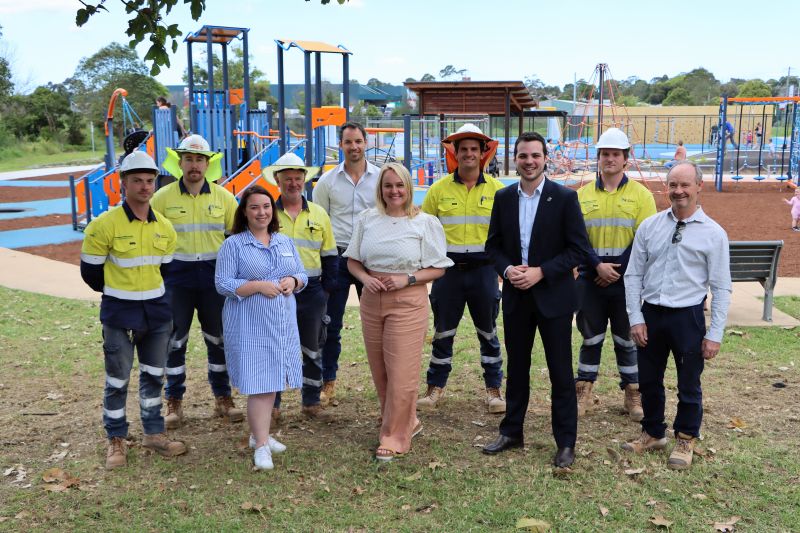
The Federal Park facility will enhance the active recreation options for families across Newcastle’s western suburbs and follows the delivery of multimillion-dollar playground developments at Stevenson Park, Blackbutt’s Richley Reserve and South Stockton.
Newcastle Lord Mayor Nuatali Nelmes said the Wallsend Active Hub reinforces City of Newcastle’s commitment to delivering recreational opportunities for the community across the area including those in the western suburbs.
“Since 2018, City of Newcastle has completed four District level facilities including the $2 million South Stockton Active Hub, the $2.5 million Blackbutt Adventure Playground at Richley Reserve, and the $1.2 million inclusive, all-abilities playground at Stevenson Park, Mayfield West,” Cr Nelmes said.
“The newly opened $2 million Wallsend Active Hub has transformed Federal Park into a hub of activity, making it a destination not only for local residents but for families from outside the area who will enjoy the mix of informal recreational spaces right beside Wallsend Swimming Centre.
“We know how much our community values open spaces and their local playgrounds, which is why we’re proud to have invested $7.7 million during the past five years into these four significant playground developments.
“These major projects have been delivered alongside our annual playground renewal program that also sees four of Newcastle’s 134 playgrounds upgraded each year, ensuring locals and visitors are spoiled for choice when it comes to quality recreation facilities across our city.”
The Wallsend Active Hub draws its inspiration from the Stockton Active Hub and provides a variety of recreation facilities including an expanded playspace, bike track, multi-sport courts, rebound wall, climbing wall and fitness stations.
The construction of the Wallsend Active Hub was supported by a $500,000 grant from the NSW Government’s Resources for Regions program.
Deputy Premier and Minister for Regional NSW Paul Toole said Resources for Regions has been very successful, with rounds one through to eight delivering 242 projects worth $420 million to mining communities since 2012.
“Mining plays a very important part in the NSW economy, supporting tens of thousands of jobs across the state and it will continue to play a role in Newcastle for years to come,” Mr Toole said.
“The NSW Government is committed to supporting regional mining towns that supply our State with these precious resources, and I am pleased these projects will support the ongoing prosperity of the local community.”
City of Newcastle will celebrate the completion of Wallsend Active Hub with the community on Sunday 20 November with a fun, family-friendly opening event from 10am.
Landmark package to recruit, retain and better take care of NSW police
The NSW Government will make its biggest ever investment in the physical and mental wellbeing of police officers as part of a more than $100 million package of reforms designed to help recruit, retain and better take care of the 22,000 members of the NSW Police Force throughout their career.
Deputy Premier and Minister for Police Paul Toole said $79 million will be invested over the next five years in Pulse – a new program designed to better look after sworn and unsworn members’ physical and psychological wellbeing.
“Police run towards danger when the natural instinct is to run the other way – and that carries with it a toll that can be both physical and mental,” Mr Toole said.
“Our Force make a commitment to spend their days on the frontline keeping our community safe. This is our commitment to make sure we do the same for them and take care of them at every stage of their career.”
Mr Toole said the reforms would also include the investment of an additional $27 million over the next five years in a new recruitment and retention fund to ensure the NSW Police Force’s ongoing strength.
“Our Government has delivered the biggest increase to Police numbers in 30 years with the addition of 1500 roles,” Mr Toole said.
“This fund will ensure we continue to draw in the talent we need for a world-class Police Force of more than 18,000 sworn officers – and to retain them in regional and remote areas.”
Commissioner Karen Webb said the new Pulse program is the single most significant investment into the health, safety, and wellbeing of our entire workforce.
“Our people are our biggest asset – and this investment recognises that, and ensures we put the right support around them from their first day on the job to their last,” Commissioner Webb said.
“For the first time we will see Mental Health clinicians embedded in stations and Specialist Commands across the state focusing on consultancy and counselling.
Officers medically retiring will gain access to a dedicated Career Transition team, designed to help them transition to civilian life.
Through periodic health checks, officers will also have access to nurses, dieticians and trainers to improve their overall health and wellbeing.
Police Association of NSW Acting President Ian Allwood said providing police with improved support and services is crucial to continue to attract and retain our police.
“Policing is an incredibly difficult job that takes its toll both mentally and physically. Providing our cops with the support they need isn’t just good for police themselves, but also for the broader community who rely on our police to keep them safe,” Mr Allwood said.
“NSW has a world class police force and ensuring the mental and physical well-being of officers is paramount. This investment will aid in the retention of officers across the state.”
Construction industry joins forces for veterans
The NSW Government has held its first annual Veterans Employment Roundtable at the Anzac Memorial in Hyde Park with a focus on transitioning veterans from the Defence Force into the construction industry.
Minister for Transport, Veterans and Western Sydney David Elliott today met with the Civil Contractors Federation, Master Builders Association and Housing Industry Association along with veterans support and employment organisations to discuss veterans career opportunities after their service.
“Today I met with leaders within the construction industry to discuss how veterans can ply their trade, using the skills they have learnt while serving in the Australian Defence Force.” Mr Elliott said.
“Approximately 1,200 personnel transition from the Australian Defence Force into NSW annually and each veteran has a transferable skillset that enables them to work across a great range of varying roles.”
“The construction industry is booming with many projects around our State. Veterans are employable and have the skills and attributes to contribute to roles in all sectors.”
As part of the development of the NSW Veterans Strategy, a NSW Veterans Employment Roundtable was to be convened annually. Previous Roundtables have been held in 2020 and 2021 and focused on work that government can do in partnership with private employers towards increasing collaboration and ultimately veteran’s finding meaningful employment.
This year’s Roundtable had a special focus on veterans working in the construction industry, and was attended by various organisations willing to work together and support veteran employment opportunities.
“We understand it can be challenging for some former Australian Defence Force personnel to find work after their service. We want to ensure our veterans enjoy a smooth transition from military service to civilian life. Today’s discussions centered on collaborative opportunities and a way forward for veterans looking for post service employment.” Mr Elliott said.
CEO of the Civil Contractors Federation David Castledine is a veteran himself and served with the Royal Australian Navy.
“Veterans are highly skilled, extremely adaptive, and come with an outstanding work ethic. The civil industry, being very process and compliance focused, greatly values such attributes. With a workforce shortage and a civil contractor working in every town in the State, there is great opportunity in our industry for these amazing people.” Mr Castledine said.
“Civil Contractors Federation NSW looks forward to assisting and enabling veterans to transition into the civil construction industry through our Veterans in Civil Program, which encourages more veterans to join the industry and to inform and support employers in the veteran recruiting process.”
More information on the NSW Government Veterans Employment Program available here.
Crucial program changing lives of regional patients
4,572 new patients have taken advantage of the increased financial assistance available to people in regional communities who need to travel long distances to receive specialist care.
Minister for Regional Health Bronnie Taylor said more than 1,000 additional patients per month have lodged claims under the Isolated Patients Travel and Accommodation Assistance Scheme (IPTAAS) since August 1, when the NSW Government’s $149.5 million funding boost came into effect.
“We know there were people in our regional and rural communities who were not seeking the care they needed because of the high cost of travel and accommodation,” Mrs Taylor said.
“With the increased subsidies now available, many of these people are now receiving life-changing treatment.
“This crucial program is helping to ensure that no matter where you live in NSW, you can access the healthcare you need.”
Treasurer Matt Kean said the subsidy for people requiring accommodation has almost doubled, while the NSW Government has also almost doubled the private vehicle subsidy rate from 22 cents to 40 cents per kilometre for patients who have to travel more than 100 kilometres for care.
“As well as receiving more money back, additional patients are now eligible to apply,” Mr Kean said.
“It’s great to see so many more people receiving help to ease the financial burden of travel and accommodation, and we want even more patients to come forward and use IPTAAS.”
Member for Coffs Harbour Gurmesh Singh said patients attending non-commercial clinical trials, high-risk foot clinics, highly specialised publicly funded dental health clinics and ocularists can now access funding thanks to the expansion.
“It is fantastic that as a Government we are able to help reduce the financial burden of regional NSW patients and their families when travelling for treatment,” Mr Singh said.
“If you are paying travel and accommodation and you haven’t heard about this program I encourage you to check your eligibility as it could save you thousands of dollars.”
Armidale couple Pat and Robert Hanson thought they’d have to budget for large travel and accommodation costs when Robert learned he needed cancer treatment in Coffs Harbour.
“When Robert was diagnosed with cancer, it was a very stressful and overwhelming time as Robert’s treatment was going to be in Coffs Harbour, 180km away, and he needed six weeks of radiation treatment,” Mrs Hanson said.
“IPTAAS allowed us to travel and stay in Coffs Harbour for that time without needing Robert to drive back and forth, which was a huge relief. It covered our petrol and our accommodation at the hospital, saving us around $3,000.”
Community-based charity Can Assist provides financial support to cancer patients living in rural and regional areas to help access treatment and care.
“I can’t put into words the weight I see lifted when patients and our volunteers realise what the increase in IPTAAS rebates means for them,” Can Assist Executive Director Emma Phillips said.
The NSW Government is launching a comprehensive awareness campaign to promote the benefits of the expanded scheme, which will include flyers, fact sheets, an updated website and social media posts targeting existing, new and potential patients and their families and carers.
In addition, NSW Health is continuing to review and streamline the IPTAAS application processes to make it easier for patients to lodge claims.
New initiatives to increase female participation in NSW cyber security
The NSW Government has today announced two new initiatives to increase the number of women working in leading roles as the State continues to increase its uplift in Cyber Security.
Speaking at the 2022 NSW Government Cyber Security Showcase, Minister for Customer Service and Digital Government Victor Dominello announced 11 new $15,000 sponsorships for women across the NSW Government to increase their cyber security skills and that Cyber Security NSW would sponsor the Australian Women in Security Network, a not-for-profit dedicated to supporting and growing the number of women in the security community.
“These initiatives are designed to boost the number of women in cyber security and to help expand the recipients’ skills, whether in the technical, policy, governance or intelligence areas of the industry,” Mr Dominello said.
“With this investment we can upskill our workforce and offer new and exciting opportunities our candidates might have not considered in the past.
“While Cyber Security NSW is one of the leading agencies at the forefront of female participation in the industry, just like cyber security itself, this work is not set and forget.”
Minister for Women Bronnie Taylor said the NSW Government is shifting the dial and increasing the participation of women in traditionally male dominated industries.
“The NSW Government is committed to understanding the challenges women face when looking to succeed in emerging high-value industries like Cyber-Security,” Mrs Taylor said.
“We know that when women and girls feel comfortable and welcome in an industry, they stick with it, so initiatives that support and encourage women to pursue their dreams are so important.
“My message to all women considering a future in cyber security is that we need you, we value you and your contribution to this space is crucial.”
NSW Chief Cyber Security Officer Tony Chapman said the Australian Women in Security Network (AWSN) is ideal the organisation for Cyber Security NSW sponsorship.
“The AWSN aims to increase the number of women entering, working in, and leading Australia’s security industry, in turn inspiring women to pursue a career in security and helping build the Australian pipeline of talented security professionals,” Mr Chapman said.
“The NSW Cyber Security Strategy has forecast that almost 17,000 new cyber security jobs will be needed by 2026.”
For more information about Cyber Security NSW visit: https://www.digital.nsw.gov.au/policy/cyber-security
Next step towards expansion of urgent care services
Further efforts to relieve demand on emergency departments with expanded urgent care services are a step closer today, with expressions of interest now open.
The urgent care services, a joint commitment of the NSW and Victorian governments, can help ease pressure on emergency departments by giving people faster care for urgent but non-critical conditions and free up critical resources for patients with more serious needs.
As a result of the expression of interest process, it is expected that urgent care services will be enhanced in Western Sydney. Existing urgent care services are located in Wentworthville, Rouse Hill, Marsden Park and Castle Hill.
A total of 25 urgent care services will operate across New South Wales, with the expression of interest process to fill the remaining sites.
Premier Dominic Perrottet said the NSW Government was stepping up to provide a service which supports the primary care sector and reduces pressure on emergency departments.
“We know the Federal Government is looking at providing more support for GPs and primary care but we need to act now to continue to make the NSW health system the best in Australia,” Mr Perrottet said.
“Demand on emergency departments nationwide is at unprecedented levels, with many thousands of people presenting for treatment as they haven’t been able to see a GP, and often they don’t require emergency care.
“This initiative will help give people with non-critical conditions convenient and streamlined care.”
Minister for Regional Health Bronnie Taylor said by expanding our urgent care services, the NSW Government is bridging the gap between GP Practices and hospitals.
“More people than ever are presenting to our hospitals, and with COVID still in our community, our health services are understandably under pressure,” Mrs Taylor said.
“We need to be bold and try different things to improve health outcomes in our communities and that is exactly what this initiative will achieve.
“By expanding the footprint of urgent care services across NSW, we will ensure that people can get the high quality care they need for less serious conditions and also free up space in our emergency departments.”
Health Minister Brad Hazzard said the latest quarterly BHI figures reveal almost 375,000 people attending our EDs – almost half of all those coming in for treatment – were for non-critical conditions.
“Our health staff will always triage the most urgent and life-threatening cases first, which means less urgent cases who could get their treatment at a GP, end up waiting,” Mr Hazzard said.
“The expanded urgent care services, which include partnerships with General Practitioners, aim to free up those critical resources in our emergency departments for patients with more serious needs.”
Under the joint commitment with Victoria, 25 urgent care services will operate in each state for extended hours to offer more care outside the hospital system.
These services will be well equipped to handle conditions such as sprains, broken bones, wounds, insect bites and minor ear and eye problems. Patients will not be charged, and patients without a Medicare card will also have access free of charge.
Urgent care services can be delivered through a variety of models. Expressions of interest are being sought from local health districts, specialty health networks, and from general practices through primary health networks.
Further information on NSW Urgent Care Services is available at www.health.nsw.gov.au/urgentcare
Man charged after shooting – Greta
A man will face court today over the shooting of another man in the state’s Hunter region earlier this week.
About 8pm on Tuesday (1 November 2022), police were called to a home on High Street, Greta, following reports of a shooting.
Police have been told a man, aged 38, was shot in the foot during a dispute at the home and was taken to Maitland Hospital by an associate.
The injury is not considered life-threatening.
A crime scene was established and forensically examined by specialist officers.
Detectives from Hunter Valley Police District commenced an investigation into the matter.
About 11am yesterday (Wednesday 2 November 2022), a 58-year-old man was arrested at a home on Anvil Street, Greta, and taken to Cessnock Police Station.
A search warrant was also executed at the premises. It will be alleged that police located a number of firearms, a silencer and a small amount of cannabis.
The man was charged with discharge firearm etc intend cause grievous bodily harm, fire firearm at dwelling-house with disregard for safety, possess or use a prohibited weapon without permit, holder of category A or B licence not have approved storage and possess prohibited drug.
He has been refused bail to appear at Cessnock Local Court today (Thursday 3 November 2022).
Inquiries are continuing.