
Catholic school staff endorse public sector teachers’ strike 

The Independent Education Union of Australia expresses its full support for the NSW Teachers Federation and its members who are taking industrial action on Wednesday 4 May. The IEU also supports the Federation’s bans on implementing new government policies.

“It’s time for meaningful action now,” said IEUA NSW/ACT Secretary Mark Northam.

The IEUA NSW/ACT Branch represents more than 32,000 teachers, principals and support staff in non-government schools as well as early childhood teachers.

“Teachers and support staff across the government and non-government sectors are dedicated professionals who have been pushed to breaking point,” Northam said. “The sharply rising cost of living, lack of real wages growth, ever-increasing workloads and global pandemic have led to crippling staff shortages. Our members are exhausted and burnt out.”

The IEU is in the process of negotiating new enterprise agreements for its 18,000 members in Catholic diocesan schools. The union’s campaign, Hear Our Voice, calls on employers to:

·       Pay teachers what they’re worth (an increase of 10% to 15% over two years)

·       Give support staff a fair deal (pay parity with colleagues in public sector schools)

·       Let teachers teach – cut paperwork

·       Allow time to plan

·       End staff shortages.

To take industrial action, the IEU is bound by federal legislation requiring a formal, complex and time-consuming balloting of its members in Catholic diocesan schools. But this process is well under way.

“The union has obtained a Protected Action Ballot Order in the Fair Work Commission to enable balloting of members,” Northam said. “This will proceed during May and, pending its outcome, will authorise similar industrial action in late May.”

“We urge employers to Hear Our Voice,” Northam said. “It’s time for a fair deal for teachers and support staff – it’s the only way to attract and retain the right people to fix the critical shortages and guarantee teaching and learning for our students now and into the future.”

IEUA NSW/ACT Branch President Chris Wilkinson said: “For too long the needs of teachers and support staff have been ignored, and now increasing workloads, growing class sizes, lack of casual staff and constant data collection requirements have hit crisis point. School staff deserve pay and conditions that reflect the complex work they do each and every day.

“We stand with our colleagues in the NSW Teachers Federation. We all need our voices to be heard.”
Great day for fruit pickers as new award conditions kick in, despite farming lobby’s best efforts 

The Australian Workers’ Union is today warmly welcoming the new Horticulture Award which introduces an hourly minimum rate for fruit pickers, who will now enjoy the same baseline conditions as all other Australian workers. 

In November 2021, the AWU secured an historic industrial win for fruit pickers by successfully arguing the Horticulture Award should be altered to ensure every worker is entitled to take home the minimum casual rate of pay, currently $25.41. The new Award will allow piece rates to continue, but also provide a baseline safety net. 

Despite aggressive opposition from the National Farmers Federation and the Agriculture Minister the AWU was able to persuade the Fair Work Commission that it was unfair to allow fruit pickers to be bamboozled and underpaid by the piece work system without a safety net. 

“Fruit picking is tough, important work and at the very least those workers deserve to earn the Australian minimum wage. It’s truly amazing that the NFF and David Littleproud can look themselves in mirror after arguing the opposite,” said AWU National Secretary Daniel Walton. 

“It’s unfortunate the NFF have decided they want to operate as a mouthpiece for bad farmers instead of representing the good farmers who have been undercut by dodgy exploitation and underpayment practices. 

“Of course we’re going to see more scaremongering about consumers prices, despite the fact fruit prices have actually been relatively stable over the past two years when Covid put unprecedented pressure on the labour force. 

“But even if we accept the dubious point that prices will go up slightly on average, what’s the argument? That we should encourage an underclass of workers in Australia on third world wages so our supermarket berries cost one per cent less? 

“For too long the farmers’ lobby has seen fruit pickers as somehow beneath the usual standards offered to Australian workers. But the hard work of pickers deserves the same minimum wage dignity afforded to everyone else.

“Now at the end of each day every picker should be assured that their work netted at least $25.41 an hour. If not, their employer is stealing from them and breaking the law.

“This ruling is a huge advance for this industry and for all the farmers who are already doing the right thing.”

Dingo? Bingo! How you can help dingo research from your home 

Can you tell your cats from your dingoes? Your wallabies from your wallaroos? Then Dingo? Bingo! is your chance to identify dingoes (and other wildlife) in photos and help scientists better understand and manage dingo populations in particular.

An online citizen science project Dingo? Bingo! requests the public’s help in detecting dingoes and other animals among images retrieved from a network of camera-traps. Cameras were installed in the Myall Lakes region of NSW, which is home to an important coastal population of dingoes and a long-term study into dingo ecology and management. The Myall Lakes dingo project, supported by the Hermon Slade Foundation and Taronga Conservation Society Australia, aims to develop and test non-lethal management techniques and add to our understanding of dingo behaviour and ecology along the way.

Dingoes are an iconic and valuable part of the Australian ecosystem, but where dingoes co-occur with humans – be it campgrounds, towns, or livestock areas – they can also cause issues, and these conflicts are conventionally managed by lethal means. The question is are there non-lethal alternatives for deterring dingoes from these places?

Researchers from UNSW Science and Taronga Conservation Society Australia are testing whether the dingoes’ own signals can be used to deter them and invasive predators from particular areas. Dingoes use howls and scent marks to communicate ownership of space, and so by simulating their presence in an area the team hope to be able to deter them from specific areas. 

As Dr Neil Jordan, lead researcher and Senior Lecturer at UNSW, explains, “In some circumstances, living alongside dingoes can be challenging. This project hopes to develop tools and strategies to limit the negative impacts that dingoes have in specific areas, while still allowing them to perform their ecological role as apex predator across the wider landscape”.  

Part of that ecological role may be suppressing invasive foxes, and as Taronga’s Behavioural Biologist and co-lead researcher Dr Ben Pitcher explains, this is also an important part of the team’s work. “There’s good evidence from a number of studies that animals retreat from the sound of their predators. As dingoes sometimes kill foxes and cats, we’re also testing the idea that these smaller carnivores may avoid areas where they believe dingoes are present – where they hear a dingo howl for example”. 

To test their idea, the team have set up 12 automated speaker systems, playing back dingo howls intermittently through the night. Over 60 remote camera-traps were also positioned around these sites along the dingoes’ main thoroughfares: trails and roads. And that’s where Dingo? Bingo! comes in.

Sifting through 50,000 images is a tall order for any researcher, and so the team decided to share the load and the joy of participating in this work. Nevertheless, as UNSW PhD student Brendan Alting explains, the team remain active participants themselves, “It’s always awesome seeing an unexpected quoll or koala pop up on an image, and so I wouldn’t say we’ve been 100% successful in passing this on entirely to citizen science– it’s quite addictive!”. 

Getting started on Dingo? Bingo!, users are notified of the various animal groups they might observe in the photos (bandicoot, horse, reptiles etc.), instructed how to submit their identification, and, finally, which details they might add. Is it a dingo? Bingo! 

To ensure they’re accurately classified, each photo is displayed to 20 users, and only if there is a high degree of agreement are they classified, with the research team reviewing any debated classifications.

As Dr Jordan explains, “You’ll probably see a number of fox, cat and dingo images on the platform, and this doesn’t necessarily mean that the experiment hasn’t worked. To properly test for any effect of the howls we are also playing back control sounds, including ambient noise, and we’ll compare these treatments using the data contributed through ‘Dingo? Bingo!’”. 

The entire collection of Dingo? Bingo! photos are now available and ready for public classification, so feel free to dive in immediately and help the research team discover just how effective their deterrents were.

Pending the success of this trial, the team behind Dingo? Bingo! and the Myall Lakes Dingo Project plans on furthering their work on non-lethal management and into dingo behaviour and ecology more broadly.

Northern Rivers housing crisis driven by wealthy few, new PBO data reveals

New data has revealed that a small group of out-of-town property investors own a huge number of dwellings in the Northern Rivers seat of Richmond, taking advantage of Liberal and Labor-backed tax breaks to push locals out of affordable homes in the region.  

With rental prices in the area having risen by a mindblowing 20% in a yeardouble the rate of the rise in Sydney, and secure long-term rentals for locals at crisis point in the holiday rental-heavy region, the new data from the independent Parliamentary Budget Office reveals that:

  • 89 out-of-towners own a massive 889 investment properties in Richmond. These people each have 7 or more properties in the electorate and together get Coalition and Labor-backed tax handouts of $19 million a year. Each one of these property moguls gets an average of $211,236 in public subsidies each year for their Richmond properties;
  • 10,885 properties are owned as investment properties by people who live outside of Richmond, which is a huge 11% of all properties in the electorate; and
  • Of these, 7,725 properties are owned by 2,705 out-of-area property investors that each have 2 or more investment properties and together get Coalition- and Labor-backed tax handouts totaling $165m per year. On average, out-of-town property investors with 2 or more investment properties in Richmond get a staggering $61,000 per year in tax handouts;

There are 96,778 dwellings in the seat according to census data..

The Greens would scrap the taxpayer handouts going to people who own two or more investment properties, freeing up $63b across the country to invest in affordable housing and tackling the cost of living. 

As part of the Greens $21B plan to build 1 million affordable homes, the Greens will also build 15,000 new, climate resilient and affordable homes in Richmond and Page, to fix the housing affordability crisis and help those affected by the floods.  

Adam Bandt MP said:

“Liberal and Labor are giving millions of dollars of public handouts to out-of-town property moguls, pushing up housing prices and locking Northern Rivers locals out.

“This is cooked. The Greens will scrap the public handouts to property moguls and make housing affordable for people in the Northern Rivers. 

“The Greens will not only scrap these Labor-backed handouts to property moguls, we will build new affordable homes and give renters more rights. 

Greens candidate for Richmond Mandy Nolan said:

“This data confirms what many locals have long suspected. A handful of wealthy property moguls from out of town own a huge chunk of the area’s property. 

“Locals aren’t just getting locked out, the Coalition and Labor are also making us give handouts to the property moguls buying up our towns.

“Not only are rich investors from out of town driving up the property prices and pushing out locals so they can maximise the cash from holiday rentals, they are getting millions from the taxpayer to do it.

“Our region has been turned into a game of Monopoly, where some people from out of town have lots of our houses and lots of our people have no home.”

Greens pledge $1billion Australian Stories Fund and local content quotas

The Greens will announce today, at the Screen Producers Australia Federal Election Forum, a commitment to establish a $1billion Australian Stories Fund and impose local content quotas on the global streaming giants, to help secure the future of the Australian screen industry.

The Australian Stories Fund would invest in the infrastructure, crew training and development needs of our screen industry, ensuring a robust and sustainable local industry able to keep creating high quality Australian content and telling our stories.

Greens Spokesperson for the Arts and Communication, Senator Sarah Hanson-Young said:

“Australian stories on our screens are essential in shaping national identity and reflecting the diversity of our community.

“We are home to some of the most talented filmmakers in the business, and it is high time they were given the support needed to focus on telling quality Australian stories.

“Hollywood discovered Australia as a premier filmmaking destination during the Covid-19 pandemic. After the bright lights and big names have gone home, we need to sustain our local industry to tell local stories.”

In balance of power in the next parliament, the Greens will also push to legislate local content quotas, in a move to regulate the global streaming giants profiting off Australian audiences.

“The Greens have a long history in fighting for stronger local content quotas on our televisions. Now much of viewing has shifted to streaming, regulation is needed to keep up with the nation’s expectation for local faces on our screens,” Senator Hanson-Young said.

“Netflix, Amazon Prime, Stan, Disney+ and now Paramount are growing in popularity and making a mint from Australian audiences. We will introduce new laws to require streaming services to invest 20 per cent of their earnings from Australian subscribers into Australian content creation.

“The Greens plan also ensures a sub-quota of 20 percent of the streaming giants’ local content quota to be made for children. It is so important for children to see themselves and their communities reflected on their screens.

“Investing in the screen industry puts Australian stories front and centre in the national conversation about quality film and television. Decades of local filmmaking shows Australia is an untapped talent in the industry on a global scale.”

Investing in Australian stories and regulating streaming services form part of the Greens’ Creative Australia policy, which can be viewed in full here.

Further boost for youth suicide prevention

The Morrison Government is providing a further boost for a range of school-based, online and community programmes aiming to reduce the risk of suicide and suicidal behaviours among young people across the country.

The funding forms part of the $114 million National Suicide Prevention Leadership and Support Programme (NSPLSP) grant opportunity, a key pillar of our Government’s historic National Mental Health and Suicide Prevention Plan first announced in the 2021-22 Budget.

The NSPLSP is supporting key suicide prevention activities across several significant themes, including national leadership, research and training, education and awareness, lived experience in suicide prevention, youth suicide prevention, Indigenous suicide prevention, men’s suicide prevention and veteran’s suicide prevention.

The youth suicide prevention component announced today provides more than $13 million over three years from 2022-23 to 2024-25 for key organisations to deliver national services to support the mental health and wellbeing of younger Australians.

Successful organisations include:

  • ReachOut Australia, which will receive $1.17 million to develop and deliver two evidence-based national digital media campaigns focussed on supporting young people aged 16 to 25. The campaigns will raise awareness of suicide and the help available, and will deliver a suite of digital information, resources, and interactive content;
  • Orygen, which will receive $1.35 million to extend its #chatsafe program to include updated guidance on safe online communication about suicide and self-harm for young Australians, families, educators, Primary Health Networks (PHNs) and the social media industry;
  • MacKillop Family Services, which will receive $4.89 million to support young people at risk of suicide by building the capacity of leaders and educators in schools and communities to deliver the Seasons for Growth evidence-based education programs;
  • Youth Insearch Foundation, which will receive $4.74 million to pilot a youth lived experience workforce program in rural communities; and
  • Youth Live4Life, which will receive $0.87 million to build on their successful, locally-driven, evidence-based program for improving youth mental health and reducing suicide, and expand it into new rural communities.

Minister for Health and Aged Care, Greg Hunt, said the Morrison Government recognised how important it was to give young people extra support at crucial times.

“Every life lost to suicide is a terrible tragedy and has a devastating impact on families, friends and communities,” Minister Hunt said.

“By developing and delivering support that works for young people we can save precious lives and protect our communities from enormous suffering.”

The projects focus on supporting young Australians, as well as those who work with, care for and support them.

Assistant Minister to the Prime Minister for Mental Health and Suicide Prevention, David Coleman, said the grants supported existing and successful programs as well as new and innovative approaches.

“The program reflects our multifaceted approach to suicide prevention which aims to ensure that every Australian can be supported in the way that works best for them,” Assistant Minister Coleman said.

“Youth mental health is a key commitment for our Government and we are prioritising mental health education, support and research to protect young Australians and help them reach their full potential.”

Suicide prevention is a key pillar of the Government’s landmark $3 billion National Mental Health and Suicide Prevention Plan.

The Plan recognises Australians deserve a system that acts early to help people before mental health conditions and suicidal distress worsen, and that whole-of-government and whole-of-community changes are needed to deliver preventative, compassionate, and effective care.

Since 2012–13, the Coalition Government’s investment through the Health portfolio in mental health and suicide prevention has more than doubled, growing from $3.3 billion to an estimated $6.8 billion in the 2022–23 Budget.

This is in stark contrast to Mr Albanese’s time in Cabinet, where Labor cut funding for mental health.

In the 2011-12 Budget, Labor announced a $580 million cut to Medicare subsidised mental health services, including a reduction in the number of Medicare sessions available under Better Access from 18 to 10 per year and a reduction in Medicare rebate for preparation of mental health treatment plans by GPs.

Anyone experiencing distress can seek immediate advice and support through Lifeline
(13 11 14), Kids Helpline (1800 55 1800), or the Government’s digital mental health gateway, Head to Health.

If you are concerned about suicide, living with someone who is considering suicide, or bereaved by suicide, the Suicide Call Back Service is available at 1300 659 467 or www.suicidecallbackservice.org.au.

Youth Suicide Prevention Grant Recipients

ReachOut AustraliaDevelop and deliver two evidence-based national digital media campaigns targeting broad and at-risk youth populations (16–25) across Australia. Each campaign will be supported by a suite of digital assets including social media tiles, videos and a campaign landing page that will host dedicated web-based information, resources, and interactive content.$1,170,000
OrygenExtend the #chatsafe program to include: updated guidance on safe online communication about suicide and self-harm, social media campaigns targeting the general youth population, at-risk groups and school-aged young people, web-based resources and social media campaigns for families, educators, Primary Health Networks and the social media industry, webinars, training sessions and Facebook Live event.$1,350,375
MacKillop Family ServicesSupport young people at risk of suicide by building the capacity of leadership and staff in Australian schools and communities to deliver the Seasons for Growth evidence-based change, loss and grief education programs.$4,895,919
Youth Insearch Foundation (Aust) Inc.Pilot development of a youth Lived Experience Workforce in rural communities to reduce suicide risk in at-risk youth.$4,742,860
YOUTH LIVE4LIFE LTDBuild on the development of Live4Life, a successful, evidence-based, evaluated community impact model for improving youth mental health and reducing suicide across rural communities called. Expand to more communities and include an evaluation.

Coalition Government to create 450,000 regional jobs

The Morrison Government has today pledged to create 450,000 more jobs in regional Australia over the next five years as part of our plan for a strong economy and a stronger future.

This commitment to regional Australia is part of our pledge to create 1.3 million more jobs over the next five years, with more than one in three of those jobs to be in the regions, and is supported by our plan to build Australia and strengthen our regions.

The Prime Minister said boosting job creation in the regions was part of the Coalition’s plan for a stronger economy.

“Only the Coalition has a plan for 450,000 new jobs in the regions and runs on the board to deliver them,” the Prime Minister said.

“Since we were elected, we have created over 1.9 million new jobs, and our unemployment rate is down to four per cent, the equal lowest level in 48 years, and forecast to fall further.

“Regional Australia can trust the Coalition to deliver on an economic plan for the regions because creating opportunities – city and country – is part of our DNA.

“We understand that regional Australia is the lifeblood of our country – it’s home to one in three Australians, accounts for almost a third of our national economy and a similar share of small businesses.


“Our economic plan is backing our regions to grow even more, and create hundreds of thousands of jobs, with more than $21 billion in the budget being invested into developing Australia’s regions.

“This includes job-creating investments including $7.1 billion for our Energy Security Regional Development Plan, $2 billion for our Regional Accelerator Program to drive growth and productivity in regional areas, and $1.3 billion for regional telecommunications.”

Deputy Prime Minister Barnaby Joyce said Australia’s regions are the economic powerhouse of the nation.

“The Coalition Government’s Energy Security and Regional Development plan will boost regional income and create jobs for years to come,” the Deputy Prime Minister said.

“This is on top of the substantial investments already in place to make our regions an even better place to live and work.

“Our regions are the powerhouse of our economy, the source of around two thirds of our export income, and the reason we can pay for so much of our health care, education, roads, rail and more. This is why we must invest in them.”

Treasurer Josh Frydenberg said the unemployment rate in regional Australia had declined from 5.7 per cent under the Labor Government in September 2013, to around four per cent under the Coalition Government today.

“Anthony Albanese and Labor have no plan for regional Australia or for regional jobs. All they have is a track record of increasing unemployment in regional Australia,” the Treasurer said.

“Despite fires, floods, a pandemic, a global recession, economic coercion from China and now a war in Europe, there are almost 50,000 fewer unemployed people in regional Australia than when the Coalition came to office.”

Minister McKenzie said the Government’s targeted investment in regional Australia would secure investment in new and existing industries, driving economic growth and job creation.

“The Regional Accelerator Program will supercharge job creation in the regions by driving economic diversification with the creation of new industries and growth of existing industries in regional centres,” Minister McKenzie said.

“Our record investment in the regions will grow regional economies, unlock the growth potential for our regions and enable people living in our regions to get the job they want.”

Minister for Employment, Workforce, Skills, Small and Family Business Stuart Robert said the jobs growth would span generations.

“Under the Morrison Government’s economic plan we will boost regional apprentices by providing an additional five per cent wage subsidy in the first year of a regional apprentice over and above that for the rest of the country,” Minister Robert said.

“We will also provide $22.6 million for more than 29,000 additional in-training support places to ensure regional apprentices have the support they need.”

City’s vision locked in following record community input

An ambitious long-term vision for Newcastle shaped by more than 5,000 community members was unanimously endorsed at last night’s Council Meeting.

A record number of people contributed their thoughts on achieving a liveable, sustainable inclusive global city, as part of extensive community consultation undertaken over a 12-month period for Newcastle’s new Community Strategic Plan, Newcastle 2040.

Lord Mayor Nuatali Nelmes said Newcastle 2040 reflects the community’s values and vision for Newcastle, and will guide City of Newcastle’s planning, projects and policies in future years.

Newcastle 2040 has been developed with the input of more residents than ever before with an engagement program, which met people where they were through outreach at events, schools and community facilities in addition to surveys,” Cr Nelmes said.

“We were committed to ensuring a true representation of our community was reflected through consultation by listening to people from all stages and walks of life regarding their ideas and priorities for our city’s future.

“I’d like to thank every one of the 5,440 people who gave input during the development of Newcastle 2040.

“Although Newcastle is already incredible, we must continue to plan and implement actions to ensure we maintain the city’s liveability while managing population growth, providing opportunities for economic development and diversification and making Newcastle a place for all as we become a global city.”

Community collaboration undertaken to inform Newcastle’s updated vision included thousands of interactions such as face-to-face conversations, workshops, surveys, online feedback, advisory committees and stakeholder engagement.

Priorities and objectives set out in Newcastle 2040 focus on four key themes including Liveable Newcastle, Sustainable Newcastle, Creative Newcastle and Achieving Together.

A commitment to Aboriginal and Torres Strait Islander peoples and culture, our planet, inclusion, supporting local, innovation and social justice principles underpins Newcastle 2040 and informs the actions City of Newcastle undertakes.

The shared vision for Newcastle 2040 includes a commitment to the United Nations’ Sustainable Development Goals, a macro blueprint for peace and prosperity that will be championed by City of Newcastle at the local level.

Local Councils are required to prepare a Community Strategic Plan every four years and they must be adopted by June 30 of the year following a local government election.

Early works to commence underneath Newcastle Art Gallery ahead of expansion

Work is set to commence beneath the Newcastle Art Gallery to prepare for the $40 million expansion of one of the city’s most loved cultural assets.

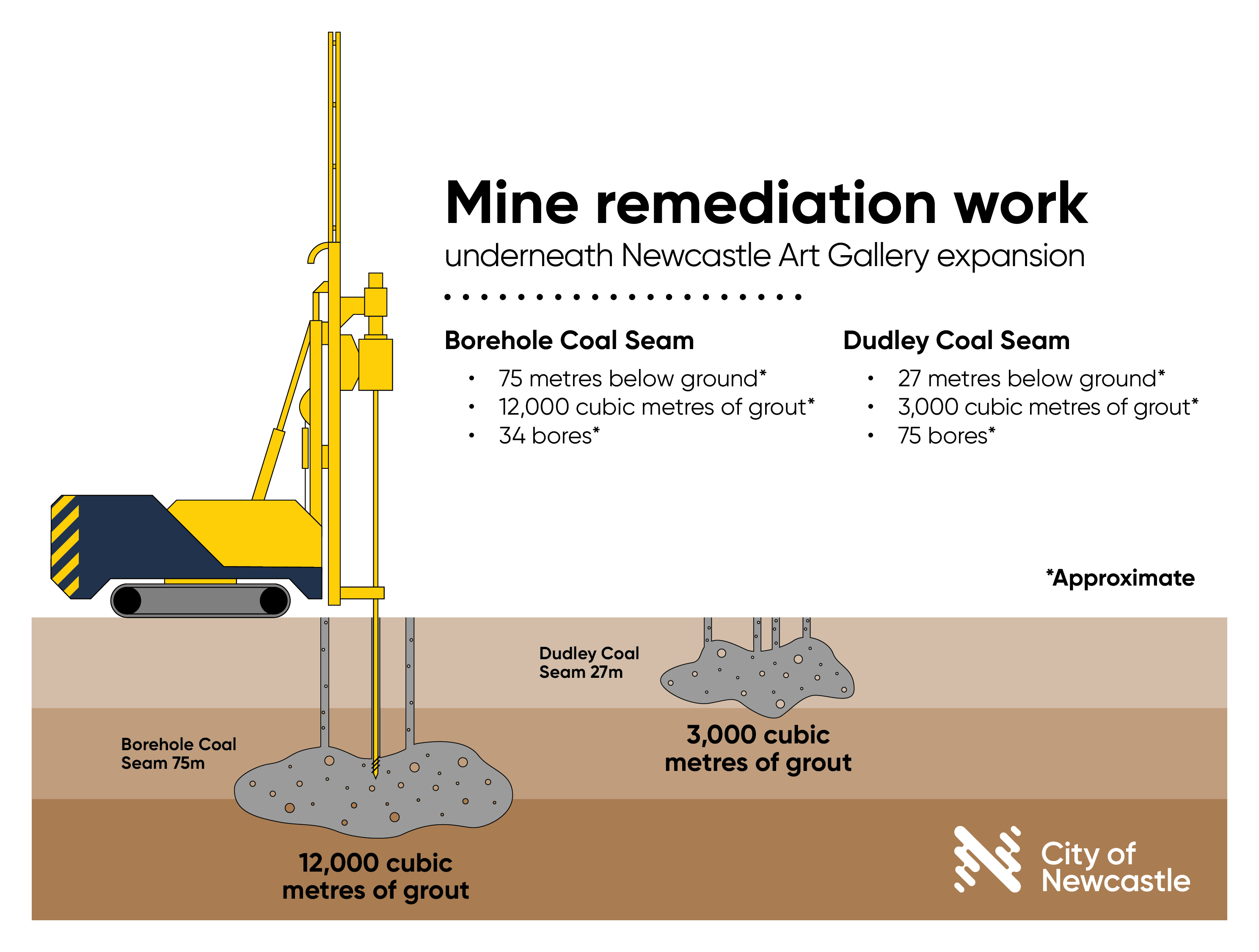
At Tuesday’s Council meeting, Councillors awarded a tender for remediation work for the site, which sits above the Dudley Coal Seam and Borehole Coal Seam.

Mine-remediation-work-underneath-Newcastle-Art-Gallery-expansion.jpgLord Mayor Nuatali Nelmes said the mine remediation is a crucial part of early work to prepare the site ahead of the main construction commencing.

“An interesting and little-known fact about Newcastle Art Gallery is that it sits atop abandoned mine workings, so it’s important that we ensure the site is safe for construction of the expanded gallery to commence later this year,” Cr Nelmes said.

“The mine remediation is a significant step forward to prepare the site, while work continues inside the gallery to decant and prepare the extensive collection for offsite storage.”

The work will target the Borehole Coal Seam, which sits around 75 metres below ground level, and Dudley Coal Seam around 27 metres below ground.

The remediation is scheduled to commence in June and will require approximately 15,000 cubic metres of grout deployed into the seams through over 100 individual bores, which will be drilled throughout the site.

The mine remediation work has been designed as part of the project’s Grouting and Verification Plan, which has received approval from Subsidence Advisory New South Wales. An application, which is currently under assessment, has been made to the Hunter Central Coast Development Corporation’s Newcastle Mines Grouting Fund to contribute to the cost of the work.

With the Gallery’s collection currently being decanted, a temporary photography studio has been set up onsite enabling the digitisation and condition reporting of the works of art prior to being placed into offsite storage.

During the Gallery’s construction period, the community can access the collection online and outreach programs will commence within local schools from May. Other special activations include events in conjunction with New Annual that will introduce local and national audiences to a new programming direction for Newcastle Art Gallery. A Gallery podcast is also due to be released later this year.

Newcastle Art Gallery closed for expansion in January this year. The expansion project includes an additional 1,600 square metres of exhibition space with dedicated areas for the Gallery’s collection on the lower level, while the upper level will cater for a variety of travelling exhibitions, including international shows.

The project will deliver a new café and retail shop, multi-purpose and educational program space, a secure international standard loading dock, and will extend the building’s footprint east along Darby Street and Queen Street. The project is expected to be completed by mid-2024.

The $40 million project has been supported by a $10 million grant from the Commonwealth and New South Wales Governments, a $10 million bequest from Valerie Ryan and $500,000 in funding from the Margaret Olley Art Trust through the Newcastle Art Gallery Foundation.

To stay up to date with behind the scenes content of the decanting process and collection highlights, visit the Newcastle Art Gallery Facebook page at www.facebook.com/NewcastleArtGalleryAustralia

Ordinary Council Meeting Tuesday 26 April 2022

Following is a summary of resolutions from the Ordinary Council meeting of Tuesday 26 April 2022. NB: it is not a full record of resolutions.

Lord Mayoral Minutes

Keep Beresfield Pool Public & low fee

A Lord Mayoral Minute (LMM) was supported that reaffirmed City of Newcastle’s longstanding commitment to the community to keep Beresfield Pool in public hands, and low fee, to ensure that families in our western suburbs have equitable access to a high-quality public pool. It also noted that in the 2022/23 draft Budget, Beresfield Pool will receive an updated playground as a part of our popular Playground Replacement Program.

Restore our Financial Assistance Grants

Council unanimously supported a Lord Mayoral Minute (LMM) to write to the Prime Minister, NSW Premier and Local Government Grants Commission opposing a decision to reduce the level of funding received under the Federally-funded Financial Assistance Grants (FAG) in nominal terms by up to four per cent, which would cut $435,000 annually from City of Newcastle (CN) budgets. CN would also seek a commitment to increase FAGs up to one per cent of Commonwealth taxation revenue, and seek a guarantee that no council will be worse off under the revised funding arrangements.

Ordinary business

Variations to development standards – first quarter 2022

Council received a report on approved development variations between 1 January 2022 and 31 March 2022.

Exhibition of draft Newcastle Development Control Plan 2012

Council voted to place four updated sections of the Newcastle Development Control Plan 2012 on public exhibition for four weeks. The sections relate to bush fire protection, mine subsidence, safety and security, and traffic, parking and access. Council will receive a report on submissions following the public exhibition.

Adoption of council policies

Council voted to re-adopt a number of reviewed policies previously adopted by the former Council. These included the Asset Management Policy, Sponsorship Policy and Media Policy.

Public exhibition of Code of Meeting Practice

Council resolved to place City of Newcastle’s Code of Meeting Practice on public exhibition for 28 days. A report detailing submissions received will be provided to Council.

Adoption of Community Strategic Plan

Council unanimously voted to adopt the new Community Strategic Plan (Newcastle 2040), which provides the basis for ongoing alignment of City of Newcastle’s decision-making processes, strategies and activities with the vision of the Newcastle community.

Adoption of the planning proposal for 41 and 47 Throsby Street, Wickham

Council voted to endorse the amended Planning Proposal for 41 and 47 Throsby Street, Wickham and forward it to the Department of Planning and Environment for finalisation. The Planning Proposal is accompanied by a draft Planning Agreement between the applicant and Council for the dedication of land and construction of a new laneway along the western boundary of 47 Throsby Street between Throsby Street and Furlong Lane.

Public exhibition of draft Delivering Newcastle 2040

Council voted to place the draft 2022-2023 Delivering Newcastle 2040, draft 2022-2023 Fees and Charges, and draft 2022-2023 Long Term Financial Plan on public exhibition for 28 days.

Executive monthly performance report

Council received the executive monthly performance report for March 2022.

Tender report – Newcastle Art Gallery mine void remediation works

Council voted unanimously to accept a tender for the completion of the Newcastle Art Gallery expansion mine void remediation works. This contract forms part of the early works required for the Gallery expansion project.

Notices of Motion

Supply and maintenance of street furniture and out-of-home media

Council supported a notice of motion to investigate the viability of partnering with a private partner to allow advertising on street furniture (including for example, bus shelters, public toilets, or appropriately placed billboards) in exchange for asset upgrades or revenue to defray the direct cost to the community of providing high quality and high standard street furniture.

505 Minmi Road – inclusion in NSW National Parks estate

Council supported a notice to motion to write to new Minister for the Environment James Griffin, and DPE, requesting that the Government includes 505 Minmi Road into the National Parks estate, noting the property’s strategic importance to the 23,000-hectare arc Green Corridor. The previous Council resolved on 8 December 2020 to nominate this site for inclusion and had consequently written to the former Minister Matt Kean.