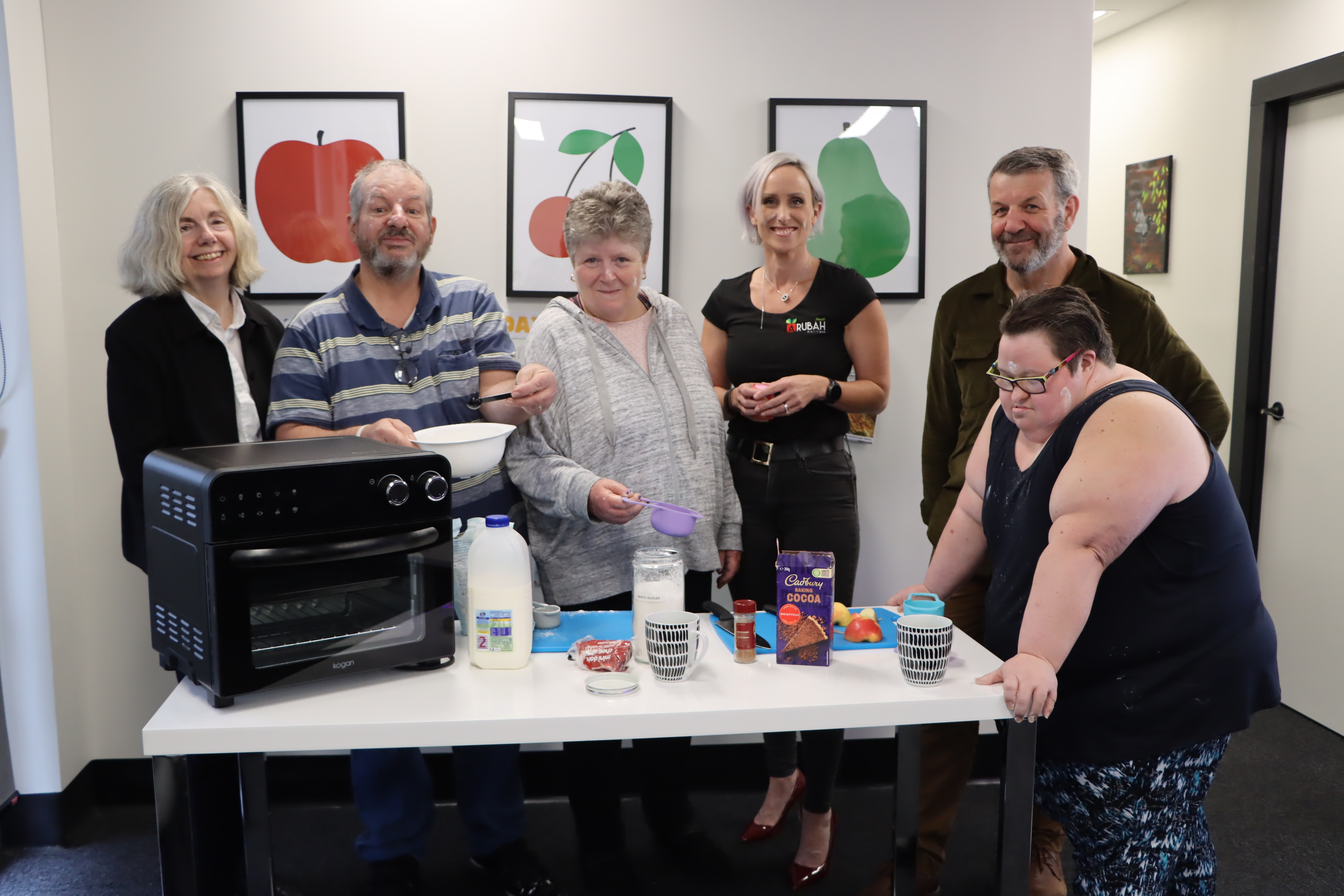
Count Us In festival puts disability inclusion front and centre

More than 30 free events and activities aimed at raising the profile of inclusion in our community will be held over the next two weeks as part of City of Newcastle’s Count Us In festival.

Count Us In will run between 13 May – 28 May and features a wide range of activities including a nutrition wellbeing workshop, drumming workshop, accessible fishing experience, inclusive dance and art experiences, social and peer networking events, plus activations focused on education and awareness exploring topics such as workplace inclusion.

Newcastle Lord Mayor Nuatali Nelmes said the Count Us In festival will encourage conversations around inclusion across the city.

“City of Newcastle prides itself on working collaboratively to ensure a more liveable and welcoming community for all people who live, visit and work here by increasing social inclusion and community connections,” the Lord Mayor said.

Councillor-Margaret-Wood-left-with-participants-at-Arubah-Health-Professionals-nutrition-and-wellbeing-workshop-delivered-as-part-of-Count-Us-In-festival-2.JPG
Councillor Margaret Wood, co-chair of City of Newcastle’s Access and Inclusion Advisory Committee, said Count Us In recognises and celebrates the contributions made by people living with disabilities.

“The 2022 festival has a strong focus on working together towards solutions for employment and workplace inclusion for people with disability, which meets the actions of our recently adopted Disability Inclusion Action Plan,” Cr Wood said.

“Count Us In effectively and respectfully brings people without disabilities into contact with people with disabilities, which builds awareness, reduces prejudice and helps create future opportunities.”

This year, City of Newcastle (CN) has engaged Community Disability Alliance Hunter (CDAH) to assist with the creation and delivery of a diverse range of inclusive events, all of which are delivered with local community partners.

“We have taken a community-led approach to Count Us In festival by engaging CDAH to enhance the range of events within the program. This will highlight the skills and abilities of our local community and demonstrate a range of opportunities for participation beyond the program,” Cr Wood said.

“This festival is for everyone, and I’d encourage all Novocastrians to come and join in the many events and activities on offer over the next two weeks.”

Andrew Vodic Executive Director Community Disability Alliance Hunter says the organisation is proud to be partnering with CN on the design of the 2022 festival program.

“At CDAH, we are committed to building the capacity of peers to develop, organise and lead peer groups and develop mentor relationships that enable them to share their experiences and learn together. Count Us In 2022 assists us to promote these peer lead groups and hopefully reach more people,” Mr Vodic said.

“With over 90 per cent of CDAH staff living with a disability, the events and activities on offer have been designed by people with lived experience to create the best possible opportunities for inclusion and by reaching a more diverse mix of people.”

For a full program of events and activities, click here.

Free Program to Accelerate Digital Skills for Tourism Operations

The NSW Government is launching a Digital Skills Accelerator for Tourism program to help NSW tourism businesses transform their online marketing.

Destination NSW has partnered with digital consultancy Tourism Tribe to offer the free program to accommodation providers, tour companies and visitor attractions.

Minister for Enterprise, Investment and Trade, Tourism and Sport and Western Sydney Stuart Ayres said the program would provide customised digital health checks to ensure businesses optimise their websites, improve their online listings and grow their Facebook and Instagram channels.

“The Digital Skills Accelerator for Tourism program is part of the NSW First Program, delivered by Destination NSW to assist businesses across the state to develop, promote and sell great visitor experiences,” Mr Ayres said.

“Digital innovation is crucial to success in the contemporary tourism landscape. Helping businesses in the visitor economy to improve their digital competency is a key pillar of the NSW Government’s Visitor Economy Strategy 2030, which aims to make NSW the premier visitor economy of the Asia Pacific.”

In addition to a customised digital health check report, successful applicants will also receive two, one-hour consultation sessions with a digital advisor and access to a course library to help improve their knowledge and digital skills.

The program complements NSW First Program content, which includes ‘how to’ guides, resources and on-demand webinars for tourism businesses.

Wajaana Yaam Adventure Tours owner Mr Clark Webb said the NSW First program played a vital role in helping his business define its product and how to get it into the market.

“The support that we received from Destination NSW helped get our business to where it is today. We have really valued the opportunity to take part in the NSW First program,” Mr Webb said.

Mr Webb welcomed the decision to add the Digital Skills Accelerator program to NSW First.

“Most small business owners run both the operational and the digital side of their business. Improving the digital skills of tourism operators will ensure better outcomes for the entire visitor economy. I always feel we can learn more in this area as it’s so vast.”

The Digital Skills Accelerator for Tourism program will be open to 150 tourism businesses in NSW.

To review eligibility criteria and apply, visit: www.tourismtribe.com/programs/dnsw2022/

Learn more about Destination NSW’s NSW First Program here: https://www.destinationnsw.com.au/tourism/business-development-resources/nsw-first-workshops-program

Tradeswomen leading the way

Female apprentices want more women to try their hand in a traditional trade to increase women in the construction sector.
 
Minister for Skills and Training Alister Henskens said the NSW Government is investing in fee-free and low-fee apprenticeships and traineeships to help address industry needs, including Built for Women, a program designed to boost female participation.
 
“We want to make it easier for women to access the skills they need for a first job, a new job, or a better job,” Mr Henskens said.
 
“The NSW Government’s infrastructure investment is providing great opportunities for women to pick up the tools and enter a dynamic and rewarding industry.”
 
Recently released data from the National Centre for Vocational Education and Research shows that female apprentice and trainee numbers are booming across the state, with a 91 per cent surge in commencements in the year to September 2021.
 
Minister for Women Bronnie Taylor said the Built for Women program has supported close to 5,000 free training places for women in trade-related work, including construction, manufacturing, engineering, transport and logistics.
 
“Greater diversity makes our workplaces stronger and a secure and fulfilling future awaits women who choose a career in trades,” Mrs Taylor said.
 
Shani Staples is studying a Certificate III in Plumbing at TAFE NSW Mount Druitt and is one woman paving the way for more females to break into trade industries.
 
“The plumbing industry is incredibly rewarding and offers a hands-on environment which is fast-paced and no two days are the same,” Ms Staples said.
 
“Many people are unaware of the scope of work that a plumbing trade covers, so if a trade is something you’ve ever considered, now is the time to give it a go.”

Flood recovery grants fast-tracked

Sole traders will now have their applications streamlined for the Disaster Recovery Small Business Grant, providing up to $50,000 to help them recover following the unprecedented flooding.
 
Deputy Premier and Minister for Regional NSW Paul Toole said the application process for the grant has been simplified to help deliver financial support sooner.
 
“We know our flood-affected communities need help now and that is why we are constantly looking for ways to speed up the grant approval  process,” Mr Toole said.
 
Minister for Customer Service and Digital Government Victor Dominello said the change will allow Service NSW to process applications quicker by cutting down the paperwork for sole traders and getting money into their hands faster.
 
“While sole traders have always been eligible for the grant, in-line with previous grant programs they have needed additional documentation to other small businesses. The changes, which take effect from today, mean that applications can now be initially approved based on statutory declarations,” Mr Dominello said.
 
“Grants are just one of a range of packages targeted at helping flood-affected communities in the Northern Rivers recover and rebuild as quickly as possible.”
 
Minister for Emergency Services and Resilience and Minister for Flood Recovery Steph Cooke said the Commonwealth and NSW governments are jointly delivering more than $3 billion in flood recovery support.
 
“We will continue to work with the Australian Government to provide flood-affected communities with the support they need to bounce back from this unprecedented disaster,” Ms Cooke said.
 
“We know a significant number of sole traders are based in regional communities, so cutting red tape in the application process for the Disaster Recovery Small Business Grant will mean money gets out the door sooner.”
 
The Disaster Recovery Small Business Grant is available in 60 local government areas and is being jointly funded by the Commonwealth and NSW governments under the Disaster Recovery Funding Arrangements (DRFA).
 
For further information or to lodge your statutory declaration, visit the Service NSW website or call 13 77 88.

Joint Statement of Foreign Ministers on increased restrictions on the human rights of Afghan women and girls

Afghan women and girls make enormous contributions to their country. Achieving peace, stability and economic development requires their equal participation in shaping Afghanistan’s future.

We remain deeply concerned by the continued restrictions on girls’ access to education in Afghanistan, and call on the Taliban to respect the right to education and adhere to their commitments to reopen schools for all female students.

We are deeply disappointed about escalating restrictions imposed by the Taliban that impact on the human rights of Afghan women.

The Taliban’s directive that women and girls must cover themselves in public and leave home only in cases of necessity, and with a man, restricts their universal and inalienable human rights. We deplore that family members could be punished to enforce compliance with these restrictions.

Afghan women should be free to choose how they express themselves in accordance with their faith and have the right to move freely in society.

The international community cannot consider these recent directives as isolated decisions. The Taliban have taken other actions that limit the human rights of women and girls.

These include their rights to education, work and freedom of movement, opinion and expression through restrictions on unaccompanied travel, participation in the workforce, and ability to express themselves openly.

These decisions contradict repeated Taliban assurances to respect and protect the human rights of all Afghans.

All Afghans should be able to enjoy their fundamental human rights. These rights are indivisible and inalienable, expressed in international human rights law, and endorsed by all members of the United Nations.

We call on the Taliban to reconsider decisions which constrain the right of women and girls to make their own choices, gain an education, work, and participate equally in society.

We will continue to judge the Taliban on their actions, not their words.

AWU condemns new wool industry push for cheap overseas labour 

The Australian Workers’ Union says this week’s wool industry appeal for Pacific Island workers to be used to fill a supposed worker shortfall is just another attempt to undercut pay and conditions using cheap imported labour.

The wool industry claims to have identified a workforce shortage of 500 shearers and 500 shed hands, and wants to use Pacific Islands workers in what it hopes will be the start of a steady pipeline of easily exploitable workers.

AWU National Secretary Dan Walton said the union was not convinced there was a genuine worker shortage.

“Despite the ongoing claims by the Shearing Contractors Association of Australia and some woolgrowers of a labour shortage, the fact is the Australian flock has been shorn year after year,” Mr Walton said.

“It was successfully shorn right through the Covid pandemic, and it can be shorn now.

“The Shearing Contractors Association and the same wool growers just don’t want to pay the current market rate, which is 15% above award, simply because they have not been able to flood the market with cheap labour.

“They should stop looking overseas and instead work to attract Aussie workers by offering fair pay and conditions, and proper training.” 

Mr Walton said while the AWU had backed the Pacific Australian Labour Mobility (PALM)  scheme’s use as a safeguard against wage theft and worker exploitation in the horticulture industry, it had raised strong concerns to the Agriculture Department about its unsuitability for the wool industry.

And he said that far only one shearing contractor had applied to become an approved PALM scheme employer.

“The AWU will be closely looking at this approved employer/contractor to ensure that they are properly training these workers and ensuring that any approved employer/contractor meets their obligations regarding labour-market testing under the PALM scheme, and they haven’t so far.”

More Major flooding for Queensland highlights escalating climate risks

THE EXTREME RAINFALL and flooding once again inundating parts of Queensland is yet another wake up call about the escalating risks of climate change, which is driving more frequent disasters, experts say. 

Heavy rainfall, which has broken May records in some areas, is sweeping the state, marking Queensland’s second major flood emergency this year. 

Climate Council Head of Research, Dr Simon Bradshaw said:


“With climate change increasing the frequency and severity of extreme weather disasters, there is greater chance of these devastating events happening in rapid succession, with little time for communities to recover.

“As India and Pakistan swelter through an extraordinarily severe heatwave and California braces for another horror fire season, Australia continues its year of record rainfall and floods. All our weather is happening in the context of climate change, in an atmosphere made warmer, wetter and more energetic through the burning of coal, oil and gas.

“Queensland is the nation’s most vulnerable state when it comes to extreme weather. Five of Australia’s top ten most-at-risk federal electorates are in Queensland. Between 2010 and 2019, Queenslanders suffered more than double the extreme weather disaster losses of any other state or territory.

“Any government that is serious about protecting Australian communities from worsening disasters must ensure that Australia’s greenhouse gas emissions plummet this decade.”

Former Commissioner Queensland Fire & Emergency Services and member of Emergency Leaders for Climate Action (ELCA), Lee Johnson, said:

“Emergency services are being hammered by the increasing frequency and severity of these events. Local communities in Queensland are being expected to step up, again and again, even when they’ve just experienced the horrendous floods we saw just a few months ago.

“After the horrific Black Summer, and now the two catastrophic flooding events so far this year, the lack of Government initiative towards disaster preparedness and reducing emissions has reached an absolutely unacceptable point.

“It is only through the swift and deep reduction of emissions, along with putting communities first, that we can avoid the worst effects of climate change. We’ve sadly seen more loss of life, homes destroyed and businesses wrecked, and yet the Morrison Government has no actual plan to drastically reduce emissions and conduct a national risk assessment of what climate change means for Australians.

“We need to see our leaders stepping up to protect communities and properly resource our emergency services. Failing to rapidly and deeply reduce our emissions will severely increase risks to Australian lives and livelihoods, communities and ecosystems. We must do our fair share to tackle the climate emergency.”

The Climate Council recommends Australia triple its efforts and aim to reduce its national emissions by 75 percent by 2030, and reach net zero by 2035. 

Four arrested after pursuit of stolen vehicles – Lake Macquarie PD

Four people are in custody following a proactive operation this morningby officers attached to Lake Macquarie and Newcastle City police districts.

Calls to Triple Zero (000) shortly after 4am (Friday 13 May 2022), alerted police to several vehicles being driven dangerously in the Lake Macquarie area.

Officers attached to Lake Macquarie Police District attempted to stop four vehicles – a BMW SUV, a Ford Ranger utility, a Suzuki Swift and a motorcycle – travelling along Wangi Road, Dora Creek, with a pursuit being initiated when the drivers failed to stop as directed. 

An 18-year-old man from Blackwells Park and a 17-year-old boy were arrested when the ute crashed into a second vehicle at Toronto. They’ve been taken to Toronto Police Station. Police have confirmed the ute had been reported stolen from Maitland.

A 57-year-old man from Warner Bay was examined at the scene by NSW Ambulance paramedics after suffering bruising in the crash with the ute. He has been taken to John Hunter Hospital to be checked as a precaution.

A short time later, two youths, aged 15 and 16, were arrested when road spikes were successfully deployed on Five Islands Road, Speers Point, stopping the Swift, earlier stolen from Dora Creek. They are also in custody at Toronto Police Station.

A BMW – which had been reported stolen from Merewether earlier today – was found dumped at Gateshead about 6am. It has been taken for forensic examination.

Inquiries are continuing into the whereabouts of the motorbike, which was also reported stolen from Merewether.

Police have also recovered a stolen BMW 3 series which was found dumped at Eleebana a short time ago.

Inquiries are continuing.

Powering the Nation with Australian-Made Batteries

A future Albanese Government will kickstart battery manufacturing in Australia.

Under our Australian Made Battery plan, Labor is determined to see Australia create more jobs and greater wealth for the nation by manufacturing batteries onshore. 

This plan will see a future Labor Government:

  • Partner with the Queensland Government to create a Battery Manufacturing Precinct in Queensland, backed by a $100 million Commonwealth equity injection.
  • Create a Powering Australia Industry Growth Centre to provide advanced technology and skills development to businesses looking to locally manufacture renewable energy technologies.
  • Support 10,000 New Energy Apprenticeships, including around 2,000 expected in Queensland. 
  • Develop a National Battery Strategy to bring government and business efforts together for the long term good of the nation.


These commitments are in addition to Labor’s National Reconstruction Fund (including $1 billion for Value-Adding in Resources).

Australian Made Batteries should power your house, your business, your school, and eventually maybe even your car.  

We can shore up our electricity grid with safe, reliable and sustainable energy that’s Australian from top to bottom – and then we can sell those batteries to the world.

We have a unique opportunity to make Australia a world leader in a future industry that will create good jobs for generations.  

There are an estimated 34,700 jobs and $7.4 billion in value to be made in Australia from battery technology and industries. 

Labor will build a better future for Australia, one which capitalises on these opportunities. 

For too long, Australians have wondered why we haven’t manufactured batteries onshore when we have one of the world’s largest deposits of critical minerals and rare earths.

On the Morrison Government’s watch, Australia is only realising 0.5 per cent of the value of global battery production.

This is largely because a lazy, decade old Liberal Government has been prepared to simply watch these resources be dug up and shipped off overseas for processing.

The Morrison Government has missed vital opportunities to build a local industry and create local jobs by manufacturing batteries here.

Labor wants our batteries to be as recognisable as Holden cars once were. Unlike the Liberals, we won’t chase manufacturers offshore – we will rebuild industry capability.

We want our allies and our competitors to know that Australia is a renewable energy powerhouse, not just a raw materials supermarket.  

We have a clear plan. Labor will power a better future, delivering economic gains and Australian jobs along the way. 

Anthony Albanese, Leader of the Australian Labor Party said:

“The resources sector has been the backbone of the Australian economy for decades. Developing Australia’s battery manufacturing capability is a step towards the potential for domestic electric vehicle manufacture. Labor will create a Future Made in Australia. Australia should be a renewable energy powerhouse, not just a raw materials supermarket.”

Ed Husic, Shadow Minister for Industry and Innovation said:

“Australia should be aggressively ambitious when it comes to battery manufacture. Labor is determined to see Australia realise more value of the supply chain. We’ve got the natural resources to become a renewable energy superpower. We need the government ambition to match.”

Mick de Brenni, Minister for Energy, Renewables and Hydrogen said: 

“Queensland’s publicly-owned power companies are already investing in more than 430MW of batteries with more to come. Battery storage will be key to the expansion of clean energy, by storing unused renewables for dispatch at peak periods, putting downwards pressure on prices. Our Buy Queensland procurement approach will require these sort of grid batteries to be sourced locally in Queensland, creating a pipeline of demand for new manufacturers which means more jobs in regional Queensland.”

Matt Burnett, Labor candidate for Flynn said: 

“Gladstone has always had a strong industry and manufacturing base. By investing in new energy industries like battery manufacture, Labor is setting up well paid, secure manufacturing jobs in our community for generations to come. Only an Albanese Labor Government has a plan for more jobs in more industries across Central Queensland”

Milestone agreement expands mental health services in Tasmania

More than $55 million will be invested into mental health and suicide prevention support and services across Tasmania over the next five years, following the signing of a landmark bilateral agreement between the Morrison and Tasmanian governments.

The Morrison Government will invest $45.6 million, with the Tasmanian Government providing $9.4 million in-kind to establish new and existing mental health services, particularly for people in the group known as the “missing middle”.

Tasmania is also well-progressed with its investment of $27 million to deliver two mental health Integration Hubs at the Peacock Centre and St John’s Park, which will provide multidisciplinary care for adults. These hubs closely align with the Head to Health model.

The funding includes:

  • $24.7 million to provide mental health care for adults and older adults across the state through the establishment of three new Head to Health satellite clinics (Burnie, Devonport, Outer Hobart), which will align with state-based services, including Tasmania’s Integration Hubs. This includes ongoing funding for the state’s first Head to Health centre in Launceston
  • $4.2 million to establish a new headspace centre (Rosny Park), and $2.9 million to boost the clinical capacity of existing headspace sites in Tasmania (Burnie, Devonport, Hobart, Launceston)
  • $12.6 million to deliver three Head to Health Kids Centres within Tasmania’s Child and Family Learning Centres (CFLCs), which includes recognition of Tasmania’s existing investment in the CFLCs
  • $2.5 million for the Tasmanian Government to establish and deliver three eating disorder day programs in 2022-23
  • $5.2 million for universal aftercare services to support individuals discharged from hospital following a suicide attempt, and
  • $3.0 million to support perinatal mental health screening.

In addition to these initiatives, the Commonwealth and Tasmanian governments will substantially deepen their partnership in the mental health and suicide prevention system, through greater data sharing and evaluation of services, closer integration of referral pathways, and working together on the regional planning and commissioning of services.

The bilateral agreement will also build and support the mental health and suicide prevention workforce, including the peer workforce.

Prime Minister Scott Morrison said the agreement would ensure Tasmanians had access to more support, when and where they needed it.

“A strong economy means you can guarantee the essential services, providing new health support to all Tasmanians helping them improve their lives,” the Prime Minister said.

“The importance of mental health support has never been more evident than in recent years when COVID had many Tasmanians seeking help for the first time, that’s why our support for these services is so important.”

Minister for Health and Aged Care Greg Hunt congratulated Tasmania on its commitment to providing this support to people across the state.

“The COVID-19 pandemic has had a profound impact on the mental health and wellbeing of Australians and there is no better time to work together and ensure we close the gaps in the mental health and suicide prevention system,” Minister Hunt said.

Tasmanian Premier and Minister for Mental Health and Wellbeing Jeremy Rockliff said that the agreement strongly aligns with the Tasmanian Government’s major investment in systemic, state-wide mental health reform, and will assist in achieving Tasmania’s long-term goals to improve timely access to care and improved mental health outcomes for our community.

Assistant Minister to the Prime Minister for Mental Health and Suicide Prevention David Coleman said the funding would create new services and much needed support for Tasmanians engaging with the mental health and suicide prevention system.

“As a result of this new agreement, every Tasmanian who is discharged from hospital following a suicide attempt will receive at least three months of immediate follow up care and support,” Assistant Minister Coleman said.

“The risk of suicide is greatest in the days and weeks following discharge from hospital due to a previous suicide attempt, yet not everyone in this group receives follow up care. These people are amongst our most vulnerable, and through this agreement we are committing to do everything we can to support them.”

Young Tasmanians will also have better access to mental health services, with headspace receiving a significant boost in funding to substantially expand and enhance services.

Staffing levels will be increased at existing headspace services, and one new centre will be established. These services will be well integrated with local Tasmanian services to ensure a supportive transition for those experiencing severe and complex mental ill health.

Three Head to Health Kids Hubs will also be integrated with the new CFLCs in Tasmania. These integrated services will provide multidisciplinary team care to children and contribute to Tasmania’s response to its review of Child and Adolescent Mental Health Services.

Three new adult Head to Health satellite clinics will also be established in 2023-24. This will provide integrated, seamless mental health care for adults and older adults across the state.

These satellites are in addition to Tasmania’s two Integration Hubs and the state’s first Head to Health centre that opened in Launceston earlier this year and will continue to support Tasmanians in the “missing middle” – those who are too unwell for the general primary care system, but not unwell enough to require inpatient hospital services or intensive state-based community care.

Within Head to Health services, care will be delivered by multidisciplinary teams consisting of psychiatrists, general practitioners, psychologists, alcohol and drug specialists, mental health nurses, social workers, occupational therapists, mental health workers and lived experience workers.

Other key initiatives include funding toward delivering three eating disorder day programs to provide additional support for people with eating disorders in Tasmania, the enhancement of digital capture and reporting of perinatal mental health screening data, and the use of the Initial Assessment and Referral tool and telephone/digital service to support consistent intake, referral and integration across all state-funded services and clinical services in Tasmania.

The bilateral agreement forms part of the National Mental Health and Suicide Prevention Agreement.

The National Agreement considers key mental health reports and inquiries including recommendations from the Productivity Commission’s Inquiry into Mental Health and the National Suicide Prevention Adviser’s final advice. It outlines actions to build a comprehensive, coordinated, consumer focused and compassionate mental health and suicide prevention system to support all Australians.

The National Agreement clarifies roles and responsibilities; progress improvements in the mental health services available to adults, children and youth; improve data collection, sharing and evaluation; reduce gaps in the system of care; expand and enhance the workforce, including the peer workforce; and work to improve mental health and suicide prevention for all Australians, across a range of settings.

The Australian Government is delivering structural reform and real change in mental health and suicide prevention, and has invested almost $3 billion towards the National Mental Health and Suicide Prevention Plan since 2021-22.

This brings the estimated health portfolio expenditure in mental health and suicide prevention services and supports in 2022-23 to a record high of $6.8 billion.

Australians needing support throughout the COVID-19 pandemic can access the Beyond Blue Coronavirus Wellbeing Support Service any time via telephone at 1800 512 348 or online at coronavirus.beyondblue.org.au.

Anyone experiencing distress can also seek immediate advice and support through Lifeline (13 11 14), Kids Helpline (1800 55 1800), or the Government’s digital mental health gateway, Head to Health.

If you are concerned about suicide, living with someone who is considering suicide, or bereaved by suicide, the Suicide Call Back Service is available at 1300 659 467 or www.suicidecallbackservice.org.au.

Young Australians needing support can access free services through Kids Helpline (1800 55 1800), their local headspace or online through eheadspace (https://headspace.org.au/eheadspace/).