
Improved connection to Richley Reserve as Blackbutt Village upgrade progresses

A new footpath connecting Blackbutt Village in New Lambton to Blackbutt’s Richley Reserve along Freyberg Street has been completed as part of a $3.7 million upgrade of the popular local centre.
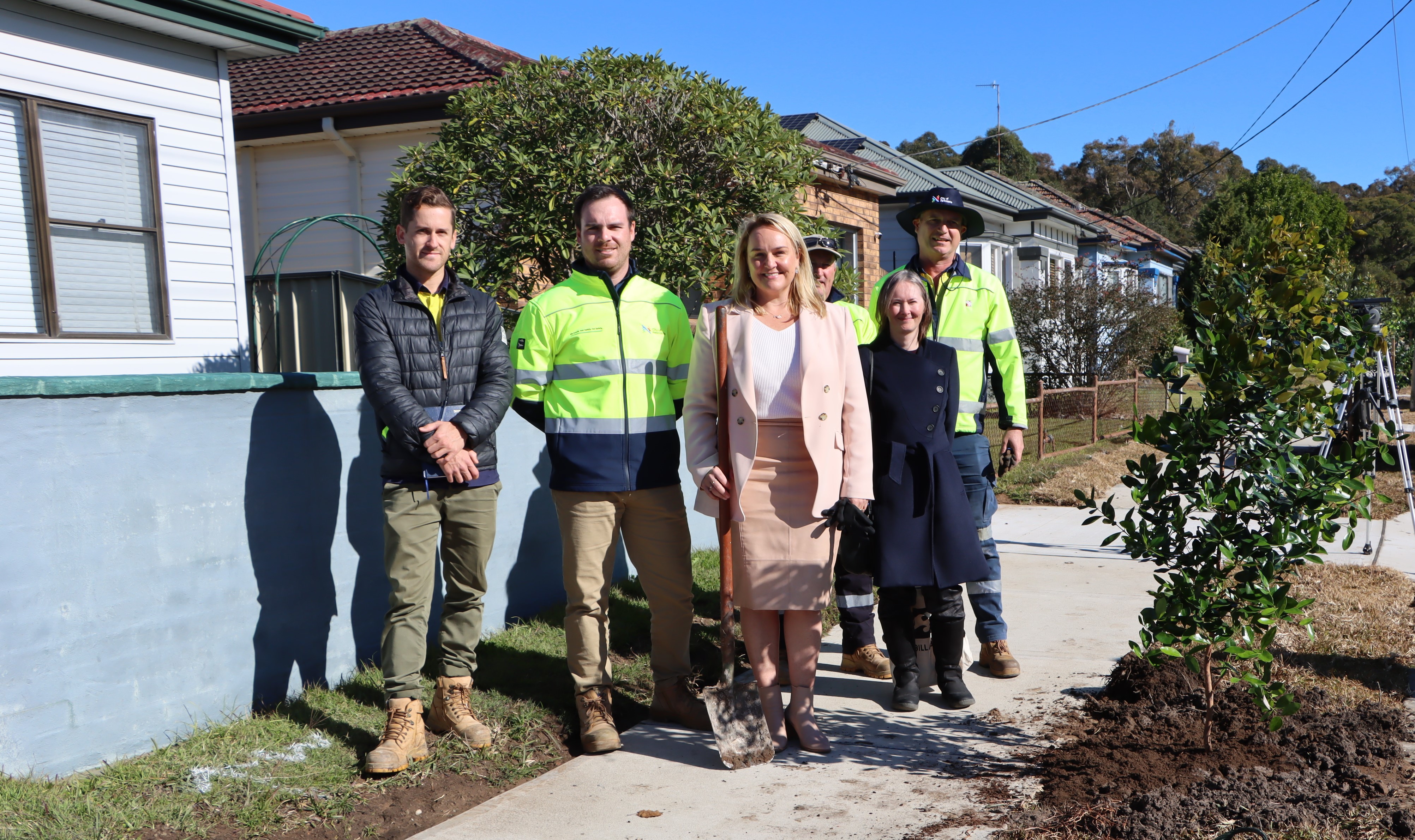
Lord-Mayor-Nuatali-Nelmes-tree-planting-on-Freyberg-Street-with-City-of-Newcastle-project-team-members.jpg

Newcastle Lord Mayor Nuatali Nelmes said this connection is a first step in delivering a safer, more attractive place for visitors and locals to spend time.

“It’s great to see improved accessibility for the community linking these two important locations,” Cr Nelmes said.

“The addition of over 30 street trees along Freyberg Street also creates a more appealing environment with increased shade and colour, with more trees being introduced along Dunkley Avenue in the coming weeks.

“Our staff are preparing to commence upgrades to stormwater infrastructure and road surfaces in the western car park area in the next few weeks, as well as seeking community feedback on timed parking options across the broader local centre area.

“When we spoke to the community during the development of this upgrade we heard concerns about pedestrian safety, and also the availability of short-term parking for visiting the shops and local services.

“We look forward to hearing community views on the range of timed parking options which were developed in consultation with local businesses during a workshop held with them earlier this year.”

Construction is scheduled for overall completion in early 2024. The upgrade has been supported with a $591,677 grant from the NSW Government under Round Seven of the Resources for Regions program.

Deputy Premier and Minister for Regional NSW Paul Toole said Resources for Regions has delivered 242 projects worth $420 million for mining communities in the last 10 years.

“The NSW Government is committed to supporting regional mining towns that supply our state with these precious resources, and I am grateful to the City of Newcastle for putting forward this project which will support the ongoing prosperity of the local community,” Mr Toole said.

“Mining plays a very important part in the NSW economy, supporting tens of thousands of jobs across the state and it will continue to play a role in Newcastle for years to come.”

The project is being delivered as part of City of Newcastle’s Local Centres program and follows similar upgrades at Carrington, Beresfield, Joslin Street in Kotara, Llewellyn Street in Merewether, James Street Plaza in Hamilton, and the upgrades currently under construction in Stockton and Shortland.

A brighter beginning for all NSW children

A life-changing package for NSW children and families has been announced today with a $376.5 million investment over four years in child development and family support as part of the 2022-23 NSW Budget.
 
Premier of NSW Dominic Perrottet said the Brighter Beginnings package will provide all children with a full suite of developmental checks before they start school and make the baby blue book digital.  
 
“The first 2,000 days of a child’s life are critical to their development and success and we want to ensure they get the best start possible,” Mr Perrottet said.   
 
“NSW is now leading the nation in providing the best developmental support giving families right across the state the brightest of futures.”
 
Treasurer Matt Kean said that 90 per cent of a child’s brain development happens before the age of five, which is why these reforms are so important for NSW’s future prosperity.  
 
“This is a long-term investment which will reap benefits for children, families and the economy today, and for many generations to come,” Mr Kean said 
 
As the Minister leading the initiative, Minister for Education and Early Learning Sarah Mitchell said it’s clear that getting it right early in a child’s life has lifelong benefits for their future.  
 
“Almost half of all 4-year-old children do not get their recommended health and development checks, so making these available in every NSW early childhood service will open the door to brighter futures for thousands of children,” Ms Mitchell said.  
 
“The Brighter Beginnings initiative will also make a huge difference to outcomes at school, from behaviour to academic results.” 
 
“Knowing where children are developmentally and physically before they start school is so important, allowing any necessary support to be identified.” 
  
Minister for Health Brad Hazzard said expanding the home-based antenatal service would make it easier for parents to access important health care information.
 
“We are bringing the Sustaining NSW Families program to more Local Health District across the state, so many more vulnerable families can be supported by free home visits by a specially trained clinical nurse,” Mr Hazzard said.   
 
Minister for Customer Service and Digital Government Victor Dominello said making the Blue Book digital will make it easier for families to access and keep track of their child’s health and development information.
 
“This initiative is modernising how we support families at a critical time in their child’s life,” Mr Dominello said.
 
Minister for Families and Communities Natasha Maclaren-Jones said that more Aboriginal Child and Family Centres will help connect families with a mix of culturally safe services and supports for their child’s development.  
 
“Expansion of the Pregnancy Family Conferencing program will mean more vulnerable families will be able to access early engagement and interagency care planning, so they can remain together,” Ms Maclaren-Jones said.   
 
The Brighter Beginnings initiative is a partnership, led by Minister Mitchell, between the Department of Education, NSW Health, the Department of Communities and Justice, the Department of Customer Service, the Department of Regional NSW, Multicultural NSW, Aboriginal Affairs, and the Department of Premier and Cabinet to drive transformational change in early childhood development.
 
Alongside the NSW Government’s Affordable Preschool Program, the Brighter Beginnings package includes:  

  • $111.2 million to bring health and development checks to all children in NSW preschool settings in partnership with health professionals; 
  • $98.7 million to continue and expand the number of Aboriginal Child and Family Centres across the state;
  • $70.9 million to expand the transformational Sustaining NSW Families clinical nurse home visiting program; 
  • $57.2 million to develop the clinical interface of the Digital Baby Book; and
  • $38.6 million to make Pregnancy Family Conferencing available to more parents across NSW.

Affordable preschool for all NSW families

Families across NSW are set to save thousands of dollars on their preschool costs thanks to more than $1.4 billion over four years in the 2022-23 NSW Budget.  
 
Premier Dominic Perrottet said the program will ease cost of living pressures for families and ensure more children receive high quality early education, which is critical for a smooth transition to school and better educational outcomes for their future. 
 
“Preschool is where the building blocks for lifelong success are established so it is vital that quality early childhood education is more accessible for families in NSW, no matter what their circumstances or where they live,” Mr Perrottet said. 
 
“We’re committed to ensuring families across the state have a brighter future and less pressure on the hip pocket.”
 
From 1 January 2023, all NSW families will be eligible for:

  • up to $4,000 per year in fee relief for 3, 4 and 5-year-olds attending a community or mobile preschool
  • up to $2,000 per year in fee relief for 4 and 5-year-olds attending preschool in a long day care setting and
  • the equivalent of 5 days a fortnight of affordable preschool fee relief for all children in Department of Education preschools.
  •  
    The NSW Government will also invest $64.1 million for a two-year pilot to support more 3-year-olds attending preschool in long day care services.
     
    NSW Treasurer Matt Kean said the evidence shows clearly the positive impact quality preschool can have on a child’s life outcomes and on the economy. 
     
    “Every $1 invested in early childhood education delivers a $2 boost to the NSW economy – it is a great investment for any Treasurer,” Mr Kean said. 
     
    Minister for Education and Early Learning Sarah Mitchell said that one of the biggest impacts we can have on educational outcomes at school is to improve early childhood education. 
     
    “A significant body of research shows that children who participate in quality preschool programs have improved lifelong educational, social and economic outcomes,” Ms Mitchell said. 
     
    “That’s why I’m so delighted to be continuing our support for community and mobile preschools. Families using these services are not eligible for the Child Care Subsidy, so NSW’s commitment to long-term funding relief is significant and genuinely needed.
     
    “We are also extending support to NSW families whose children attend preschool in a long day care setting, because at the end of the day what’s important is our littlest learners having access to great quality preschool programs.”
     
    The current Start Strong Free Pre-school Program is already providing $150 million in fee relief for children enrolled in community and mobile preschools across NSW in 2022. 

New Modern Wharf Facilities Open for Ferry Commuters

Ferry commuters in North Sydney will enjoy the benefits of a new modern wharf following a $7.5 million upgrade as part of the NSW Government’s $2.2 billion commitment to deliver accessible, safe and comfortable public transport infrastructure. 
 
Minister for Transport and Veterans David Elliott today officially opened the upgraded wharf with the Member for North Shore Felicity Wilson, and highlighted the benefits that the Transport Access Program (TAP) will provide commuters.
“It is vital for a modern transport system to deliver infrastructure that is accessible for all commuters and is future-proof to meet the demands of a growing population, and that’s what the upgrade to the North Sydney ferry wharf does,” Mr Elliott said.
“These transport infrastructure projects provide a boost to the economy and associated industries. On this particular project more than 200 workers were inducted on-site, 210 tonnes of steel was used and more than 76 cubic metres of concrete poured.”
The Government’s upgrade to the North Sydney ferry wharf includes:

  • a new accessible path leading to a gangway and covered floating pontoon;  
  • customer seating;  
  • weather protection;  
  • a new accessible parking space;  
  • kiss and ride zone; and  
  • bicycle hoops.  
  •  
    Member for North Shore Felicity Wilson said she was thrilled with the package of works which provided a safer and more accessible wharf and importantly provided quicker and more efficient boarding and disembarking.
     
    “This upgrade is a positive outcome not only for local commuters but also for visitors to the area,” Ms Wilson said.
     
    “Seating for customers, protection from the elements and a kiss and ride zone are great upgrades which makes catching public transport much more attractive and easier for commuters,” she said.
     
    Commuters in the area can also look forward to more upgrades at Greenwich Point Wharf, South Mosman Wharf and Taronga Zoo Wharf.
     
    For more information about the North Sydney Wharf Upgrade visit nswroads.work/northsydney-wharf.

A PAY RISE FOR AUSTRALIAN WORKERS

Australia’s low-paid workers will be better off because the Albanese Labor Government fought to get them a pay rise.

During the election campaign, we promised to put in a new submission to the Fair Work Commission’s annual wage review to argue that people on low wages should not go backwards. We delivered on that promise in our first fortnight in office.

Today, the Fair Work Commission has delivered a 5.2 per cent rise in the minimum wage, slightly above headline inflation.

Its decision means an extra $40 a week for full-time workers on the minimum wage or low-paid awards.

Many low-paid workers are young, female, in casual employment, and are far more likely to find themselves experiencing financial hardship. Many of them were on the front line delivering essential services during the COVID-19 pandemic.

They deserve more than our thanks. They deserve this pay rise.

This is a great result for these workers. But it’s only the beginning.

The Government is determined to get wages moving again.

For the last nine years, low wages were a deliberate design feature of the Liberal National Government’s policies. They never once advocated for low-paid workers to get a pay rise.

That era is now over.

Labor will continue to fight for more secure jobs and better pay for workers. Our submission to this wage review was simply the first step.

The Government expects there to be a comprehensive discussion about other ways to get wages moving at the Jobs Summit later this year.

We also want to acknowledge the role the union movement played in today’s decision. They too argued that low-paid workers deserved a pay rise, particularly given the cost of living pressures people are experiencing.

The Albanese Labor Government is building a better future for all Australians—just as we promised.

Appeal to locate teen missing from Lake Macquarie

Police are appealing for public assistance to locate a teen missing from the Lake Macquarie Area.

Jessica Simpson, aged 15, was last seen at a residence on Francis Street, Cardiff South, about 5.30pm on Wednesday 1 June 2022.

Unable to be located since, Jessica was reported missing to officers attached to Lake Macquarie Police District, who commenced inquiries into her whereabouts.

Police hold serious concerns for Jessica’s welfare due to her age.

Jessica is described as being of Aboriginal/ Torres Strait Islander appearance, medium build, approximately 170 to 175cm tall, with long black hair and brown eyes.

She is known to utilise public transport and frequent the Bathurst area, as well as the Sydney CBD and surrounding suburbs.

Anyone with information into the whereabouts of Jessica is urged to contact police or Crime Stoppers on 1800 333 000.

Energy ministers should boost economic benefits to host communities to smooth renewable energy transformation: report

A new report argues that energy ministers will need to increase the benefits to regional communities that host large-scale solar, wind and transmission infrastructure if governments want to ensure continued support for renewable energy.

The report is published by the Australia Institute and the Sydney Environment Institute and will be launched by independent NSW MPs Alex Greenwich and Dr Joe McGirr today (Wednesday, 15 June.)

The report authors endorse the decision by governments to establish Renewable Energy Zones (REZs) across regional Australia to replace retiring coal-fired power and expand generation capacity. Field trips and research interviews were conducted in Australia’s first two REZs: Central-West Orana and New England.

The authors found that although renewable energy enjoys a high level of community support, if the pace and intensity of development are not carefully managed and local benefits maximised it will risk creating conflict that could delay the clean energy transformation and harm energy security.

The report finds that governments can increase financial benefits for local communities, target First Nations participation, reduce negative impacts, and coordinate more sustainable economic development beyond short-term construction booms.

The Australia Institute’s Dan Cass said: “Our research is timely because the new Australian government has promised to spend $20 billion to subsidise 10,000km of new transmission lines which will unlock huge private investment in generation and storage in REZs.

“The federal government has been instantly thrust into an energy crisis but if it works quickly with state governments to design a fair system for planning and developing REZs it will be the last energy crisis Australia ever has to face.”

University of Sydney Emeritus Professor Linda Connor said: “This report highlights that the shift from coal to renewables is also a spatial shift that brings many physical and social changes to regional communities.

“This infrastructure is urgently needed for energy security and to reach zero emissions electricity, but we need to ensure it creates value for hosts. An unprecedented level of community participation, social impact assessment, and sustained local benefits is required.”


Riikka Heikkinen said: “Australia’s vital shift to renewables will proceed more quickly and ultimately at lower cost if it is better calibrated to share and amplify the economic benefits for regional communities that will host tens of billions of dollars worth of investment.”

“We have to make sure the communities that are providing us with the path to clean energy security are also communities that are benefiting fairly from the change.
ANU’s Dr Rebecca Pearse said: “In many instances regional communities are benefiting greatly from new renewable energy projects, like farmers being paid to host solar farms on relatively unproductive paddocks. But there have also been instances where communities have been disrupted by things like transmission lines being built across private land.

“Regional Australia is doing the country a terrific service by hosting our shift to renewable energy, so we need to make sure those communities have the mechanisms to negotiate beneficial deals for themselves.”

Key recommendations for energy ministers

  • Improve benefit sharing
    • More inclusive and generous benefit sharing arrangements, which should also include new transmission infrastructure.
    • Encourage the pooling of community funds from energy developments in each REZ to enable funding of larger-scale facilities and programs that benefit diverse host communities.
  • Target First Nations participation
    • Create stronger processes for culturally appropriate consultation and inclusion of Traditional Owners in all aspects of REZ development to maximise socioeconomic benefits.
  • Manage cumulative impacts
    • Governments can work with residents and local agencies to schedule when and where projects are built to minimise negative cumulative impacts.
  • Coordinate economic development
    • REZ frameworks for multisectoral economic planning can help deliver employment, skills and other sustainable benefits to host communities.

The four co-authors are affiliated with the Australian National University, University of Technology Sydney, University of Sydney and The Australia Institute.

Statement on coastal damage following weekend weather event

Large and powerful surf conditions combined with high tides have impacted sections of Newcastle’s coastline over the weekend, compounded by the recent impact of the severe weather events in March and April.

Newcastle’s southern beaches, particularly Bar Beach, has been significantly stripped of sand leaving a large drop off between the sea wall and the promenade. Beach accessways at Merewether, Bar Beach and Dixon Park have been closed due to the safety of access ramps and stairs. City of Newcastle is conducting daily inspections across the southern beaches to ensure public safety and is finalising plans for repair work.

At Stockton Beach, waves overtopped some sections of the coastline including the Kyowa rock bag structures at Barrie Crescent, the Mitchell Street Seawall at Flint Street and some of the beach dune and accessways at Meredith and Beeston Streets and the Stockton Holiday Park.

Several beach accessways remain closed at Stockton until beach conditions improve and repair works are completed. There has been no reported impact to private property in Stockton.

City of Newcastle has supported the NSW Government’s application for funding for Stockton Beach nourishment under the Federal Government’s Coastal and Estuarine Risk Mitigation Program. The total cost of a long-term solution to coastal erosion is estimated at $27.5 million and will require the approval of a licence to mine sand offshore.

The Deputy Premier’s Taskforce is scheduled to meet on June 23 to discuss mass sand nourishment sources. The initial volume of sand required for Stockton Beach is around 2.4 million cubic metres or the equivalent of 960 Olympic sized swimming pools.

Unprecedented childcare boost for families

Families in NSW will save thousands of dollars a year on childcare costs thanks to the NSW Government’s landmark investment of up to $5 billion over the next decade to expand access to high quality, affordable care.
 
Under the reforms, a middle-income Sydney family with one child in full-time childcare that benefits from the investment is expected to save up to $3,900 a year, while the equivalent family living in regional NSW with two children in childcare is expected to save up to $7,800.
 
NSW Premier Dominic Perrottet said it can be hard for families to access affordable childcare, especially in Sydney, and this funding would transform the lives of families across the state.
 
“We know that childcare places are scarce in some postcodes, making it difficult for parents to return to paid work when they want. Improving accessibility to childcare by investing in supply will provide practical assistance to families with young ones,” Mr Perrottet said.
 
“My Government is focused on building a brighter future for our state by helping people pursue their hopes and aspirations. That is what this transformational policy will do.”
 
NSW Treasurer Matt Kean said investment in childcare is the best way to improve women’s economic opportunity, increase female workforce participation and close the gender pay gap.  
 
“Childcare costs impede the dreams of women across NSW because many women are only able to keep about 30 cents in each dollar they earn when they return to work,” Mr Kean said.
 
“Childcare shouldn’t be a postcode lottery. Improving the affordability and accessibility of childcare is once in a generation economic policy. This investment, delivered alongside the Commonwealth’s childcare reforms, is expected to see up to 95,000 women enter the workforce or take on more hours, driving down the gender workforce participation gap by up to 14 per cent within a decade.”
 
Minister for Women Bronnie Taylor said this investment is expected to boost childcare supply, with a focus on increasing the supply of affordable childcare right across NSW. 
 
“This once in a generation scheme will mean women no longer need to choose between work or caring for their children,” Mrs Taylor said.
 
“This package will help break the childcare drought by targeting areas with the least access to affordable childcare, which poses the highest disincentive to parents returning to work.”
 
Minister for Education and Early Learning Sarah Mitchell said early childhood education and care providers will be able to apply for funding to help deliver more accessible and affordable care.
 
“This is one of the most important things we can do to give children the best start in life, helping young children develop their social skills and open up lifelong opportunities from their earliest years,” Ms Mitchell said.
 
“We will work with the sector on the detailed design of the fund to ensure it delivers the best outcomes for children, families and providers.”
 
The NSW Government’s investment will be made through the Affordable and Accessible Childcare and Economic Participation Fund, which will be established in this year’s budget. The Fund will:
 

  • Provide grants to childcare providers to expand infrastructure and establish new centres,
  • Target areas with limited access to childcare centres or where a shortage of childcare places poses the highest disincentive to parents returning to work,
  • Complement the Commonwealth’s demand-side childcare policy framework through flexible supply side funding, 
  • Invest $775 million over the next four years, and
  • Trial new service models to meet the needs of modern families.

For more information go to https://www.treasury.nsw.gov.au/childcare-fund

Supercharging the early childhood workforce and sector

More than 18,000 prospective early childhood teachers and carers will be supported to enter the sector or boost their skills thanks to a $281.6 million workforce package in the 2022/23 NSW Budget. 
 
The package includes early childhood teacher higher education scholarships of up to $25,000, VET scholarships of up to $2,000 and employer supplements for staff retention.
  
Premier Dominic Perrottet said NSW is leading the nation in implementing measures to address workforce supply issues and build a sustainable pipeline of early childhood educators and teachers for tomorrow. 
 
“This package will open new doors to attract, support and retain the best early childhood workforce in NSW, to create a brighter future for families and children,” Mr Perrottet said. 
 
“Early learning professionals are invaluable and we need more of them, which is why we are making a record investment in the early learning and childcare workforce.” 
 
NSW Treasurer Matt Kean said a sustainable supply of early learning professionals is critical to make the NSW Government’s landmark childcare reforms announced today a reality.  
 
“The future of our State lies in the hands of the next generation. It is our responsibility to give them the best possible education from the earliest years,” Mr Kean said.
 
“If you are passionate about giving kids the best start to life, there is no better time than now to start a career in the growing early childhood education and care sector.”
 
Minister for Education and Early Learning, Sarah Mitchell, said this significant investment underscores the commitment of this government to the early childhood sector and will create lasting benefits now and into the future for NSW children, families and the economy. 
 
“I have had many conversations with early childhood teachers and educators, peak bodies, service directors, and stakeholders about the need to invest in our early childhood education and care workforce, and I am so proud that the NSW Government is delivering that support in spades today,” Ms Mitchell said. 
 
“Growing and supporting our workforce will help ensure our youngest learners develop strong educational foundations ahead of starting school and have the opportunity to thrive.”