
Employment in NSW grew by 61,900 full-time jobs in May and the participation rate increased to a record high of 66.2 per cent according to the latest data from the ABS.
Employment across the State is now 133,000 above the pre-COVID level and more than 90,000 above the pre-Delta peak.
Treasurer Matt Kean said today’s results were very positive for the State with the participation rate jumping by 1 percentage point, now sitting 0.9 percentage points above pre-COVID levels (Feb 2020).
“Employment growth is booming in NSW and we’re seeing record participation rates, well above pre-pandemic levels, and this is no fluke. Our nation-leading response to the pandemic helped families and businesses across the State with more than $47 billion in support since March 2020,” Mr Kean said.
“Our record participation in the NSW workforce is being driven by the continuing rise in female participation which is now at record levels.”
The female participation rate hit a record 61.9 per cent, well above the pre-COVID level of 60.2 per cent. The male participation rate rose by a strong 1.2 percentage points to 70.7 per cent, also above the pre-COVID levels.
The number of hours worked rose by 2.2 per cent in May, despite continued Omicron-related illness and an uptick in flu cases. Hours worked is now 2.7 per cent above December 2021 levels.
The large jump in participation meant that the unemployment rate rose 0.5 percentage points to 4.0 per cent in May, up from last month’s record low.
“The unemployment rate in NSW remains low and the number of hours people are working has seen a strong increase as we continue to recover from the impacts of the pandemic,” Mr Kean said.
“Month-on-month we’re reaping the benefits of the NSW Government’s strong economic management throughout the challenges of the pandemic and our recovery.”
Author: admin
$20 Million to Help Women Smash the Gyprock Ceiling
An ambition to triple the number of women working in the construction industry will be backed by a $20.2 million commitment in the NSW Government’s 2022-23 Budget.
Treasurer Matt Kean said the Government will lead the way with a goal of 15 per cent women in construction by 2030, with a view towards reaching a more gender-balanced industry into the future.
“The latest estimates show that skills shortages in the Australian construction industry could top 105,000 workers by 2023,” Mr Kean said.
“Increasing the number of women in the construction industry is essential to lower the gender pay gap and ensure we have the skilled workforce required to deliver the Government’s record $110.4 billion infrastructure pipeline.”
Minister for Infrastructure, Cities and Active Transport Rob Stokes said that women currently make up about 5% of the construction workforce and Infrastructure NSW would work closely with industry to reach the 2030 goal.
“Historic skills shortages coupled with the biggest infrastructure program our State has ever seen means there is no better time to support more women to pursue a career in the construction industry,” Mr Stokes said.
“This funding will go towards breaking down the cultural barriers that stop women from considering a career in construction and help them smash through the gyprock ceiling.”
Minister for Women’s Safety and the Prevention of Domestic and Sexual Violence Natalie Ward said the Government will work towards its 15 per cent goal by shifting the culture in construction and leading by example on its own worksites.
“We have to ensure women on construction sites have access to adequate, clean amenities, necessary personal protective equipment, that worksites are free of offensive materials and there are opportunities for more flexibility in working hours,” Mrs Ward said.
“Women employed in male-dominated environments are at greater risk of sexual and gender harassment compared with the national average, but this plan can help improve the experience of women in construction.”
Infrastructure NSW will continue to engage with stakeholders, building on the work already done by industry associations and trade unions. Funding will be used to sponsor innovative industry-led initiatives, and increase existing participation targets, skills and training initiatives.
The initiative is part of the NSW Government’s commitment to growing the economy and building opportunity for all.
STRONGER ACTION ON CLIMATE CHANGE
The Australian Government is committed to taking more ambitious action on climate change.
Today, the Prime Minister, Anthony Albanese and the Minister for Climate Change and Energy, Chris Bowen conveyed Australia’s updated Nationally Determined Contribution (NDC) under the Paris Agreement to the Executive Secretary of the United Nations Framework Convention on Climate Change (UNFCCC).
This formalises Australia’s pledge to reduce greenhouse gas emissions by 43 per cent below 2005 levels by 2030, and will put Australia on track to achieve net zero emissions by 2050.
When Parliament resumes, the Government will seek to enshrine these targets in legislation, providing the certainty industry and investors have been seeking.
The current issues confronting Australian and global energy markets highlights why these policies are so important.
We will support the transition to renewable energy by investing in the transmission and storage needed to balance the grid, which will lower energy prices and support economic growth.
Our plan will create more than 604,000 jobs, with five out of six new jobs to be created in the regions, and will spur $76 billion of investment. Australia’s abundant renewable energy resources mean we’re well placed to become a clean energy superpower.
The Government’s comprehensive set of policies include:
- $20 billion investment in Australia’s electricity grid to accelerate the decarbonisation of the grid.
- An additional $300 million to deliver community batteries and solar banks across Australia.
- Up to $3 billion investment of from the new National Reconstruction Fund to support renewables manufacturing and low emissions technologies.
- Powering the Regions Fund to support the development of new clean energy industries and the decarbonisation priorities of existing industry.
- A further $100 million to train 10,000 New Energy Apprentices in the jobs of the future.
- $10 million New Energy Skills Program to provide additional training pathways.
- The introduction of declining emission baselines for Australia’s major emitters, under the existing Safeguard Mechanism.
- Australia’s first National Electric Vehicle Strategy, to reduce emissions and accelerate the uptake of electric vehicle.
- Double existing investment in electric vehicle charging and establish hydrogen refuelling infrastructure – to $500 million.
- The application of new standardised and internationally-aligned reporting requirements for climate risks and opportunities for large businesses.
- A commitment to reduce the emissions of Commonwealth Government agencies to net zero by 2030.
- Restoring the role of the Climate Change Authority, while keeping decision-making and accountability with Government and introducing new annual Parliamentary reporting by the Minister.
- Bid to host a future Conference of the Parties in Australia with an offer to Pacific partner countries to co-host.
The Australian Government has also confirmed Australia will not use over‑achievement (otherwise known as carryover) from its 2020 and Kyoto Protocol targets to meet its Paris Agreement targets.
The Prime Minister said:
“Updating Australia’s 2030 emissions reduction target is a promise our Government made to the Australian people.
“The new target reflects my Government’s resolve to urgently step up the pace of action, and work alongside global partners and particularly with our Pacific family, to tackle the climate crisis and keep 1.5 degrees within reach.
“When Parliament resumes, we will move quickly to enshrine Australia’s 2030 and 2050 targets in legislation, providing the certainty industry and investors have been seeking.
“Our Powering Australia plan will support the transition to renewable energy, including investing in the transmission and storage needed to balance the grid.
The Minister for Climate Change and Energy said:
“The world’s climate emergency is Australia’s jobs opportunity.”
“With the right ambition, action and cooperation, Australia can seize the once-in-a-generation opportunity ahead of us and thrive in a net zero world,” he said.
“The Government will be working in collaboration with states and territories, industry, community groups and the Australian people to drive down emissions while ensuring secure, affordable energy supplies.
“The current crisis in the east coast energy market, highlights how the nation needs a long-term plan and that it is more important than ever to invest in renewable energy sources, and that’s exactly what our Government will do.”
Appeal to locate man missing from Newcastle
Police are appealing for public assistance to locate a man missing from Newcastle.
Scott Coleman, aged 55, was last seen at his home on Jubilee Road in Elemore Vale about 1pm today (Thursday 16 June 2022).
He has not been seen since and officers from Newcastle City Police District were notified and commenced investigations to locate him.
Police and family hold concerns for his welfare as his disappearance is out of character.
Scott is described as being of Caucasian appearance, about 183cm tall, solid build, with grey hair.
It is not known what he was last seen wearing.
Scott is believed to be travelling in a red Kia Rio with NSW registration AXI91W.
Anyone with information on Scott’s whereabouts is urged to contact Crime Stoppers on 1800 333 000.
Global displacement hits another record
Despite some signs of progress, the speed and scale of forced displacement is outpacing solutions for refugees.
The number of people forced to flee their homes has increased every year over the past decade and stands at the highest level since records began, a trend that can only be reversed by a new, concerted push towards peacemaking, UNHCR, the UN Refugee Agency, said today.
By the end of 2021, those displaced by war, violence, persecution, and human rights abuses stood at 89.3 million, up 8 per cent on a year earlier and well over double the figure of 10 years ago, according to UNHCR’s annual Global Trends report.
Since then, the Russian invasion of Ukraine – causing the fastest and one of the largest forced displacement crises since World War II – and other emergencies, from Africa to Afghanistan and beyond, pushed the figure over the dramatic milestone of 100 million.
“Every year of the last decade, the numbers have climbed,” said the United Nations High Commissioner for Refugees, Filippo Grandi. “Either the international community comes together to take action to address this human tragedy, resolve conflicts and find lasting solutions, or this terrible trend will continue.”
Last year was notable for the number of conflicts that escalated and new ones that flared; 23 countries, with a combined population of 850 million, faced medium-intensity or high-intensity conflicts, according to the World Bank.
Meanwhile, food scarcity, inflation and the climate crisis are adding to people’s hardship, stretching the humanitarian response just as the funding outlook in many situations appears bleak.
The number of refugees rose in 2021 to 27.1 million. Arrivals climbed in Uganda, Chad and Sudan among others. Most refugees were, once again, hosted by neighbouring countries with few resources. The number of asylum seekers reached 4.6 million, up 11 per cent.
Last year also saw the 15th straight annual rise in people displaced within their countries by conflict, to 53.2 million. The increase was driven by mounting violence or conflict in some places, for example Myanmar. The conflict in Ethiopia’s Tigray and other regions has spurred the flight of millions within the country. Insurgencies in the Sahel drove fresh internal displacement, particularly in Burkina Faso and Chad.
The speed and volume of displacement is still outpacing the availability of solutions for those displaced – like return, resettlement or local integration. Yet the Global Trends report also contained glimmers of hope. The number of refugee and IDP returns increased in 2021, returning to pre-COVID-19 levels, with voluntary repatriation having surged 71 per cent, though numbers remained modest.
“While we’re witnessing appalling new refugee situations, and existing ones reigniting or remaining unresolved, there are also examples of countries and communities working together to pursue solutions for the displaced,” Grandi added. “It’s happening in places – for example the regional cooperation to repatriate Ivorians – but these important decisions need to be replicated or scaled up elsewhere.”
And although the estimated number of stateless people grew slightly in 2021, some 81,200 acquired citizenship or had it confirmed – the biggest reduction in statelessness since the start of UNHCR’s #iBelong campaign in 2014.
Rosemary Kayess re-elected to the United Nations Committee on the Rights of Persons with Disabilities
We congratulate Rosemary Kayess on her re-election to the United Nations Committee on the Rights of Persons with Disabilities.
A respected lawyer and academic, Ms Kayess’ candidacy was strongly supported by the Australian Government and Australian organisations of persons with disabilities.
She was awarded the Australian Human Rights Medal in 2019 in recognition of her contribution to human rights at home and abroad.
Australia is a global leader on disability issues.
Australian advocacy played a leading role in establishing the Committee at the United Nations.
In her second term, Ms Kayess will advance the Committee’s critical work advocating for the human rights of all persons with disabilities.
Ms Kayess will promote the rights of women and girls with disabilities; inclusive education; and reasonable accommodations to allow people with disabilities to fully participate in their communities.
Minister for Foreign Affairs, Senator the Hon Penny Wong said:
“Ms Kayess’ re-election is a strong endorsement from her international peers of her decades-long work to progress disability rights.”
Minister for the National Disability Insurance Scheme, the Hon Bill Shorten MP said:
“It’s wonderful to have an Australian with a disability as a representative at the United Nations. She will be an exceptional voice for people with disability on the Committee, particularly promoting the rights of women, children and inclusivity.”
Improved connection to Richley Reserve as Blackbutt Village upgrade progresses
A new footpath connecting Blackbutt Village in New Lambton to Blackbutt’s Richley Reserve along Freyberg Street has been completed as part of a $3.7 million upgrade of the popular local centre.
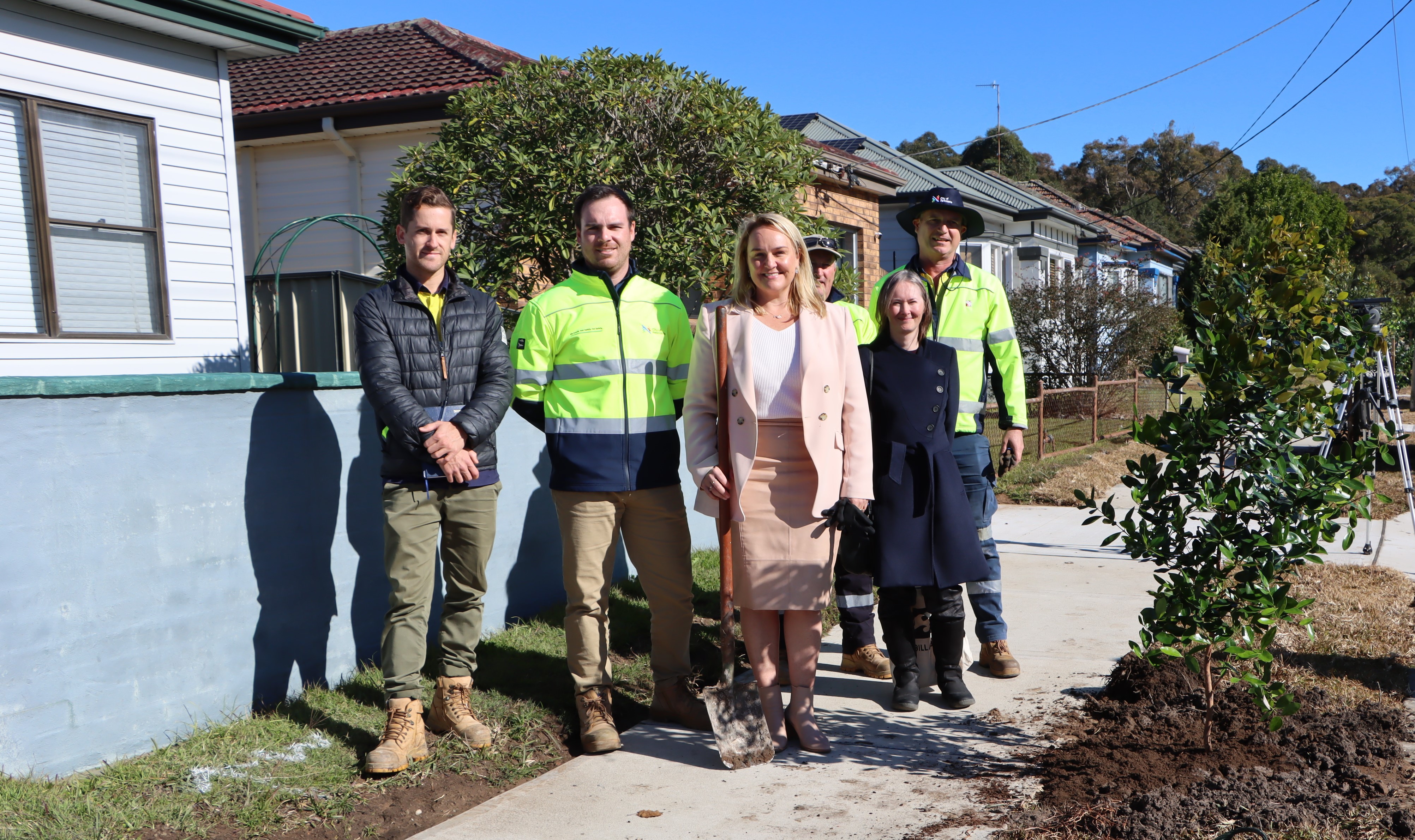
Newcastle Lord Mayor Nuatali Nelmes said this connection is a first step in delivering a safer, more attractive place for visitors and locals to spend time.
“It’s great to see improved accessibility for the community linking these two important locations,” Cr Nelmes said.
“The addition of over 30 street trees along Freyberg Street also creates a more appealing environment with increased shade and colour, with more trees being introduced along Dunkley Avenue in the coming weeks.
“Our staff are preparing to commence upgrades to stormwater infrastructure and road surfaces in the western car park area in the next few weeks, as well as seeking community feedback on timed parking options across the broader local centre area.
“When we spoke to the community during the development of this upgrade we heard concerns about pedestrian safety, and also the availability of short-term parking for visiting the shops and local services.
“We look forward to hearing community views on the range of timed parking options which were developed in consultation with local businesses during a workshop held with them earlier this year.”
Construction is scheduled for overall completion in early 2024. The upgrade has been supported with a $591,677 grant from the NSW Government under Round Seven of the Resources for Regions program.
Deputy Premier and Minister for Regional NSW Paul Toole said Resources for Regions has delivered 242 projects worth $420 million for mining communities in the last 10 years.
“The NSW Government is committed to supporting regional mining towns that supply our state with these precious resources, and I am grateful to the City of Newcastle for putting forward this project which will support the ongoing prosperity of the local community,” Mr Toole said.
“Mining plays a very important part in the NSW economy, supporting tens of thousands of jobs across the state and it will continue to play a role in Newcastle for years to come.”
The project is being delivered as part of City of Newcastle’s Local Centres program and follows similar upgrades at Carrington, Beresfield, Joslin Street in Kotara, Llewellyn Street in Merewether, James Street Plaza in Hamilton, and the upgrades currently under construction in Stockton and Shortland.
A brighter beginning for all NSW children
A life-changing package for NSW children and families has been announced today with a $376.5 million investment over four years in child development and family support as part of the 2022-23 NSW Budget.
Premier of NSW Dominic Perrottet said the Brighter Beginnings package will provide all children with a full suite of developmental checks before they start school and make the baby blue book digital.
“The first 2,000 days of a child’s life are critical to their development and success and we want to ensure they get the best start possible,” Mr Perrottet said.
“NSW is now leading the nation in providing the best developmental support giving families right across the state the brightest of futures.”
Treasurer Matt Kean said that 90 per cent of a child’s brain development happens before the age of five, which is why these reforms are so important for NSW’s future prosperity.
“This is a long-term investment which will reap benefits for children, families and the economy today, and for many generations to come,” Mr Kean said
As the Minister leading the initiative, Minister for Education and Early Learning Sarah Mitchell said it’s clear that getting it right early in a child’s life has lifelong benefits for their future.
“Almost half of all 4-year-old children do not get their recommended health and development checks, so making these available in every NSW early childhood service will open the door to brighter futures for thousands of children,” Ms Mitchell said.
“The Brighter Beginnings initiative will also make a huge difference to outcomes at school, from behaviour to academic results.”
“Knowing where children are developmentally and physically before they start school is so important, allowing any necessary support to be identified.”
Minister for Health Brad Hazzard said expanding the home-based antenatal service would make it easier for parents to access important health care information.
“We are bringing the Sustaining NSW Families program to more Local Health District across the state, so many more vulnerable families can be supported by free home visits by a specially trained clinical nurse,” Mr Hazzard said.
Minister for Customer Service and Digital Government Victor Dominello said making the Blue Book digital will make it easier for families to access and keep track of their child’s health and development information.
“This initiative is modernising how we support families at a critical time in their child’s life,” Mr Dominello said.
Minister for Families and Communities Natasha Maclaren-Jones said that more Aboriginal Child and Family Centres will help connect families with a mix of culturally safe services and supports for their child’s development.
“Expansion of the Pregnancy Family Conferencing program will mean more vulnerable families will be able to access early engagement and interagency care planning, so they can remain together,” Ms Maclaren-Jones said.
The Brighter Beginnings initiative is a partnership, led by Minister Mitchell, between the Department of Education, NSW Health, the Department of Communities and Justice, the Department of Customer Service, the Department of Regional NSW, Multicultural NSW, Aboriginal Affairs, and the Department of Premier and Cabinet to drive transformational change in early childhood development.
Alongside the NSW Government’s Affordable Preschool Program, the Brighter Beginnings package includes:
- $111.2 million to bring health and development checks to all children in NSW preschool settings in partnership with health professionals;
- $98.7 million to continue and expand the number of Aboriginal Child and Family Centres across the state;
- $70.9 million to expand the transformational Sustaining NSW Families clinical nurse home visiting program;
- $57.2 million to develop the clinical interface of the Digital Baby Book; and
- $38.6 million to make Pregnancy Family Conferencing available to more parents across NSW.
Affordable preschool for all NSW families
Families across NSW are set to save thousands of dollars on their preschool costs thanks to more than $1.4 billion over four years in the 2022-23 NSW Budget.
Premier Dominic Perrottet said the program will ease cost of living pressures for families and ensure more children receive high quality early education, which is critical for a smooth transition to school and better educational outcomes for their future.
“Preschool is where the building blocks for lifelong success are established so it is vital that quality early childhood education is more accessible for families in NSW, no matter what their circumstances or where they live,” Mr Perrottet said.
“We’re committed to ensuring families across the state have a brighter future and less pressure on the hip pocket.”
From 1 January 2023, all NSW families will be eligible for:
- up to $4,000 per year in fee relief for 3, 4 and 5-year-olds attending a community or mobile preschool
- up to $2,000 per year in fee relief for 4 and 5-year-olds attending preschool in a long day care setting and
- the equivalent of 5 days a fortnight of affordable preschool fee relief for all children in Department of Education preschools.
-
The NSW Government will also invest $64.1 million for a two-year pilot to support more 3-year-olds attending preschool in long day care services.
NSW Treasurer Matt Kean said the evidence shows clearly the positive impact quality preschool can have on a child’s life outcomes and on the economy.
“Every $1 invested in early childhood education delivers a $2 boost to the NSW economy – it is a great investment for any Treasurer,” Mr Kean said.
Minister for Education and Early Learning Sarah Mitchell said that one of the biggest impacts we can have on educational outcomes at school is to improve early childhood education.
“A significant body of research shows that children who participate in quality preschool programs have improved lifelong educational, social and economic outcomes,” Ms Mitchell said.
“That’s why I’m so delighted to be continuing our support for community and mobile preschools. Families using these services are not eligible for the Child Care Subsidy, so NSW’s commitment to long-term funding relief is significant and genuinely needed.
“We are also extending support to NSW families whose children attend preschool in a long day care setting, because at the end of the day what’s important is our littlest learners having access to great quality preschool programs.”
The current Start Strong Free Pre-school Program is already providing $150 million in fee relief for children enrolled in community and mobile preschools across NSW in 2022.
New Modern Wharf Facilities Open for Ferry Commuters
Ferry commuters in North Sydney will enjoy the benefits of a new modern wharf following a $7.5 million upgrade as part of the NSW Government’s $2.2 billion commitment to deliver accessible, safe and comfortable public transport infrastructure.
Minister for Transport and Veterans David Elliott today officially opened the upgraded wharf with the Member for North Shore Felicity Wilson, and highlighted the benefits that the Transport Access Program (TAP) will provide commuters.
“It is vital for a modern transport system to deliver infrastructure that is accessible for all commuters and is future-proof to meet the demands of a growing population, and that’s what the upgrade to the North Sydney ferry wharf does,” Mr Elliott said.
“These transport infrastructure projects provide a boost to the economy and associated industries. On this particular project more than 200 workers were inducted on-site, 210 tonnes of steel was used and more than 76 cubic metres of concrete poured.”
The Government’s upgrade to the North Sydney ferry wharf includes:
- a new accessible path leading to a gangway and covered floating pontoon;
- customer seating;
- weather protection;
- a new accessible parking space;
- kiss and ride zone; and
- bicycle hoops.
-
Member for North Shore Felicity Wilson said she was thrilled with the package of works which provided a safer and more accessible wharf and importantly provided quicker and more efficient boarding and disembarking.
“This upgrade is a positive outcome not only for local commuters but also for visitors to the area,” Ms Wilson said.
“Seating for customers, protection from the elements and a kiss and ride zone are great upgrades which makes catching public transport much more attractive and easier for commuters,” she said.
Commuters in the area can also look forward to more upgrades at Greenwich Point Wharf, South Mosman Wharf and Taronga Zoo Wharf.
For more information about the North Sydney Wharf Upgrade visit nswroads.work/northsydney-wharf.