More Kids Addicted to Screens – Labor will ban Phones in NSW Schools

NSW Labor is reiterating its plans to ban mobile phones in New South Wales schools as a new report shows more and more kids are addicted to screens and devices.
 
Today’s Daily Telegraph reports that a group of Australian psychiatrists and psychologists specialising in video gaming, technology and associated behavioural difficulties have formed the Australian Gaming & Screens Alliance (AGASA).
 
They are calling on the government to take action, particularly after COVID.
 
Labor announced in September, that a Minns Labor Government will restrict the use of mobile phones in NSW public school classrooms to improve students’ learning and social development.
 
South Australia, the Northern Territory, Victoria and Western Australia have all announced a ban in schools. Mobile phones are banned in primary schools in NSW but there is no mandatory restrictions on phones in high schools.
 
The Premier and his Education Minister are refusing to budge. That is despite parents writing to the Government urging a ban, and study after study suggesting children are more addicted to screens then ever.
 
Under the proposed policy, all NSW public school students would have their phones turned off during school hours and kept off and out of sight until the end of the school day.
 
There will be exemptions for students with special circumstances, such as needing to monitor a health condition, or when under the direct instruction of a teacher for educational purposes or with teacher permission for a specified purpose such as for language translation and communication.

Chris Minns, NSW Labor leader said:

As any family across New South Wales knows, the biggest conversation around the dinner table at the moment is how to get kids off devices.

“I’ve got 3 boys, I share the concerns of parents about the impact devices and phones are having on the next generation of kids.
 
“NSW Labor will ban mobile phones in NSW schools. It will mean kids can focus more on learning and during recess and lunch they are back to kicking a ball around or talking face to face with their friends.

Labor will end failed overseas teacher recruitment plan and ectually get more teachers into schools

A Minns Labor Government will end the NSW Government’s failed $13.5 million Recruitment Beyond NSW program and redirect resources towards actually recruiting New South Wales teaching students into schools.
 
The Perrottet Government’s signature Recruitment Beyond NSW scheme that promised 460 overseas teachers has yielded only three new teachers.
 
Meanwhile, figures from the NSW Department of Education reveal 7,174 people received Initial Teacher Education (ITE) qualifications in 2021, but an alarming 1,418 (or 1 in 5) chose not to become teachers. 

This is worsened by the fact that the number of people taking up teaching degrees declined by 29 per cent over the period of 2014 to 2019.
 
After 12 years, the NSW Liberals just don’t get it. They have presided over a chronic teacher shortage, which has meant merged and cancelled classes, and students falling behind in national and international rankings when it comes to literacy, numeracy and science.
 
NSW Labor has a plan for a better NSW education system for a better future for our kids. 

To get more teaching graduates into schools, a Minns Labor Government will:
 
•    Match NSW teaching graduates directly with vacant teaching positions, ensuring new graduates aren’t lost to the school system.
•    Provide permanent teaching job offers earlier to ensure high-achieving teacher education students have guaranteed teaching roles upon graduation.
•    Expand the Hub Schools program to provide more partnerships between schools and teacher education providers.
•    Create a state-wide teacher placements system to match specialist teachers with schools’ subject needs. 
 
And to get more people to take on a teaching degree in the first place, a Minns Labor Government will:
 
•    Create a $20 million Innovative Teacher Training Fund, to support innovative pathways into teaching such as the Clinical Teaching School Hubs model developed by Alphacrucis University College. 
•    Expand evening and weekend Master of Teaching courses for career-changers, by partnering with teacher education providers so career-changers can earn an income whilst retraining as a teacher. 
 
NSW Labor will redirect unallocated funding from the Teacher Supply Strategy and the failed Recruitment Beyond NSW strategy towards these new initiatives.
 
Today’s measures build on Labor’s already announced policies to fix the long term problems in our education system and to make a teaching career in New South Wales more attractive, including:

•    Cutting 5 hours of admin work per week. 
•    Creating 10,000 new permanent positions to end the casualization of the teaching profession.
•    Removing the Perrottet Government’s wages cap to make the profession competitive again.

Labor is commitmed to valuing the teaching profession, putting a stop to increasing attrition from the profession and bringing teachers back into NSW schools. 

NSW Labor Leader Chris Minns:
 
“The Perrottet Government spent years and millions of dollars coming up with a scheme that gave us only 3 new teachers, while 1,400 NSW teaching graduates chose alternative careers right under their noses.”  
 
“Why should New South Wales continue spending millions on recruiting teachers from overseas when there are thousands who spend years training to become teachers locally, but never end up in schools?”

This is a common-sense, back-to-basics approach to fixing the teacher shortage in NSW.”

 “My dad was a public school teacher. He worked in the public school system of New South Wales for nearly 40 years.  
 
“Teaching was his life’s work , and I want to ensure we attract and retain the next generation of career teachers, who want to work and teach right here in New South Wales. 
 
NSW Deputy Labor Leader and Shadow Minister for Education Prue Car:
 
“Every qualified teaching graduate should be contacted directly and told that there is a job waiting for them in our schools. I will call them myself if I have to – it’s a travesty these teaching graduates aren’t going into our schools.”
 
“Labor’s plans will make the teaching profession a more attractive career choice, get more teachers into classrooms and ensure they can make teaching their life’s work.”

20 syllabus announcements since 2018 – but education outcomes are still going backwards under the liberals

It’s clear this Government has run out of ideas and its best days are behind them, with an announcement today by the Education Minister on another syllabus change – it’s 20th  announcement since 2018.

Despite the 20 announcements, a report released by the McKell Institute yesterday confirmed that New South Wales is going backwards when it comes to education outcomes.
 
International PISA results show that between 2006 and 2018, NSW students dropped from 6th to 23rd in reading, dropped from 9th to 31st in maths and dropped from 3rd to 23rd in science.
 
In fact, NSW had the largest decline of any Australian jurisdiction in PISA reading results between 2000 and 2018.
 
This year’s NAPLAN results also showed the literacy levels of teenage boys had fallen to record lows with one in six failing to reach the minimum standard in grammar and punctuation and about 12 per cent struggled to read at a basic level.

Today there’s another syllabus announcement, yet the Perrottet Government has failed to recruit enough teachers to actually teach it.
 
There are currently 2,963 teacher vacancies across NSW and a NSW Parliament survey shows that 60 per cent of NSW teachers are planning to leave their jobs in the next 5 years.
 
After 12 years, the NSW Liberals just don’t get it.
 
They have presided over a chronic teacher shortage, which has meant merged and cancelled classes, and students falling behind in national and international rankings when it comes to literacy, numeracy and science.
 
Another four years will mean more of the same.
 
A list of syllabus announcements by the NSW Government since 2018:

  1. 14 May 2018 – Curriculum Review launched
  2. 24 August 2018 – Public consultation of curriculum review has started
  3. September 2018 – Terms of Reference revealed
  4. April 2019 – Consultation review released
  5. 22 October 2019 – Interim Curriculum report released. ‘Back to basics’ plan for new NSW schools curriculum
  6. 23 October 2019 – Curriculum to include more trades subjects
  7. 23 June 2020 – Masters review released
  8. 14 February 2021 – Expert teachers to help curriculum reform
  9. 23 March 2021 – K-2 English and Maths curriculum revealed
  10. 19 June 2021 – $196 million for implementation of curriculum reform
  11. 2 August 2021 – English and Maths syllabuses released for public consultation
  12. 15 November 2021 – English and Maths Yr1 and 2 curriculum
  13. 18 March 2022 – Year 3-10 English and Maths curriculum revealed
  14. 21 March 2022 – AUSLAN joins NSW curriculum
  15. 16 August 2022 – Music and Dance curriculum consultation
  16. 7 October 2022 – Extra 30mins release time for teachers to learn curriculum
  17. 17 October 2022 – Aboriginal Languages syllabus revealed
  18. 24 October 2022 – STEM syllabus revealed
  19. 21 November 2022 – Technology syllabus revealed
  20. 5 December 2022 – English syllabus announcement


It’s time for a fresh start for our education system in New South Wales.

NSW Labor has begun to outline a comprehensive plan to fix the long term problems in our education system, reverse the decline in student outcomes and to make a teaching career in New South Wales more attractive by:

  • Cutting 5 hours of admin work per week so teachers spend more time in the clasroom;
  • Converting 10,000 existing casual teachers to permanent to give them the security of job they are asking for to stay in teaching;
  • Creating better teacher pathways to ensure our graduates end up in New South Wales schools;
  • Banning the use of mobile phones in schools to reduce distraction and improve education outcomes; and
  • Removing the Perrottet Government’s wages cap to make the profession competitive again.

Wait Times for Ambulances and in our Hospitals are now at Record Levels under the Liberals

The release of the latest Bureau of Health Information (BHI) today confirms people in New South Wales are still waiting too long for an ambulance and too long in Emergency Departments with 1 in 10 patients spending longer than 22 hours in Emergency before discharge – the longest of any quarter since BHI reporting began.
 
Across the state:

  • 60,000 patients or 1 in every 12 walked into an Emergency Department in the last 3 months and left without, or before completing treatment.  
  • More than one in three Priority 1A patients, that is people with life threatening conditions like cardiac or respiratory arrest, waited longer than the 10-minute target for an ambulance to arrive.
  • Almost half of critical emergency patients did not start their treatment on time.
  • Almost 100,000 people were on elective surgery waiting lists at the end of September, including close to 18,000 who had waited longer than clinical guidelines say they should.

These figures show the dire state of our health system. It’s not fair on our hardworking healthcare professionals to have to manage a system that is stretched to its limits.

For the last 12 years, our health system and the people who work in it have been neglected by the Liberals and Dominic Perrottet. New South Wales lost 365 hospital beds, and we have a shortage of nurses who are leaving the profession.

In the last year alone, 35 emergency department nurses left Westmead Hospital, and another 35 left Blacktown Hospital.

But Dominic Perrottet and the Liberals don’t get it. In response to the outpouring of concern about the state of our public hospitals from paramedics, to nurses to senior doctors in the bush and in the city – the Minister for Health declared – that if the conditions were so bad – perhaps the doctors should go and work in the third world.

In response to a question on the health system in crisis, Minister Hazzard said ‘Bullshit, there certainly is not. It’s the best health system in the country by a long shot!”

NSW Labor leader Chris Minns said:

“The wait times for ambulances and in our hospitals are now at record levels.”This is not a health system that is coping, after 12 years of under investment by the NSW Liberals. “It’s why NSW Labor will begin the long overdue task of repairing and reforming our health care system across New South Wales.

“We’ll introduce safe staffing levels in NSW hospitals, starting with EDs. It will help with workloads, it will take pressure of nurses and ensure they can treat patients with the care they deserve and need.

“Our nurses, hospital staff, paramedics and doctors need more support.

NSW Shadow Minister for Health Ryan Park said:

“This data does not paint  a picture of a healthy system.”

“We have hospitals across the state and particularly in Western Sydney that are under continued pressure.

“Whether it is Nepean, Westmead or Blacktown, all major hospitals continue to show they are under resourced and struggling to cope with increased demand.

Man missing from Maitland found 

A man reported missing from the Maitland area has been found safe and well.

The 55-year-old was last seen in Coonamble about 6.20pm on Monday (5 December 2022).

When he could not be contacted by friends and family, officers attached to the Port Stephens-Hunter Police District were notified and immediately commenced inquiries into his whereabouts.

Following inquiries, the man was found safe and well in Thornton about 1am this morning (Thursday 8 December 2022).

Police would like to thank the public and the media for their assistance

SANTOS RULING MARKS TIME TO PIVOT

Contrary to what fossil fuel companies and lobby groups would have you believe, the landmark ruling against Santos in favour of the Munupi people isn’t connected to domestic gas supply. 

Greens spokesperson for resources and Yamatji-Noongar Woman Senator Dorinda Cox said:
 

“The Labor Albanese Government must respect and uphold the Federal court’s decision, by changing legislation and regulations to ensure First Nations people are appropriately consulted about resources projects on their Land and Sea Country.

“Santos has publicly stated that Barossa gas is for export markets such as Japan and Korea distributed via the Middle Arm Sustainable Development Precinct in Darwin Harbour. 

“I back Rod Sims’ call for Labor to cut high energy prices through the existing export trigger. Labor needs to stand up to their big donors and put the interests of Australians first. 

“A recent poll found 71% of Australians support limiting gas exports. Santos and Woodside are fear mongering, putting their windfall profits ahead of protecting First Nations cultural heritage.  

“80% of our gas is contracted to foreign entities and sold on the spot market. We have enough gas reserves in Australia to meet our domestic needs. We don’t need to be opening new gas fields, we need to invest in clean, green renewable energy infrastructure and storage solutions. 

“If Australia wants to see itself as a global clean energy powerhouse, we must end our reliance on fossil fuels and invest in renewable projects with First Nations people as equal partners.

RBA ACTIONS HIGHLIGHT NEED FOR MACROECONOMIC REFORM

Greens Treasury spokesperson, Senator Nick McKim, has responded to today’s decision by the RBA to raise rates again by highlighting the need for macroeconomic reform to deal with the housing market and declining real wages.

“The RBA has seriously undermined its credibility this year.

“They should not have raised rates as fast as they have, and should not have gone again today.

“Today’s decision is the RBA thumbing its nose at people who are hurting the most. 

“High inflation was sparked by supply-side shocks and has been fuelled by corporate profiteering.

“It has not been driven by wage claims.

“Yet the RBA has consistently invoked wage pressures to justify eight consecutive interest rate increases.

“By jawboning down wages and openly aiming to increase unemployment the RBA has been running cover for corporate Australia.

“The RBA’s interest increases have also significantly increased housing costs for renters and mortgage holders.

“This comes after the RBA’s forward guidance during the pandemic sent house prices to record highs by inducing people to borrow record amounts.

“The last three years have demonstrated that Australia’s economic institutions and policy settings are not fit for purpose.

“House prices should not be a primary tool for economic recovery. Doing so only increases volatility and decreases affordability.

“And wage suppression should not be the only tool to reduce demand. Doing so worsens inequality and hurts those who are most vulnerable.

“The RBA review must call for monetary and prudential policy to be brought under the one roof to curb the flow of credit to housing.

“And the government needs to pull its finger out and implement tax reform that hits speculators and the wealthy.

“Getting rid of negative gearing and the capital gains tax discount would stop housing costs yo-yoing up and down in response to shifts in interest rates.

“And taxes on super profits and the super wealthy could help slow inflation and fund cost of living relief for those who need it.”

GREENS RENT FREEZE PLAN COULD’VE SAVED RENTERS ALMOST $5,000 EACH LAST YEAR

Updated analysis by the Parliamentary Library estimates that renters across Australia would be $10.7 billion better off if rents had been frozen nationwide for the past 12 months. With rents having increased by 21.5% nationwide, the average renter in Australia is paying $4,896 more for their home than last year. 

The impact of a rent freeze varies by state. Sydney renters, who’ve seen their rents increase 28.6% in the last 12 months, would’ve been $7,450 better off on average had a rent freeze been in place. Melbourne renters, who’ve faced a 23.9% increase in the last 12 months, would’ve been $5,219 better off, and Brisbane renters, who’ve seen a 24% rent increase, would’ve been $5,104 better off had rents been frozen.

The Greens are calling on the Federal Government to put a nationwide two-year rent freeze  on the agenda for this week’s National Cabinet meeting, as part of national tenancy standards including an end to no grounds evictions and minimum standards for rental properties.

Max Chandler-Mather MP, Greens spokesperson for Housing and Homelessness said:

The average renter would have nearly $5,000 more in their pockets this Christmas if the government had frozen rent increases over the last 12 months. 

$5,000 could be a holiday and some great Christmas presents for the kids, or it could pay those outstanding bills, and instead it has been eaten up by unfair rent increases.

Over the last 12 months, renters paid an extra $10 billion in rent, while property investors pocketed $8.5 billion in federal tax concessions, which is desperately unfair and a reminder that right now politics really only works for the rich. 

The Prime Minister needs to put a nationwide rent freeze and end to no grounds evictions on the agenda at this week’s National Cabinet meeting, and give the millions of people struggling with outrageous rent increases much needed certainty and relief.

If the Prime Minister doesn’t put a national rent freeze and an end to no-grounds evictions on the table at the National Cabinet meeting this week, then this will be a spectacular failure of leadership in the middle of the worst rental crisis in our recent history.

The Federal Budget has projected that over the next two years real wages will continue to decline while rents skyrocket and let’s be real, that will see Australia lurch into a major social crisis, unless Labor finally shows some leadership and freezes rents. 

An emergency rent freeze worked in Victoria during the pandemic and it can work now across Australia to protect families from unfair rent increases that will either push them into devastating financial stress or even homelessness. 

Background

 Estimated impacts of 12 month rent freeze, by state

Impacts of freeze on rent increases

COVID-19 antivirals prevent severe illness and death

A statement from Australia’s acting Chief Medical Officer, Professor Michael Kidd AM, on COVID-19 antiviral treatments.

Australia’s real-world experience is that the two COVID-19 oral antiviral treatments approved for local use are both highly effective at protecting older Australians – a key at-risk population group – from hospitalisation and death.

Although vaccination remains the best form of protection against COVID-19, the two treatments – Lagevrio® (molnupiravir) and Paxlovid® (nirmatrelvir and ritonavir) – have been an additional gamechanger in preventing severe illness and death among those most at risk.

The real-world findings are based on an analysis of Victorian data involving more than 27,000 people aged 70 years and over. This analysis found that the use of COVID-19 oral antivirals led to clear reductions in the risks of hospitalisation and death, compared to instances where treatments were not used.

Given people aged 70 and over are eligible for the treatments in every state and territory, the conclusions are applicable nationwide.

The experience in Australia is more positive than the findings contained in PANORAMIC – a UK trial of molnupiravir.

It needs to be stressed the participants in the UK study were generally younger than those eligible for the treatments in Australia – and many had no risk factors that would make them more likely to become seriously unwell.

A large proportion of the people enrolled in the UK study would not be eligible for the treatments in Australia and these research findings cannot be directly applied to most people receiving treatments in Australia.  

Australia’s Pharmaceutical Benefits Advisory Committee (PBAC) recently noted that in two-thirds of the instances in which molnupiravir had been used through its listing on the Pharmaceutical Benefits Scheme, patients were aged 70 years or over. In the PANORAMIC study, only 6 per cent of participants were aged 75 years or older.

PBAC also noted patients at highest risk of progression to severe disease in the UK were not the target population for enrolment in the PANORAMIC trial. In Australia, these are the people who have specifically been made eligible for these treatments.

It further noted the Victorian data, combined with the results of observational studies in Israel and Hong Kong, demonstrated a benefit of molnupiravir over no treatment in patients at high risk of progression to severe disease.

PBAC concluded that while nirmatrelvir and ritonavir may be preferred for many patients at high risk of becoming severely unwell, in many common clinical circumstances, this treatment is contraindicated or unsuitable for use, especially in people with some underlying conditions, such as severe kidney or liver disease. It also has a number of drug interactions with commonly used medicines. 

In such circumstances, molnupiravir remains a suitable option.

It is very important Australians, particularly older Australians and those who are immunocompromised, talk to their doctors about their eligibility for COVID-19 antiviral treatments – and if eligible, make sure they can access and start their treatments as quickly as possible after a positive COVID-19 test result. 

Historic lifeboat to be preserved for future generations by Newcastle Museum 

The lifeboat involved in one of the most dramatic rescues in Newcastle’s maritime history will be preserved for future generations as part of a project being carried out by Newcastle Museum.

The first stage of the conservation work, which will see damaged timbers in the vessel’s bow replaced by a skilled local shipwright, will get underway next year after Newcastle Museum was awarded more than $6500 through the Federal Government’s Maritime Museums of Australia Project Support Scheme.

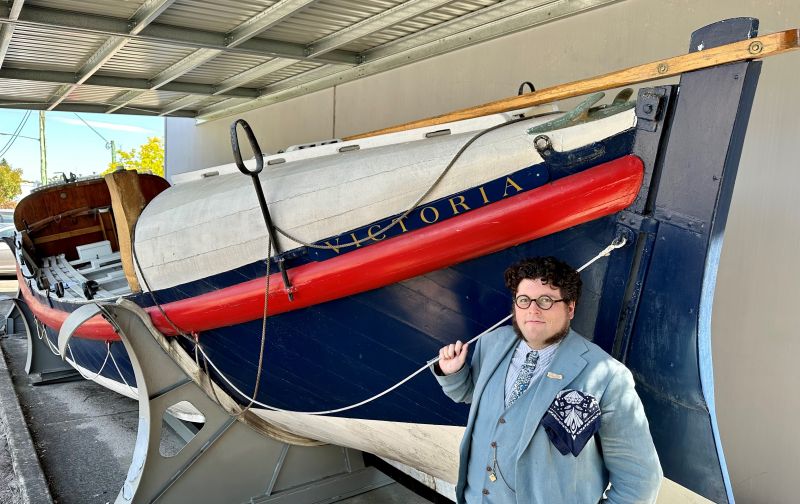
Newcastle Museum Manager Collections and Community Partnerships, David Hampton with the Victoria lifeboat, which will undergo restoration work next year.

Newcastle Museum Manager Collections and Community Partnerships, David Hampton, said the Victoria is a central and significant artifact from Newcastle’s maritime history used between 1897 and 1946 to enact some of our harbour’s most daring rescue missions.

“Newcastle Museum plays an important role in interpreting and preserving our city’s fascinating history and telling local stories,” Mr Hampton said.

“For almost half a century, the Victoria and its brave crew contested the turbulent waters in what was at the time one of the most dangerous harbours in the world to come to the aid of ships off Newcastle’s coast.

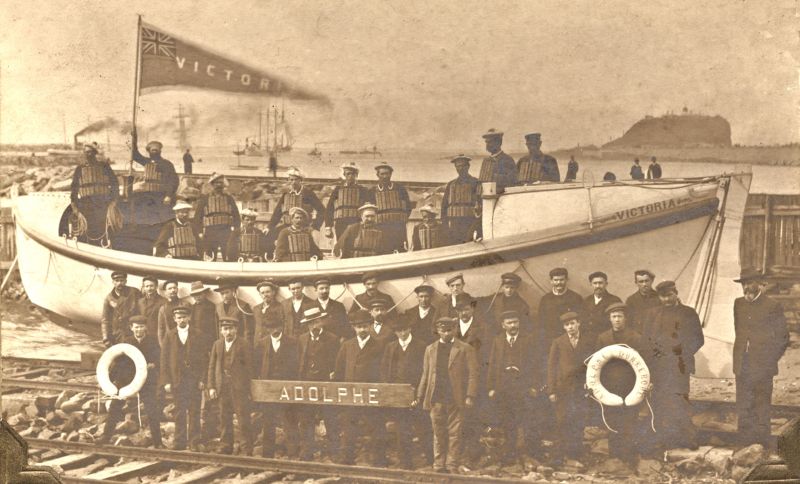
“This included the dramatic rescue of 32 men on board the stricken French sailing ship Adolphe, which ran aground on the harbour’s notorious Oyster Bank sand shoals in September 1904.

“Despite the huge swells, the heavily laden rescue vessel carried 47 people to safety including the lifeboat’s own crew, who were hailed as heroes and rewarded with a purse of sovereigns from the Consul-General for France, who made a special visit to Newcastle to thank them.”

Members of the Adolphe crew rescued by the Victoria lifeboat in 1904. Photo credit: Newcastle & Hunter District Historical Society Collection, Special Collections, University of Newcastle (Australia)

The Victoria’s final mission occurred on 23 July 1921 when the lifeboat crew battled gale-force conditions in Stockton Bight for 15 hours to rescue crewmen from the struggling steamer CENTURY.

Although the crew stayed on-call for many years after this event, the Victoria never again went to sea. The Lifeboat Service was disbanded in 1946.

The historic vessel has formed part of various heritage collections since being officially retired from service and was among several significant objects from the Newcastle Maritime Museum Society Collection transferred into the care of Newcastle Museum earlier this year.

Future conservation plans for the lifeboat include the construction of a new stillage (support structure), repainting and restoration works that will allow the vessel to form part of a future public display at the Museum.