SUPPORT FOR CRITICAL MINERALS BREAKTHROUGHS

The Albanese Government is accelerating the growth of the critical minerals sector and supporting clean-energy technologies through new initiatives as part of efforts to reach net zero.

A new National Critical Minerals Strategy is being developed in consultation with industry and community stakeholders, including traditional owners.

Australia has some of the world’s largest reserves of critical minerals and a new National Critical Minerals Strategy will set out a clear vision for the sector.

The Strategy will complement other Government initiatives including the National Battery Strategy and the Electric Vehicle Strategy.

The National Reconstruction Fund will include the $1 billion Value Adding in Resources Fund which will work alongside the $2 billion Critical Minerals Facility.

These initiatives will expand Australia’s mining science technology capability, diversify supply chains, create local jobs and help drive growth in the critical minerals sector including rare earths – a key component of low-emissions technologies, such as batteries, electric vehicles and solar panels.

Additionally, next week’s Budget will include $50.5 million over four years to establish the Australian Critical Minerals Research and Development Hub to help unlock our nation’s critical minerals potential.

The Hub will combine expertise from Geoscience Australia, the CSIRO and the Australian Nuclear Science and Technology Organisation to work with Australian industry to
address technical challenges and support international research and development collaborations.

The Government will also allocate $50 million over three years to the Critical Minerals Development Program for competitive grants to support early and mid-stage critical minerals projects, building on the $50 million recently committed to six key projects across Australia.

The International Energy Agency projects mineral demand for use in electric vehicles and battery storage could grow at least thirty times to 2040.

Australia is the world’s largest lithium producer, and latest figures forecast the value of lithium exports are due to increase more than 10 fold over two years, from $1.1 billion in 2020-21 to almost $14 billion in 2022-23, with continued growth over future years.

The development of a battery industry could contribute $7.4 billion annually to our economy and support 34,700 jobs by 2030.

Prime Minister Anthony Albanese said:

“Australia’s natural resources have powered our nation and we are committed to supporting the critical minerals sector and new clean technologies to reach our target of net zero, and make our nation an economic powerhouse with a clean energy future.

“Today’s new initiatives will ensure we can create and support local jobs, diversify global supply chains and meet the growing demand for batteries, electric vehicles and clean energy technology.

“These minerals will be critical to Australia achieving net zero emissions, and to helping the rest of the world make that transition as well.”

Minister for Resources and Northern Australia Madeleine King said:

“This package of measures demonstrates our commitment to net zero and the important role the resources sector can play in our energy transition.

“We are investing in the science and R&D collaborations. We are backing projects that are early to mid-stage, as well as helping to fast-track financing for projects which are further along in their development.

“The new Critical Minerals Strategy will be developed in consultation with the industry and experts, and will help the government identify how it can best support the growth of a sector that will be crucial to help the world reach its low-emissions goals.

“The new measures will help bring online new sources of supply, support robust supply chains, and create high-paying regional jobs for Australians while improving Australia’s export resilience.

“Building on the sector by generating new downstream industries and diversifying global supply chains will help Australia and its partners to meet net zero commitments.

“Without Australia’s resources, the world will not reach net zero.”
Cost of Driving on WestConnex Set to Rise by 6.1% as Inflation Takes its Toll

Thanks to Dominic Perrottet and the Liberal’s tollmania, new forecasts confirm the WestConnex toll will rise on 1 January 2023 by a record 6.1 per cent, with further significant toll increases expected during the 2023 election period.
 
The increase means a one way trip on the M8 goes up to $7.98 one way, and on the M4 to $6.82 one way.
 
Western Sydney households will be hardest impacted by the increases. The government’s own data shows that 17 of the top 20 most tolled postcodes are in Western Sydney.
A driver going from Penrith into the Sydney CBD for work every day using the M4 could now potentially pay $3,410 a year on tolls.

The figures were revealed in a release to the stock exchange by tolling company Transurban to co-incide with its Annual General Meeting.
 
It was also revealed that April 2023 to September 2023 will see the ‘peak’ toll increases as inflation forecasts spike.
 
Peak toll inflation will impact on a further seven Sydney toll roads (Northconnex, Westlink M7, Cross City Tunnel, Hills M2, Lane Cove Tunnel, M5 South West and the Eastern Distributor)  each quarter and will then further flow through to Westconnex on 1 January 2024. 
 
Because of Dominic Perrottet, motorists in Sydney pay tolls on over a million trips per day, totalling about $2.3 billion annually.
 
Over the remaining life of existing toll road contracts, this will leave Sydney motorists paying over $100 billion in tolls – all going to private toll road operators.

 OLDNEW
 CarsTrucksCarsTrucks
Westconnex M8$7.52$22.56$7.98$23.94
Westconnex M5 East$7.52$22.56$7.98$23.94
Westconnex M4 (max toll)$8.87$26.61$9.41$28.23


NSW Labor Leader Chris Minns said:

This will be a massive hit to the family budgets of people in Western Sydney.
 
“And what we can be certain of is that tolls will continue to go up and up and up because of this privatisation obsession of Dominic Perrottet.”
 
“And in the middle of a cost of living crisis, Sydney households are getting slammed for it. We’re already the most tolled city in the world.”

 
NSW Shadow Minister for Roads John Graham said:
 
“This is the worst ever New Year’s Day gift as tolls on Westconnex leap 6.1%.
 
“This market reporting predicts it will then get worse.
 
“The report shows that peak toll inflation will hit Sydney just as voters go to the polls in March.
 
“That will have drivers upset and the Government worried.”

Woman missing from Lake Macquarie located 

A woman reported missing from the Lake Macquarie area has been located this morning.

The 61-year-old was last seen about 7pm on Wednesday 12 October 2022, when she was dropped at Wellington Street, Umina Beach.

She was reported missing to officers attached to Brisbane Water Police District on Tuesday (18 October 2022), who commenced inquiries to locate her.

Following inquiries, including a public appeal for information, police located the woman safe at Blackwall Mountain about 7.30am today (Friday 21 October 2022).

Police thank the community and media for their assistance.

Appeal to locate woman missing from Lake Macquarie 

Police are appealing for public assistance to locate a woman missing from the Lake Macquarie area.

Susan Chiddy, aged 61, was last seen about 7pm on Wednesday 12 October 2022, when she was dropped at Wellington Street, Umina Beach.

She has since failed to contact family or friends and officers attached to Brisbane Water Police District were notified on Tuesday (18 October 2022) and commenced inquiries to locate her.

As part of inquiries, it has been established Susan visited the Deepwater Plaza, on Railway Street, Woy Woy, about 4pm on Wednesday 12 October.

Susan is described as being of Caucasian appearance, about 170cm tall, of thin build, with shoulder length blonde hair.

CCTV shows she was last seen wearing a purple jacket, pink pants, a green cap and was carrying a black handbag.

Anyone who may have seen Susan, or may know of her whereabouts, is urged to contact Crime Stoppers on 1800 333 000.

Further actions in response to Russia’s illegal invasion of Ukraine

Australia has imposed additional costs on Russia for its unprovoked, illegal, and immoral war on Ukraine.

The Australian Government is extending the application of a punitive tariff on goods imported from Russia and Belarus for a further 12 months until October 2023.

The additional 35 per cent tariff on Russian imports, together with the prohibition on energy imports, has had a significant impact on trade.

The Australian Government has also directed Export Finance Australia to reject any requests for loans or other finance that support trade with, or investment in, Russia or Belarus. This legal direction will ensure Russia and Belarus do not benefit from any financing provided by Export Finance Australia.

These measures are intended to undermine Russia’s ability to fund its invasion of Ukraine.

We call on Russia to immediately withdraw its forces from Ukrainian territory.

the Minister for Foreign Affairs, Senator the Hon Penny Wong said:

“Russia’s war on Ukraine is an attack on the UN charter. It impacts all nations and all peoples. Australia is working together with the international community to diminish Russia’s ability to fund its illegal, immoral war.”

the Minister for Trade and Tourism, Senator the Hon Don Farrell said:

“The Australian Government condemns in the strongest possible terms Russia’s unprovoked, unjust and illegal invasion of Ukraine. We are maintaining the economic costs on Russia and Belarus by extending the application of an additional tariff on imports from these countries for a further 12 months. We reiterate our strongest support for Ukraine’s sovereignty and territorial integrity, and for the people of Ukraine.”

More questions than answers on Marinus

Today’s announcement on Marinus Link raises far more questions than answers on what was already a dubious project, the Greens say.

Tasmanian Greens Energy spokesperson Dr Rosalie Woodruff MP said:

 “Tasmanians have a right to know what impact Marinus would have on people’s energy bills, as well as what thesubsequent debt would mean for the state.”

“The Treasurer refused to answer our question in Parliament today about what the debt would mean for Tasmanians, or to table the cost allocation methodology that will be used. We are already in a cost of living crisis – to burden households with even higher power bills would be devastating.”

“There are also serious questions about the environmental impacts of this proposal, particularly on sensitive ecosystems in the North West.”

“Tasmanians were promised the world and delivered an atlas with Basslink – this can’t happen again with Marinus.”

Greens Senator for Tasmania Nick McKim said:

“Basslink proved to be a boon for coal-fired generators in the Latrobe Valley, and the very real danger is that Marinus will be the same.

“Marinus cannot be allowed to prolong the life of the dinosaur coal fired power stations in Victoria by providing another outlet to get their dirty electricity into Tasmanian homes and businesses.

“The federal government has serious questions to answer about the costs and benefits of this project including ecological harm and its impact on domestic and small business power bills.

“They need to explain why it would be more efficient than funding local renewable energy generation and storage, like rooftop solar and batteries, close to demand centres across the southern states.”

Cost of top end tax cuts surges past a quarter of a trillion dollars

Treasurer Jim Chalmers’ revelations that the cost of the Stage 3 tax cuts for CEOs, politicians and billionaires has surged over a quarter of a trillion dollars is further confirmation they should be scrapped, the Greens say.

“$254 billion is a staggering amount of money that would be far better spent putting mental and dental health into Medicare, wiping student debt and making childcare free,” Greens Economic Justice spokesperson Senator Nick McKim said.

“Giving massive tax breaks to CEOs and billionaires while inequality and the cost of living are surging is a choice this government is making.”

“Next week’s budget will be a statement of this Government’s priorities – it is still not too late to scrap the Stage 3 tax cuts and invest in genuine, immediate cost of living relief.”

“Keeping them in place will be a slap in the face to all the Australians who are struggling to make ends meet.”

Libs: Labor’s West-Jerusalem Reversal

This has been a shambolic process, contemptuous of many stakeholders, all to make a completely unnecessary decision with shocking timing.

Last night the Foreign Minister’s office were officially telling journalists no change had been made to the policy of Australia recognising West Jerusalem as Israel’s capital.

Just hours later the Foreign Minister has announced a complete reversal of Australia’s position on what is a significant matter of international foreign policy.

Astonishingly, the government was clumsy enough to announce this on a Jewish Holy Day and foolish enough to do so in the heated environment of an Israeli election campaign.

From what we can see today, the Labor Government ignored speaking with Australians who care about a two-state solution that provides peace and security for Israel and a future Palestinian state, and instead informed them of the Government’s decision only after it was made.

The Labor Government needs to explain not only why they have made this unnecessary decision, but also the chaotic process behind it.

Federal co-funding welcomed for Stockton Beach

City of Newcastle has announced $1.5 million co-funding in partnership with $4.7 million Federal Government funding for the planning, design and approvals to secure sand for amenity nourishment at Stockton Beach.

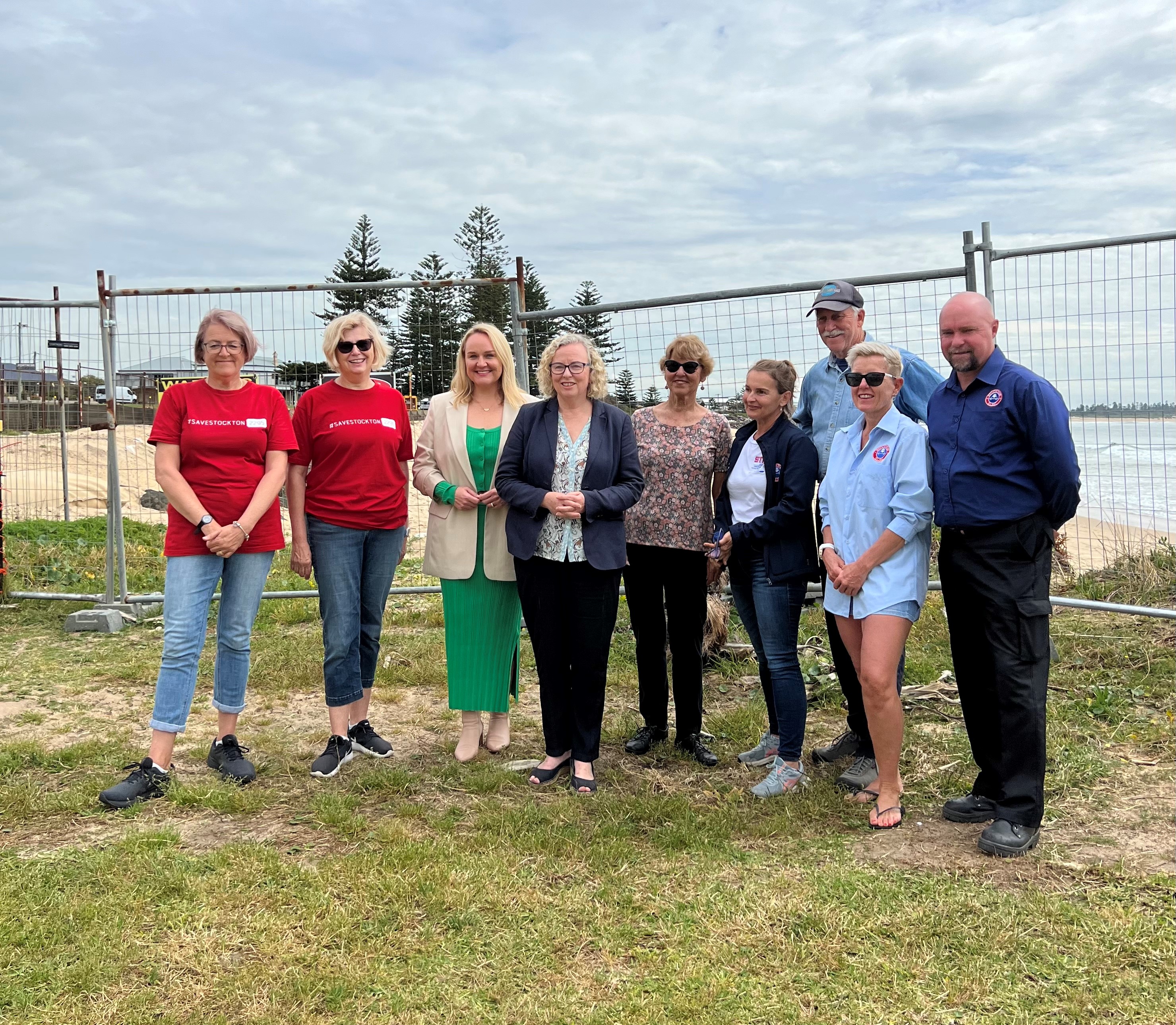
Picture caption: Lord Mayor Nuatali Nelmes with Federal Member for Newcastle Sharon Claydon MP and members of the Stockton community.

Newcastle Lord Mayor Nuatali Nelmes thanked Federal Member for Newcastle, Sharon Claydon MP, at Stockton Beach this morning and reiterated the importance of this collaborative funding and the work it enables for the Stockton community.

“City of Newcastle has been working hard on the ground in Stockton to protect the beach and secure funding for mass sand nourishment,” Cr Nelmes said.

“This $1.5 million co-contribution is part of our $27.5 million commitment we made in 2020, with $4.6 million already invested into the Coastal Management Program.”

The federal grant includes a 25 per cent co-contribution from City of Newcastle and the immediate priority is to source 300,000 cubic metres of sand from the entrance to the harbour to provide short-term relief to the current shoreline recession pending mass sand nourishment.

City of Newcastle Executive Manager Planning and Environment Michelle Bisson said mass sand nourishment remained the long-term solution to protecting Stockton Beach pending support from the NSW Government.

“The long-term solution is to secure the 2.4 million cubic metres of sand needed an initial mass nourishment, and annual sand top ups in line with community wishes and the plan endorsed by the NSW Government in 2020,” Ms Bisson said.

The grant will fund these investigations and approvals – looking at sand sources from the north arm of the Hunter River, as well as three suitable bodies of sand in the Stockton Bight which were identified in the NSW Government’s 2021 Stockton Offshore Sand Exploration Project.

“Securing multiple sand sources builds flexibility into the mass-nourishment strategy to ensure the longevity of sand supply to Stockton Beach, building necessary resilience and future-proofing the project,” Ms Bisson said.

City of Newcastle’s Stockton Coastal Management Program was one of the first of any Councils in the State to be certified, under the Coastal Management Act 2016, by the NSW Minister for Local Government in August 2020.

City of Newcastle invested $4.6 million on coastal protection measures over the 10 years prior to the Stockton CMP being certified in August 2020.

The cost to implement coastal management actions including the initial amenity sand nourishment, outlined in the Stockton Coastal Management Program 2020, to provide a buffer for the coastline and beach amenity at Stockton will be $27.5 million, with $4.6 million of this already spent on coastline protection and emergency repair works.

City of Newcastle has completed an engineering design process to determine the best locations to place sand to achieve the objective of providing a buffer against storm erosion risks and projected sea level rise impacts while restoring the recreational beach amenity for the Stockton community and broader Hunter region.

Avenue of trees to commemorate the Queen’s Platinum Jubilee

A 700m long avenue of native trees stretching along the creek side of Maryland Drive will create a living legacy in honour of Queen Elizabeth II.

The 70 mature trees, which were initially planned as part of Platinum Jubilee celebrations to mark the Queen’s 70 years of service to the Commonwealth, will now provide a lasting tribute to the late monarch, who visited Newcastle four times during her reign.

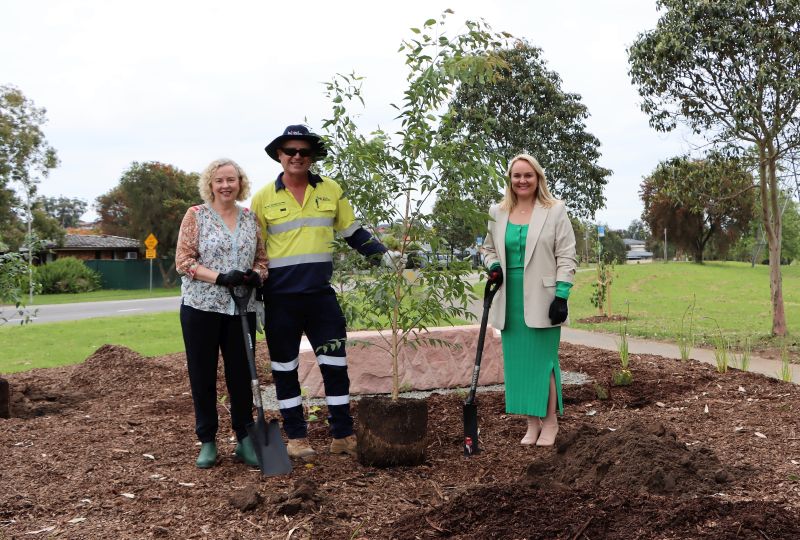
Federal Member for Newcastle Sharon Claydon, City of Newcastle Tree Planting Officer Michael Linsley and Newcastle Lord Mayor Nuatali Nelmes help plant the final trees at Maryland for the Queen's Jubilee project.

The project was jointly funded by City of Newcastle and the Australian Government’s Planting Trees for The Queen’s Jubilee Program, which was designed to support community-based tree planting events across Australia.

Newcastle Lord Mayor Nuatali Nelmes and Federal Member Sharon Claydon visited the site today to unveil a commemorative plaque and plant the final three trees in the Queen’s Jubilee Avenue of Native Trees.

Cr Nelmes said the avenue provided a fitting tribute to the long-lasting reign of the Queen while also contributing to the biodiversity of the area.

“Just over a month ago we joined the world in mourning the passing of Queen Elizabeth II after more than 70 years serving her nation and our country as Australia’s Head of State,” Cr Nelmes said.

“Today we pay tribute to that dedicated service with this splendid avenue of native trees, which will continue to grow and mature over the years for future generations to enjoy.”

Newcastle MP Sharon Claydon said it was a poignant day that celebrates the Queen’s long reign by creating a living legacy in her honour.

“I am honoured to help plant the final trees and unveil this commemorative plaque, which will provide beautification and sustainability for Maryland locals and visitors alike, whilst commemorating the Queen’s extraordinary life and service,” Ms Claydon said.

A large garden bed planted with native shrubs and grasses is located at the beginning of the Queen’s Jubilee Avenue and features a large sandstone block, providing a striking centrepiece to display the commemorative plaque.

The project supports City of Newcastle’s commitment to increasing urban forest canopy cover and improving open spaces for wildlife and future generations.

Twelve native tree species were chosen in the planting program to provide the maximum benefit to the biodiversity of this area and ensure the successful establishment of vegetation within an important wildlife corridor.

The project also involves restoration of the northern vegetation surrounding Maryland Creek enabling wildlife to move between landscapes, creating more resilient local wildlife populations and ensuring weeds are kept to a minimum.

Future community-tree planting events will be held to improve the connection of the Queen’s Jubilee Avenue of Native Trees, Maryland Creek, and the nearby RAMSAR-listed Hunter Wetlands, which are internationally significant for migratory shorebirds and other wildlife.