Investigation underway after fatal crash – Tighes Hill 

A man has died following a fatal crash in the state’s Hunter overnight.

Emergency services were called to Maitland Road, near Henry Street, at Tighes Hill, after reports a car had left the road and collided with a power pole about 11.10pm yesterday (Saturday 5 November 2022).

Initial inquiries suggest a Hyundai i30 was travelling east on Maitland Road when it left the roadway and collided with a power pole, splitting it in half and ejecting the male passenger from the vehicle.

The Hyundai then impacted with a parked car and a sedan before coming to a stop.

The male passenger, 27, died at the scene and is yet to be formally identified.

The driver, a 31-year-old man, was able to free himself from the wreckage and was treated at the scene by NSW Ambulance paramedics.

Officers from Newcastle City Police District attended and established a crime scene which has been examined by specialist police from the Crash Investigation Unit.

The driver of the Hyundai was transported to John Hunter Hospital, where he remains, and has since undergone mandatory testing.

As inquiries continue, police are appealing for anyone who was travelling on Maitland Road and may have seen the Hyundai, or who has dashcam vision from around the time of the crash, to come forward.

A brief will be prepared for the information of the Coroner.

COST OF NEGATIVE GEARING AND CAPITAL GAINS TAX DISCOUNTS TO BLOW OUT TO $157 BILLION OVER THE NEXT DECADE

According to analysis performed by the Parliamentary Budget Office, the cost of negative gearing will skyrocket as interest rates rise, reaching $97 billion over the next decade. Meanwhile the cost of capital gains tax discounts will reach $60 billion over the next 10 years, bringing the total cost for both tax concessions to $157 billion.

According to the distributional analysis done by the PBO, 56% of the two tax concessions will go to the top 10% of income earners, with 85% of capital gains tax discounts going to the top 10% of earners over the next 10 years.

The analysis is based on an official cash rate of 2.85%, which the RBA announced on Tuesday. The totals are measured for 10 years from the 2023-24 financial year.

Lines attributable to Max Chandler-Mather MP, Greens spokesperson for Housing and Homelessness:

In the middle of one of the worst housing crises in our country’s history, the Federal budget includes $157 billion worth of tax concessions to property investors, 56% of which will go entirely to the top 10% of income earners.

When it comes to capital gains tax discounts, I have no idea how Labor justifies a tax concession that will see 85% of the benefit flowing to the top 10% of income earners.

Negative gearing and capital gains tax discounts work together to artificially inflate house prices, and turbo charge inequality, funnelling tens of billions of dollars into the pockets of the top 10% of income earners in Australia.

These tax concessions alone mean it is often easier for a property investor to buy their fifth house, rather than someone to buy their first home, and that’s deeply unfair.

The higher interest rates go, the more negative gearing will cost the budget, which means right at the time when the government needs extra revenue to help alleviate the cost of living crisis they are instead handing it over in the form of tax concessions to wealthy property investors.

Rather than spend $157 billion on tax concessions to property investors, the government should scrap negative gearing and capital gains tax discounts and invest the extra revenue in building well designed public and community housing, bringing dental into Medicare and cutting energy bills.

Table of revenue foregone due to negative gearing and capital gains tax discounts over 10 years

TAX REFORM NEEDED TO TACKLE INFLATION, NOT INTEREST RATE HIKES

Greens Treasury spokesperson, Senator Nick McKim, has responded to the release today by the RBA of their quarterly Statement of Monetary Policy.

“The RBA has today admitted that inflation is not happening because people are buying more things.”

“This is supported by ABS figures also out today showing that retail volumes grew only 0.2 per cent in the September Quarter.”

“The RBA states that retail inflation is ‘mainly driven by price increases rather than higher volumes’.”

“But having made this pertinent insight, in the next breath the RBA says that it needs to guard against possible wage claims that might arise because workers need more money to pay these higher prices.

“This circular logic reveals the extent to which the RBA has been captured by corporate interests.”

“The RBA is fear mongering about non-existent wage increases citing its dodgy business liaison program.”

“But businesses have complained about wages through the entire history of capitalism.”

“Instead of parroting the corporate lines, the RBA should be upfront about the limits of monetary policy in tackling the current bout of high inflation.”

“Increasing interest rates will bring down inflation only by smashing household incomes and this will most affect those who are already doing it tough.”

“The government needs to pull its finger out and engage in genuine tax reform.”

“The government should be taxing company super profits and unearned wealth, and funding cost-of-living relief for those that are most in need.”

Church Walk Park

City of Newcastle (CN) has collaborated with community members to highlight a hidden green oasis in the heart of Newcastle’s CBD.

New signage has been installed at the entry points to Church Walk Park, which explores the history of the area and provides visitors with an insight into the vast ecosystem that exists within the compact public space.

CN worked closely with volunteers from The Friends of Church Walk Park on the project, with the aim of increasing awareness of the park’s significant heritage with respect to civic history, transport and coal mining and encourage visitors and residents to explore the space.

The park is known for its eclectic range of plants which reflect the age and changes in the park’s design and function since its development in 1924. Earlier plantings in the eastern end of Church Walk Park are European in character with large camphor laurels and date palms. In the 1960s, plants including hibiscus and other exotic ornamental species were introduced. Australian native species of flora were the focus of planting up until the end of the 20th century and the 21st century saw the inclusion of native plants local to Newcastle. City of Newcastle has provided and planted a selection of plants endemic to the Newcastle and Hunter region with these species thriving throughout Church Walk Park.

It has entry points located on the corner of Church Street and McCormack Street as well as an entrance located on King Street. A winding path throughout allows visitors to discover the variety of plants and animals hidden within.

Church Walk Park is conserved by the community group, The Friends of Church Walk Park, who meet regularly and are involved in the maintenance of the park including the removal of deadwood, weeding and planting of new flora.

If you would like to get involved with the Friends of Church Walk Park, please click here.

Colourful career of former Commonwealth Meat Inspector celebrated with Freeman of the City honour

A former campaigner to improve health and safety conditions for those working in abattoirs is the latest honouree to be conferred as a Freeman of the City of Newcastle.

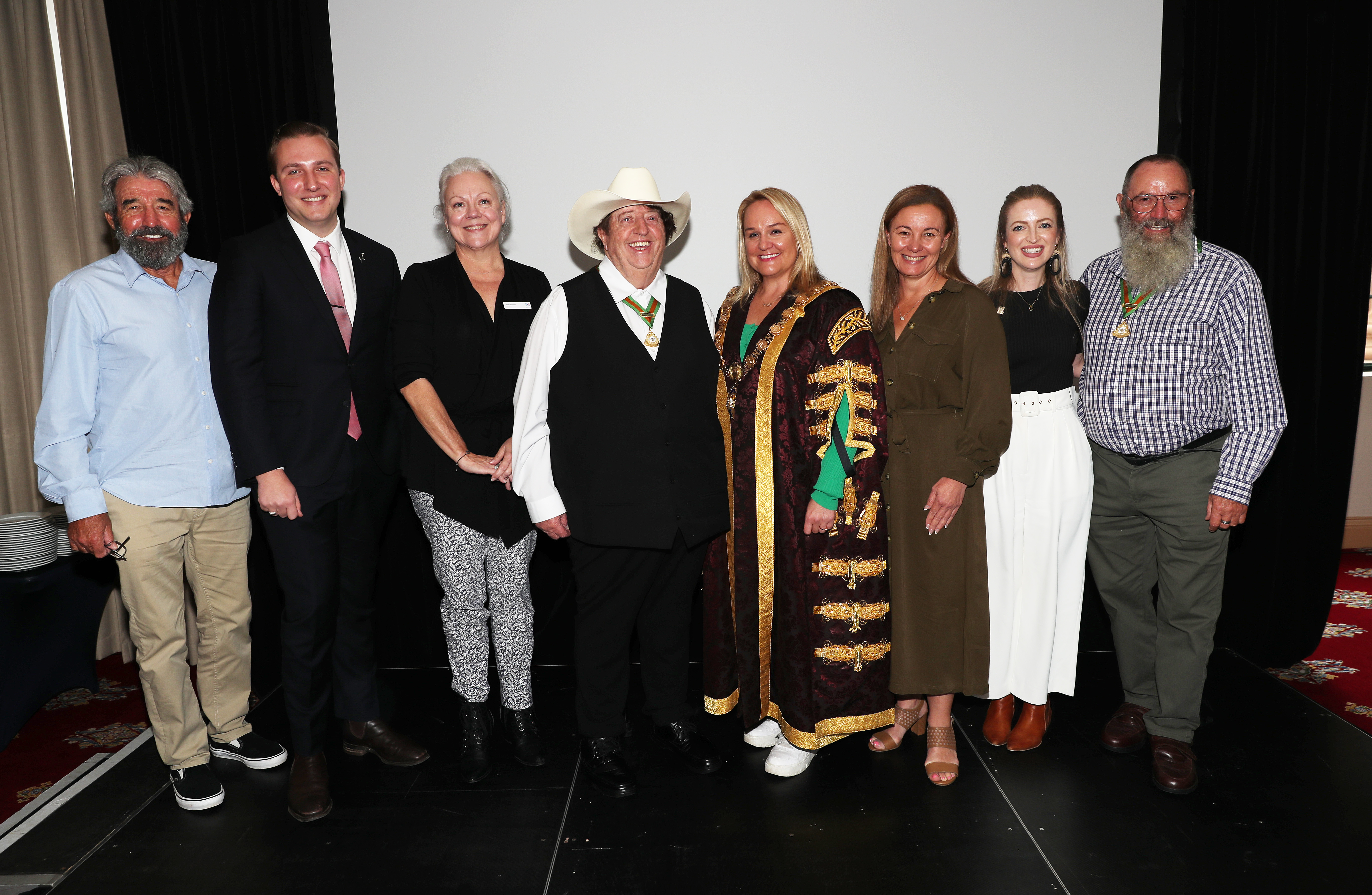
Fletcher resident Phil Mahoney became the 16th recipient of the lifetime achievement award at Newcastle City Hall on Friday, in recognition of his work throughout the 1970s and 80s as a Commonwealth Meat Inspector, changing the way the industry responded to zoonotic diseases, such as Q-Fever, brucellosis, and leptospirosis.

Phil-Mahoney-at-today-s-Freeman-of-the-City-ceremony-with-Lord-Mayor-Nuatali-Nelmes-and-guests.JPG

Mr Mahoney was also lauded for his significant contributions to the entertainment industry as a performer, children’s show host and mentor, his past and current mentees including homegrown international country music star Morgan Evans and Derek Redfern of Young Talent Time fame, who travelled from Melbourne to perform for dignitaries and guests at the award ceremony.

Mr Mahoney’s achievements don’t end there, Lord Mayor Nuatali Nelmes said, with Camp Quality, the Australian Heart Foundation, No Kids Hungry Australia, Black Dog Institute, Melanoma Institute, and Foster Carers Association all benefiting from his extensive charity work.

“Phil has worked tirelessly over many decades to improve the lives of others, raising the first funds for The Calvary Mater hospital’s oncology clinic and revolutionising cancer treatment for local patients by reducing travel to Sydney,” the Lord Mayor said.

“I am proud to present the city’s highest honour to such a worthy recipient who has dedicated his life’s work to these important causes.”

Mr Mahoney said it was a privilege to receive the award among friends, family and supporters.

“I’d like to take this opportunity to thank the Lord Mayor and the people of Newcastle for bestowing this honour upon me,” Mr Mahoney said.

“I’m thrilled to share this moment with those who have been part of the journey. My colourful career wouldn’t be half of what it is without their support, and I look forward to continuing to give back to the community and entertainment industry.”

Visit City of Newcastle’s website for further information about the Freeman of the City award program, including past recipients.

New courses to target future skills needs

New short courses focused on the advanced manufacturing skills of the future will be rolled out in Western Sydney, with the aim of unlocking the half-a-trillion dollar global semiconductor market.
 
Semiconductors are the building blocks of modern computing and power almost all electronic devices, from smartphones to military communication and medical devices.
 
Minister for Enterprise, Investment and Trade and Minister for Skills and Training Alister Henskens said three new semiconductor micro-credentials would be rolled out under the NSW Government’s $37 million New Education Training Model (NETM).
 
“The global semiconductor shortage in recent years has affected all manufacturers of electronic goods, including computers, smartphones and cars,” Mr Henskens said.
 
“NSW is perfectly positioned to capitalise on the opportunity that the semiconductor industry presents, but to truly cement our spot in the market, we need future-focused skills and knowledge.
 
“These new micro-credentials will be driven by what industry needs and will teach local people how to design and test semiconductors, fostering innovation, creating jobs and securing a brighter future for Western Sydney.” 
 
The University of Sydney, along with Cadence, a leader in electronic systems design and computational software, have developed three micro-credentials, or short courses, which will build knowledge, skills and experience in designing semiconductors.
 
Western Parkland City Authority Chair Jennifer Westacott said the NETM is being delivered by the Authority in collaboration with industry, universities, vocational education and training providers and government.
 
“As we attract new industry and create skilled new jobs in the Western Parkland City, giving people access to the right skills, training and education will be critical to taking advantage of these new high quality, high paying jobs,” Ms Westacott said.
 
“The NETM is industry-led and designed to fill the gaps in traditional training quickly. It allows businesses to create micro-credentials that plug gaps in their workforce training and lets them expand and grow into new and emerging industries.”
 
The launch of the new micro-credentials follows the NSW Government’s recent $4 million investment to establish the Semiconductor Sector Service Bureau (S3B) which will build capability and talent in the semiconductor industry.
 
S3B Director Dr Nadia Court said by 2025, the leading use of semiconductors is expected to be in smartphones, especially as these devices support advanced technologies like 5G and extended reality.
 
“The use of semiconductors in the automotive industry is also expected to triple with an increase in autonomous driving and e-mobility,” Dr Court said.
 
“It’s so great to see two leaders in their fields, Cadence and University of Sydney come together to deliver three amazing micro-credentials to design semiconductors.”
 
By 2025, the NETM will develop 100 micro-credentials providing more than 7,000 training opportunities. Some of the courses currently on offer include practical foundations of biology, microbiology, organic and inorganic chemistry, technical drawing and additive manufacturing.
 
For more information about the NETM visit, https://www.wpca.sydney/delivery/netm/.

Find your path in NSW national parks

The first ever joint National Parks and Wildlife Service (NPWS) and Destination NSW tourism campaign has been launched, encouraging Australians to ‘find your path’ in the State’s magnificent natural landscapes.
 
Minister for Environment James Griffin said the advertising campaign showcases some of the most diverse national parks on the planet.
 
“From the crystal clear waters of Tomaree National Park, to other-worldly rock formations in the Warrumbungles, Australia’s best snow at Kosciuszko, and ancient cultural landscapes of Mungo and Mutawintji, we are so lucky to have an incredibly diverse range of landscapes right here in our backyard,” Mr Griffin said.
 
“With more than 890 diverse national parks are reserves, we know that NSW is the national parks capital of Australia, but research suggests that our national parks aren’t quite as well known as parks in other states.
 
“If you don’t know, you won’t go, so in collaboration with Destination NSW, NPWS has created a campaign to showcase our magnificent national parks to Australia and the world – from our icons to our hidden treasures.
 
“Our aim is for visitors to fall in love with our spectacular regions, arriving at our national parks as tourists and leaving as conservationists.
 
“Our national parks aren’t just brimming with natural wonders, they also support 74,000 jobs and contribute $18 billion in visitor expenditure to our economy annually, with 75 per cent of the economic benefits delivered in rural and regional NSW.”
 
The campaign will reach millions of people as it rolls out across television, digital media, billboards and outdoor media in Victoria, Queensland, the ACT, Sydney and regional NSW from 4 November.
 
Minister for Tourism Ben Franklin said the first major National Parks and Wildlife Service and Destination NSW campaign aligns with the NSW Government’s ‘Feel New’ brand.
 
“Our ‘Feel New’ material creates an emotional connection to our
State unlike any previous campaign,” Mr Franklin said.
 
“Visitors to our national parks can bask on sunlit coastlines, walk among World Heritage-listed rainforests, make snow angels atop Australia’s highest mountain, and connect with Country on stunning desert landscapes.
 
“Tourism is the lifeblood of many regional and rural communities, and our national parks are perfectly positioned to support regional economic recovery and assist communities that have endured drought, bushfires, flooding and a pandemic.”
 
NSW is the ‘National Park State’ of Australia, with 890 spectacular parks and reserves, including the second oldest national park in the world Royal National Park, in Sydney.
 
Earlier this year, Lonely Planet reported that one of the prevailing trends in travel is the continued surge of interest in hiking.
 
NSW is one of the best places in the world to hike, and the NSW Government is determined to make it even better, with 755 kilometres of new and upgraded walking and mountain-biking tracks, 61 new or improved picnic and visitor areas, and 36 campground upgrades.
 
To make sure the experience in NSW national parks is as spectacular as the parks themselves, the NSW Government is delivering the largest investment in national parks history, with $450 million dollars for more than 200 visitor infrastructure projects across the State by 2024.
 
Learn more: Nature And Parks NSW – Plan a Holiday – National Parks & Wildlife (visitnsw.com)

FuelCheck goes live in the nation’s capital

Motorists visiting the Australian Capital Territory will now be able to search and compare petrol prices in real-time, with the nation leading FuelCheck app expanding across the NSW border again.
 
Minister for Customer Service and Digital Government Victor Dominello said the app would display prices for the 60 plus service stations in the ACT to help motorists get the best price at the bowser.
 
“We know how porous the ACT and NSW border is so this is a win for residents of both NSW and the capital territory.  I congratulate the Chief Minister and his Government for embracing this technology,” Mr Dominello said.
 
“Today’s announcement builds on the Tasmanian Government utilising this marvelous technology in 2020.
 
“There is often more than a 20-cent per litre difference in the price of petrol between service stations and using FuelCheck regularly can save you in excess of $800 per year.
 
“Since it went live in NSW in 2017, the app has had more than 2.2 million downloads, with 93 per cent of motorists giving it the thumbs up.
 
“I look forward to the app being adopted by other states on the eastern seaboard for the mutual benefit of our citizens”.
 
The app will list prices for Unleaded and Ethanol and Premium fuel types as well as Diesel. The technology will be initially piloted for six months in the ACT.
 
FuelCheck is one of more than 70 ways households can save money and boost their budget through the NSW Government.
 
For more information on FuelCheck and to download the app visit:  https://www.fuelcheck.nsw.gov.au/app 

$4.8 million cycleway to connect Sydney’s North West

The NSW Government is funding a crucial active transport link at Winston Hills in Sydney’s north-west connecting dozens of suburbs and vital pieces of infrastructure, including the 24km north-west T-way.
 
Minister for Infrastructure, Cities and Active Transport Rob Stokes said the funding, part of the $110 million Get NSW Active program, would create real active transport solutions for people and families in and around the Parramatta and Cumberland Local Government areas.
 
“Funding this critical missing link will connect residents north of the Cumberland Highway to several key pieces of infrastructure including Toongabbie East Public School, the Westmead Health and Innovation District and the north-west T-way, 24km of uninterrupted cycleway from Parramatta to Blacktown and Rouse Hill.”
 
“By unlocking a safer, easier way to travel to school we’re providing families with greater choice on how they get around and giving them the opportunity to leave the car at home and save on fuel.”
 
Member for Seven Hills Mark Taylor said the cycleway will also connect Old Windsor Road, Constitution Hill, with Briens Road, Northmead, providing a separated cycling connection that is accessible to people of all ages and cycling abilities.
 
“Children will be able to safely ride their bikes to school with mum or dad, local workers at Westmead, Toongabbie and Parramatta will have an entirely new option for their commute and members of the community will have a new way to explore their suburbs,” Mr Taylor said.
 
The path will cross over the Cumberland Highway and a new bridge will be built over Toongabbie Creek with construction due to commence in 2023.
 
The first two of three tranches of Get NSW Active funded 55 metropolitan and 67 regional projects across the Six Cities.
 
The final tranche for the year will be announced in its entirety in coming weeks.

Major Investment to Modernise the Rail Network at Central Station

The NSW Government has committed a further $180 million to continue modernising the rail network at Central Station’s Grand Concourse providing commuters with more frequent and reliable services, while reducing wait times and overcrowding.
 
The next stage of the More Trains, More Services program will also deliver critical railway infrastructure works to station platforms to accommodate new fleet and allow up to 15 trains every hour to access rail platforms at Central Station’s Grand Concourse.
 
Minister for Transport, Veterans and Western Sydney David Elliott said the multi-million dollar investment represented the future of our rail system.
 
“The More Trains, More Services initiative will simplify and bring our rail network into the 21st century, creating high capacity, turn up and go services for commuters,” Mr Elliott said.
 
“We are committed to future-proofing the existing rail network and ensuring it remains in the best shape for generations to come. The investment will upgrade rail infrastructure and improve signalling to increase reliability, resilience, and frequency of services.
 
“Updating ageing critical signalling assets with new-generation technology means the rail network can recover faster after extreme weather or technical failures, leading to fewer delays and cancellations for our commuters.
 
“The program will further simplify and modernise the rail network, while supporting service changes from 2024 to integrate Sydney Metro City & Southwest services with the heavy rail network.”
 
The additional funding is on top of the NSW Government’s existing investment of more than $5.3 billion in the More Trains, More Services program, which has already delivered 41 new Waratah Series 2 trains and more than 1700 additional weekly services since 2017.