COVID-19 antivirals prevent severe illness and death

A statement from Australia’s acting Chief Medical Officer, Professor Michael Kidd AM, on COVID-19 antiviral treatments.

Australia’s real-world experience is that the two COVID-19 oral antiviral treatments approved for local use are both highly effective at protecting older Australians – a key at-risk population group – from hospitalisation and death.

Although vaccination remains the best form of protection against COVID-19, the two treatments – Lagevrio® (molnupiravir) and Paxlovid® (nirmatrelvir and ritonavir) – have been an additional gamechanger in preventing severe illness and death among those most at risk.

The real-world findings are based on an analysis of Victorian data involving more than 27,000 people aged 70 years and over. This analysis found that the use of COVID-19 oral antivirals led to clear reductions in the risks of hospitalisation and death, compared to instances where treatments were not used.

Given people aged 70 and over are eligible for the treatments in every state and territory, the conclusions are applicable nationwide.

The experience in Australia is more positive than the findings contained in PANORAMIC – a UK trial of molnupiravir.

It needs to be stressed the participants in the UK study were generally younger than those eligible for the treatments in Australia – and many had no risk factors that would make them more likely to become seriously unwell.

A large proportion of the people enrolled in the UK study would not be eligible for the treatments in Australia and these research findings cannot be directly applied to most people receiving treatments in Australia.  

Australia’s Pharmaceutical Benefits Advisory Committee (PBAC) recently noted that in two-thirds of the instances in which molnupiravir had been used through its listing on the Pharmaceutical Benefits Scheme, patients were aged 70 years or over. In the PANORAMIC study, only 6 per cent of participants were aged 75 years or older.

PBAC also noted patients at highest risk of progression to severe disease in the UK were not the target population for enrolment in the PANORAMIC trial. In Australia, these are the people who have specifically been made eligible for these treatments.

It further noted the Victorian data, combined with the results of observational studies in Israel and Hong Kong, demonstrated a benefit of molnupiravir over no treatment in patients at high risk of progression to severe disease.

PBAC concluded that while nirmatrelvir and ritonavir may be preferred for many patients at high risk of becoming severely unwell, in many common clinical circumstances, this treatment is contraindicated or unsuitable for use, especially in people with some underlying conditions, such as severe kidney or liver disease. It also has a number of drug interactions with commonly used medicines. 

In such circumstances, molnupiravir remains a suitable option.

It is very important Australians, particularly older Australians and those who are immunocompromised, talk to their doctors about their eligibility for COVID-19 antiviral treatments – and if eligible, make sure they can access and start their treatments as quickly as possible after a positive COVID-19 test result. 
Historic lifeboat to be preserved for future generations by Newcastle Museum 

The lifeboat involved in one of the most dramatic rescues in Newcastle’s maritime history will be preserved for future generations as part of a project being carried out by Newcastle Museum.

The first stage of the conservation work, which will see damaged timbers in the vessel’s bow replaced by a skilled local shipwright, will get underway next year after Newcastle Museum was awarded more than $6500 through the Federal Government’s Maritime Museums of Australia Project Support Scheme.

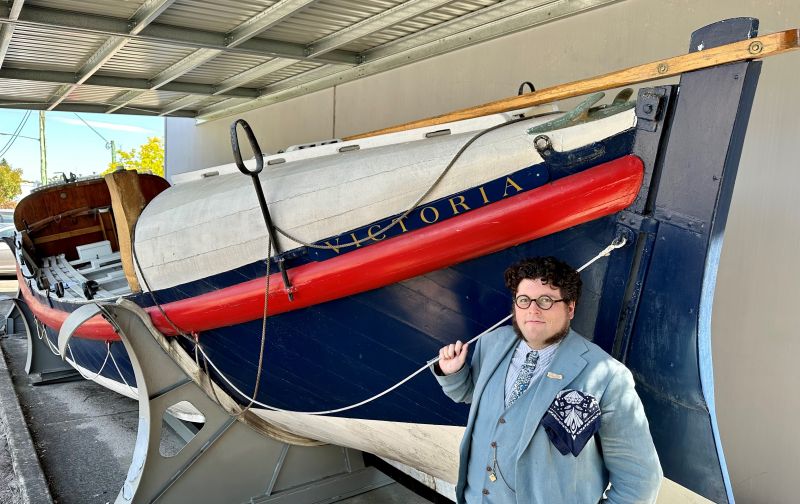
Newcastle Museum Manager Collections and Community Partnerships, David Hampton with the Victoria lifeboat, which will undergo restoration work next year.

Newcastle Museum Manager Collections and Community Partnerships, David Hampton, said the Victoria is a central and significant artifact from Newcastle’s maritime history used between 1897 and 1946 to enact some of our harbour’s most daring rescue missions.

“Newcastle Museum plays an important role in interpreting and preserving our city’s fascinating history and telling local stories,” Mr Hampton said.

“For almost half a century, the Victoria and its brave crew contested the turbulent waters in what was at the time one of the most dangerous harbours in the world to come to the aid of ships off Newcastle’s coast.

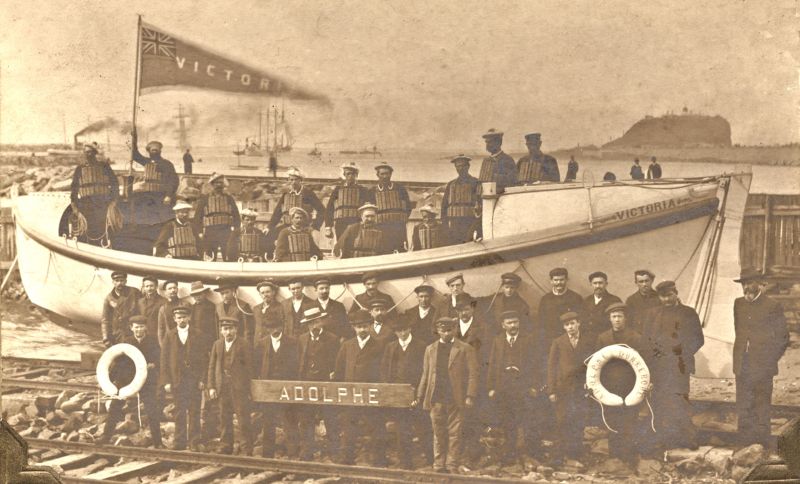
“This included the dramatic rescue of 32 men on board the stricken French sailing ship Adolphe, which ran aground on the harbour’s notorious Oyster Bank sand shoals in September 1904.

“Despite the huge swells, the heavily laden rescue vessel carried 47 people to safety including the lifeboat’s own crew, who were hailed as heroes and rewarded with a purse of sovereigns from the Consul-General for France, who made a special visit to Newcastle to thank them.”

Members of the Adolphe crew rescued by the Victoria lifeboat in 1904. Photo credit: Newcastle & Hunter District Historical Society Collection, Special Collections, University of Newcastle (Australia)

The Victoria’s final mission occurred on 23 July 1921 when the lifeboat crew battled gale-force conditions in Stockton Bight for 15 hours to rescue crewmen from the struggling steamer CENTURY.

Although the crew stayed on-call for many years after this event, the Victoria never again went to sea. The Lifeboat Service was disbanded in 1946.

The historic vessel has formed part of various heritage collections since being officially retired from service and was among several significant objects from the Newcastle Maritime Museum Society Collection transferred into the care of Newcastle Museum earlier this year.

Future conservation plans for the lifeboat include the construction of a new stillage (support structure), repainting and restoration works that will allow the vessel to form part of a future public display at the Museum.

70,000 new homes to be unlocked

The NSW Government will further boost housing supply by unlocking an extra 70 000 new homes across NSW, under the $73.5 million Rezoning Pathways Program.
 
Premier Dominic Perrottet said the Government will initiate 10 land rezonings, the majority in Western Sydney, to pave the way for these 70 000 new homes.
 
“Working with councils, rezoning is one important lever that we are pulling to get the ball rolling on more housing supply across our state,” Mr Perrottet said.
 
“We are throwing everything at getting more houses built so more people get keys in doors and can realise their dream of owning a home.
 
“We are focusing our efforts on some of the fastest growing areas in Western Sydney to help more families get into homes sooner.”
 
Minister for Planning and Minister for Homes Anthony Roberts said the Rezoning Pathways Program is part of the Government’s $2.8 billion Housing Package.
 
“We’re creating a pipeline for tens of thousands more homes, giving more people in NSW the opportunity to put a roof over their heads,” Mr Roberts said.
 
“This is all about accelerating the rezoning of key housing areas to make more land development-ready for new homes.”
 
Under the program, the NSW Government will assess select State or regionally significant planning proposals, or lead the rezoning work from start to finish, with all land to be rezoned by 2024.
 
Mr Roberts said the program includes a pilot process for proponents proposing more than 1,000 homes in metropolitan areas or over 300 in regional areas that could be assessed by the NSW Government.
 
“We want projects that can make a difference to our housing supply quickly, which is why we are seeking nominations for proposals that are well advanced with a planning proposal able to be submitted within two months, Mr Roberts said.
 
 
The NSW Government will lead the work to unlock new homes in:

  • Broadmeadow, Newcastle;
  • Camellia-Rosehill;
  • Explorer Street, Eveleigh;
  • Macquarie Park Stage 1;
  • Orchard Hills;
  • Parramatta North’s University and Northern sites; and
  • Riverstone East Stage 3.

The NSW Government will also be responsible for assessing planning proposals that could pave the way for new housing in:

  • Appin;
  • Gilead; and
  • North Appin.

 
For more information, visit www.planning.nsw.gov.au/rezoning-pathways

Have your say on knives, firearms and other weapon offences review

The NSW Sentencing Council is calling for early feedback as part of its comprehensive review of sentencing for firearms, knives and other weapon offences in NSW.
 
Attorney General Mark Speakman said the feedback will help determine the scope and the direction of the review.
 
“The NSW Government is committed to keeping our community safe and to ensuring our laws and legal system continue to best promote access to, and the administration of justice,” Mr Speakman said.
“We want to ensure that sentencing laws in relation to crimes of this nature remain in line with community expectations. We also want law enforcement agencies to continue to have access to the tools they need to keep our community safe.
 
“This is the first time that a comprehensive review of weapons offences will be undertaken by the Sentencing Council. A limited review of firearms offences was last undertaken by the Council in 2004, and some knife offences have never been reviewed.
 
“I encourage community members and justice stakeholders to have their say about the issues they would like to see included in this review.”
 
Mr Speakman said preliminary submissions should raise issues that are relevant to the terms of reference. The preliminary submissions are due by 3 March 2023.
 
The independent review and terms of reference were announced by the Attorney General on 7 November 2022.
 
Terms of reference
 
Under the terms of reference, the Sentencing Council has been asked to conduct a review of sentencing for firearms, knives and other weapons offences, including but not limited to offences in the Crimes Act 1900 and Summary Offences Act 1988, and make any recommendations for reform that it considers appropriate.
 
 
In undertaking this review, the Sentencing Council should:
 

  • provide sentencing statistics for convictions and penalty notices (where relevant) over a five-year period;
  • provide information on the characteristics of offenders, sentence type and length;
  • provide background information, including:
    • the key sentencing principles and reasoning employed by sentencing judges;
    • the mitigating subjective features of offenders; and
    • any other significant factors considered in sentencing decisions that explain how courts come to their final decision on sentence (which may be done using case-studies or collation of predominate themes across cases);
  • consider whether the standard non parole periods where identified remain appropriate;
  • consider whether offences for which penalty notices are available remain appropriate;
  • consider whether the maximum penalties for the offences are appropriate with reference to other jurisdictions;
  • consider whether any existing summary offences should be made indictable offences;
  • consider any other matter the Council considers relevant.

 
Preliminary submissions should be emailed to sentencingcouncil@justice.nsw.gov.au.
 
More information on the review can be found on the NSW Sentencing Council website.

Callan Park revitalisation up and running

The NSW Government’s record investment in Callan Park has received a major boost, with an additional $6.5 million committed to revitalising the inner west park, taking the total budget to $20.5 million.
 
Minister for Infrastructure, Cities and Active Transport Rob Stokes broke ground on the waterfront revitalisation project, which will see more green open space, new picnic facilities and amenities, revamped sporting facilities, enhanced heritage connections and an upgrade to the Bay Run.
 
“Callan Park is a green oasis and a heritage gem overlooking the beautiful Iron Cove and these works, led by Greater Sydney Parklands, will ensure it can be enjoyed by many more people for generations to come,” Mr Stokes said.
 
“Intrusive buildings with no historic value have been removed to create the Waterfront Green, and we’re upgrading the heritage-listed 497 building, giving the Balmain & District Football Club a long-term home for their 3,000 registered players.
 
“This will also help us achieve our vision of a safe and separated CBD to Parramatta walk, completing the missing link of the Bay Run with a much wider and safer path for the 50,000 walkers, joggers and bike riders that use it every week.”
 
Member for Balmain Jamie Parker acknowledge the long-standing advocacy of the community and local sporting clubs and welcomed the additional government funding commitment to the historic public space.
 
“Callan Park is cherished for its history, heritage, and strong connection to Country for our First Nations people. The upgrade of the waterfront has been driven by the community and will ensure the best possible use of the space with a greater experience for all users of the park,” Mr Parker said.
 
Balmain & District Football Club president Paul Avery said a $1.8 million grant from the NSW Government’s Multi-Sport Community Facility Fund was a major win.
 
“We’re the biggest community football club in NSW and this grant, alongside the extensive works at Callan Park, will allow generations of local juniors to play the world game at one of Sydney’s best public parks,” Mr Avery said.
 
Callan Park will receive $6.5 million in addition to the $14 million original investment to deliver further upgrades in the Park including:

  • $1.7 million for a new publically accessible toilet block along the waterfront, a first for people with disability users of the Bay Run.
  • $1.8 million for adaptive re-use of the heritage-listed Building 497, providing a long-term home for the Balmain & District Football Club.
  • $3 million to build a separated walking and cycling path between King George Oval and Waterfront Green which is currently the missing link of the Bay Run.
  • The provision of a temporary replacement carpark closely located to Waterfront Sports field by recycling a hardstand paving

 
Waterfront Green is expected to be complete by December 2023, while work on the Bay Run is expected to begin in the first half of next year.
 
To view the plans for the Callan Park waterfront revitalisation, visit: https://www.environment.nsw.gov.au/topics/parks-reserves-and-protected-areas/park-management/callan-park/waterfront-revitalisation

Easing the burden on school parents

School parents are getting a helping hand from the Perrottet Government with the cost of vacation care, thanks to the $500 Before and After School Care (BASC) vouchers.

Liberal candidate for Coogee, Dr Kylie von Muenster, welcomed this support for local families ahead of summer school holidays.

Families with children aged 4 to 13 that attend primary school, including children starting kindergarten in 2023, can access the vouchers to reduce the out-of-pocket costs of before and after school.

“As a mum of three I know how stressful this time of the year can be, and the current pressures on family budgets of rising interest rates and increasing costs is really affecting people.

“I was particularly excited to have the Premier and ministers in Coogee to highlight some of the great providers that we have locally,” said Dr von Muenster.

“I urge families to make the most of this opportunity by using the Service NSW search tool to find one that’s near you.”

“There are more than 70 rebates and vouchers that the Perrottet Government has delivered for our community, and if elected I will be a strong voice for Coogee in the Government advocating for continued strong focus on supporting our community.”

Premier Dominic Perrottet said the BASC vouchers are a huge success, supporting NSW families to juggle work and family responsibilities.

“We know the Before and After School Care vouchers help to ease hip pocket pressure and give parents and carers the flexibility they need around work commitments.

“I encourage parents who haven’t already to download and redeem a BASC voucher before the summer holidays are over to help cover the cost of vacation care.”

Minister for Education and Early Learning Sarah Mitchell said parents should download and redeem the $500 vouchers available to them.

“Every family with a child going into Kindergarten in 2023 can now download their voucher until 31 January 2023 if they have not yet done so. These vouchers support students in getting quality before and after school care, but also allows parents to have more money back in their household budgets.”

The Before and After School Voucher Program is delivered in partnership with Service NSW. Minister for Customer Service and Digital Government, Victor Dominello said BASC vouchers will be available to download from 5 December 2022 until 31 January 2023 by parents and carers.

They must be redeemed by 31 January but can be used for services up to 30 June 2023. Customers can register and apply online via a MyService NSW account, in the app, or by visiting their nearest Service Centre.

To apply or find out more information about BASC vouchers, visit: https://www.service.nsw.gov.au/basc-voucher. 

Mulgoa Road upgrade motoring ahead

A major upgrade of Mulgoa Road is motoring ahead with the contract awarded to Seymour Whyte Constructions and Turnbull Engineering.
 
Minister for Metropolitan Roads Natalie Ward said the milestone would allow work to begin between Jeanette Street and Blaikie Road at Jamisontown.
 
“Mulgoa Road is already one of Western Sydney’s key arterial routes with 52,000 car movements every day, which is why we’re making these important upgrades to ensure it keeps pace with the region’s growth,” Mrs Ward said.
 
“This is yet another example of the Perrottet Government delivering on its vision for a brighter future for people right across NSW and building the world-class infrastructure they deserve.”
 
Member for Penrith Stuart Ayres said the upgrade would support the future economic growth of the region through an improved connection to the M4 Motorway and increased productivity.
 
“Mulgoa Road will be widened from two to three lanes in either direction which will ease congestion along with upgraded intersections, including at the M4 Motorway,” Mr Ayres said.
 
“I’m excited to see early works begin with the appointment of a contractor, ahead of major work next year.”
 
Member for Mulgoa Tanya Davies said the entire community would benefit from the project.
 
“In addition the upgrade will include bus priority works around intersections, new landscaping, upgraded paths and a noise barrier,” Ms Davies said.
 
“Three sections of Mulgoa Road are also progressing to a final design; around 850 metres between Glenmore Parkway and Jeanette Street, about 1.2 kilometres between Blaikie Road and Jamison Road and a further kilometre between Jamison and Union Roads.”
 
The Mulgoa Road upgrade is jointly funded by the NSW and Federal Governments and is part of a wider plan to improve important connectivity across the Penrith area.
 
This project complements work the NSW Government has undertaken around the Jane Street intersection and the upgrades completed along The Northern Road.
 
For more information about the upgrade, go to https://nswroads.work/mulgoardjamisontown

New English and maths curriculum adds up to greater learning outcomes

New syllabuses released this week require a renewed focus on core skills in English and mathematics to boost learning outcomes for all students.  
 
Premier Dominic Perrottet said the changes for years 3 to 10 are significant milestones in NSW’s once-in-a-generation Curriculum Reform.
 
“It is vital that NSW students are developing strong skills in both literacy and numeracy so they can succeed in school and beyond,” Mr Perrottet said. 
 
“If our NAPLAN results have shown us anything, it’s that we need to focus on the explicit teaching of grammar, sentence structure and punctuation in high school, along with better preparation for mandatory HSC maths.
 
“Focusing on those foundational skills is key to success and there’s no better place to start that journey than at the beginning of a child’s education – in primary school.”
 
Minister for Education and Early Learning Sarah Mitchell said the new English syllabus for primary and high school builds on the reformed Kindergarten to Year 2 syllabus, released earlier this year.
 
“Our focus on phonics in those early years is a game-changer that is already delivering results,” Ms Mitchell said.
 
“The year 3 to 6 English syllabus will build on the success we are seeing in the early years with an increased emphasis on grammar, which is key to writing well.
 
“It also requires teachers to ensure students in years 3 and 4 can read fluently and decipher new words quickly. For students in years 7 to 10, they will be taught ways to interpret unfamiliar words and use grammar to express complex ideas.”
 
For the Maths syllabus, key changes include ensuring students develop stronger foundations in sequencing and reasoning.
 
“In primary school, students will now develop a deeper understanding of maths and will have the depth to master important skills before moving on to another concept,” Ms Mitchell said.
 
“In other words, students will need to not only know Pythagoras’ Theorem; they will need to be able to explain how it works in practice and why.”
 
In Years 7 to 10, a new flexible Core-Paths structure will better prepare students for Year 11 and 12 maths courses and mandatory HSC maths.
 
The NSW Education Standards Authority, who are responsible for delivering NSW Curriculum Reforms, will provide schools with support materials as they implement the new syllabuses.
 
The new syllabuses will be available for teachers to plan and prepare during 2023 and will be taught in all NSW schools from 2024.

Australian and NSW Governments sign landmark skills agreement for 120,000 fee-free TAFE and VET places

The Australian and NSW Governments have signed a landmark 12-month Skills Agreement to address the current skills shortage and deliver Fee Free TAFE and more vocational education places for the people of NSW.

The $319 million agreement will deliver a significant boost to the NSW skills and training sector.
This will provide immediate support through approximately 120,000 Fee Free TAFE and vocational education and training (VET) places in 2023.

The course list will see approximately 40,200 fee-free places in the care sector (including approximately 10,000 in the Early Childhood Education and Care sector), 9,900 in technology and digital, 6,900 in agriculture, 5,200 in construction, 5,000 in hospitality and tourism, 1,200 in sovereign capability, and 51,400 in other priority sectors including foundation skills.  

The Agreement will increase opportunities and workforce participation of priority groups, including First Nations Australians, young people (17-24), people out of work or receiving income support, unpaid carers, women undertaking study in non-traditional fields, people with disability and certain categories of visa holders.

The 12-month Skills Agreement confirms TAFE’s central role in the VET sector, increases opportunities and workforce participation of priority groups and addressing skills gaps in the economy.

Fee Free TAFE and more VET places in NSW come at a crucial time as the State works to strengthen its workforce in a range of sectors of National and State priority. 

The Agreement includes an Australian Government commitment of $1.32 million for essential VET data infrastructure reform in NSW and $7.5 million from the Australian Government’s TAFE Technology Fund to improve training facilities in NSW.

The $7.5 million commitment from the TAFE Technology Fund will upgrade essential infrastructure for training at TAFE NSW campuses. 

All Governments have also agreed to a vision and guiding principles for longer-term VET reform to commence in 2024.

Brendan O’Connor MP, Minister for Skills and Training said:

The Australian Government recognises the urgency of the skills crisis facing the nation, and the challenges particular to NSW, which is why this Agreement is so important.

If we want to provide greater opportunity in NSW for secure and rewarding employment, we must be able to skill and reskill our workforce.

Whether it’s a need to build our care sector, construction, hospitality and tourism, or technology and digital sectors, we need to deliver these skills at a time of acute skills shortages.

I’m thrilled to make this joint investment to expand opportunities for all people in NSW.

Alister Henskens SC MP, NSW Minister for Skills and Training said:

The NSW Government has invested a record $3.1 billion in the skills and training sector this financial year to help people get the skills they need for the jobs they want.  

NSW is leading the nation when it comes to skills and training and this additional $164 million investment from the Australian Government recognises our State as the economic powerhouse of the nation.

This additional investment in fee-free training places will target priority industries and help address skills and labour shortages that are hampering businesses across NSW.

I welcome the Australian Government’s investment in this space and look forward to continuing to work together to strengthen the pipeline of skilled workers in NSW.  

$15.2 million for defence, space and smart sensing Research & Development projects

NSW is turbocharging the development of its sovereign industrial capability in critical industries like defence, aerospace and manufacturing through a $15.2 million NSW Government investment in its Research Networks.
 
Minister for Science, Innovation and Technology Alister Henskens said this year’s funding plus a three-year extension for the NSW Smart Sensing Network (NSSN), the NSW Defence Innovation Network (DIN) and the NSW Space Research Network (SRN) provides more opportunities to turn ideas into real-world solutions, jobs and new industries.
 
“We are investing in our human capital to help our innovative researchers unlock their potential and turn their ideas into solutions that will grow the economy and secure a brighter future for the people of NSW,” Mr Henskens said.
 
“The defence and aerospace industry, including the space industry, and smart sensing technologies will be critical to our nation’s prosperity and NSW is best placed to lead the way when it comes to innovation and commercialisation of research in these areas.
 
“Our Research Networks foster collaboration between government, academics and industry to find solutions to some of the most complex challenges we face.”
 
Through the NSW Government’s commitment, the DIN is providing $450,000 in funding to support three defence innovation projects in its Pilot Project grant scheme:
 

  • The University of Wollongong, Western Sydney University and NSW companies BlueZone Group and Vyom Tech will develop a prototype system to assess military diver health
  • Western Sydney University, in partnership with The University of Sydney and Australian company AU Cloud, are examining how to fuse data sources and distribute data processing across a constellation of satellites, and
  • The University of Sydney and University of Technology Sydney will deliver a system for monitoring the structural health of autonomous air vehicles.

 
Defence and Aerospace NSW contributed $3.2 million of the total funding towards the DIN and SRN. Director Mike Gallagher said the funding would increase NSW defence capabilities across all domains.
 
“DIN is a key enabler for our sector that ensures that NSW remains at the forefront of delivering the high-tech capability to the Australian Defence Force,” Mr Gallagher said.