
Next stop for Central Station restoration

Plans for the Sydney Terminal Building revitalisation are now open for public feedback, detailing the proposal for customer and community experience improvements, heritage restoration and new retail, dining and events spaces. 

The plans will transform hidden spaces such as the storeroom and loading dock into a multi-purpose event space and thriving marketplace, connecting previously inaccessible areas and creating a world class transport interchange.

Minister for Infrastructure Rob Stokes said the Environmental Impact Statement (EIS) now on public exhibition reflects early feedback about the need to improve wayfinding and accessibility, retail offerings and heritage restoration.

“Central Station is Sydney’s gateway to the regions. The magnificent colonnade and clocktower are a centerpiece of our state to be celebrated,” Mr Stokes said.

“The sandstone walls of the Sydney Terminal Building have witnessed so many moments of Australian history, great and small.  So many farewells and reunions that have formed the collective memory of NSW.

“Heritage enhancements come with modernisation, introducing Wi-Fi connectivity, charging points for commuters and a brand new event space for live music, public art and pop-up events.”

The EIS will outline the proposed renewal of the Sydney Terminal Building, including the loading dock, Grand Concourse, Booking Hall and the Central Electric Building.

In addition to the creation of new social spaces for the community, the revitalisation will also prioritise new and improved pedestrian connections including new lifts, stairs and escalators to provide convenient and direct pedestrian connectivity.

The community will be able to provide feedback from February 8 to March 8 2023 which will inform a decision by the Minister for Planning on the project. If approved, construction could start this year and would take around three years to complete.  To have your say on the Sydney Terminal Building EIS go to: www.planningportal.nsw.gov.au/major-projects/projects/sydney-terminal-building-revitalisation
New infrastructure to accelerate 140,000 homes

The NSW Liberal and Nationals Government is investing $250 million into essential infrastructure across the state to support the delivery of close to 140,000 new homes. 

This funding will deliver new cycleways and active transport options in Parramatta and Ryde, road and bridge improvements in regional NSW, and sewerage upgrades on the Central Coast to enable more homes needed to cater for growing communities.

Premier Dominic Perrottet said an initial 36 councils and agency-led projects will receive funding through the third round of the Accelerated Infrastructure Fund (AIF).

“We are fast-tracking the delivery of essential infrastructure required to speed up the construction of thousands of new homes right across our state,” Mr Perrottet said. 

“This is part of our strategy to get people into homes faster by cutting red tape, speeding up development applications and boosting construction by getting more shovels into the ground sooner.

“Our long term economic plan is delivering major infrastructure projects for the future and will support communities as they grow.”

Deputy Premier and Minister for Regional NSW Paul Toole said the new funding builds on a $215 million investment from the Government in the first two rounds of the program, with eligibility extended to regional councils for the first time.

“We know that getting infrastructure right is the key to unlocking land for housing in regional NSW, which is why we have allocated almost $120 million for regional councils in this round, including fast growing areas in the Central West and the Mid-North Coast,” Mr Toole said.

“The areas eligible for this funding account for 94 per cent of NSW’s total population growth over the next 10 years, according to the latest population projections.

“Towns across regional NSW are booming, with more and more people moving away from the city. These projects will help set the foundations for future growth.”

Minister for Planning and Minister for Homes Anthony Roberts said the councils successful in this round of the AIF will also provide their own funding for projects, amounting to a combined $517 million worth of infrastructure on the way for NSW. 

“We had an outstanding response from regional councils eager to work in partnership with the NSW Liberal and Nationals Government to unlock land for new homes faster and boost economic growth. We share their ambition and look forward to working together,” Mr Roberts said. 

The Accelerated Infrastructure Fund is part of the $2.8 billion NSW Housing Package, announced in the 2022-2023 NSW State Budget.

For further details and the complete list of projects visit the AIF webpage here.

Delivering road safety for Randwick pedestrians

Liberal candidate for Coogee, Dr Kylie von Muenster, has been campaigning for pedestrian safety in Randwick, and has welcomed the Perrottet Government’s decision to install new signage near two bus stops on Avoca Street.

Following a review of road safety on Avoca Street near Bundock Street and Sturt Street, two pedestrian warning signs will be put in place in Bundock Street and one on the approach to Sturt Street, to warn motorists of foot traffic in the area.

“We care about the safety of every person using our roads, whether motorists or pedestrians or cyclists, and have always been prepared to invest in keeping our community safe,” Dr von Muenster said.

“With three schools nearby – Rainbow Street Public School, Randwick Girls’ High and Randwick Boys’ High – there is often increased foot traffic on Avoca Street so it’s imperative motorists heed the soon-to-be installed pedestrian warnings signs and slow down in this area.

“We encourage motorists to be extra vigilant in all zones where there’s pedestrian movement, particularly around schools, shops and bus stops.

“The Perrottet Government will continue to look at ways to improve our local roads so that all users can keep moving forward safely and confidently.”

The two pedestrian warning signs are expected to be installed by the end of February.

FINDINGS RELEASED ON NEWCASTLE LIQUOR TRIAL

Proposals to relax liquor licence conditions for Newcastle hotels, bars and nightclubs will be considered on a case-by-case basis following the release of findings from a major trial examining options for boosting the city’s nightlife. 

Independent Liquor & Gaming Authority (ILGA) Chairperson Caroline Lamb said a wide range of data and community and stakeholder views have been taken on board from stage two of the trial, which involved 21 venues. 

“The evaluation report includes feedback from Newcastle venues, residents, and various stakeholders as well as patronage, noise complaints and alcohol-related offence data,” Ms Lamb said.

“After carefully considering the findings, ILGA has resolved that the trial conditions should continue for participating venues until 30 June to give them time to apply for changes to liquor licences.

“Because there were wide variations in levels of alcohol-related offences among the 21 venues in the trial, it’s vital that any proposals to relax conditions are considered individually, with a strong focus on compliance, safety and avoiding any unacceptable risks to the community.”

Key findings from the evaluation report include:

  • The majority of participating venues indicated that the relaxed licensing conditions positively impacted their patronage, business turnover and employment opportunities 
  • There was a 40 per cent increase in total spending on dining and entertainment across the whole Newcastle LGA compared to 2019, the most recent year not impacted by COVID restrictions.
  • While there was an overall rise  in the number of assaults and incidents of affray at the participating venues during the trial compared to previous years, the  majority of venues recorded no increases.  Compared to 2008 when the conditions were imposed, there has been significant declines in levels of offences across all venues.  

The first stage of the trial was undertaken from October 2020 to March 2021 and involved extended trading hours and removal of drink restrictions after 10pm for restaurants and small bars.

The stage two trial involved hotels, bars and nightclubs and included:

  • Removal of 1am and 1:30am lockout restrictions;
  • Extension of liquor trading hours until 3.30am on any night venues are normally authorised to sell liquor until at least 2.30am; and
  • Easing of restrictions on the types of drinks that may be served, allowing higher strength cocktails, neat spirits and shooters.

The evaluation report for stage two of the trial is available here: https://www.liquorandgaming.nsw.gov.au/__data/assets/pdf_file/0008/1124765/newcastle-liquor-licensing-trial-stage-2-evaluation-report.pdf  

ENDORSEMENT OF DRAFT BEHAVIOUR CODES A TURNING POINT

Australian Greens Deputy Leader, Senator Mehreen Faruqi, has said that today’s parliamentary endorsement of Behaviour Standards and Codes is a step forward in ensuring parliament is a safer, more respectful workplace that rejects discrimination. 

Senator Faruqi is a member of the Joint Select Committee on Parliamentary Standards, which developed the Behaviour Standards and Codes and reported in November 2022.

Senator Faruqi said:

“I’m optimistic that this is a turning point for making parliament a safer, more respectful workplace that rejects discrimination. 

“The codes will set an expectation of how we behave here. How this place changes for the better will depend on our commitment to changing culture. We must keep an eye on each other and call out unacceptable behaviour whenever and wherever it happens.

“The new codes explicitly prohibit discrimination on grounds that marginalise First Nations people, people of colour, disabled people and LGBTQI+ communities.  There is now recognition that this is unacceptable – and that perpetrators will face consequences for their actions.

“I urge the government to quickly set up the investigative and enforcement mechanisms to give the codes power to make the change so desperately needed and to hold us accountable.

“The mandatory training recommended by the parliamentary standards committee, including on anti-racism, disability discrimination and First Nations cultural awareness, is crucial for challenging entrenched privilege and power. This work should be prioritised as well.”

Disaster Assistance Response Team for Türkiye

The Australian Government is working to provide a Disaster Assistance Response Team (DART) to Türkiye to support local authorities with search and rescue efforts.

Foreign Minister Penny Wong has activated an AUSASSISTPLAN to deploy an Urban Search and Rescue team of up to 72 personnel to Türkiye to assist local authorities.

Our National Emergency Management Agency, or NEMA, is working closely with Fire and Rescue NSW, DFAT and the ADF to coordinate the deployment as soon as possible, with an aim to have boots on the ground by the end of the week.

These Urban Search and Rescue specialists are highly trained to locate, deliver medical assistance to, and remove victims who have been trapped or impacted by a structural collapse.

We wish to thank the personnel and their families in advance, for their willingness to support this important international effort with such short notice.

The Australian Government will continue to monitor the situation as it unfolds and assess further needs and where Australia can best assist.

We extend Australia’s condolences to families and communities that have lost loved ones, and those whose lives and livelihoods have been affected.

Australians in need of emergency consular assistance should contact the Australian Government 24-hour Consular Emergency Centre on 1300 555 135 in Australia or +61 2 6261 3305 outside Australia.

Darby Street trial creates record trade boom for local businesses

A City of Newcastle trial to extend outdoor dining options and improve pedestrian and cyclist safety along Darby Street has resulted in a trading boom for local businesses.

Economic data from October to December 2022 shows that Darby Street as a whole achieved its highest ever trading revenue levels, which occurred during the first three months of CN’s six-month trial of streetscape improvements under the NSW Government’s Streets as Shared Spaces initiative.

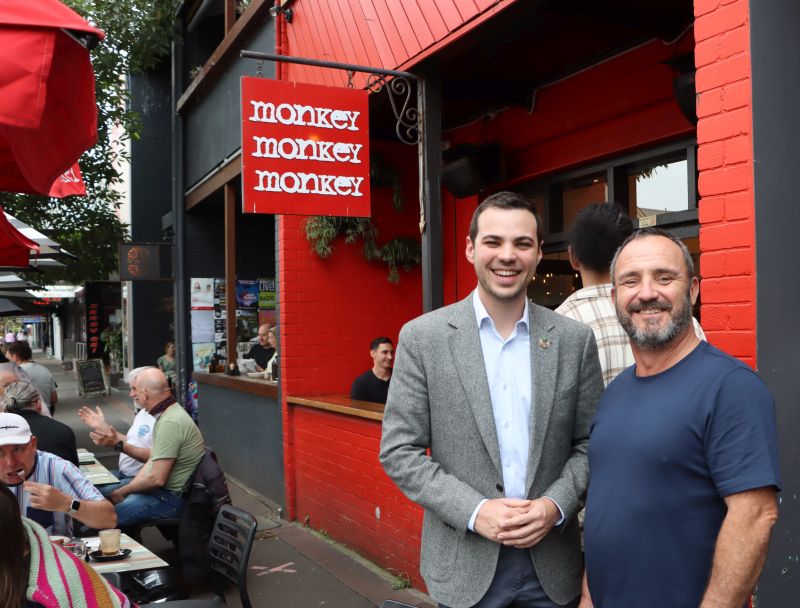
Deputy Lord Mayor Declan Clausen with Darby Street Three Monkeys Café owner Ant Strachan.

The trial, which included the installation of a temporary raised outdoor dining area, as well as a relocatable “mini deck” outdoor dining, and traffic calming measures to reduce motorist speed and improve safety and accessibility for pedestrians and cyclists, was designed to encourage increased visitation and trade along Darby Street.

Newcastle Lord Mayor Nuatali Nelmes said economic data show a 17% increase in sales revenue along Darby Street during the trial period compared to the previous three months (July to September 2022). This was 5.2 per cent higher than the average sales revenue growth experienced anywhere else in Newcastle during the same period.

“Even accounting for the normal December trading spike, Darby Street has fared well during this period, with sales levels also up 9.2 per cent compared to the same period last year,” Cr Nelmes said.

“What was really pleasing to see was 47% of the total sales over the Christmas period were attributed to customers who don’t live in Newcastle.”

Pedestrian and cyclist traffic also reported an increase to the area, on average up 18% and 13% respectively.

City of Newcastle has just wrapped up two days of consultation with businesses along Darby Street, as they near the end of the six-month trial.

Co-Owner of Three Monkeys café on Darby Street, Anthony Strachan said the trial has been a positive step towards bringing people back into the precinct.

“For us the dining deck has been a fantastic success, it’s one of the first places people want to sit when they come in,” Mr Strachan said.

“I think the trial has been great to bring in more tourists and create a more pedestrian friendly space. I would however like to see some of this work continued along the rest of the street, to create a longer-term beautification of the precinct.”

Deputy Lord Mayor Declan Clausen said there was an overall positive sentiment towards the trial.

“To date, our online survey has been completed by 280 people, with 67% in favour of keeping the trial infrastructure, which includes the wooden dining deck, traffic calming and the pedestrian crossing adjacent to the headphones courtyard,” Cr Clausen said.

“During the trial we also heard that parking on Darby Street was a concern to businesses. We responded by converting over 30 all-day paid parking spaces into free two-hour parking, and we’re now looking at further innovative approaches to assist with the ongoing monitoring of parking in the area.

“The trial forms a first step toward a possible upgrade to Darby Street. We will also apply what we’ve learned from the trial to commercial areas across Newcastle LGA as part of our popular Local Centre Upgrade program.”

The outcomes of the Darby Street trial, including the results of community consultation and data analysis, will be presented to Councillors, for the potential retention of infrastructure installed for the trial.

Community engagement on the trial is open until 28 February 2023, to submit an online feedback form, visit www.newcastle.nsw.gov.au/Have-Your-Say/Darby-SaSS.

The trial has been made possible with a $500,000 grant from the NSW Government through the Streets as Shared Spaces program (Round 2) and funding from the City of Newcastle Urban Centres Program.

City welcomes Labor pledge for Stockton Beach

City of Newcastle has welcomed today’s announcement by Labor leader Chris Minns that NSW Labor will commit $21 million needed from the State Government for mass sand nourishment at Stockton if it wins the upcoming March election.

Newcastle Lord Mayor Nuatali Nelmes said this announcement was a positive and significant step towards achieving mass sand nourishment at Stockton Beach.

“This announcement demonstrates the commitment of a NSW Labor Government to resolving ongoing erosion issues caused by the Stockton breakwater, which is owned by the NSW Government,” Cr Nelmes said.

“Mass sand nourishment is the outcome preferred by the community and endorsed through the 2020 Coastal Management Program. This is the most significant commitment yet towards that outcome.”

In October 2022, the NSW Government was successful in obtaining a $6.2 million grant through the Coastal and Estuarine Risk Mitigation Program, which includes $4.7 million from the Federal Government and $1.5 million from the City of Newcastle.

City of Newcastle’s Executive Director Planning and Environment Michelle Bisson said mass sand nourishment remained the long-term solution to protecting the State Government owned Stockton Beach.

“The long-term plan is to secure the 2.4 million cubic metres of sand needed for initial mass nourishment, as outlined in the Stockton Coastal Management Program endorsed by the NSW Government in 2020,” Ms Bisson said.

Council committed $27.5 million to respond to the immediate risks to Stockton’s coastline in the 2020 Coastal Management Program with $9.5 million already invested. A further $21 million is needed from the State Government to fund the long-term solution of mass sand nourishment.

Last year City of Newcastle progressed the design work for sand placement and anticipate having the associated environmental approvals finalised over the next few months. The new placement plans are informed by the most recent sand movement study and will ensure that sand sourced for Stockton is placed in the most effective location.

More Paediatric Palliative Care Services for NSW

Children with life limiting conditions and their families will benefit from a $16 million funding boost to enhance paediatric palliative care respite and hospice services.

Premier Dominic Perrottet said the new services will complement those already provided by Bear Cottage and at the children’s hospitals in Sydney and Newcastle.

“Few of us could ever imagine the extraordinary courage and resilience needed to support a much-loved child as they progress through their illness,” Mr Perrottet said.

“I am absolutely committed to ensuring we improve the quality of life of these kids and their families, whether the care is being provided at home, in a hospital or a hospice.”

The additional enhancement brings the total funding for palliative care from the NSW Liberal and Nationals Government to more than $2.2 billion over the next five years.

Treasurer Matt Kean said the funding would help provide vital care closer to home.

“Parents going through such inconceivable sadness deserve our support to ensure they can receive respite and assistance when they need it most,” Mr Kean said.

Paediatric palliative care aims to improve quality of life of children with a life-limiting illness as they head towards the end of life. It can include the prevention and relief from pain and other symptoms.

Health Minister Brad Hazzard said those caring for children with life limiting conditions face the most challenging situation imaginable and need our every support.

“Families often choose to care for their loved ones at home but many children have complex medical and nursing needs which make that task difficult,” Mr Hazzard said.

“By further enhancing paediatric palliative and end of life care services, we are giving more families support and access to the care they need in a home-like environment.”

NSW Health will work with stakeholders including families and carers, relevant non-government organisations and paediatric palliative care clinicians to identify and fund appropriate services, ensuring the best outcomes for children and their families.

These services may include, but are not limited to, providing dedicated end of life care space for children and their families in children’s hospitals and the provision of additional respite care capacity and support services.

$632 million Campbelltown Hospital Emergency Department triples in size

The new $632 million Campbelltown Hospital –  with an emergency department that has tripled in size – has had 33,000 emergency presentations and over 950 babies born since opening last year.

Premier Dominic Perrottet, joined by Health Minister Brad Hazzard, Member for Camden Peter Sidgreaves and Member for Wollondilly Nathaniel Smith, today officially opened the clinical services building, the centrepiece of the $632 million Stage 2 redevelopment.

“The NSW Government is delivering major projects across South-West and Western Sydney to make these communities an even better place to live, work, play and raise a family,” Mr Perrottet said.

“It has been wonderful to see this amazing project progress to a modern facility, enabling our dedicated frontline staff to deliver high-quality care to the people of Macarthur.” 

Mr Hazzard said the $632 million investment is on top of the $134 million Stage 1 redevelopment of Campbelltown Hospital and the new $34 million hospital car park.

“No matter whether you look north, south, east or west, the NSW Liberals and Nationals Government is delivering more hospitals and health facilities across the State than any other NSW Government in history,” Mr Hazzard said.

“This magnificent new $632 million clinical tower will help future proof local health services for years to come to accommodate the growing population of Macarthur.”

Mr Sidgreaves said the new tower includes a new maternity unit, increased medical and surgical services, expanded children’s services and integrated mental health services.

“The record investment in our health system ensures people from within the Macarthur region have access to the healthcare they need, close to home,” Mr Sidgreaves said.

“The state-of-the-art building will service the more than 130,000 new residents expected to call the Macarthur Region home over the next decade.”

Mr Smith said over the past three years, some 4,000 workers were employed to support construction for the $632 million Stage 2 redevelopment.

“This new hospital is a major boost to the local economy and jobs. It is an extraordinary achievement to support our health staff and patients,” Mr Smith said.

Since commissioning of the new building, staff have performed more than 1,500 surgical procedures and cared for more than 780 inpatients through its new children’s unit.

The redevelopment is on track for overall completion in late 2023, with works commencing on the first nuclear medicine department, an expanded medical imaging department and an additional entrance.

The new 12-storey clinical services building includes:

·       New state-of-the-art digital operating theatres and procedure rooms;

·       Double the ICU bed capacity in the future;

·       Almost double the number of maternity beds (as well as an almost 60 per cent increase in the special care nursery and 50 per cent increase in birthing suites);

·       New and expanded surgical services, including interventional radiology; and

·       Significantly expanded mental health services, including a specialised older people’s unit and civil secure unit for adults.

Former buildings have already received a range of refurbishment works, including significant expansion of the hospital’s Pathology Laboratory, Pharmacy, Clinical Information Department (medical records), and for the first time a new Dental Centre.

The works also include landscaping and a range of enhancements to Cancer Therapy Centre, staff administration areas, overnight stay rooms and a dedicated area for Junior Medical Officers.

The NSW Government is investing a record $11.9 billion in health infrastructure to 2025-26. More than 180 hospitals and health facilities have been built since 2011, with a further 130 currently underway.