SENATOR MEHREEN FARUQI’S STATEMENT ON SENATOR PAULINE HANSON

“The Senate has rightly forced Senator Hanson to withdraw her unacceptable racist comments and held her to account for once.

“This should send a strong message to Senator Hanson that she cannot continue to make this parliament an unsafe workplace for people like me day in, day out.

“Senator Hanson’s racist bile is extremely damaging and also unleashes vile hate and abuse from bigots. It must be nipped in the bud.

“If Parliament is to be a safe workplace, then it needs to set a standard that any form of bigotry and racism are unacceptable. Racist hatred should never be tolerated in any workplace, let alone one that is supposed to lead the way in standards of behaviour.

“People who look like me have all been told to ‘go back to where they come from’ at one point or another, and it is harmful and unacceptable every single time. I’ve copped it more times than I can count, and so have many others in the community. Enough is enough!

“The government needs to stop dragging the chain on Parliamentary behaviour codes and implement the codes and the consequences for breaching these without delay.”

REPORT FOR THE INQUIRY OF DISABILITY SERVICES AND INCLUSION BILL TABLED

The Community Affairs References Committee has today tabled a report on the inquiry into the Disability Services and Inclusion Bill.

The Disability Services and Inclusion Bill seeks to repeal the Disability Services Act 1986 and provide legislative authority for new and existing spending on disability-related programs outside the National Disability Insurance Scheme.  

Australian Greens Senator Jordon Steele-John welcomes the repeal of the Disability Services Act 1986, however, has submitted additional comments to the report that indicate his intention to move significant amendments to the legislation. 

Senator Jordon Steele-John, Australian Greens Spokesperson for Disability Rights and Services said:

“This bill requires significant amendments to do justice to the implementation of the recommendations of the Royal Commission into Violence, Abuse, Neglect and Exploitation of People with Disability. 

“It is imperative that this opportunity to replace the Disability Services Act 1986 does not pass by without doing everything we can to end the cycle of segregation that too many disabled people find themselves trapped within.

“It’s time for the government to put into law timeframes for ending the cycle of segregation. Disabled people will no longer accept being kept out of view; we will not accept government policies that reinforce segregated employment and education any longer. 

“We need to ensure that the human rights of disabled people are upheld in all services that would be funded under this bill, and we need to ensure that disabled people are included in the decision-making processes.

“Many in our community welcome the establishment of a Code of Conduct, however, what I have heard from the community is there is still concern about the independence of those reviewing breaches and the process for handling complaints. 

“Getting this Act right could be transformational in the lives of disabled people.”

GUARANTEES NEEDED IN MURRAY-DARLING BASIN PLAN

Responding to the release of the Senate inquiry report into the Water Amendment (Restoring Our Rivers) Bill 2023, Senator Hanson-Young, Greens spokesperson for the Environment and Water said:

“This Bill should not pass in its current form.

 “Extending deadlines for water recovery will just kick the can down the road. After a decade of inaction, there must be a guarantee in this Bill that will ensure the Plan will be delivered in full and on time, including the 450GL promised to South Australia and the environment.

“Without a guarantee of real water delivery, the Basin will continue to see more fish kills, species decline and degradation of ecosystems.

 “We can’t eat cotton, we can’t drink mud. There are no jobs on a dead river.

“As climate change gets worse and El Nino threatens a hot dry summer, it is crucial that we see water flowing before the next election.

 “The Greens will not rubber stamp this Bill. We will continue discussions with the Government in good faith. As it stands the Bill will not pass the Senate without a guarantee of environmental flows.”

WIDE SUPPORT FOR CANNABIS LEGALISATION IN SENATE SUBMISSIONS

There is strong support from more than a dozen key stakeholders across the country for the Greens plan to legalise cannabis. The support comes from organisations as diverse as the Pennington Institute, National Drug and Alcohol Research Centre, Families and Friends for Drug Law Reform, Australian Lawyers Alliance, Drive Change and Harm Reduction Australia.

Of course there is opposition from groups that have opposed serious drug law reform for decades, including some police unions. Other bodies such as the AMA have taken a surprising approach to cannabis legalisation that is inconsistent with recent previous statements on drug law reform.

This level of constructive engagement with the Greens’ plan to legalise cannabis nationally will almost certainly produce a highly engaged senate inquiry that will be a critical step on the way to reform. 

Greens Senator and Justice Spokesperson David Shoebridge said:

“The Greens welcome the strong support for the Legalising Cannabis Bill from so many key stakeholders across the country. 

“The level of engagement with our proposal to legalise cannabis is a strong indication of just how much support there is for this Bill across Australia.

“Many stakeholders acknowledged the obvious fact that an illegal market for cannabis already exists in Australia and that illegal market causes harms ranging from criminalisation to poor public health outcomes.

“A legal market immediately reduces harm to almost 60,000 people every year who will no longer get dragged into the criminal justice system for the crime of cannabis possession.

“Of course there is traditional opposition from vested interests who benefit from criminalisation including some police bodies and some existing commercial players. This is to be expected with any serious reform.

“The Greens welcome the constructive engagement from so many organisations looking for ways to improve the Bill and improve the public health and public interest outcomes that flow from cannabis legalisation.

“It is disappointing to see the inconsistency in the approach to drug law reform from the AMA who, as recently as January 2023, publicly acknowledged the positive health outcomes achieved in jurisdictions such as Portugal from non-punitive approaches to drug use.”

Comments from stakeholder submissions regarding the Legalising Cannabis Bill 2023:

All Families and Friends for Drug Law Reform (ACT) Inc.
“This submission urges you to identify the “sweet spot” for cannabis. Most of the harm caused by cannabis comes from the police, courts and jails. Moving to a regulated system reduces the need to participate in the illegal production and supply of cannabis and can reduce the harm of maximum prohibition and move us to the sweet spot without going to maximum liberalisation as had occurred with other potentially addictive activities like gambling and consumption of tobacco and alcohol, where commercial interests profit from promoting harmful patterns of consumption.

“The tight complex regulatory scheme is welcome in that it would prevent the exploitative commercialisation as has existed in relation to other addictive substances like alcohol and tobacco.” 

The Australian Lawyers Alliance
“The ALA, therefore, welcomes the advent of the Legalising Cannabis Bill 2023 which represents a significant step away from Australia’s current approach modelled on criminalisation. Such an approach has shown little success in reducing illicit drug use in general.

“The ALA supports the proposal to implement legalisation in the manner proposed by the Bill, that is, through the registration and licencing of cannabis strains. Such a system allows for the growth, manufacture and distribution of cannabis to become legal and also regulated by law enforcement. On the other-hand, decriminalisation prevents the safe operation of a cannabis business.”

National Drug Research Institute, Curtin University (NDRI)
“Overall, we see the Bill to be well intended and consistent with the developing research evidence on the impact of cannabis legalisation schemes and expert advice and recommendations regarding the potential public health benefits of middle ground, rather than fully commercial profit-driven, models of cannabis legalisation. We also note the following specific elements of the Bill as beneficial and in keeping with the public health evidence: 
1. Exclusion of persons involved in the manufacture of alcohol or alcohol products, tobacco or tobacco products, or pharmaceutical products from being able to receive a licence under Section 27 or engage in activities under Section 10. 
2. Permitting cultivation of cannabis not more than 6 plants per household. 
3. Allowing small scale social supply of cannabis where the value of the cannabis is not more than $50 under Section 20 (d). 
4. Allowing for Cannabis Social Clubs under Section 27 (2) (b), a not-for-profit co-operative that is registered on a State or Territory co-operatives register. 
5. Generally appropriate conditions for location and operation of cannabis cafes under Section 30. 6. Public health consistent requirements for labelling, packaging and storage of cannabis products under Section 32.”

Pennington Institute
“Penington Institute endorses several elements of the Legalise Cannabis Bill 2023. These include the following: 
• Allowing cultivation of cannabis plants in households for personal use, although we observe that there is debate around the optimal number of plants that should be permitted per household. Canada, for instance, established a limit of four plants per household, which was found during a review to be generally satisfactory to the small proportion of people who choose to grow.8 
• The distribution of cannabis via dispensaries and dedicated cannabis cafes, including those organised as not-for-profit cooperatives. We further endorse the separation of sites offering alcohol sales and consumption from sites offering cannabis sales and consumption. 
• The proposed minimum age of 18, as well as the removal of criminal penalties for all offences committed by those under 18 years of age and for all people consuming cannabis in prohibited areas.”

Drug Policy Modelling Program UNSW
“We commend the efforts underpinning this Bill to address harms that exist within the current cannabis legislative landscape in Australia. These harms include: 
• the criminalisation of personal use/possession (Lenton & Heale, 2000; Lenton et al., 2000) 
• the reliance on fines in decriminalisation and diversion schemes (Hughes et al., 2018; see also McCarron et al., 2008) 
• uneven policing in decriminalisation and diversion schemes (Baker & Goh, 2004; Hughes et al., 2019; Taperski & Rahman, 2023; see also McCausland & Baldry, 2023) 
• unregulated supply (Armstrong, 2021; Fischer et al., 2022; Lynskey et al., 2016).

“We look forward to Australia making progress on cannabis regulation. It is an area requiring long-overdue policy reform, in light of the substantial harms of the current recreational cannabis policies across Australia.”

Harm Reduction Australia and Drive Change
“The removal of criminal sanctions for these low-level offences would help to reduce the negative impact of the current laws on individuals and their families as well as reducing the burden on law enforcement and judicial systems.

“As noted above, we are supportive of the Legalising Cannabis Bill as it presents an opportunity to divert people away from the criminal justice system, and encourage a harm minimisation approach on the use of cannabis.”

National Drug and Alcohol Research Centre
“According to the latest Criminal Intelligence Report (Australian Criminal Intelligence Commission (2023), there were 66,285 arrests across Australia in 2020/21 for consuming or providing (selling) cannabis. The vast bulk of these arrests (59,353 or 90%) were for using or possessing cannabis.”

List and links to stakeholder submissions on the Legalising Cannabis Bill:

Hilary Charlesworth re-election to the International Court of Justice

The Australian Government congratulates the Honourable Judge Hilary Charlesworth on her re-election to the International Court of Justice.

The election took place at the United Nations headquarters in New York overnight (9 November 2023, EST) to fill vacancies that will arise in February 2024.

Judge Charlesworth has served as a member of the International Court of Justice since 2021 and is a world-leading jurist, as well as the first Australian woman to serve as a Judge of the Court in its 78-year history.

The International Court of Justice plays a critical role in upholding international law and the rules-based order.

The Australian Government is confident that Judge Charlesworth will continue to draw on her exceptional expertise and act in accordance with the highest standards of independence and integrity.

These qualities are integral to the International Court of Justice in its mission to support the peaceful resolution of disputes between States.

The Australian Government sincerely thanks the outgoing judges for their service to the Court and wishes them well for the remainder of their terms.

More information about the Court can be found on the International Court of Justice website.

Labor dithers as hundreds of manufacturing jobs axed

Reports that Australian advanced manufacturer Tritium will close its Brisbane factory are devastating. The closure will result in 400 jobs being lost from the heart of Brisbane.

This failure sits squarely with the Albanese and Palaszczuk Labor Governments, destroying what little credibility Labor had left on manufacturing.

Tritium represents the very best of Australian innovation and manufacturing and is exactly the sort of Australian manufacturer we need to ensure Australia can transition to a low emission economy.

The closure of this factory is directly attributable to unaffordable energy costs and a failure of the Albanese Government to get the economic settings right for Australian manufacturers.

Time and time again Anthony Albanese used Tritium as a backdrop for his press conferences and as a totemic business to launch his manufacturing policies during the Federal Election. He even highlighted Tritium during his recent trip to Washington.

The very factory the Prime Minister used to market his politics will close thanks to his policies.

Labor’s much vaunted National Reconstruction Fund is proving useless as Aussie jobs go offshore.

With the Prime Minister overseas once again, Australians are losing their jobs, facing unaffordable mortgage repayments and a cost of living crisis.

Anthony Albanese’s failure to deliver an economic plan has led to the closure of this factory and that will hang like an albatross around the Government’s neck. Higher energy costs are sending Australian businesses to the brink and Labor does not have a plan to stop the squeeze.

While Industry Minister Ed Husic was overseas, alarm bells were ringing and now we have lost another Australian manufacturing enterprise. Factory workers in Brisbane lost their jobs while Ed Husic was focused on his next one.

Ed Husic will forever be the Industry Minister who killed Australia’s sovereign satellite industry program and instructed his Department to hide it from the White House. Now he will also be known as the Industry Minister who went missing in action while Australian factory workers lost their livelihoods.

Anthony Albanese pledged he would ‘build things in Australia’, but with hundreds of real jobs gone because of his failures, this is just another promise he has broken.

Community invited to help shape revitalisation of Georgetown local centre

Plans to enhance the village atmosphere of Georgetown’s neighbourhood shopping precinct have been placed on public exhibition as part of City of Newcastle’s Local Centres program.

A new plaza, wider footpaths, street trees and safety improvements are among the improvements proposed under the draft Public Domain Plan, which has been developed by City of Newcastle following early community consultation.

Georgetown Local Centre proposal render

The upgrade would reinforce the existing 40km/h zone to reduce driver speeds and make it easier for residents to safely navigate the area on foot following installation of new pedestrian refuges, along the busy Georgetown Road.

A new public plaza is also proposed at the intersection of Moate Street and Georgetown Road, which would create an attractive destination to support the shopping precinct while also facilitating safe cycle access between Asher Street and Parkview Street.

Lord Mayor Nuatali Nelmes said upgrading the shopping precinct would attract more people to visit and spend time in Georgetown and would benefit the growing number of young families living in the suburb.

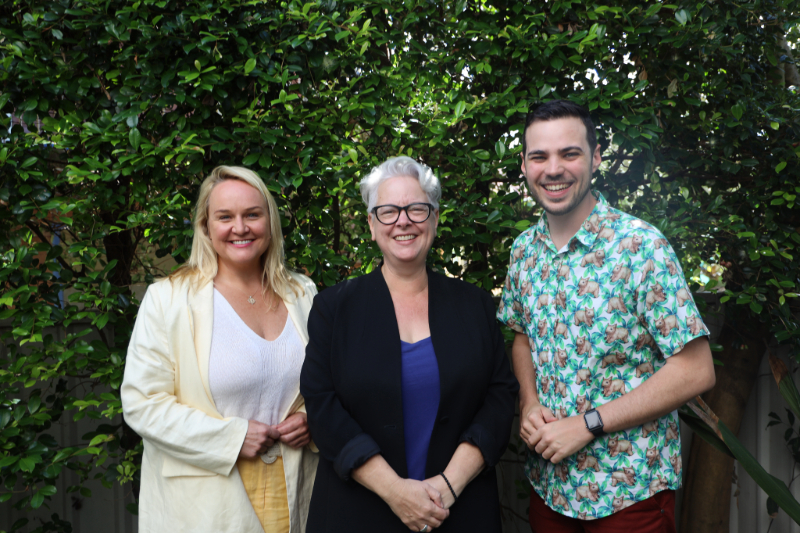
Councillor Katrina Wark, Councillor Margaret Wood, Lord Mayor Nuatali Nelmes, Councillor Peta Winney-Baartz and Senior Project Planner Sarah Horan launch draft Public Domain Plan for Georgetown

“City of Newcastle is committed to developing vibrant, safe and active public places,” Cr Nelmes said.

“Through early consultation with residents and businesses we heard that people love the community and village atmosphere in Georgetown but would like it to be enhanced with improved public spaces.

“The upgrades proposed will benefit both businesses and residents, delivering a safer, more attractive place to visit while presenting an alternative to large shopping centres.

“Introducing more street trees and landscaping throughout the precinct will improve the natural environment as well as the look and feel of the area whilst reducing heat with increased shade.

“A major component of CN’s Local Centres program includes drainage improvements. We will also look to partner with businesses to beautify the local shop fronts through a future Façade Improvement Scheme.”

The George Espresso Bar owner Tegan Rossiter welcomed plans to revitalise and upgrade the neighbourhood shopping precinct.

“It’s going to look awesome. I can’t wait to see more trees and greenery,” Ms Rossiter said.

“Georgetown is already a bustling community hub but an upgrade is going to bring so much more life to the area.”

The community is invited to attend a drop-in session at the corner of Georgetown Road and Asher Street on Saturday 25 November between 8.30am and 10.30am.

The draft Public Domain Plan will go on public exhibition from Friday 10 November until 5pm Friday 8 December 2023 to seek business and community feedback, with a report going back to the elected Council following the exhibition period.

Visit newcastle.nsw.gov.au/yoursay for more information and to access the online survey.

Flood recovery and resilience boost delivered for NSW Central West

More funding has been committed to help the NSW Central West region’s recovery from last year’s devastating floods and build resilience for the future.

The Albanese Government has agreed to match funding announced last week by the Minns Government to deliver the Central West Recovery and Resilience Package, bringing the total joint funding for the program to $60 million.

This package includes support for the repair and replacement of critical community assets, improving the resilience of public infrastructure and legal aid assistance.

In addition, the Albanese Government has provided in-principle support to match funding to deliver a $40 million resilient housing program for the Central West, with details of the program to be agreed following consultation with the local community.

This brings the total commitment for these programs to $100 million jointly funded by the Albanese and Minns Governments.

These important projects will be overseen by a forum of community leaders and representatives from both Commonwealth and State Governments, to ensure all levels of Government are committed to the long-term recovery of the Central West.

These programs will prioritise the most impacted local government areas of CabonneParkesForbes and Lachlan.

Funding will be provided under the jointly funded Disaster Recovery Funding Arrangements (DRFA).

Federal Minister for Emergency Management Murray Watt said funding for communities devastated by natural disasters remains a top priority for the Albanese Government.

“The floods experienced by communities across the Central West almost a year ago were on a scale never seen before,” Minister Watt said.

“After the event we supported the community through recovery initiatives, but longer-term, it’s important that all levels of Government are looking at ways to make communities more resilient to future events.

“This funding provided by the Albanese and Minns Government will help to build stronger, safer communities in the Central West.

“I acknowledge the persistent advocacy of the local Mayors and the Member for Calare, Andrew Gee MP, which has resulted in today’s commitment.

“Over coming months, the Albanese Government will work closely with the NSW Government to develop an appropriate approach to supporting the resilience of housing in the Central West.”  

NSW Minister for Emergency Services Jihad Dib said the commitment from the Commonwealth would provide important additional funding that will help Central West communities build back stronger. Mr Dib also acknowledged the work of the Member for Orange, Phil Donato, in advocating for support for his community.

“The NSW and Commonwealth Governments are committed to helping communities in the Central West recover, rebuild and prepare,” Minister Dib said.

“We know how important targeted support is for communities after a natural disaster, and it’s clear that more needs to be done to help them adapt and mitigate future extreme weather events.

“Over the coming months, the NSW Reconstruction Authority will engage with the community and work closely with local community leaders to prioritise the additional funding and help design the Central West housing program.”

NSW Minister for Planning and Public Spaces Paul Scully said the funding demonstrates a joint commitment to the region to help them recover and is about better preparing communities for future natural disasters.

“Recovery doesn’t happen overnight – it’s a long-term issue that requires evidence-based planning and community leadership,” Minister Scully said.

“This funding will go a long way to making sure communities are better placed to mitigate future disasters and recover more quickly.”

Further information:

The Central West Recovery and Resilience Package, jointly funded by the Albanese and Minns Governments, is comprised of:

  • Regional Transport Resilience Fund estimated $32m
  • Community Assets Program estimated $25m
  • Legal Aid Assistance Program estimated $1m
  • Central West Housing Consultation Program estimated $2m
  • Central West Housing Program (in principle agreement) estimated $40m

NSW charts new course for volunteering across the state

The NSW Government is leading the way in supporting and recognising the contributions of the state’s 4.3 million volunteers with the launch today of a new Volunteer Charter.

The NSW Volunteer Charter sets out a clear code of conduct organisations can adopt to grow and support volunteering across the state.

It contains 10 guiding principles spanning the volunteer journey that can be adapted to different needs and complements existing codes of conduct. A companion document provides guidance on how each principle can be implemented.

Minister with responsibility for volunteering Jodie Harrison said the NSW Government was proud to be the first state in Australia to have such a charter, and together with a refreshed NSW Volunteering Strategy, there is a clear path to grow the sector.

“Whether they are on the sports field, in the foodbank, patrolling the beach or deploying to an emergency, volunteers are the heartbeat of every community,” Minister Harrison said.

“The government is focused on building sector capacity, investing in research, and enhancing the recognition of volunteers.

“This Charter provides a way for organisations to deliver best practice, support good communication and positive relationships. Most importantly, it will encourage more people to take up volunteering and find meaningful ways to give back to their communities.

“Our united vision for the future is one where volunteering in NSW grows and is vibrant, everyone can volunteer, more often, throughout life and their contributions are celebrated.”

Volunteers contribute close to 900 million hours, worth $178 billion, to our collective wellbeing.

The development of the NSW Volunteer Charter was done in consultation with the volunteering sector, in response to NSW Volunteering Taskforce recommendations. It is a key new initiative under the NSW Volunteering Strategy 2020 to 2030.

Centre for Volunteering CEO Gemma Rygate thanked the NSW Government for their work coordinating the development of the milestone document.

“Volunteering has so many benefits for communities and individuals, helping people connect, boosting health and wellbeing,” Ms Rygate said.

“Setting consistent standards and supporting good practice across organisations helps our sector to grow, and the Volunteer Charter is an important tool to help ensure this.”

Get more information about the NSW Volunteer Charter and the NSW Volunteering Strategy 2020 to 2030.

Future Jobs & Investment Authorities stakeholder engagement comes to Central West

The NSW Government is continuing to progress its election commitment to establish Future Jobs and Investment Authorities in coal-producing regions in NSW.

Minister for Natural Resources Courtney Houssos today hosted a Central West roundtable meeting in Lithgow, providing an opportunity for local stakeholders to discuss the region’s core priorities, including future employment and economic opportunities.

The Central West roundtable follows a successful event in the Hunter in August. It is an important step as the NSW Government establishes authorities in the Central West, Hunter, Illawarra, and North West.

Local leaders, representatives of mining companies, unions and industry groups discussed ways to create jobs and investment, re-skill workers and advance economic diversification in the Central West region.

The Minns Labor Government has committed $5.2 million over four years to establish local authorities. They will work with the Commonwealth Government’s Net Zero Authority to support workers, industries and NSW coal mining communities.

Further Roundtable discussions will be held in North West and the Illawarra in early 2024.

Minister for Natural Resources Courtney Houssos said:

“These roundtables are a great opportunity to consult with workers, the community and industry about how to tailor the local authorities for the Central West.

“The Minns Labor Government committed to making sure that coal-producing communities, like those in the Central West, are supported to find new opportunities.

“We’re working closely with local stakeholders to identify ways we can help workers and their families prepare for a strong and prosperous future.

“Our future productivity will rely on the workforce planning and economic diversification we do now. The best way we can support coal producing regions like the Central West into the future is to get the right structures in place.

“The Minns Labor Government is committed to ensuring we get this right, and that only comes from listening to the workers, the industry, and communities.

“The coal sector as we know it in NSW is changing. As part of this consultation I have heard a wide range of views from local stakeholders as to how we can best support new economic opportunities and new industries in the Central West region.”