Accessibility on the agenda as City of Newcastle delivers amenities upgrade at Wallsend pool

A new accessible changeroom at Wallsend Swimming Centre has been completed as part of an estimated $1.25 million of accessibility improvements for City of Newcastle’s (CN) inland pool network.

The work is the first accessibility project to be prioritised under the unanimously adopted Inland Pools Strategy 2043, which sets out a strategic path to enhance and protect Newcastle’s public pools for the community during the next 20 years.

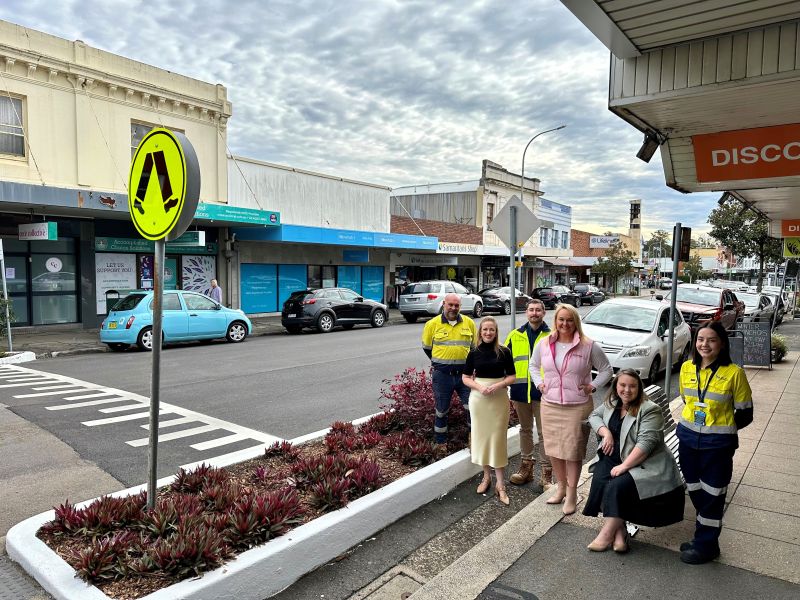
Councillor Callum Pull, Councillor Deahnna Richardson, Councillor Margaret Wood, Lord Mayor Nuatali Nelmes and Councillor Elizabeth Adamczyk mark the opening of a new accessible changeroom at Wallsend Swimming Centre

Its completion means that all five of CN’s swimming centres now provide accessible amenities, ensuring a more inclusive swimming experience for all members of the community.

Future projects proposed in the Strategy include the installation of accessible entry into each of CN’s 50-metre pools, with investigations into the most appropriate means for improving access into the pools now underway.

Refurbished accessible changeroom facilities are also proposed for Lambton Swimming Centre as part of improvements in the future.

Lord Mayor Nuatali Nelmes said improving access to the city’s pools was a priority for CN.

“City of Newcastle is committed to maintaining and investing in our network of inland swimming centres to ensure they continue to meet the expectations and evolving needs of more than 320,000 people who visit them each year,” Cr Nelmes said.

“That’s why we developed our Inland Pools Strategy 2043, which sets out an investment plan for Newcastle’s network of public swimming pools to ensure they are fit-for-purpose in the long term and made accessible to all members of the community.

“Accessibility is an issue facing councils across the region given almost all local pools were built more than fifty years ago.”

Councillor Margaret Wood, co-chair of CN’s Access and Inclusion Advisory Committee, praised CN for completing the accessible changeroom at Wallsend Swimming Centre this season.

“Ensuring accessibility into, around and within activity spaces for all members of the community regardless of their age or ability is one of the key principles used to guide the investment and improvement direction of our Inland Pools Strategy,” Cr Wood said.

“The completion of the new changeroom at Wallsend Swimming Centre sees this priority become a reality and will be a welcome addition to this popular community facility.

“With accessible changerooms now available at all five of CN’s swimming pools, City of Newcastle has ensured a more comfortable and inclusive experience for everyone visiting our pools this summer.

“I look forward to seeing future projects continue to improve access to our pools for all members of our community.”

City of Newcastle celebrates Japanese Sister City agreement

The four-decade relationship between City of Newcastle (CN) and its Sister City in Japan has been commemorated in person thanks to the visit of a delegation from Ube City, Yamaguchi Prefecture.

The COVID-19 pandemic prevented the milestone being marked in 2020, making it almost 43 years to the day since Newcastle’s first female Lord Mayor, the late Joy Cummings, joined the Mayor of Ube to sign the agreement.

Current Ube Mayor Keiji Shinozaki, his fellow councillors and members of the Ube-Newcastle Sister City Friendship Society were greeted by Newcastle Lord Mayor Nuatali Nelmes, Councillor Elizabeth Adamczyk, Councillor Margaret Wood and Councillor Katrina Wark at Blackbutt Reserve, where a tree was planted to commemorate the 40th anniversary before the Japanese delegation had the chance to meet some local wildlife.

Councillor Elizabeth Adamczyk, Newcastle Lord Mayor Nuatali Nelmes, Ube Mayor Keiji Shinozaki, Councillor Katrina Wark and a member of the Ube City delegation plant a tree at Blackbutt ReserveCr Nelmes said the relationship between the two cities has delivered countless benefits over the years.

“Despite being 7,700 kilometres apart, Newcastle and Ube have developed strong connections in education, youth exchange, economics, sport and art, with Newcastle Art Gallery holding one of the largest collections of Sodeisha ceramics outside Japan,” Cr Nelmes said.

“Local high schools such as Newcastle, Merewether, Kotara and Wallsend have participated in annual student exchanges with Ube, which provide an immersive cultural experience, while the University of Newcastle’s Language Centre embraces Japanese language, art and culture.

“There’s an event called the Newcastle Fair in Ube, where visitors can experience the cultural aspects of Newcastle. In 2019, Ube City gifted the winners of the Japanese Speech Contest held in Newcastle a trip to attend this fair.

“I’m proud to represent City of Newcastle and continue the legacy of Joy Cummings, who was instrumental in the establishment of the Sister City link, believing the port harbour cities with similar populations and industrial backgrounds in coal exports and steel manufacturing had much in common.”

A symbolic exchange of gifts took place 43 years ago with City of Newcastle presenting Ube officials with an inscribed plaque bearing the city’s coat of arms, while Ube provided Newcastle with a Kabuto (Samurai Helmet).

That tradition continued when Mayor Shinozaki and the Japanese delegation attended a welcome reception and dinner on Monday at City Hall, where more gifts were exchanged and a treaty was signed to recommit the Sister City relationship.

The tour of Newcastle continued on Tuesday with the Ube City officials visiting the CSIRO Energy Centre at Mayfield West, the Port of Newcastle, Nihon University’s Newcastle Campus and the Anzac Memorial Walk.

CN currently has three other adopted Sister City relationships including the Californian city of Arcadia, the English city of Newcastle upon Tyne, and the central western NSW town of Dubbo.

The relationships are designed to promote and encourage friendship and cooperation between local governments, business leaders and the wider community, in addition to facilitating cultural exchange programs and economic development.

City of Newcastle trials new technology to improve parking and safety

Innovative new technology is being trialled by City of Newcastle (CN) to help improve parking management and safety across the Local Government Area.

Licence plate recognition technology mounted to the roof of an electronic vehicle (EV) will assist CN parking officers detect vehicles that exceed timed parking restrictions or that are parked illegally.

With more than 6,500 customer requests received by CN each year relating to parking issues, the new technology will supplement foot patrols to improve the efficiency of parking compliance and enable staff to focus on other educational based activities.

In line with neighbouring councils in the Hunter, tickets generated will now be issued by Revenue NSW via Australia Post to the registered vehicle owner, rather than attached to windscreens by parking officers.

The new technology and streamlined process will play an important role in supporting safe parking and enforcement across Newcastle.

City of Newcastle parking officers are reporting an increasing number of incidents of aggressive and inappropriate behaviour from members of the public while undertaking their work on Newcastle streets. These new measures will help provide a safer working environment for staff.

Local business precincts are also set to benefit with improved short-term parking turnover and making parking more readily available for the community.

Neighbouring councils in the region have already rolled out similar technology and CN is trialling this technology with an EV car.

City of Newcastle’s ‘On the street’ Parking Plan 2021 and associated Parking Implementation Plan 2021 highlight the need to support enforcement activities currently undertaken by CN parking officers.

United Services Union (USU) Official Luke Hutchinson welcomed the trial for the safety and wellbeing of CN parking officers.

“This technology will provide improved workplace conditions for parking officers by decreasing their interaction with members of the public and better enabling them to carry out their work safely, in all weather conditions,” Mr Hutchinson said.

“City of Newcastle has the USU’s full support in taking action to address the challenges parking officers face in the workplace and look forward to the outcomes of the trial.

“The USU calls on all members of the community to treat all workers with respect especially when they are endeavouring to provide equitable access to the city for everyone.”

For more information visit City of Newcastle’s parking webpage.

Labor’s cost of living crisis hits Victoria hardest

Australians are only going backwards under this Albanese Government, and Victorians are being hit the hardest of all.

Despite the Prime Minister’s promise that Australians would be better off under Labor, new analysis has shown that Victorians are $1,100 worse off compared to their counterparts in New South Wales.

This comes at the same time as new analysis of ABS State Accounts data which revealed that in the year to June 2023, Victorians faced the fastest decline in real household disposable income per person, at a rate of 6.5 per cent.

Chair of the Cost of Living Committee and Liberal Senator for Victoria Jane Hume said that it is going to be a really tough Christmas period for many Victorian families because of Labor’s cost of living crisis.

“We know that mortgage stress is increasing, real wages are going backwards, and the price of everything is going up. Now we have analysis to show just how much the average Victorian is worse off under Labor.

“The Cost of Living Committee has repeatedly heard from charities that they are seeing record demands on their services, now from families with two incomes, and some even with mortgages. At Christmas, those services will be busier than ever and from these numbers we can expect Victorians will see the worst of it.

“We have consistently heard that the best thing the Government can do to help take the burden off these charities and help families is to get inflation down. That is the only way we take pressure off the RBA so they don’t have to keep raising interest rates.

“Both the state and federal Labor Governments need to own up to the damage they have done to our state. Victorians are clearly worse off under Labor.”

Regional Australians continue to suffer a healthcare crisis – Butler must act now

The Albanese Labor Government continues to politicise the health of regional Australians rather than take real action, Shadow Assistant Minister for Regional Health Anne Webster says.

On Wednesday, Health Minister Mark Butler will announce a review into the Monash Modified Model, the District of Workforce Shortage and Distribution Priority Areas (DPAs), which effect the distribution of doctors throughout Australia.

“I have been calling for a review of all of these challenges for months but Minister Butler fails to acknowledge his Government bled the regions of doctors by expanding the DPAs,” Dr Webster said.

“He opened the door for International Medical Graduate Doctors to leave the regions for peri-urban settings, with exits from regions increasing by 57 per cent in the first 6 months after his policy change. This has been a major factor in GP clinics closing in Mallee and around Australia.

“Regional health is in crisis, as I have been saying since my appointment as Shadow Assistant Minister in December. Action and funding is needed to address regional health issues now, not after another review that will only confirm what regional Australians and our health workforce already know. In fact, the Coalition set a number of these reviews in motion 20 months ago.

The Minister’s announcement comes after the Coalition-instigated Strengthening Medicare Taskforce which recommended the creation of an independent workforce planning agency, expanded training pathways for doctors in regional and remote areas and greater incentives for practitioners to work in regional Australia. These were already key initiatives of the Coalition Stronger Rural Health Strategy.

“Minister Butler’s proposed Distribution and Thin Markets Review shows how thin the Albanese Labor government has been on action, thin on funding and thin on caring about the plight of regional Australians,” Dr Webster said.

“The Coalition’s strategy included a range of incentives, targeted funding and bonding arrangements that give doctors more opportunities to train and practice in rural Australia. It also strengthened the role of nurses and allied health professionals to deliver more multidisciplinary, team-based models of primary health care. Initiatives such as the Murray-Darling Medical Schools Network, Junior Doctor Training Program and More Doctors for Rural Australia program were all targeted to improve access to doctors for people in regional Australia.

“Regional Australians collectively are missing over $6.55 billion annually in spending on healthcare access compared to those in the city, according to the Nous Report commissioned by the National Rural Health Alliance.

“Without doctors providing primary care in regional Australia, the health costs are falling on stretched regional emergency departments. Only 6.5 per cent of total Government health funding goes to General Practice. Government spending on an equivalent visit to the GP is $80 compared to an Emergency Department visit for the same illness at over $600. Primary Care needs more funding as it keeps people out of hospital. Funding for Regional Primary Care is essential for efficient and effective regional health care delivery.”

$750,000 for Paralympians to pursue Paris 2024 dream

The NSW Government has today committed $750,000 to Paralympics Australia to support athletes competing at next year’s Paris 2024 Paralympic Games, matching a commitment made to the Australian Olympic Committee (AOC) National Team Appeal in March.

The funding reaffirms NSW’s commitment to backing athletes with disabilities and reflects the state’s unwavering dedication to promoting the Paralympic movement and recognising the outstanding accomplishments of all Australian athletes.

The financial support will contribute to covering the escalating operational costs of helping the Australian Paralympic team achieve its sporting dream, including flights, accommodation, meals, uniforms and medical services.

The Paralympic Games provide an opportunity for people with motor disabilities, sensory disabilities or intellectual disabilities to achieve sporting excellence, entertain crowds of spectators and showcase their skills across a range of sports, from wheelchair tennis and wheelchair basketball to para swimming, para athletics and para equestrian.

The Games will be held in France over 12 days, from 28 August – 8 September 2024 and bring together 4,400 athletes competing across 549 events.

Minister for Sport Steve Kamper said:

“It is a great honour to support our National Paralympic team as it prepares to represent Australia at the Paris 2024 Paralympics. Our fantastic Paralympic team is gearing up to represent Australia in 19 out of the 22 sports.

“The Australian Paralympics team deserve the very same support as any other athlete who represents our nation, and we’re proud to play a small part in helping them to make a mark on the greatest stage of all.

“Our $750,000 commitment matches the grant we provided the AOC and will support athletes, coaches, and staff as they go for gold next August and September.

“The grant will ensure our athletes have the necessary tools and facilities to excel in their respective events in Paris.”

Minister for Disability Inclusion Kate Washington said:

“The Paralympics unites our nation and the world, and our courageous, dedicated, and remarkable athletes are an inspiration to us all.

“We know this funding will help our Paralympic athletes achieve their dreams in Paris and inspire the next generation of sporting heroes.

“Along with this funding, we are sending our best wishes to every single Paralympian as they pursue their dreams.

“Know that all of Australia is behind you and cheering you on from loungerooms across the country, along with those lucky ones in the stands!”

Parliamentary Secretary for Disability Inclusion Liesl Tesch said:

“As a former Paralympian who did years of fundraising to support my athletic career, I know Paralympians across NSW welcome this contribution towards chasing their dreams in Paris.

“I can’t wait to see the Australian Paralympian team at the Opening Ceremony of Paris 2024, knowing the NSW Government is supporting athletes every step of the way, as they go out in the green and gold.

“Best wishes to all our Paralympians and support staff – know that we will be cheering for you from home.”

Paralympics Australia Chief Executive Catherine Clark said:

“On behalf of our elite Para-athletes and Paralympics Australia, I’d like to thank the NSW Government, particularly the Premier Chris Minns, Minister for Sport Steve Kamper and the Minister for Disability Inclusion Kate Washington, for this very generous and vital injection of funds for our Paris Paralympic Games campaign.

“Delivering an Australian Team of some 170 athletes, along with coaches, team managers, carers, medical experts and Paralympics Australia’s outstanding operational staff is an enormous undertaking and there are, of course, substantial costs involved.

“The NSW Government’s contribution, equal to its support for Paris-bound able-bodied athletes, is a strong statement of belief in our Australian Paralympic Team and the power of sport to create meaningful change across society.”

Prosecution of threats and incitement to violence set to be streamlined

The Minns Labor government is strengthening the law to further protect people from threats and incitement of violence based on their race, religion, or other attributes.

The NSW Government is introducing a bill today to improve the prosecution process for the offence of publicly threatening or inciting violence against a person or group based on their race, religion, or other attributes.

Section 93Z of the Crimes Act 1900 makes it an offence for a person to, by a public act, intentionally or recklessly threaten or incite violence towards another person or group of people because of their race, religious belief or affiliation, sexual orientation, gender identity, intersex status, or because that person is living with HIV/AIDS.

Currently, subsection 93Z(4) of the Crimes Act 1900 provides that a prosecution under section 93Z requires approval from the Director of Public Prosecutions (DPP) before it can proceed.

Concerns have recently been raised in relation to subsection 93Z(4) and the time it takes to refer matters to the DPP and obtain approval to prosecute may act as a disincentive to laying appropriate charges.

The proposed change will enable NSW Police to prosecute people who offend against section 93Z, without the approval of the DPP.

Removing the DPP approval requirement will make this offence consistent with the overwhelming majority of other offences in NSW.

When committed by an individual, the offence is punishable by a fine of up to $11,000, up to 3 years’ imprisonment, or both. In the case of a corporation, the crime is punishable with a fine of up to $55,000.

Premier Chris Minns said:

“NSW is the most successful multicultural state in the world, but our community cannot take that for granted.

“If you’re going to have a law on the books saying threats and incitement of violence are not allowed in NSW, then it needs to have teeth.

“There is no room for threats and incitement of violence in NSW.”

Attorney General Michael Daley said:

“NSW is a diverse, vibrant and successful multicultural and multifaith community. Our values of respect, tolerance and inclusivity enrich us all.

“We are for the most part a harmonious society, and we all want to remain that way.

“Hate speech that incites violence or threatens violence based on a person’s race or religion, or their sexual orientation or gender identity is completely unacceptable in our community. We want to ensure offences of this type can be prosecuted in a timely and efficient manner to ensure community safety.”

Fresh approach to funding digital solutions to target housing supply and frontline services

Community is at the heart of the Minns Labor Government’s reset of the Digital Restart Fund (DRF), with $100 million now aimed at finding digital solutions to address the state’s biggest challenges including housing supply, frontline service delivery and climate change.

As part of a major shift in how the NSW Government prioritises digital investment, funding will be targeted at 5 new focus areas that better align with the needs of the state’s residents as cost-of-living and environmental pressures rise.

Under the changes, digital investment will focus on housing supply, support for frontline and essential workers, efficient energy use and protections for biodiversity and the natural environment, reducing cyber risk, and the accessibility of government services.

Under the changes, projects prioritised for funding under the DRF will include:

  • Projects which make it easier, safer, and simpler for frontline and essential workers to deliver services.
  • Projects with outcomes targeted at speeding up the supply of housing and acceleration of the housing planning cycle.
  • Projects which increase accessibility of government services for Aboriginal and Torres Strait Islander peoples, people from culturally and linguistically diverse (CALD) backgrounds, regional, remote and rural communities, seniors, people with a disability, and people experiencing social issues and disadvantage.
  • Projects targeted at driving more efficient energy use and supporting biodiversity and the natural environment.
  • Projects aimed at reducing cyber security risk.

NSW Government agencies have been asked to submit applications to the DRF with a focus on the new priority areas.

Major projects delivered through the DRF include a project to uplift the digital literacy of western Sydney residents, and the use of Artificial Intelligence (AI) to irrigate and cool Sydney Olympic Park and mitigate the ‘Urban Heat Island effect’ in surrounding areas.

A project using AI to help prevent rubbish entering Sydney Harbour has also been funded under the DRF. Smart sensors, which have been rolled out to the Blacktown, Parramatta and Northern Beaches local government areas, detect the types of rubbish entering waterways and inform stormwater managers when rubbish collection points need to be emptied. 

Through the DRF, the NSW Government is working to enhance digital innovation and transform services by streamlining planning, funding, risk mitigation and delivery processes to ensure government agencies meet the needs of NSW residents.

Minister for Customer Service and Digital Government Jihad Dib said:

“I am setting a new direction for the Digital Restart Fund to help us find innovative answers to some of the biggest challenges people in NSW are facing right now.” 

“It makes sense to shift the focus of the DRF so it can deliver the most value possible to communities right across the state.”

“The NSW Government has a range of programs and resources available to the community but that is only 1 part of the matrix, people need to know this support exists and investing in accessibility, particularly for Indigenous and CALD communities, is critical.”

“We are also targeting investment in projects that will help us speed up housing delivery, drive more efficient energy use, automate services to support our essential and frontline workers, and reduce cyber risk.”

S&P affirms NSW credit rating

S&P Global has affirmed NSW’s AA+ credit rating with a stable outlook, in the latest acknowledgement of the Minns Government’s 2023-24 Budget approach to fiscal repair.

The S&P decision follows both Fitch and Moody’s affirmation of their triple-A credit ratings last month.

S&P downgraded NSW from a triple-A rating to a AA+ under the previous government in December 2020. 

The state’s fiscal position weakened in recent years, fuelled further by the former government’s $27 billion spend in the 9 months leading up to the last election and their legacy of a $7 billion black hole of unfunded programs.

Through the September budget, the Minns Government began the work of budget repair, including through the Comprehensive Expenditure Review (CER) which identified $13 billion in budget improvements. 

These funds are being reinvested into essential services to help keep the state’s overall expenses at a manageable level.

S&P noted the financial difficulties the Minns Government inherited, including work to reduce the impact of the Debt Retirement Fund and the Transport Assets Holding Entity on the balance sheets.

The NSW Government maintains that the path back to a modest surplus remains challenging.

Treasurer Daniel Mookhey said: 

“The Minns Labor Government is still in the early stages of setting NSW’s finances on a sustainable footing.

“The NSW economy is gaining momentum, but as noted by S&P, there are still significant headwinds to navigate.

“I will be providing the next budget update in our half-yearly review on 14 December.”

Tougher new laws to make community safer

The Minns Labor government is increasing community protection, particularly for those people in NSW experiencing domestic and family violence, by strengthening the laws governing serious strangulation offences.

Quick exitlaunchCall 1800RESPECT (1800 737 732) for 24/7 support.

The NSW Government will introduce amendments to the Crimes (High Risk Offenders) Act 2006 [CHRO Act] into Parliament today.

As a result of these amendments, applications will be able to be made to the Supreme Court of NSW against release or an order for strict supervision if it is believed the offender poses an unacceptable risk of committing another serious offence.

Including serious strangulation offences in the definitions of ‘serious violence offence’ and ‘serious sex offence’ will put these kinds of violent acts in the same category as other crimes like murder, manslaughter, intentionally inflicting grievous bodily harm and recklessly inflicting grievous bodily harm.

Non-fatal strangulation is well known as a key marker for the escalation of violence in a domestic relationship. In particular, non-fatal strangulation in a domestic relationship is a strong indicator of future risk for serious harm and death of the victim.

The NSW Domestic Violence Death Review Team report has previously stated that the research ‘demonstrates a link between strangulation and domestic homicide’ and over a quarter of intimate partner homicides involve the abuser having strangled the victim during a prior attack.

In fact prior attempted, non-lethal strangulation is one of the best predictors of the subsequent homicide of victims, with the risk of becoming an attempted homicide victim increasing by 700%, and the risk of becoming a homicide victim increasing by 800%.

According to the NSW Bureau of Crime Statistics and Research, domestic violence assaults and sexual assaults are the only 2 of the 13 major crime categories that showed an upward trend in the last 5 years, increasing by 13.5% and 29.8% respectively.

Domestic and family violence is one of the most challenging issues that NSW faces and responses are required right across the spectrum. This reform is one part of the broader work the NSW Government is doing to reduce domestic and family violence.

Minister for Police and Counter-terrorism Yasmin Catley said:

“The NSW Police and the NSW Government have a resolute commitment to reducing domestic and family violence. These amendments send a strong message to abusers.

“Strangulation and choking must be taken extremely seriously and that’s what this government is doing.

“The fact is domestic and family violence is a pervasive scourge on our society, the trauma not only impacts the victim, but their family, friends and the entire community.”

NSW Attorney General Michael Daley said:

“Reducing domestic violence is a top priority for the NSW Government. It is crucial that our legislation capture the kind of violent offending that may escalate to homicide.

“The amendments to the Crimes (High Risk Offenders) Act 2006 are informed by research that has identified patterns of behaviours committed by domestic and family violence perpetrators.

“This Bill leaves no doubt as to the gravity of serious strangulation offences and sends a strong message to offenders who continue to pose an unacceptable risk of committing a serious offence at the end of their prison sentence.

“The NSW Government is determined to strengthen protections for victims of domestic and family violence as well as the broader community.

“I thank Police and Counter-terrorism Minister Yasmin Catley and Minister for Women and the Prevention of Domestic Violence and Sexual Assault Jodie Harrison for their hard work and invaluable input into these proposed new laws.”

Minister for the Prevention of Domestic Violence and Sexual Assault Jodie Harrison said:

“This is an important amendment to the Crimes Act to ensure that men who use violence against women are appropriately dealt with by our legal system.

“Non-fatal strangulation is a serious and violent form of intimate partner violence and victims are at elevated risk of future homicide.

“I am committed to working together with Attorney General Michael Daley and Police Minister Yasmin Catley to make sure women and children in NSW are kept safe. Together we can make NSW free from domestic and family violence.”

Quick exitlaunch Call 1800RESPECT (1800 737 732) for 24/7 support.