
Residents to pave the way to a more walkable Newcastle

Novocastrians are being invited to have their say on a 10-year plan designed to increase pedestrian activity in Newcastle by building and supporting walkable neighbourhoods.

Council voted last night to place City of Newcastle’s draft Walking and Mobility Plan on public exhibition for six weeks.
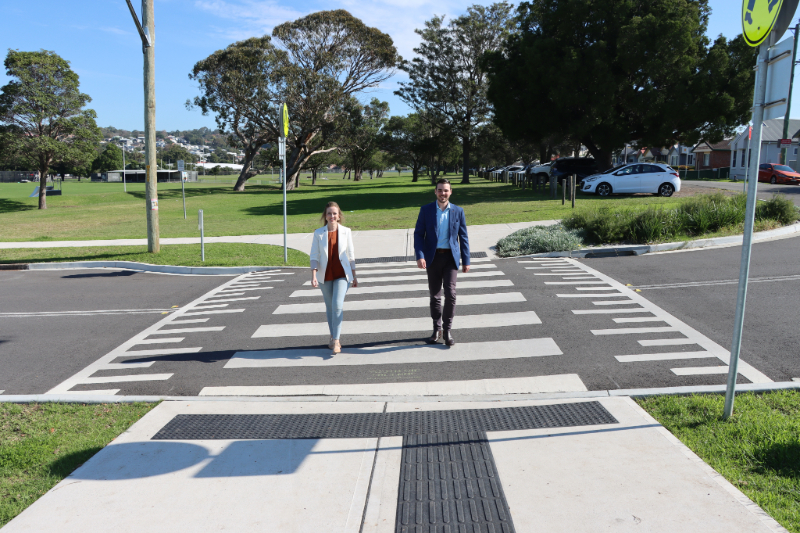
Councillor Elizabeth Adamczyk and Deputy Lord Mayor Declan Clausen using pedestrian infrastructure at New Lambton.Councillor Elizabeth Adamczyk and Deputy Lord Mayor Declan Clausen using pedestrian infrastructure at New Lambton.The plan aims to make walking and active transport the natural choice for short trips for every member of the community, by prioritising pedestrians in all infrastructure upgrades across the city.

Lord Mayor Nuatali Nelmes said walking and active transport have a range of benefits for residents, visitors, and the environment.

“Walking and riding are efficient ways to travel short distances, reduce congestion, lower emissions and increase the vibrancy of local places,” Cr Nelmes said.

“When we refer to walking, we include all pedestrian movements, including skateboards, mobility scooters, wheelchairs and prams. Walking presents an opportunity for everyone in our community to enjoy Newcastle while also providing significant health benefits from more active lifestyles.

“Newcastle is already highly walkable city, and by enhancing the walkability of our neighbourhoods we will support our community, businesses and visitors to embrace walking, including options to connect with public transport as a better way to explore the city and its surrounds.”

The draft plan has been developed through consultation with the community and other relevant stakeholders, utilising surveys, interactive maps, and the establishment and coordination of the Walking and Mobility Working Party.

Councillor Elizabeth Adamczyk, Chair of the Walking and Mobility Working Party said the 10-year plan contains four main themes.

“In order to achieve our goals, we need to promote safety and the prioritisation of pedestrians, build and maintain walkable neighbourhoods, support walking trips and celebrate walking in our communities, for all people, of all abilities,” Cr Adamczyk said.

“Surveys have shown 70 per cent of people in Newcastle walk at least 30 minutes every day, but it’s mainly for recreational purposes, not for transport.

“To change those statistics, we need to guide development to take pedestrians into greater consideration while also encourage pedestrian-friendly drivers by introducing traffic calming measures and advocating for lower speed limits.

“By 2034, City of Newcastle aims to be a place where all pedestrians, of all ages, abilities, and mobilities, feel safe and prioritised within the public road space.”

The Walking and Mobility Plan aligns with the main objectives of the Newcastle 2040 Community Strategic Plan, helping to make our city a more liveable, sustainable and creative place.

The plan will be on public exhibition from 27 June to 8 August 2024.

To find out more and have your say visit haveyoursay.newcastle.nsw.gov.au

$3.1 million for new women’s rugby league sheds in Queanbeyan

Local and visiting sportswomen will soon have dedicated female changerooms at Freebody and Seiffert Ovals in Queanbeyan, providing better comfort, increased safety and encouraging more women to become involved with their local sporting clubs.

The NSW Government has provided $2.1 million for the construction of new dedicated female changerooms for the Kangaroos Rugby League Club at Freebody Oval, and the renovation of an existing amenities block at Seiffert Oval for the Queanbeyan Blues Rugby League Club to include women’s amenities.

In addition, the Federal Government has provided $1 million for the work on the rooms at the Freebody Oval.

These major new and upgraded facilities will support the growing number of female rugby league players in the region and will address the major scheduling issues associated with women and men’s teams sharing the current facilities.

Female changerooms will also encourage greater local female participation, with players now able to change at the venue, rather than having to change before travelling to training.

The rooms will also provide a dedicated space for athletes to prepare before a match and to celebrate after the game.

Construction and renovation work is being managed by Queanbeyan-Palerang Regional Council and is scheduled to commence in late 2024. Work at both ovals is expected to be completed in 2025.

The NSW Government’s commitment to promoting women’s participation in sport also includes:

  • $250,000 to Sport NSW to deliver the Female Leadership and Fair Play Project which will expand on Sport NSW’s female leadership and Fast Track for Female Coaches program
  • $30 million to the Level the Playing Field Program which will revive sport facilities by providing new or upgrading existing sport facilities, amenities and sporting fields including new and upgraded lighting that will enable more women and girls to train and compete in sport in a safe and inclusive environment.

Federal Member for Eden-Monaro, Kristy McBain said:

“Sporting clubs are the life and blood of our local communities, but they need suitable facilities if they are going to be viable in bringing us together.

“Freebody Oval is used year-round by the Kangaroos and the Queanbeyan Cricket Club, but the facilities are in dire need of improvements – which is why this $1 million in federal funding will make a huge difference.

“These are growing clubs, we are seeing more kids sign up, more young girls keen to play and more women playing as well, so we need to make sure our girls and women are accommodated for.”

Minister for Regional NSW Tara Moriarty said:

“Sport plays a major role in bringing together our regional communities, and a lack of dedicated female facilities is often a barrier to encouraging participation in sport and with local clubs.

“Women’s rugby league is more popular than ever, especially in our regions, and these changerooms will provide much needed local facilities that will serve these clubs for generations to come.

“These facilities will help drive participation in sport in Queanbeyan and help support a further rise in female memberships that has already seen steady growth over recent years.”

Member for Monaro Steve Whan said:

“The women’s game is growing across the state and especially here in Queanbeyan, the fans are loving it and wanting to come and support the players.

“These new facilities will encourage more talented young players to become part of the game with many hoping to take the next step into bigger competitions.”

President of the Kangaroos Rugby League Club Ian Baker said:

“Our Club has a rich history, going back to 1966. We have achieved many impressive feats in our time, including 10 First Grade Premierships, however, one of our most exciting achievements in the past few years has been the development of our women’s sides.

“With 50 female players in our Senior Club and 101 in our Junior Club, the amenities upgrades will allow us to further build the capacity of the women playing for the Queanbeyan Kangaroos.”

General Manager from the Queanbeyan Blues Rugby League Club Jeremy Wyatt said:

“Having the upgraded facilities will allow our sport to grow and have the facilities to cater for the ever-increasing participation of female athletes.

“The Queanbeyan community will be proud to have up to date facilities for all to enjoy.”

Kenrick Winchester Mayor Queanbeyan Palerang Council said:

“The Queanbeyan region is a rugby league heartland and it is fantastic to have the support of the Australian and NSW Governments to build these much needed facilities.

It will be great for our local players to have appropriate and high quality facilities that support the continued growth of women’s rugby league.”

Regional NSW communities’ big winners in Active Transport funding

More than 80 councils across NSW will share in $60 million to boost walking and cycling, with $10 million dedicated to supporting active travel to and from schools, as part of the NSW Government’s Get NSW Active program.

Of the 88 projects, 51 are in regional NSW including 14 around primary schools, which will be funded under this latest round of the grant program to build crucial pathways and cycleways that promote walking and bike riding as an easy, safe, and convenient way for people to get around.

Some highlights from 51 regional projects, worth a total value of $24.9 million, include:

  • Warrumbungle Shire Council – $789,000 to construct several walking and shared paths around Coonabarabran Public School and High Schools. It will fill in crucial missing sections that will make it possible for students and their families and carers to complete safe and comfortable journeys to school.
  • Brewarrina Shire Council – $800,000 to build infrastructure that will directly connect residents of the predominantly Aboriginal community in the Weilmoringle Village to the local public school. Currently, students and the broader community must access the school and other services via unsealed roads. The project will significantly improve accessibility by providing a continuous sealed path and includes solar lights so the path can be used at all times of day.
  • Singleton Council – $5.074 million for construction of a 1.55km long walking and bike riding connection along Combo Lane and Wilkinson Boulevard.  The project will deliver entirely new transport options for people living in Singleton Heights and Hunterview. The construction of a bridge over the Hunter River will provide a quiet route along Combo Lane to connect people directly to the Singleton CBD and make walking and bike riding a safe and attractive choice for day-to-day travel.

For the remaining projects,10 projects valued at $9.9 million will be delivered in Western Sydney and 27 projects in the remaining Greater Sydney area, worth a total value of $25.2 million.

This most recent round of the Get NSW Active program received 345 applications from councils with a total request worth $287.6 million which shows the strong desire for infrastructure that supports people who choose to walk or ride to their destination.

The next step will be to confirm the award of funding to councils so they can begin construction or planning phases of their projects.

Read the full list of Get NSW Active successful applicants and projects

Quotes attributable to Transport Minister Jo Haylen MP:

“It’s exciting to see the wide range of active transport projects that will soon come to life, positively impacting potentially hundreds of thousands of people across the state.

“This year, of the amount shared, $10 million will be dedicated to delivering infrastructure that supports walking and riding to school, which received an overwhelming amount of interest from councils. “

“I want to thank councils across the state for their commitment to making it easier for people to safely walk, cycle and scoot around their communities.”

Minister for Regional Transport and Roads, Jenny Aitchison:

“I’m thrilled that more than half of the projects successful in this year’s round of funding is going to regional NSW to provide active transport options for local communities to enjoy.

“It’s this type of infrastructure that makes our communities happier and healthier.

“There is a strong movement towards active transport corridors in our regional communities and it’s great to be part of a government which is funding the development and delivery of infrastructure to envisage this.”

Enmore nightlife model to be replicated statewide

The success of Enmore Road as the state’s first ever Special Entertainment Precinct has inspired 18 other councils across NSW to begin the process of establishing their own nightlife neighbourhood, including Burwood, the Northern Beaches, Waverley and the City of Sydney.

An explosion of bars, entertainment venues and restaurants has made Enmore Road one of the Top 20 coolest neighbourhoods in the world, according to Time Out Magazine.

Establishing an entertainment precinct allowed Inner West Council to set later trading hours and more flexible noise levels to support live music and performance

Venues inside the precinct can trade an hour later every night, and two extra hours on nights they stage live music entertainment.

The Enmore SEP has been made permanent after an Inner West Council survey found 83% support among locals and the area is attracting people and business.

A process led by the Office of the 24-Hour Economy Commissioner has led to interest by 18 councils to establish their own entertainment precinct called for expressions of interest from local councils. Four of the councils have passed resolutions to explore or establish at least one SEP.

The Inner West Council is seeking to establish six additional SEPs in Leichardt, Rozelle, Balmain, two in Marrickville, and Dulwich Hill. Last night the council voted for the proposed SEPs to be submitted to the Department of Planning, Housing and Infrastructure (DPHI) for Gateway Determination.

The NSW Government’s vibrancy agenda also includes changes to stop single neighbour noise complaints shutting local venues noise complainants shutting down venues, streamlining noise complaints, extending outdoor dining, supporting live music through Sound NSW, funding street events, supporting businesses to cooperate and market their local night-life precincts.

Minister for Music and the Night-time Economy John Graham said:

“This is another exciting step in rebuilding Sydney’s night-time economy after the era of lockouts and lockdowns.

“The success in Enmore proves Sydney can have both a safe and a vibrant nightlife, catering for a wide range of ages, tastes and budgets.

“This is part of the government’s wider vibrancy agenda which is about rebuilding the night-time economy block-by-block, neighbourhood-by-neighbourhood. The success in Enmore shows that we’re well and truly on the way.

Digital First Aid Certificate to be test-driven in the Service NSW app

In a milestone for digital identification in NSW, the NSW Government is trialling the first verifiable credential to be added to the state’s new Digital Wallet.

As part of a trial run in partnership with St John Ambulance, a group of first responders, employees and members will have access to a Digital First Aid Certificate as a verifiable credential through the Service NSW app.

When launched, the Digital First Aid Certificate will help people easily access and share the important credential with employers and other organisations.

It marks another major step towards implementing the NSW Digital ID and Wallet, set to transform the way people transact digitally by offering a convenient and more secure way of sharing information.

The roll out of the NSW Digital ID and Wallet is being supported with a $21.4 million investment in the 2024-25 NSW Budget.

In the trial, participants who complete a first aid or CPR course with St John Ambulance NSW will have their qualifications sent to the new Digital Wallet on the Service NSW mobile app.

The Digital First Aid Certificate is the first verifiable credential to be trialled by an Australian government, and it follows the successful launch of the digital renewal option for the Working with Children Check (WWCC) late last year.

More than 21,200 people have now renewed their WWCC digitally and have saved about an hour by doing so online rather than in person.

Verifiable credentials are digital versions of physical credentials that allow users to share the minimum data required for a transaction, increasing the security of their personal information.

For example, a nurse with a digital first aid qualification could securely share it with an employer or other organisation while choosing to withhold other personal information which may have been included on a physical credential.

Feedback received during the trial will also be used to improve the user experience and design of the Digital Wallet for future verifiable credential roll outs.

Find out more about the NSW Digital ID and Wallet

Minister for Customer Service and Digital Government Jihad Dib said:

“In an increasingly digital world, we’re working to help people safeguard their personal information and make everyday transactions more convenient and secure by building a new Digital ID and Wallet for the people of NSW.”

“The NSW Digital ID and Wallet are a game-changer, providing a safe and accessible home for people’s important identification documents and putting time back in their busy lives.”

“The new Digital First Aid Certificate is an important milestone in our program, which the Minns Labor Government is supporting with a $21.4 million investment in the coming financial year.”

“We’re simplifying the processes needed to store and share digital identification documents, and the new Digital First Aid Certificate is going to help people across the state, including our hardworking medical professionals.”

“By securing someone’s identity and documents digitally, forms of identification or qualifications will also be safe when disasters strike and destroy physical copies.”

“Reducing the oversharing of identity documents and credentials will also reduce the risks associated with data breaches, because organisations will hold less information about individuals.”

St Johns Ambulance NSW CEO, Dominic Teakle:

“Just as we’ve been at the forefront of first aid training innovation for over 140 years, St John Ambulance is excited to lead the way with the NSW Government to improve how people will receive and manage their first aid certifications.”

“A digital first aid certificate will mean an improved experience for students and employers, but also helps the Vocational Education and Training (VET) industry to progress in the digital space.”

“We’re proud to be the first non-government organisation to participate in this initiative.”

New ambulance station for south western Sydney

The Minns Labor Government has purchased the site of the planned purpose-built Oran Park ambulance station on Porter Street.

The vital new health service will serve communities across south western Sydney including Oran Park, Camden and Narellan.

The station will support local paramedics to provide the best emergency and mobile medical care, when and where it’s needed, now and into the future for this growing region.

Health Infrastructure and NSW Ambulance carried out a thorough evaluation of the site to ensure the location best meets the needs of the local community as well as emergency ambulance operations and paramedic staff.

The site was identified following a comprehensive service planning process using best practice modelling software which maps Triple Zero calls.

With good access to the major road network, the site is ideally situated to form part of the ambulance station network and will optimise emergency ambulance responses across south western Sydney, while meeting the future health needs of the community.

It will also improve network coverage supporting existing stations including the ambulance stations at Camden and Campbelltown.

Construction and operational timeframes will be determined as the project progresses.

The next steps for the project include design development and seeking planning approval for the new station.

The new station is being delivered as part of the NSW Government’s $615.5 million investment into the NSW Ambulance Infrastructure Program. 

The Program will deliver 30 additional ambulance stations and supporting infrastructure across NSW over the coming years, including in south west Sydney.

Health Infrastructure is working with NSW Ambulance and other Government stakeholders to identify potential sites for new ambulance stations under the Ambulance Infrastructure Program with sites also already confirmed at North Sydney and South Windsor.

The program follows the success of the $202 million Sydney Ambulance Infrastructure Strategy (SAMIS), which delivered 12 new Ambulance Stations across the Sydney Metropolitan area, and the $232 million Rural Ambulance Infrastructure Reconfiguration (RAIR) program that is delivering 54 new and upgraded ambulance stations across regional NSW.

The NSW Government is working to improve access to care and reduce wait times, through our budget emergency department relief package which will invest:

  • $171.4 million to introduce three additional virtual care services helping 180,000 avoid a trip to the ED
  • $100 million to back in our urgent care services to become a mainstay and key instrument of the health system in providing a pathway to care outside of our hospitals for an estimated 114,000 patients
  • $70 million to expand emergency department short stay units to improve patient flow to reduce ED wait times by nearly 80,000 hours
  • $15.1 million to for an Ambulance Matrix that provides real time hospital data to enable paramedics to transport patients to emergency departments with greater capacity and reducing wait times
  • $31.4 million to increase Hospital in the Home across the state allowing over 3,500 additional patients each year to be cared for in their home rather than a hospital bed
  • $53.9 million to improve patient flow and support discharge planning by identified  patients early on that are suitable to be discharged home with the appropriate supports in place.

Minister for Health Ryan Park:

“Our top priority is to ensure that our growing communities can access the care they need, where they need it, when they need it.

“The purchase of the site marks a significant milestone bringing the south west Sydney community one step closer to a new Oran Park ambulance station.”

Member for Camden Sally Quinnell:

“The new Oran Park Ambulance Station will bolster emergency care for south western Sydney and provide a first-class workplace for local paramedics.”

New strata laws to rise to the challenge of living in higher density homes

The Minns Labor Government will impose greater disclosure obligations and stamp out bad behaviour in the strata sector, with new laws set to be introduced to Parliament.

Strata laws put owners corporations in charge of making key decisions on the buildings and common property of townhouses and apartments. Owners Corporations usually appoint a strata managing agent to provide advice on meeting legal obligations and managing the delivery of services to the strata scheme.

Recently the behaviour of a small number of managing agents has put a dent in public confidence around apartment living.

NSW Fair Trading had more than 965 complaints about strata agents in the five years to 2023 with more than half of those complaints about rules of conduct or budgets, levies or finances.  

We have a housing crisis in NSW and solving it means we need to build more high quality, higher density housing. More than 1.2 million people already live in strata communities in NSW and that number is set to grow under the Government’s comprehensive plan to build a better NSW.  

New laws will help build confidence in the sector so apartment owners and residents can feel safe they aren’t being ripped off by unscrupulous agents.

Key changes proposed include:  

  • increasing the maximum penalties and penalty infringement notice amounts for existing agent obligations to disclose information about commissions.
  • strengthening the conflict-of-interest disclosure requirements.
  • banning agents from receiving a commission on insurance products when they don’t play a role in finding the best deal for residents.
  • strengthening NSW Fair Trading’s enforcement and compliance powers.

Higher penalties, greater transparency and new enforcement powers follow an $8.4 million investment in more resources for the Strata and Property Services Commissioner in this year’s budget.

The Government will consult with key stakeholders such as the Owners Corporation Network and Strata Community Association on the draft laws in the coming weeks. The Parliament will consider the new laws later this year.

Minister for Better Regulation and Fair Trading Anoulack Chanthivong said:

“These reforms are critical to supporting confidence in investing and living in strata schemes. 

“We want to change the perception that strata managing agents easily, and readily, take advantage of owners by significantly increasing the consequences for those who do the wrong thing.

“The new laws are designed to take immediate action to help restore confidence in living and investing in strata schemes, ensuring more people consider apartment living as a housing option.”  

Delivering more homes for Australia

The Albanese Labor Government’s Homes for Australia plan will deliver significant new funding across the country to build more homes with a new national housing agreement beginning on 1 July.

As part of the new 5-year National Agreement on Social Housing and Homelessness which starts on 1 July 2024, states and territories will share in $9.3 billion.

The funding will help to combat homelessness, provide crisis support and build and repair social housing.

This new agreement includes a doubling of Commonwealth funding for homelessness, which state and territory governments must match.

States and territories will also share in a further $1 billion outside of the agreement directed towards crisis and transitional accommodation for women and children fleeing domestic violence, and youth, through Housing Australia.

The Albanese Labor Government will also help nearly 1 million Australian households with the cost of rent by delivering a 10 per cent increase to the maximum rates of Commonwealth Rent Assistance, as part of the first back-to-back increase in more than 30 years.

The Government’s Budget last month also included:

  • Training more tradies to build the homes Australia needs with 20,000 Fee Free TAFE and pre-apprenticeship places for the construction industry.
  • Working with the higher education sector on new regulation to require universities to increase student accommodation, taking pressure off the rental market.
  • Increasing the Government’s line of credit to Housing Australia by $3 billion, and liability cap by $2.5 billion.
  • Providing up to $1.9 billion in concessional finance for community housing providers and other charities, to support delivery of 40,000 social and affordable homes under the Housing Australia Future Fund and National Housing Accord.

This significant new investment is part of the $32 billion in new housing initiatives the Albanese Labor Government is delivering through our Homes for Australia plan.

The Albanese Labor Government has already delivered $2 billion to states and territories through the Social Housing Accelerator to deliver around 4,000 new social homes.

Prime Minister Anthony Albanese:

“I know firsthand the life-changing power that a secure roof over your head provides.

“That’s why my Government is committed to delivering more homes, more quickly, in more parts of Australia.

“This Budget means more tradies, fewer barriers to construction, less talk and more homes.”

Minister for Housing and Homelessness Julie Collins:

“This historic new agreement with states and territories will provide much needed funding to support homelessness services across the country and help build more Homes for Australia.

“The agreement is another important demonstration of our Government’s collaborative approach to addressing Australia’s housing challenges.

“We understand that working together is the best way to ensure more Australians have a safe and affordable place to call home.

“That’s why collaboration is at the heart of our $32 billion Homes for Australia plan and the ambitious national target to build 1.2 million homes by the end of the decade.”

Homes for Australia funding by State and Territory

State and territory$9.3 billion National Agreement on Social Housing and Homelessness
(estimated funding 2024-25 to 2028-29)
New South Wales$2.82 billion
Victoria$2.36 billion
Queensland$1.86 billion
Western Australia$993.2 million
South Australia$625.1 million
Tasmania$195.3 million
Northern Territory$290.2 million
Australian Capital Territory$157.4 million

Man dies after being hit by car – Lake Macquarie

A man has died after being hit by a car at Lake Macquarie.

About 3:15am today (Wednesday 26 June 2024), emergency services were called to Alhambra Avenue, Cardiff, following reports a man had been hit by a car.

Officers attached to Lake Macquarie Police District attended and were told a man had been laying on the road and was hit by a utility.

NSW Ambulance paramedics attended; however, the man died at the scene.

He is yet to be formally identified.

The male driver, aged 45, was taken to hospital for mandatory testing.

A crime scene was established, and an investigation has commenced into the circumstances surrounding the incident.

A report will be prepared for the Coroner.

Woman charged following unauthorised protest – Hunter Valley

A woman has been charged following an unauthorised protest in the Hunter Valley earlier today.

About 4:20pm (Tuesday 25 June 2024), officers from Hunter Valley Police District received notification that a number of people had entered the rail corridor off the New England Highway at Hermitage Road, Belford.

Officers attached to Hunter Valley Police District attended the site and arrested a 64-year-old woman.

She was taken to Singleton Police Station and charged with enter inclosed lands serious safety risk, cause obstruction to railway locomotive and enter inclosed land without lawful excuse.

She was refused bail to appear before Newcastle Local Court tomorrow (Wednesday 26 June 2024).