NSW Government to ban the use of Alternative Care Arrangements for vulnerable children

The Minns Labor Government will ban the use of unaccredited emergency accommodation for vulnerable children in the foster care system, reversing the former government’s reliance on these inappropriate and costly arrangements.  

The announcement, made during Child Protection Week, follows numerous reports and distressing firsthand accounts that have revealed the terrible outcomes faced by children living in Alternative Care Arrangements (ACAs).  

In a recent report by the Advocate for Children and Young People, one young person compared their experience living in an ACA to that of a “dog being moved from cage to cage.” 

Alternative Care Arrangements:

  • can cost upwards of $2 million per child per year,
  • have cost $500 million over the last six years,
  • often involve children being placed in hotels, motels and caravan parks with rotating shift workers instead of foster carers,
  • are the placement option of last resort for children in the foster care system, and
  • are provided by unaccredited agencies with limited government oversight who are not required to meet the NSW Child Safe Standards for Permanent Care.  

The Minns Labor Government has consistently flagged its concerns with the use of ACAs and has already taken decisive action to reduce the number of children in these arrangements by 72 per cent. As at 16 August 2024, there are 39 children in an ACA compared to 139 in November last year.  

Of the 39 children currently in an ACA, suitable alternative placement types have been identified for each individual, and efforts are ongoing to facilitate these transitions. The available options include returning the children safely to their parents, placing them with a foster carer or relative, or providing support in an intensive therapeutic care environment. 

The NSW Government has recently expanded Intensive Therapeutic Care capacity and recruited approximately 200 emergency foster carers to help support children being moved out of emergency accommodation. 

Within six months, unaccredited ACAs will be a prohibited placement type, which will complement other urgent reform measures already underway.  

The Government is also reducing the number of children in other types of emergency accommodation. Since November last year, the total number of children in all types of High-Cost Emergency Arrangements (HCEAs) has fallen from 506 to 376 – a 26 per cent reduction. 

The 2024-25 NSW Budget has invested $224 million in funding that will allow the Department of Communities and Justice (DCJ) to:

  • re-enter the market as a foster care provider and expand the recruitment of DCJ emergency foster carers to include longer-term carers,
  • introduce government-run intensive and professional foster care models,
  • deliver government-run residential care for children where non-government providers are unable to offer stable placements,
  • ensure children living in residential care are supported by high quality, accredited providers, and
  • commence recruiting family time workers and additional caseworkers to undertake carer authorisation assessments. 

These initial measures will help rebuild the broken out-of-home care system and ensure that more children grow up in safe and loving homes in NSW.

The Minister for Families and Communities Kate Washington said:

“Since I became Minister, I’ve made it very clear that vulnerable children do not belong in hotels, motels or caravan parks with shift workers instead of foster carers.

“We acted early, and we’re already seeing meaningful results, with the number of children in unaccredited Alternative Care Arrangements falling by 72 per cent in just eight months.

“The former government let the child protection system spiral out of control, and the use of these emergency accommodation providers for vulnerable children skyrocketed.   

“The Minns Labor Government’s ban on ACAs is a critical step towards making the child protection system sustainable, and will put vulnerable kids on safer paths to brighter futures.

“Under our government, unaccredited emergency accommodation will become a thing of the past, which is long overdue.”

Supporting local jobs, boosting local businesses with Jobs First Commission and ‘If not, why not’ government spending rules

The Minns Labor Government will introduce a series of new measures to support NSW jobs and businesses and encourage the development of local industries, removing barriers to local growth.

These policy changes have the backing of workers and industry and will transform the way the government spends its precious procurement dollars on goods and services.

Working in partnership with local industry

Minister for Domestic Manufacturing and Government Procurement Courtney Houssos will on Tuesday instruct the NSW Procurement Board to axe the previous Liberal-National Government’s prohibitions on local content rules.

Those rules made it unlawful for NSW government agencies to seek, or even consider, local employment and business growth opportunities at any stage of the procurement process, harming local businesses at a time when they needed access to valuable procurement opportunities.

NSW government agencies can now consider local content and local development opportunities when suppliers bid for government contracts.

‘If not, why not’ rules for local procurement

To ensure agencies embrace the policy reversal, Minister Houssos has issued a new direction to the NSW Procurement Board called ‘If not, why not’.

Under this direction, the NSW Procurement Board will mandate that NSW Government agencies engage with local NSW suppliers before going to tender for projects worth more than $7.5 million.

The new rules also mandate that if a contract worth more than $7.5 million is awarded to a supplier outside of NSW, agencies will need to undergo a ‘please explain’ process prior to the contract being awarded, outlining why a local supplier was not successful.

The definition of a ‘local supplier’ for the purposes of the ‘If not, why not’ direction is limited to NSW enterprises.

While upholding Australia’s free trade obligations that prevent discriminating against suppliers because of where they’re based or owned, this policy will refocus agencies on supporting jobs and local production in NSW.

This will assist with the Minns Labor Government’s plans to boost the competitiveness of NSW industries and help rebuild the manufacturing sector decimated by the previous Liberal-National Government.

‘Value for money’

Purchasing the cheapest goods and services does not always equate to ‘value for money’ for the people of NSW.

Under the previous Liberal-National Government, thousands of jobs and billions of dollars of major contracts were sent abroad. What came back were delays, cost blowouts and, ultimately, inferior products.

A more robust approach to ‘value for money’ considers factors like supporting employment opportunities and developing regional economies. With these changes, the NSW Government is delivering confidence to domestic and international investors and suppliers alike.

Establishing the Jobs First Commission

The Minns Labor Government will also legislate to create the Jobs First Commission to oversee the implementation and enforcement of local content measures. It will help grow domestic industries and jobs for local workers.

This includes enacting key measures including:

  • A local content policy which will implement Labor’s election commitment to apply a minimum 30% weighting to NSW Government tenders worth more than $7.5 million that captures local content, job creation, small business and ethical supply chains.
  • A Future Skills Guarantee with workforce targets, including that 20% of the trades workforce on NSW Government construction or infrastructure contracts valued above $7.5 million are apprentices.
  • An independent advisory board with representation from across industry, small business, unions, and the public sector to provide ongoing engagement with, and advice on, government procurement policies as well as local development and industry growth strategies.
  • Appointing a Job First Commissioner conferred with ‘name and shame’ and other compliance and enforcement powers. This will ensure all parties, including NSW agencies, adhere to the government’s procurement rules and standards, in particular the new tender weightings rules and local content and skills requirements.

The definition of ‘local content’ under the Jobs First Commission legislation will be any Australia or New Zealand-based enterprise.

In the seven years since implementing its Local Jobs First policy, the Victorian government has supported 40,000 Victorian jobs and demonstrated the potential impact of policies like these.

Last year the NSW Government spent approximately $42 billion on goods and services.

Together, these initiatives will also direct more work to the more than 100,000 apprentices and trainees currently registered in NSW and encourage even more to pick up a trade.

This announcement complements the Minns Labor Government’s ongoing procurement reforms.

The revocation of the previous government’s anti-local content provisions will take effect within 45 days, while the ‘If not, why not’ direction will come into effect on 1 January 2025. Consultation on an exposure draft of legislation to establish the Jobs First Commission is targeted to be released by the end of the year.

Minister for Domestic Manufacturing and Government Procurement Courtney Houssos:

“Businesses and workers in NSW have so much to offer – not just to government but to all consumers.

“These changes will support our local industries and give them new opportunities to secure a larger slice of the NSW government’s $42 billion procurement spend.

“Our announcement today delivers the next step on an important election commitment we made to support local jobs and local businesses.

“The former government’s ideological zealotry harmed local industries, local businesses and local workers.”

Minister for Industry and Trade Anoulack Chanthivong:

“NSW has the most innovative and dynamic businesses in the nation. It makes sense for the NSW Government to invest in those companies.

“Our state has all the ingredients to be a manufacturing powerhouse, but we need to pull all of the levers available to realise that ambition. Government procurement is a powerful tool to boost industry growth.

“When boardrooms are making big investment decisions, they need to know that NSW has the skills and capabilities for manufacturing and these changes will send a powerful signal.” 

Minister for Skills, TAFE and Tertiary Education Steve Whan:

“Alongside our commitment to deliver 1,000 additional apprentices and trainees across NSW Government agencies, this announcement demonstrates our commitment to developing the skilled workforce for the state’s future.

“Local industry and business represent key players in workforce development across the state. Through this initiative we will open up more opportunities for young people to secure highly skilled, well-paid and secure jobs within their local area.”

Business NSW CEO Dan Hunter:

“Not only will this decision supercharge our manufacturing base, it will also boost local skills development and drive innovation.

“NSW has the biggest and most sophisticated private enterprise economy in the country, and this decision will go some way to ensuring we remain the best place to start and develop a business.

“NSW’s small and medium businesses have always been happy to compete with the big players when it comes to winning government contracts – they just need a level playing field.”

Unions NSW Secretary Mark Morey:

“For too long, we’ve seen valuable contracts and opportunities sent offshore, at the expense of local workers and industries. The new ‘Jobs First’ approach, with its focus on local content policy and skills, will help ensure NSW public spending directly benefits our communities, workers, and apprentices.

“Unions pushed hard for a Jobs First Commission with oversight and enforcement powers, because it’s vitally important that local industry is supported to create sustainable, skilled jobs for NSW workers. We particularly welcome the targets for apprentices and trainees on major projects, which will help build the skilled workforce of tomorrow.

“This is a profoundly important policy shift which recognises that supporting local jobs and businesses sets us up for the future. This fosters innovation and stronger industrial capability, creating solid opportunities for the next generation of NSW workers.”

Landmark agreement signed to fully fund Western Australian public schools

All Western Australian public schools will be fully and fairly funded by the Albanese and Cook Governments following a historic bilateral agreement signed today. 

The bilateral agreement will increase funding for all Western Australian schools to 100 per cent of the Schooling Resource Standard (SRS) by 2026.

Western Australia has become the second state or territory to sign on to the Better and Fairer Schools Agreement, delivering record funding to its schools and introducing targeted reforms which will help WA students to catch up, keep up and finish school.  

Today’s bilateral agreement formalises the Statement of Intent, signed by both Governments earlier this year.

Under the agreement, the Australian Government will invest an estimated additional $785.4 million from 2025 to 2029 in Western Australia public schools. The Western Australian Government will invest at least an equivalent amount over this period, bringing total additional investment in public schools to approximately $1.6 billion.

This means the Commonwealth will increase its share of funding from 20 per cent to 22.5 per cent of the SRS by 2026, and the Western Australian Government will increase its funding share to at least 77.5 per cent of the SRS by 2026.

Funding will be tied to reforms in the Better and Fairer Schools Agreement, including:

  • Year 1 phonics and early years numeracy checks to identify students in the early years of school who need additional help.
  • Evidence-based teaching and targeted and intensive supports such as small-group or catch-up tutoring to help students who fall behind.
  • Support for students to come to school ready to learn, such as greater wellbeing support for learning and engagement, including counsellors, school psychologists and health nurses.
  • Trialling place-based approaches to delivering a full-service school model in at least four WA public schools from 2026 which includes community, health and social services support.
  • Recruiting more co-ordinators to better support students with the most complex needs.
  • Identifying opportunities to reduce workloads and better support teachers and school leaders through professional learning.
  • Providing more support and pathways for people to transition to a teaching career in Western Australian public schools, with a focus on First Nations people, people with disability and those from culturally and linguistically diverse backgrounds.

The head agreement also includes the following key national targets by 2030:

  • Increasing the proportion of students with Year 12 or equivalent certification by 7.5 percentage points, compared with 2022 results.
  • Reducing the proportion of students in the Needs Additional Support proficiency level in NAPLAN by 10 per cent.
  • Increasing the proportion of students in the Strong and Exceeding proficiency levels in NAPLAN by 10 per cent
  • Increasing the student attendance rate for all students, returning it to pre-pandemic levels.

The Western Australia bilateral agreement can be accessed here. The BFSA Heads of Agreement can be accessed here.

Prime Minister Anthony Albanese

“I know firsthand the power of a good quality education. I want to make sure that every student in Australia, no matter where they live and learn, receives every opportunity.

“That’s why we are working hand in hand with the Cook Government to fully fund Western Australian schools, in a landmark agreement signed today.”

WA Premier Roger Cook

“Every Western Australian school student deserves access to a quality education.

“WA public schools have received high levels of State funding under my Government, and this new landmark agreement with the Federal Government takes support for our schools to the next level.

“Importantly, the additional funding will be tied to reforms that will help our students keep their learning on track, and assist those at risk to catch up – ensuring no student in a WA public school is left behind.”

Minister for Education Jason Clare

“This is a historic day for public education in Western Australia.

“It shows what can be done when governments work together. It shows that we can fully fund public schools and invest in the reforms that will make a real difference to the students who really need it.

“This agreement means all Western Australian public schools will now be fully funded. This is massive day for public education in WA.

“Today’s agreement builds on the agreement signed with the Northern Territory to fully fund NT public schools.

“The Albanese Government will continue to work together with remaining states and territories to fully fund public schools across the country.”

WA Minister for Education Tony Buti

“We are so happy to be getting this done for the people of Western Australia.

“This funding will focus on improving equity and excellence in schools, supporting the wellbeing of students and teachers, and providing a strong and sustainable workforce of teachers and non-teaching school staff.

“We are currently delivering record levels of reform and investment into public education, which is working to help ensure all students and their families have access to a great education.”

Dodgy real estate agents would face $78,000 fines for breaching renters’ rights under Greens plan for National Renters Protection Authority

The Greens have announced their election policy to establish a National Renters Protection Authority that will enforce national tenancy standards and the Greens proposed rent freeze and ongoing caps. The NRPA would have the power to independently investigate and fine landlords and real estate agents, as well as referring serious offenders for prosecution by states and territories.

Under the Greens plan to establish the NRPA, costed by the Parliamentary Budget Office at $200 million per year on average, the Authority will have 1000 staff in a range of locations nationwide, allowing them to investigate rental breaches as well as offering advocacy, advice and education to renters all around the country. 

The NRPA will be able to issue on-the-spot infringement notices of up to $3,756 to individuals (12 Commonwealth penalty units), or $18,780 (60 penalty units) to real estate agencies. Serious or repeat offenders could be fined up to $15,650 (50 penalty units) for individual landlords or $78,250 (50 penalty units) for agencies, subject to sanctions such as removing a real estate agents’ licence to practise or referred for prosecution by states and territories. 

The NRPA is part of the Greens broader plan to coordinate national tenancy standards by distributing $2.5 billion a year (indexed) to the states and territories in exchange for introducing model tenancy standards including:

  • a 2 year freeze on rent increases, 
  • ongoing 2% cap on rent increases, 
  • right to guaranteed lease renewal
  • access to 5 year leases, and 
  • nationwide minimum standards covering ventilation, heating, cooling and insulation. 

The NRPA would help to enforce these new standards, while the $2.5 billion a year would in part go toward bolstering state and territory respective tribunals dealing with tenancy disputes. 

Along with proactive investigations targeted at compliance with new rent caps, rights to lease renewal and minimum standards, the NRPA would be the first port of call for renters nationwide facing unfair rent hikes, retaliatory evictions, unfair bond claims, landlords who won’t make essential repairs or a notice to leave without reason.

Right now around most of Australia there’s zero protection against unlimited rent increases and nothing to stop renters being forced to move without warning every year, and there’s nothing in Labor’s weak patchwork of ‘Better Deal for Renters’ that will change this.

The states can’t even agree that every renter deserves a working kitchen, electricity supply, heating or cooling or a house free from mould. According to a new report released this week, a year on from Labor’s Better Deal announcement, renters around the country remain vulnerable, with National Cabinet reforms falling short in protecting tenants. National Shelter’s Emma Greenhalgh called on the Commonwealth to play a leadership role in coordinating national rental reform, saying that “states and territories have not done enough to strengthen renters’ rights amid the unprecedented housing crisis”.

Greens Leader Adam Bandt MP:

“For too long renters have been treated like second-class citizens by both Labor and the Liberals.

“Unlimited rent increases should be illegal. Unliveable rentals should be illegal. That’s what a National Renters Protection Authority would achieve.

“Labor and the Liberals think they can tinker around the edges with a fundamentally broken housing system but renters will punish them at the ballot box.”

Max Chandler-Mather, MP for Griffith, Greens spokesperson for housing and homelessness:

“Across this country, there are 7 million renters who are powerless in their own home, unable to push back against unfair rent hikes, dodgy agents and landlords who never do basic repairs. 

“In a system stacked against renters, The National Renters Protection Authority will fight to protect every renters’ right to a secure and affordable home.

“Any renter will be able to tell you about the terrible anxiety that comes when a landlord or real estate breaks the rules and the NRPA is about ensuring every renter has someone to call when that happens. 

“Australia is one of the worst places in the world to be a renter, we desperately need a national body with teeth to fight in their corner and enforce stronger renters rights across the country.

“Governments treat renters’ rights like an opt-in scheme for property investors but the Greens are fighting for legal enforcement of minimum standards and limits on rent increases.

“What’s the point of minimum standards for renters if there’s nobody to call when the landlord or real estate breaks the rules?

“There will be no more pleading with the landlord to send a plumber, fix the heater or send an electrician – it’s your right to have a liveable rental home, and the Greens will make that a reality.

“Over the next 10 years Labor will give property investors $176 billion in tax handouts while millions of renters get screwed.”

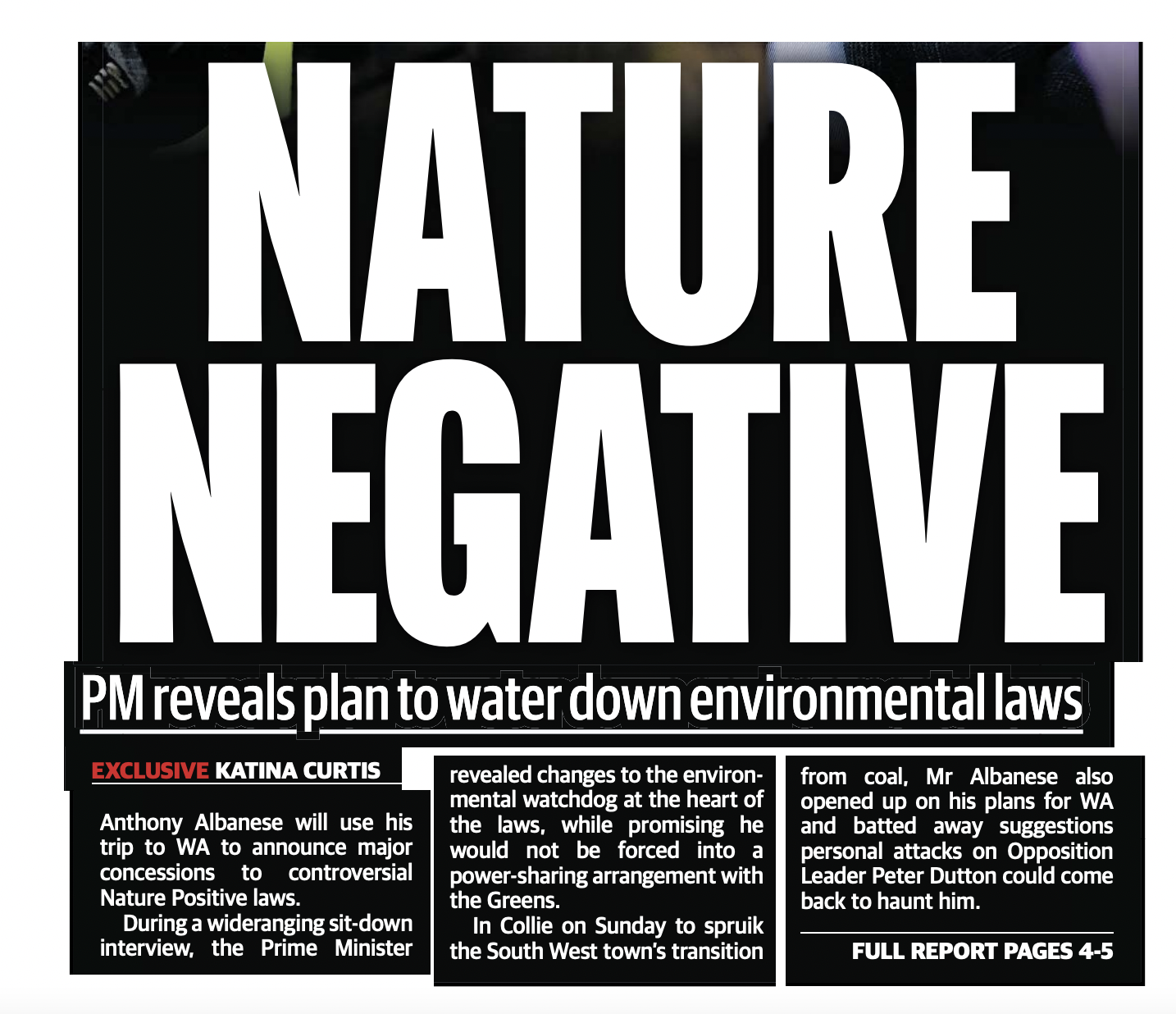
Labor caves again on environment, breaking election promise: Greens

The Greens have slammed the Albanese Government for flagging they will cave in and do a deal with Peter Dutton to gut their already weak environment legislation, breaking an election promise, as reported on the front page of the West Australian today.  

Senator Sarah Hanson-Young is Greens Spokesperson for the Environment:

“Labor caving in on environment laws would be the final nail in the coffin for Labor’s environmental credibility before the next election.

“It appears the Prime Minister is prepared to torch Labor’s environment and climate credentials for a dirty deal with Dutton to appease the likes of Gina Rinehart and the coal, gas and logging corporations.

“Yet another cave-in to polluting corporations will accelerate extinction, fuel the climate crisis and destroy critical habitat for endangered species like our precious koala.

“The science is clear: we need environment laws that actually protect the environment. That means ending native forest logging and stopping new fossil fuel project approvals, via a climate trigger.”

“Instead of working with the Greens to protect the environment and climate, the Prime Minister is flagging yet another broken promise that will fast track destruction and pollution.”West Australian front page: Labor caves

First Nations art to take pride of place in Newcastle Art Gallery

First Nations culture will be celebrated at the heart of the expanded Newcastle Art Gallery following the acquisition of a significant work of art by internationally acclaimed Quandamooka artist Megan Cope.

Generously donated by the Newcastle Art Gallery Foundation, Kinyingarra Guwinyanba (Off Country) features 44 poles adorned with a bouquet of rock oyster shells, which will be suspended within the new central atrium of the Gallery and be visible from the ground and first floors.

Artist Megan CopeArtist Megan CopeEach pole is approximately two metres long and shaped from cypress pine, which has been collected by the artist and Quandamooka community collaborators from Minjerribah (Stradbroke Island).

Lord Mayor Nuatali Nelmes thanked the Newcastle Art Gallery Foundation for the culturally important work of art, which is expected to attract international interest.

“Newcastle Art Gallery is dedicated to honouring the culture and traditions of our First Nations communities, so it’s fitting that such a significant work of art will fill the atrium of our expanded Gallery,” Cr Nelmes said.

“In recent years, Megan has exhibited across the globe at major exhibitions and institutions in cities including Seoul, Tokyo, Hong Kong, Milan, and Quebec.

“We’re thrilled to become the custodian of Megan’s world-renowned creativity and passion through this generous donation from the Newcastle Art Gallery Foundation, who continue to play a valuable role in supporting the Gallery, its expansion and the growth of its collection.”  

Chair Suzie Galwey said the Newcastle Art Gallery Foundation is incredibly proud to present a major artwork by Indigenous artist Megan Cope to the Gallery Collection.

“Members and supporters of the Foundation are eagerly anticipating this important work being added to the gallery’s already nationally acclaimed collection,” Ms Galwey said.

This gift is in addition to the Foundations’ $13-million philanthropic fundraising goal for the building expansion.

“We would like to take this opportunity to encourage the community to be part of the story and join us in our final fundraising push to bring this long-awaited cultural asset to completion,” Ms Galwey said.

Kinyingarra Guwinyanba, meaning ‘place of oyster rocks’ in Jandai and Gowar language, is part of Megan Cope’s ongoing project of on-and-off-Country oyster-shell based sculptures, which investigate the impact of the early colonial lime-burning industry and devastation of both Aboriginal middens and oyster reefs in Quandamooka Sea Country.

Kinyingarra Guwinyanba (Off Country)Kinyingarra Guwinyanba (Off Country)Empty oyster shells are attached to marine-resistant wood poles planted in intertidal zones to help propagate new oyster reefs, which themselves are living sculptures and an ancestral technology.

Megan Cope said Kinyingarra Guwinyanba is a project she started in 2022 on her traditional Country.

“Kinyingarra Guwinyanba is a living, generative land and sea artwork that demonstrates how art can physically heal country that has been colonised through the practice of ecologically restorative and ancestral processes,” Ms Cope said.

“By suspending the sculpture in the Gallery, I hope it will help us connect with the two worlds of the intertidal zone, to that feeling of being buoyant when swimming and being able to see both above and below.”

Newcastle Art Gallery Director Lauretta Morton OAM said Newcastle Art Gallery was also looking forward to welcoming Megan back to Newcastle later this month as part of City of Newcastle’s New Annual festival.

Megan is working with the Gallery to present Ngumpi Kinyingarra Oyster House, a site-specific socially engaged project designed with the University of Newcastle’s Architecture students that will take place in a custom-built temporary structure at Honeysuckle Marina from 27 September to 6 October.

“It is an honour to not only acquire Megan’s incredible work of art into our Gallery’s nationally significant collection, but to also partner with her on our New Annual locally based participatory project celebrating local oysters, collaboration and environmental stewardship,” Ms Morton said.

Kinyingarra Guwinyanba (Off Country) 2022 will be suspended in the 11-metre-high central atrium – essentially in the ‘heart’ of our reimagined Art Gallery. Beyond its evident artistic merit, it strongly signals the Gallery’s commitment to support First Nations artists, works of scale and artists of calibre.

“While the Gallery has strong representation of First Nations paintings and works on paper, this represents a significant addition to the Gallery’s holdings of sculpture by First Nations artists. Moreover, it aligns with the Gallery’s ambitions to support living artists. 

“We are incredibly grateful to the Newcastle Art Gallery Foundation for their continued generosity in support of our Art Gallery.”

The Newcastle Art Gallery expansion project is supported by $5 million from the Australian Government under the Regional Recovery Partnerships and $5 million from the New South Wales Government under the Regional Recovery Package, as well as $12 million from the Newcastle Art Gallery Foundation made possible through the Valerie and John Ryan bequest, Margaret Olley Trust, and community fundraising over many years.

A further $1 million is currently being sought through the Foundation’s public fundraising campaign.

Quest to bring international surfing event to Newcastle gathers momentum

City of Newcastle has thrown its support behind discussions to transform Surfest into one of the top 16 surfing contests in the world.

The plan would see the iconic Newcastle event line up in the Challenger Series, which is the second highest tier on the World Surfing League (WSL) calendar, contested by some of the top male and female surfers from across the globe.

Sarah Baum, Philippa Anderson, Lord Mayor Nuatali Nelmes, Ryan Callinan, Julian Wilson and Jackson Baker at Merewether Beach.Sarah Baum, Philippa Anderson, Lord Mayor Nuatali Nelmes, Ryan Callinan, Julian Wilson and Jackson Baker at Merewether Beach.A Lord Mayoral Minute unanimously adopted this week called on City of Newcastle to advocate for the event with the NSW Government and the WSL.

The move is supported by Surfest founder Warren Smith, along with the city’s top surfers including Ryan Callinan, Jackson Baker, Julian Wilson, Sarah Baum and Philippa Anderson who joined Cr Nelmes at Merewether Beach today.

Lord Mayor Nuatali Nelmes said Newcastle has proven it’s more than capable of hosting major events.

“Newcastle has become a destination of choice for promoters around the world thanks to the success of major events such as the Supercars Newcastle 500, Paul McCartney, Elton John and Pink concerts, as well as various international rugby union, league, football and netball matches,” Cr Nelmes said.

“City of Newcastle also has a proud history of supporting world-class surfing as the founding sponsor of Surfest, which this year celebrated its 38th anniversary as the largest surfing festival in the Southern Hemisphere.

“Newcastle’s reputation as a premier surfing destination was enhanced when we hosted the Rip Curl Newcastle Cup in 2021, marking the first time a combined male-and-female World Championship Tour event was held in NSW since 1999. 

“That event showcased Merewether Beach and Newcastle to a global audience of more than 10 million people and injected an estimated $15 million into the local economy.

“Securing Surfest as part of the Challenger Series in 2025 and beyond represents a significant opportunity that would bring substantial economic, cultural, and tourism benefits to Newcastle and the wider Hunter region.”

Surfest founder and Freeman of the City of Newcastle Warren Smith will meet with WSL officials in Queensland this week.

Mr Smith said the passion of Cr Nelmes and City of Newcastle’s support has resurrected the dream of adding Surfest to the six-event Challenger Series, which provides a stepping stone to the prestigious 10-event Championship Tour.

“When the World Surf League restructured it competition structure three years ago Surfest became a Qualifying Series event for the Asia-Pacific region, essentially a third-tier event,” Mr Smith said.

“If we’re successful in being added to the Challenger Series we’ll welcome the return of surfers from all over the world, all vying to earn a spot on the Championship Tour.”

Merewether professional surfer Jackson Baker said he’s extremely excited about the prospect of a Challenger Series event coming to his hometown and being hosted at his local beach.

“Having won Surfest in 2022, it would mean the world to me to have an opportunity to win a Challenger Series event at home,” Mr Baker said.

“I travel the world all year to compete at all the Challenger Series stops so having an event at home would definitely boost my chances at requalifying for the Championship Tour.”

Fellow Merewether surfer Philippa Anderson said it’s events like Surfest that inspire childhood dreams.

“From the age of 12 I watched Surfest at Newcastle Beach, then when it moved to Merewether where I started to compete a few years later. As an experienced surfer I now look back on how much those events meant to a young girl who had dreams to become a professional,” Ms Anderson said.

“If the Challenger Series comes to town all the young Novocastrians who aspire to follow in the footsteps of Mark Richards, Ryan Callinan, Morgan Cibilic and Jackson Baker will get to watch and maybe even surf with amazing female and male professional surfers.

“There’s just nothing that can compare to that. I hope we can get the event here and the rest is history.”

City of Newcastle secures $1 million grant to roll out innovative development assessment process

A groundbreaking planning tool designed by City of Newcastle, which has slashed determination times for simple developments by more than 75 per cent, will be rolled out across two Hunter councils. 

City of Newcastle will leverage a $1 million Federal grant to integrate and expand its award-winning Accelerated Development Application (ADA) system across Upper Hunter and Muswellbrook Shire Councils as part of a memoranda of understanding with its Hunter neighbours.

Since being introduced by Newcastle in 2022, the system has reduced the average assessment of low-impact, decision-ready development applications to seven days, down from the previous average of 40.

It has also helped cut Newcastle’s overall processing times by 30 per cent.

Newcastle Lord Mayor Nuatali Nelmes said the three-council accord will springboard the acclaimed ADA into more efficient approvals for low-risk developments.

“This is a significant achievement that means our hard work and expertise is set to benefit our colleagues at Upper Hunter and Muswellbrook shire and ultimately more people across the Hunter,” Cr Nelmes said.

“I’m delighted that the vision of our staff is being recognised through this federal grant and I’m proud that City of Newcastle is leading and collaborating through this first-of-its-kind system, which is setting a benchmark for other councils across NSW.

“By expanding the ADA program across the Hunter, we will help increase the planning capability and housing delivery in the region.”

The councils jointly secured the grant through the Australian Government’s Housing Support Program, part of the National Housing Accord target of 1.2 million new homes.

The system will be rolled out to Upper Hunter and Muswellbrook councils by City of Newcastle through training, support, shared expertise and mentoring.

City of Newcastle will also lead analysis and expansion of ADA, with input from the development sector, key stakeholders and artificial intelligence, to capture and speed up a greater share of applications.

The three councils will then collaborate to finetune the expanded ADA on an ongoing basis.

Muswellbrook Shire Mayor Steve Reynolds said gaining ADA as an approval tool would remove barriers to vital housing and development.

“Just like everyone who lives in the Hunter and across the state, our residents want housing that meets their needs,” Cr Reynolds said.

“Being able to share and take ownership of this proven system for Muswellbrook is going to help us address that need into the future.”

Upper Hunter Shire Mayor Maurice Collison praised the cooperation of the three councils in securing the federal grant and signing the memoranda of understanding.

“Newcastle, Muswellbrook and the Upper Hunter are unique places with their own unique qualities but we have many things in common – an expectation of timely approvals is one of them,” Cr Collison said.

“Already we’re seeing the benefits of working together and this shared approach to the benefits of ADA is a prime example.”

The ADA system has proven highly effective at slashing red tape around the hundreds of simple, decision-ready development applications made to City of Newcastle each year.

The higher efficiency frees council resources for more complex DAs, increasing capacity for merit assessment and responding to site constraints.

The system also improves the quality of information lodged and uses an eligibility checker to quickly determine if an application can be assessed through ADA. In the most recent financial year, ADA determinations accounted for 27 per cent of all applications determined by City of Newcastle.

City of Newcastle’s ADA pathway covers 10 types of developments. Most applications determined are residential, including alterations and additions, single dwellings and secondary dwellings.

Multicultural Health Week 2024: Celebrate culture through food with multicultural family lunchboxes

The importance of healthy eating for culturally and linguistically diverse communities is the focus of Multicultural Health Week 2024 which is encouraging everyone to get together to prepare healthy lunchboxes for work, school, or a day out.

NSW Health Minister Ryan Park announced the theme for this year, ‘Celebrate culture through food with multicultural family lunchboxes’ and encouraged everyone to create delicious and healthy lunchboxes as a great way to teach children some positive lifelong habits.

One of Australia’s favourite chefs and multicultural health ambassador, Adam Liaw joins this year’s Multicultural Health Week to help promote healthy eating for adults and children by creating some family lunchbox recipes, as well as providing some healthy eating tips.

Research shows five serves of vegetables are recommended each day for adults for overall health and wellbeing and to help lower risks of cancer and chronic illnesses.

However, only four out of 100 adults and six out of 100 children eat enough vegetables. Studies reveal children eat about a third of their day’s food at school which is why it is important to add more vegetables to lunchboxes.

The Multicultural Health Week 2024 resources and program include:

Visit the Multicultural Health Week webpage and social media for more information and resources.

Healthy Eating Active Living is where you can find practical tips, tools, and free NSW Government programs to help you and your family make simple changes now to live healthier lives in the future. NSW Health also has a range of low cost, easy-to-make recipes for the whole family, including a weekly menu planner.

Minister for Health Ryan Park:

“Multicultural Health Week is an important annual event which aims to improve health outcomes for culturally and linguistically diverse communities.

“This year’s theme is centred on promoting healthy eating, specifically emphasising the link between culture, diet and food as represented by the humble but very important lunchbox.

“Adam Liaw’s recipes will inspire families to build their own multicultural lunchboxes with delicious and healthy foods including vegetables and fruit.”

Minister for Multiculturalism Steve Kamper:

“NSW is a diverse and cohesive multicultural society, and the health and wellbeing of our multicultural communities reflects the health and wellbeing of NSW as a whole.

“At the last census in 2021, 8.1 million people called NSW home with more than 2.2 million people speaking a language other than English at home, higher than any other state or territory.

“Let’s come together to celebrate Multicultural Health Week and use this great opportunity to show support for multicultural communities, celebrate cultural diversity, promote healthy eating and connect with each other through sharing stories and food.”

NSW Health Secretary Susan Pearce:    

“This year, I encourage everyone to get involved in Multicultural Health Week across schools, workplaces and community settings.

“These engaging resources will help all people, including culturally and linguistically diverse communities, eat in a way that is healthy and budget friendly.”

NSW Multicultural Health Communication Service Director Lisa Woodland:

“I’m pleased to take this opportunity to help launch the Multicultural Family Lunchbox Challenge in partnership with the Western Sydney Local Health District’s Prevention Education and Research Unit. This is a competition for young people from multicultural backgrounds to showcase their family lunchboxes, exploring healthy eating using foods from their culture.”

Chef Adam Liaw:

“I’m delighted to be part of Multicultural Health Week this year. Coming from a migrant family, I understand the unique challenges and barriers that multicultural communities may experience in accessing food and practising healthy eating.”

“Whatever your background or culture, the way you eat at home can easily be your inspiration for healthy eating.”

A safer NSW: Stronger protections for victim-survivors of domestic and family violence

The Minns Labor Government is continuing work to create a safer New South Wales and increase protections for victim-survivors of domestic and family violence, with a suite of significant reforms announced today. 

To be introduced to Parliament in September, these reforms include new offences to respond to the danger posed by repeated and intentional breaches of Apprehended Domestic Violence Orders (ADVOs), an entirely new scheme to help prevent domestic and family violence and other reforms to address gaps in existing legislation.

These reforms include:

Strengthening the penalties for repeated and serious breaches of an ADVO

The NSW Government will move to amend the Crimes (Domestic and Personal Violence) Act 2007, to create two new aggravated offences for certain breaches of an ADVO. This will include a new offence for knowingly contravening an ADVO with intent to cause harm or fear and a new offence for repeated breaches of an ADVO.

The current offence of breaching an ADVO carries a maximum of 2 years’ imprisonment and/or a $5,500 fine.

The new offence for knowingly contravening an ADVO will be directed at serious or harmful breaches of ADVOs due to an offender’s intention to cause harm or fear to the protected person. It will carry a maximum of 3 years imprisonment and/or an $11,000 fine.

The new persistent breach offence will be directed at repeated breaches of an ADVO. Where a person knowingly contravenes an ADVO three or more times within a 28-day period, it will be punishable by up to 5 years imprisonment and/or a $16,500 fine.

The addition of this offence reflects and responds to the fact that persistent breaches within a short timeframe indicate an escalation of behaviour and therefore a greater risk.

Introducing Serious Domestic Abuse Prevention Orders

Reflecting the gravity of Domestic and Family Violence, the NSW Government will introduce Serious Domestic Abuse Prevention Orders (SDAPO), adapted from the Serious Crime Prevention Orders scheme, which responds to organised crime.

Serious Domestic Abuse Prevention Orders will allow the court to impose any conditions considered appropriate to prevent the person’s involvement in domestic abuse. This includes positive obligations such as a requirement to inform police of any dating profiles they create or use.

The orders will be able to be sought by the Commissioner of Police or the Director of Public Prosecutions in instances where:

  • The person has been convicted of two or more domestic violence offences that carry a maximum penalty of 7 years imprisonment or higher; or
  • The person has been charged with a ‘serious domestic violence’ offence against a relative or current/former intimate partner, regardless of whether the person has been tried, acquitted, or had their conviction quashed or set aside.

The court will have to be satisfied there are reasonable grounds to believe the SDAPO will protect the person’s relatives, their past, current or potential intimate partner.

The orders will have a maximum duration of five years with breaches being a criminal offence with a maximum penalty of five years imprisonment and/or a $33,000 fine.

Modernising the definition of ‘stalking’

In response to the increased role of technology in modern society, the definition of stalking will be amended to more clearly cover technology facilitated tracking or monitoring conduct.

Under the Crimes (Domestic and Personal Violence) Act 2007, the use of technology in the offence of stalking has a narrow scope, defined as, ‘contacting or otherwise approaching a person using the internet or any other technologically assisted means.’

Under the amended definition it will explicitly state conduct which involves monitoring or tracking a person’s activities, communications or movements whether through technology or another way, and regardless of whether the victim is contacted or approached, constitutes stalking.

This means the use of GPS trackers or monitoring a person online will be captured under the Act, in the same way ‘in person’ conduct currently is.

Making it easier and safer to change a child’s name

Bringing New South Wales into line with other jurisdictions, the Births, Deaths and Marriages Registration Act 1995, will be amended to allow a sole parent to change their child’s name, if they have a Family Court order authorising them to do so.

Currently under the Act, both parents must apply to change a child’s name, unless there is no other surviving parent, or only one parent is named in the registration of the child’s birth, or a court has approved the proposed new name of the child.

A parent with a parenting order granting them sole responsibility for the child’s name cannot apply to change the child’s name without a further court order approving the new name, or the other parent’s consent.

These requirements may pose a safety risk to victim-survivors of domestic violence who are seeking to change their child’s name as they are unable to do so without reengaging with the perpetrator.

The requirement for a further court application may increase risk by making the applicants’ contact details accessible to the perpetrator or revealing the child’s new name – undermining the desire to change a child’s name for protective reasons. This amendment will resolve this issue.

Premier of New South Wales, Chris Minns said:

“The safety of victim-survivors of domestic and family violence is paramount and these laws reflect the risk posed by intentional and ongoing breaches of ADVOs.

“Everyone should be able to feel safe in their own home, but all too often for many that is not the case. When that right has been taken away from someone, these laws aim to support victim-survivors in feeling and being safe again.

“We know that legislative reform alone will not end the scourge of domestic and family violence, but these laws send an important message that the safety of victim-survivors is the priority of the NSW justice system.”

Attorney General, Michael Daley said:

“These new laws are tough, they’re very tough, but unfortunately, they’re necessary to keep women safe from domestic and family violence.

“There are simply too many instances of domestic abuse and violence against women.

“It must stop; and these new laws are the next step that the Minns Government is taking to ensure that police and prosecutors are empowered to protect victim-survivors of domestic abuse.”

Minister for the Prevention of Domestic Violence and Sexual Assault, Jodie Harrison said:

“Too many lives have been lost to domestic and family violence.

“These proposed reforms strengthen existing protections to keep victim-survivors safe, while the new Serious Domestic Abuse Protection Orders help reduce the future risk of violence.

“We have listened to the domestic violence sector and advocates about what is needed to ensure the safety of victim-survivors – and acted.”

Women’s Safety Commissioner, Dr. Hannah Tonkin said: 

“The community has called for wide-ranging action to address the shocking rates of domestic and family violence, including measures to prevent violence as well as stronger accountability for perpetrators.

“These reforms prioritise the safety of women and children and send a clear message that domestic and family violence will not be tolerated.”