
Record investment keeping schoolkids in Parramatta cool

Liberal candidate for Parramatta, Katie Mullens, has welcomed every public school classroom across Western Sydney being air-conditioned as part of an additional $130 million investment from the WestInvest fund.

“The Cooler Classrooms Program means a big win for students in Parramatta,” Ms Mullens said.

“A more comfortable classroom means a more comfortable learning experience for students. These air conditioners will continue the Perrottet Liberal Government’s commitment to upgrading our schools in Parramatta.”        

Schools in Parramatta benefitting from this initiative are:

  • Bayanami Public School
  • Cumberland High School
  • James Ruse Agricultural High School
  • Telopea Public School
  • Yates Avenue Public School

The additional 84 public schools will receive air-conditioning as part of the $5 billion WestInvest program, with more than 3,500 classrooms across 301 public schools in Western Sydney to be air-conditioned.

This builds on the 1,000 public schools across NSW already receiving cooler classrooms, thanks to the NSW Liberal and Nationals Government program introduced in 2018.

Premier Dominic Perrottet said the investment would ensure students in public schools across Western Sydney would enjoy fully air-conditioned classrooms improving the learning environments for both students and teachers.

“This WestInvest boost finishes the job of installing air-conditioning in our Western Sydney schools as part of the Cooler Classrooms Program,” Mr Perrottet said.

“We are making the investments that matter for our growing communities in Western Sydney, helping prepare our children for the future as part of the largest investment in public education infrastructure in the history of our State.

“Only the NSW Liberal and Nationals can deliver modern schools and classrooms for our kids because we have the long term economic plan to fund these vital projects.”

Minister for Education and Early Leaning Sarah Mitchell said the funding was thanks to the NSW Liberal and Nationals Government’s $5 billion WestInvest program, which is securing the best quality of life for the people of Western Sydney – one of the youngest, fastest-growing and most diverse populations in the nation.

“So far through our Cooler Classroom Program we’ve delivered air-conditioning to more than 7,500 learning spaces and 491 libraries,” Ms Mitchell said.  

“It’s fantastic news that this additional funding boost will support Western Sydney students and that they will all soon have to access to more comfortable learning spaces in the summer and winter.

“It’s all thanks to the NSW Liberals and Nationals, investing in every aspect of our public schools. From fresh paint to air-conditioning and security fencing to accessibility works, this Government understands the importance of maintaining and upgrading our schools.” 

Where feasible, solar PV systems and battery storage technology is also being installed to offset energy usage. More than 210 systems have been installed with a further 460 underway.  

The NSW Government is investing $8.6 billion in school infrastructure over the next four years, continuing its program to deliver 160 new and upgraded schools to support communities across NSW. This builds on the more than $9.1 billion invested in projects delivered since 2017, creating a total $17.7 billion investment in public education infrastructure.
30,000 EV chargers across NSW by 2026

The number of Electric Vehicle (EV) chargers will soar to 30,000 across the State by 2026 under a re-elected NSW Liberal and Nationals Government.

The NSW Liberals and Nationals will fast track the rollout of its public and private EV charging plans by:

· Reforming strata laws to make it easier for people living in apartments to charge their EV

· Installing EV chargers throughout NSW transport hubs including commuter carparks and train, bus and ferry stations

· Streamlining planning laws to accelerate the construction of chargers in public places like on power poles and parking meters

Treasurer Matt Kean said with more than one million EVs expected to hit NSW roads by 2030, the Government is already investing $209 million to ensure a comprehensive world-class charging network across NSW.

“We want all drivers to be able to recharge whenever and wherever they need to, whether it’s on a road trip, commuting to work or at home,” Mr Kean said.

Minister for Planning and Homes Anthony Roberts said that the Liberal and Nationals Government is only days away from streamlining planning laws to make it easier to install EV chargers in public places like on power poles and parking meters.

“We know that 30 per cent of drivers can’t access off-street parking and will rely on public chargers, which is why we are cutting red tape to roll them out even faster,” Mr Roberts said. 

Minister for Fair Trading Victor Dominello said a re-elected Liberal and Nationals Government will work closely with stakeholders on developing “Right to Charge” strata reforms, meaning where apartment owners are willing to pay the cost and comply with strict safety requirements, their requests to install EV chargers cannot be unreasonably refused.

“These reforms will make it as easy as possible for people living in one of the 84,000 apartment buildings in NSW to install a charger, without passing on unfair costs to other residents,” Mr Dominello said.

Minister for Transport, Veterans and Western Sydney David Elliott said the Government was set to roll out EV chargers in transport hubs across our train, bus and ferry network.  

“Commuter carparks are a great option for EV drivers to recharge while at work, making sure they can hit the road fully charged by the end of the day,” Mr Elliott said.  

Switching to an EV can save motorists about $1,000 in running costs each year. There are currently about 1,000 public chargers in NSW.  

The 30,000 EV chargers will be more than twice the number of existing petrol pumps in NSW.

These reforms build on the NSW Government’s nation leading Electric Vehicle Strategy, ranked equal 1st in the country, which includes:

· $209 million for EV charging infrastructure

· No stamp duty on EVs under $78,000

· $3,000 rebates for EVs under $68,750

· Transitioning the State’s entire 8,000 plus bus fleet to zero emissions

· Allowing EVs to drive in transit lanes

Sites for the first stage of the transport hubs EV chargers:

· Barclay Road (North Rocks) commuter carpark

· Beverly Hills commuter carpark

· Emu Plains commuter carpark

· Revesby commuter carpark

· Riverwood commuter carpark

· St Marys commuter carpark

· Warwick Farm commuter carpark

· West Ryde commuter carpark

Metro boost for Western Sydney

A re-elected Liberal and Nationals Government will transform Western Sydney by expanding the world-class Sydney Metro to connect greater Sydney to the new Western Sydney Airport

The Government today announced it would kick off the process of delivering four new metro lines in Western Sydney by undertaking the final business cases for the new routes, which include:

· Tallawong to St Marys

· Westmead to the Aerotropolis

· Bankstown to Glenfield via Liverpool; and

· Macarthur to the Aerotropolis

Premier Dominic Perrottet said this major expansion will deliver the missing links in the Sydney Metro network, transforming Western Sydney with around 100km of new track.

“Sydney Metro is Australia’s biggest public transport project and is already re-shaping this city and transforming how we move around,” Mr Perrottet said.

“These new lines will complete the missing links in the metro network in the west and connect our city like never before in what will be a major win for the people of Western Sydney, providing them with even better transport services.

“We are future-proofing the transport needs of our city, to ensure people can travel quickly and safely while also supporting thousands of jobs, additional housing and access to services across region.

“Our long term economic plan is delivering major rail projects for the future and will support communities as they grow.”

Minister for Infrastructure, Cities and Active Transport Rob Stokes said the Liberals and Nationals were turning paddocks into a thriving city around the future airport. 

“Our cities will be shaped by world-leading infrastructure, connecting people to jobs, students to educational institutions and Western Sydney to the world,” Mr Stokes said.  

“Our ambition is to complete the Metro network that we started when we first came to government. The first step is a coordinated strategic business case to determine which link needs to start first. This will set up a pipeline of projects to power the productivity of Western Sydney.”

“By starting this work now, we’re putting the Aerotropolis on a strong footing to be one of the most accessible cities in Australia for people on bikes, cars, planes or trains – connected to a new airport, active transport network and world-class metros and motorways.”

Minister for Transport, Veterans and Western Sydney David Elliott said the completion of the metro in Western Sydney would provide critical transport connections for commuters across Western Sydney and deliver improved access into the Sydney CBD.

“The population of this State is expected to grow by 42 per cent to 11.5 million by 2061, increasing the demand for easy, reliable, turn-up and go services for statewide transport connectivity,” Mr Elliott said.

“This is why it is critical we plan for the future and have the vision to deliver the transport connections where they are needed to ensure people can move conveniently and seamlessly from one side of Sydney to the other.”

The proposed new Sydney Metro lines will include (approximately):

· Tallawong to St Marys – 20 kilometres of track and six or seven potential station locations along the route.

· Westmead to the Aerotropolis – 37 kilometres of track and six or eight potential station locations along the route.

· Bankstown to Glenfield – 20 kilometres of track, with the number of stations to be determined.

· Macarthur to the Aerotropolis – 23 kilometres of track and six to seven potential station locations along the route.

A business case is already underway for a new metro line between Glenfield and the Aerotropolis.

The proposed new lines will be integrated with the broader Sydney Metro network, which includes:

· Sydney Metro North West – completed in May 2019.

· Sydney Metro City and South West – services from Chatswood to Sydenham to commence in 2024, then to Bankstown within 12 months.

· Sydney Metro West – on track to be completed by 2030.

· Sydney Metro Western Sydney Airport – The Australian and NSW Governments are working together to deliver this project alongside the opening of Western Sydney International Airport in 2026.

Labor’s public sector wages policy blows almost $9 billion budget black hole

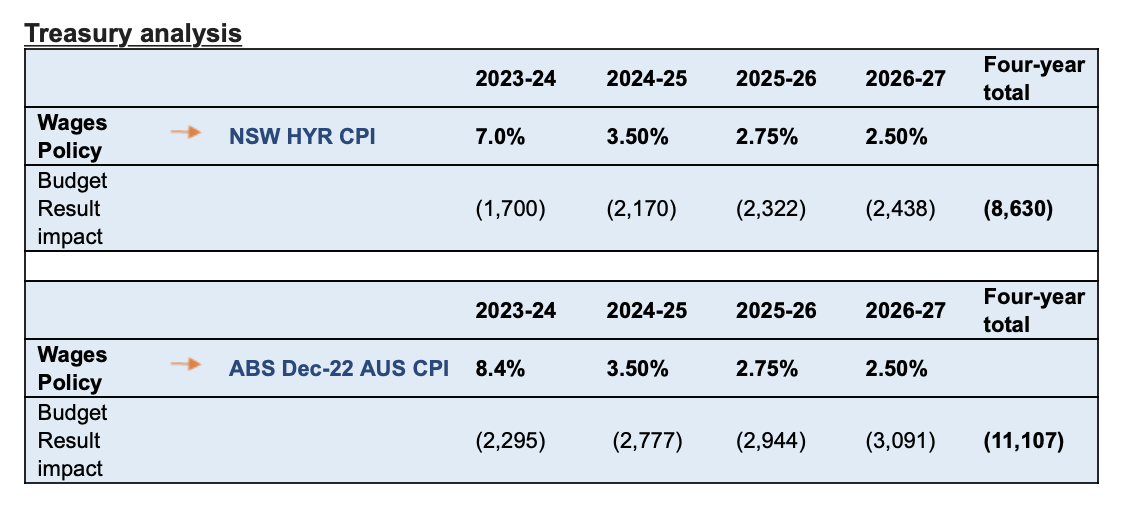
NSW Labor’s plan to scrap the public sector wages cap would blow an almost $9 billion black hole in the state’s budget, according to analysis from NSW Treasury.

Chris Minns will be forced to cut infrastructure projects or increase taxes to make up the shortfall given he has repeatedly said that public sector wages should keep up with inflation, otherwise they would amount to a pay cut.

Treasury analysis shows that if wage rises were in line with the current inflation forecast in the Half-Yearly Review it would blow an $8.6 billion black hole in Labor’s budget.

If NSW Labor used the latest ABS CPI indicator, it would cost $11.1 billion over four years.

Premier Dominic Perrottet said removing the wages cap and aligning wages with inflation would have disastrous consequences for the entire state.

“Our long-term economic plan will continue to provide record investments in road and rail projects that generate jobs and help future-proof our state,” Mr Perrottet said.

“The Liberal and Nationals have funded the biggest infrastructure program in NSW history because of hard fought financial management.”

Labor leader Chris Minns told media a fortnight ago: “It’s really important to know that the system that we’re bringing in New South Wales is to scrap the wages cap.”

“NSW Labor are putting our record infrastructure pipeline at risk because they have multi-billion-dollar budget black hole,” Mr Perrottet said.

“NSW Labor will need to cut metros, motorways and our cost of living relief measures to pay for their public sector wage increase.

“The NSW Labor plan to unleash public sector wages is a recipe for economic disaster that will stall our economy and take NSW backwards.”

Treasurer Matt Kean said Labor’s Daniel Mookhey had ruled out increasing borrowings and raising taxes which begged the question of how Labor would pay for its wages policy.

“As Treasurer I know the damage a multi-billion-dollar black hole would do to the budget, the economy and the opportunities for future generations – and it’s a price not worth paying,” Mr Kean said.

“If Labor is true to its word then it will have submitted its policy of CPI wage increases to the Parliamentary Budget Office and it should come clean on how it plans to fund the billions of dollars it will cost.

“If Labor has back-flipped on its promise, then it needs to be truthful and explain why. If it hasn’t, it needs to explain exactly which projects and services will be cut to meet the $8.6 billion shortfall.”

NSW public sector workers have experienced real wages growth over the past decade. The current 3 per cent cap plus an additional 0.5 per cent for productivity measures is far more generous than Labor-run Victoria.

Treasury-Analysis.png

Over 400 scholarships awarded to state’s budding interpreters

The state’s pool of language professionals has grown substantially over the past four years thanks to the NSW Government exceeding its election commitment to fill 400 positions through the Multicultural NSW Interpreting Scholarship Program.  

Facilitated by a number of educational institutions, including TAFE NSW, University of NSW and RMIT, the program has enabled people speaking more than 50 different languages and dialects to join the NSW Government’s interpreting ranks. 

Minister for Multiculturalism Mark Coure said the Interpreting Scholarship Program empowers people to use their language skills as a career and help their communities access government information and services.

“We have seen through the latest Census data that more and more people are speaking a language other than English at home, including new and emerging languages that weren’t prominent in communities five, ten or even fifteen years ago,” Mr Coure said. 

“We have worked with various universities and TAFE NSW so the program could evolve to train those who speak these languages and have them become qualified interpreters.

“By doing this, we have been able to bolster our interpreting ranks with a greater breadth of language capabilities and ensure we have the people available to support our state’s diverse communities.”

The program’s most recent graduates include TAFE and university-trained interpreters speaking Amharic, Dari, Hazaragi, Kannada, Karen, Mongolian, Swahili and Tamil.

NSW Federation of Community Language Schools president Lucia Johns said the program was further evidence of the value of multi-lingual study.

“Language is one of NSW’s greatest cultural, social and business assets. So it cannot be ignored and must be fostered and developed. By teaching children languages at community language schools throughout the state we are protecting and guaranteeing our future linguistic skills,” Mrs Johns said.

“Children who learn a second language at community languages schools will have the option of developing a career in interpreting and translation which benefits all aspects of our society.”

Mr Coure added that the program had attracted a great mix of people of various ages across the state interested in using their language skills as a career, including from regional NSW. 

“More than 20 per cent of students participating in the program are from regional NSW, which shows our multicultural state isn’t in one city or suburb,” Mr Coure said.

“We have also had many people from refugee backgrounds use their language skills to gain employment and support their community. This year alone, 30 per cent of scholarship participants were on refugee or special humanitarian visas.

“Everyone who completes the program and attains their certification can join our expert panel of language professionals.”

Through the 2022-23 NSW Budget, $16 million was secured over two years to improve the state’s whole-of-government language service. 

“The NSW Government understands that a strong and robust language service is key to a future without barriers for diverse communities, and ensure no one is restricted in accessing information or services because of the language they speak,” Mr Coure said. 

For more information about the Multicultural NSW Interpreting Scholarship Program, visit multicultural.nsw.gov.au.  

Languages Spoken by Scholarship Students
AmharicFilipinoKurdish- KurmanjiThai
ArabicGreekMacedonianTibetan
Arabic/SudaneseHakha ChinMalayalamTigrinya
AssyrianHazaragiMongolianTongan
BurmeseHmongNepaliTurkish
ChaldeanHungarianPersianTwi
Chinese HakkaIgboPortugueseUkrainian
Chinese-Chiu ChowIndonesianSamoanUrdu
Cook Islands MaoriItalianSerbianUyghur
CreoleKannadaSomaliVietnamese
DariKarenSpanishZomi Chin
DinkaKhmerSwahili 
EweKinyarwandaTamil 
Fiji HindiKirundiTelugu 
FijianKrioTemne 

Bonnyrigg’s multimillion dollar housing boom

The NSW Liberal and Nationals Government’s $855 million Bonnyrigg Renewal Project is moving into its next delivery phase in stages 8 to 11, following the appointment of a development partner to deliver 275 more homes including 65 new social homes for Western Sydney.

Minister for Planning and Minister for Homes Anthony Roberts said 702 dwellings, including 256 social homes had already been completed in earlier stages 1 to 7 of the state-significant urban renewal project.

“This is an ambitious project that is transforming the former Bonnyrigg social housing estate in Western Sydney to become a vibrant, mixed-tenure precinct, by taking 833 ageing social properties and creating 3,000 new homes for residents, 900 of which are dedicated for social housing,” Mr Roberts said.

Minister for Families and Communities and Minister for Disability Services Natasha Maclaren-Jones said the NSW Liberal and Nationals Government is committed to creating secure communities for the state’s most vulnerable.

“We are not only investing in housing where it’s needed most, but we’re creating a safe place for people to live and work. This precinct is providing more than just a roof over people’s head, it is providing a new community centre, open space, and town centre with a village green so residents can thrive,” Mrs Maclaren-Jones said. 

The project also makes great use of the existing Parramatta to Liverpool rapid bus transitway that is nearby.

Following a competitive procurement process to the market, the NSW Land and Housing Corporation (LAHC) has appointed Sydney-based developer Traders In Purple to deliver these next stages of the Bonnyrigg Renewal project.

LAHC Chief Executive Simon Newport said the Bonnyrigg Renewal displays how partnerships can deliver more homes for the community.

“We were able to secure $26.4 million of Commonwealth funding through the National Housing Infrastructure Fund, which unlocks critical infrastructure such as improvements to the road network that are crucial to delivering this type of project,” Mr Newport said.

“When all levels of government, community housing providers and industry come to the table with a shared vision to deliver more and better homes for the people who need it most, we can achieve great things and the transformation underway at Bonnyrigg is a shining example of that.”

As part of the earlier stages of the renewal project, Landcom has also managed the construction and completion of a $7 million 841 square metre community centre, using funds from LAHC under its voluntary planning agreement with Fairfield City Council.

Fairfield City Council Mayor Frank Carbone said the new community centre will be called The Hub @ Bonnyrigg (Dhanawi) and it will become a central focal point for all aspects of community life for local residents, with a large hall for social and cultural activities, meeting rooms, a kitchen and play areas for children. Council will own and manage the new facility moving forwards.

“The Hub @ Bonnyrigg (Dhanawi) will allow people to come together to meet and celebrate, with fully accessible facilities and a community garden. We are proud to have worked together with LAHC to design and deliver this facility for our community,” Mr Carbone said.

The transformation of the Bonnyrigg Estate is a major 30-year project that will be delivered over 18 stages, creating 4,275 jobs and delivering homes for more than 9,000 residents.

Works on the latest stage of the development are set to commence in April 2023.

For more information, please visit www.dpie.nsw.gov.au/land-and-housing-corporation/greater-sydney/bonnyrigg-estate

Boost for walkers and cyclists in Manly

A new pedestrian and cycling bridge will be built over the Manly Lagoon in Queenscliff after securing $3.95 million in funding from the Liberals and Nationals Government. 

Minister for Active Transport Rob Stokes said the investment would make it safer to walk and cycle around the Northern Beaches, delivering on the aims of the NSW Government’s Active Transport Strategy.

“The unprecedented funding commitment for walking and cycling by the Liberals and Nationals Government’s is all about making it easier for local families to move around, and this investment will have a transformative impact,” Mr Stokes said.

“This funding will allow for the construction of a new four-metre wide shared pedestrian and cycling bridge alongside Pittwater Road, delivering on our Strategic Cycleway Corridors plans for the Eastern Harbour City.”

Member for Manly James Griffin said the new bridge delivers on longstanding calls from the local community for this project, delivering a win for the people of Manly.

“This project resolves a significant chokepoint in our local walking and cycling network. Whether you’re riding to Manly Wharf as part of your daily commute or enjoying our beautiful coastline on the weekend, this investment will make a world of difference to the everyday needs of our local community,” Mr Griffin said.

“We know that the biggest barrier to people taking up cycling is concerns about riding on the road, so this project will encourage more people to leave the car at home and save on the household budget.”

Construction on the bridge is expected to begin mid-2024 following detailed design. The investment is part of the Liberals and Nationals’ record $950 million investment in active transport across NSW, transforming local communities and making every day better and easier for families.

For more information about the Get NSW Active program, go to: Get NSW Active | Transport for NSW.

Sydney set for stunning city high line

Sydney will have its own high line to rival Paris and New York, with a re-elected NSW Liberals and Nationals Government committing to transform the rail corridor from Lavender Bay to Waverton into a new public space with sweeping views of the world’s best harbour.

The Lavender Bay high line project would start with a 300 square metre expansion of Wendy’s Secret Garden, followed by a strategic business case to canvas options for converting the 3.3-kilometre-long disused rail corridor along the Milsons Point foreshore.

Premier Dominic Perrottet said the project would return the Milsons Point foreshore to the local community as a spectacular harbour front attraction.

“Sydney is home the world’s most beautiful harbour, but for many years much of the foreshore has been left underutilised or inaccessible to the public,” Mr Perrottet said.

“We have made it a priority to transform our foreshore precincts so that Sydneysiders can make the most of the city they call home.

“The Lavender Bay high line project will unlock another part of our city that has been hidden away for more than a century, transforming it into a beautiful public space and no doubt a tourism drawcard.”

Minister for Infrastructure, Cities and Active Transport Rob Stokes said this commitment to delivering the community’s vision would create a world-class linear park and walking trail linking other public spaces in North Sydney.

“Once fully realised, this vision will result in a 3.3 kilometre linear park connecting some of Sydney’s most iconic landmarks including the Sydney Harbour Bridge and Luna Park while traversing public spaces like Wendy’s Secret Garden, Ball’s Head Reserve and Lavender Bay Parklands,” Mr Stokes said.

“We’ve committed to working with the community, including the Sydney Harbour High Line Association and Wendy’s Secret Garden volunteers to turn the vision into reality, starting with new landscaping, weed eradication and new tree plantings.”

Member for North Shore Felicity Wilson applauded the local community for their vision and pursuit of the high line, working alongside her to build on the legacy of Wendy Whiteley and the Secret Garden volunteers to expand public space from railway land.

“We get to call the most beautiful harbour in the world home – and our community has championed a transformation that will ensure visitors from across Sydney and the globe get to share in this iconic location,” Ms Wilson said.

“At a time where our cities are growing and more of us are calling apartments home, the shared vision of the Sydney Harbour High Line Association and the NSW Liberals and Nationals will ensure we retain beautiful places with the open space and active transport we need.”

Transport for NSW and North Sydney Council will work together to facilitate the use of the Land by Council for community use as public open space and active transport connections.

The Lavender Bay Rail Corridor Delivery Group will include representatives from Council. TAHE, Sydney Trains, Transport for NSW and the Sydney Harbour High Line Association.

New ambulance station for Illawarra community

Frontline emergency care for residents in the Illawarra has received a major boost, with a new ambulance station set to be built near Unanderra.

Minister for Health Brad Hazzard said the announcement forms part of a record $1.76 billion NSW Government investment which will transform NSW Ambulance services over the next four years with more than 2,000 extra staff, including 1,858 paramedics, and 30 new ambulance stations across NSW.

“Ambulance services are experiencing unprecedented demand and this new station will not only keep us ahead of the curve but provide our hardworking paramedics with first-class facilities as they assist communities in their time of need,” Mr Hazzard said. 

“The NSW Government is investing in ambulance stations right across the state to ensure communities continue to receive emergency care when they need it, no matter where they live.”

Parliamentary Secretary for Wollongong and the Illawarra Peter Poulos welcomed the news which he said will ensure the local community has improved access to emergency care when and where they need it most.

“The investment will also bring more jobs to the local area as well as providing a better working environment for our paramedics who are doing their utmost to serve communities across the state,” Mr Poulos said.

“The new station will feature internal parking for emergency ambulance vehicles, vehicle wash facilities, staff parking, multipurpose spaces to support staff education and rest, logistics and storage spaces, an office area for administration as well as staff amenities.”

NSW Ambulance identifies suitable locations to improve ambulance response times for patients using best practice modelling software that maps Triple Zero call demands.

The new ambulance station at Unanderra is being delivered as part of the $615.5 million NSW Ambulance Infrastructure program, which is also delivering a new ambulance station at Warilla. Both new ambulance stations are in addition to the existing station in Wollongong and the new ambulance station underway for Fairy Meadow which will be located on the University of Wollongong’s Innovation Campus.

Minister Hazzard said the exact location for the new ambulance station at Unanderra will be determined once further planning is completed which includes working with key stakeholders to identify a suitable site.

“We will shortly commence a process to identify potential sites for the new ambulance station. This process will ensure we best meet the needs of the Illawarra community and our emergency staff and is currently underway for the Warilla location.”

The NSW Government is committed to increasing the capacity of NSW Ambulance. In total, more than $1 billion is being invested across three major NSW Ambulance infrastructure programs, with more than 100 projects announced since 2014.

The NSW Government’s $1 billion investment in NSW Ambulance infrastructure includes:

· Sydney Ambulance Metropolitan Infrastructure Strategy ($184 million) – 19 projects – 18 of these projects have been completed to date with one due for completion in late 2023. The program began in 2014

· NSW Ambulance Infrastructure Program ($615.5 million) 30 projects – eight of which are in early planning. The program was announced in 2022-23 State Budget.

· RAIR program Stage 1 & 2 ($232 million) – 54 projects – 39 of these have been completed, with 15 underway. The program began in 2015.

Creating strong communities of the future

A re-elected Liberal and Nationals Government will commit a further $90 million to the Stronger Country Communities Fund to continue building the projects that make regional NSW the best place to live, work and raise a family.

In the past five years, the Stronger Country Communities Fund has delivered more than 2,500 grassroots projects benefitting every regional LGA in the State.

Deputy Premier and Minister for Regional NSW Paul Toole said the further $90 million commitment would take the total investment in the fund to three quarters of a billion dollars.

“Everywhere I go, people tell me about the big difference these Stronger Country Communities projects make to everyday life – whether it’s a new skate park that kids love, a new community hall, upgrades to the main street or programs that make living in the regions even better,” Mr Toole said.

“We aren’t just building playgrounds and sporting ovals, we’re building communities to be proud of.

“It’s the little things that make a big difference to the way we all work, live, play and do business, and the NSW Liberals and Nationals  Government is  delivering the projects that make a difference to everyday life right across regional NSW, from Byron Bay to Bega to Broken Hill.

“Not only do these projects improve life for those who already call regional NSW home, but they also act as a major drawcard for those visiting to consider staying longer term.”

The Stronger Country Communities Fund is part of the NSW Liberal and Nationals Government’s $3.3 billion Regional Growth Fund, designed to support growing regional centres, activate local economies and improve services and community infrastructure in the regions.

For more information, visit: nsw.gov.au/sccf