
East End revitalisation taking shape

The long-term revitalisation of the Hunter Street Mall is a significant step closer, with work being finalised on the first stage of the East End Village project.

The $5 million first stage has seen new paving, service upgrades, street furniture, and increased ground cover and trees on Hunter Street, at the block bound by Wolfe and Perkins Street, and includes significant upgrades to stormwater and drainage, cycleways and footpaths.
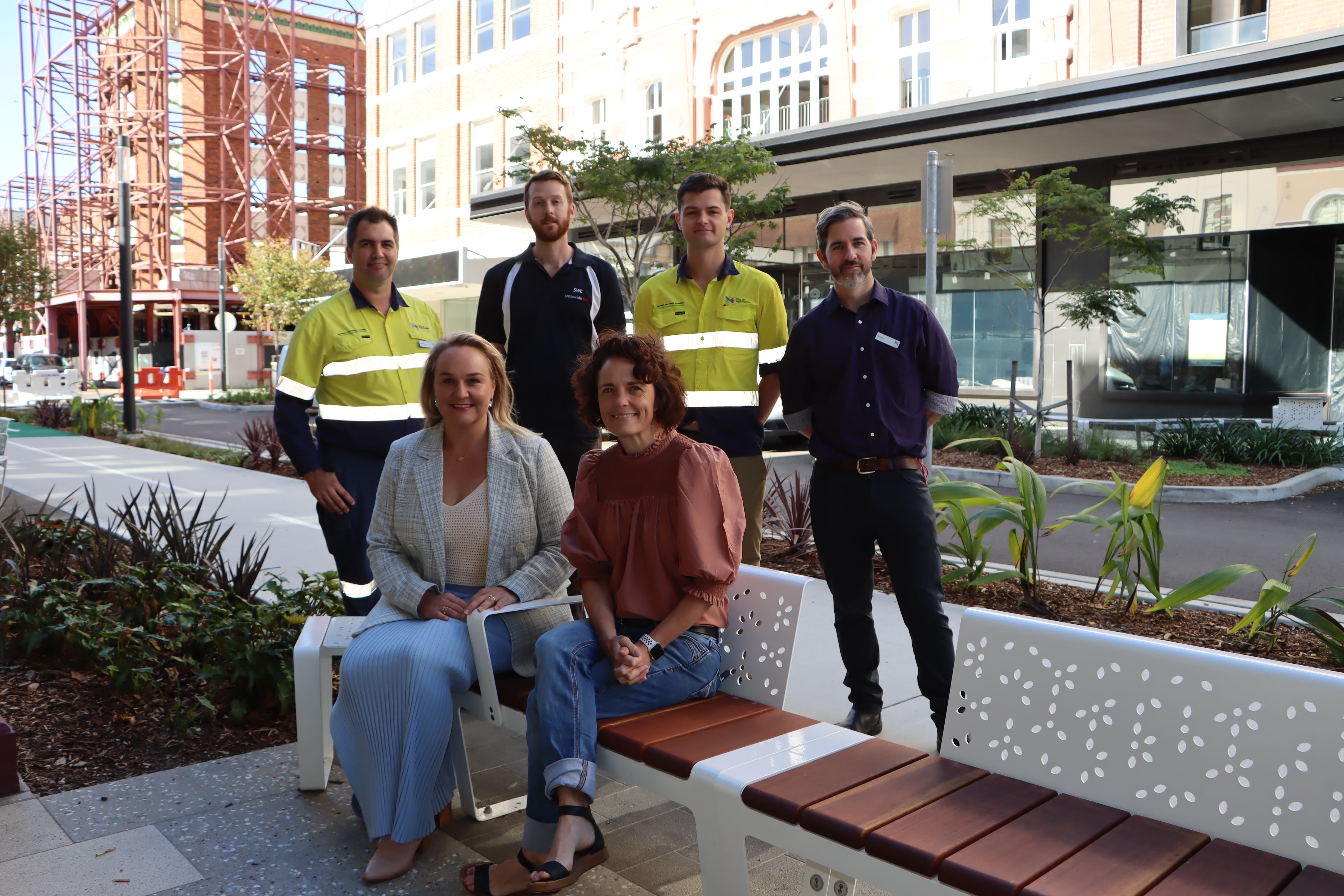
Lord-Mayor-Nuatali-Nelmes-with-Angela-Hailey-from-Studio-Melt-with-the-project-team-and-construction-contractor.JPG
Lord Mayor Nuatali Nelmes said that stage one is a step towards positioning the precinct as a traditional high street and attractive shopping destination for locals and visitors.

“We have invested five million dollars into the first stage of public domain works in our cultural heritage precinct at the east end.

“It’s wonderful to see our long term vision for the former Hunter Street Mall take shape. Delivering these outcomes for our community have taken significant collaboration, public and private sector investment. It’s wonderful to see our plans become a reality,” Councillor Nelmes said.

“Delivering Stage 1 has been a significant undertaking and the complete renewal of the streetscape brings a level of excitement and anticipation for the future because the public now has a very clear understanding of what an upgraded precinct will look like for Newcastle.

“I’d also like to thank businesses and local residents for their patience during the construction period. We look forward to continuing to work together as we deliver a much improved and revitalised Hunter Street Mall area.”

“To celebrate the new and improved space, our community is invited to attend the ‘East End Party’ on Hunter Street from 2-6pm tomorrow, Saturday 7 May. I encourage everyone to come out, support local business and see what’s been delivered in this unique part of our city.”

The East End Party, which is being run as part of the Autumn Alive program, will showcase the nearby businesses, and provide people an opportunity to explore the upgraded block and recently completed piazza. The event will put a spotlight on local products and will also include live music, roving entertainment, food stalls and interactive spaces. City of Newcastle will also be on hand to share photos, maps and architectural renders for anyone interested in finding out more about the East End Village.

Chair of the City/Darby Street Business Improvement Association Mike Chapman said the group was happy to see the initial section of works be delivered in this unique part of Newcastle.

“These works bring a level of excitement for the future, and we would like to invite anyone interested to come along for the community event on Saturday. It will be a great opportunity to showcase our unique businesses and traders and show off what great local products we offer in the East End.”

The second phase of construction, which will target Hunter Street between Perkins and Brown Street, is scheduled to commence late 2022.

The East End Village is being delivered under the City Centre Revitalisation Program, one of Newcastle’s four Priority Projects. Visit www.newcastle.nsw.gov.au/eastend for more information.

NAPLAN BEGINS ON TUESDAY 10 MAY  

The annual NAPLAN assessment begins tomorrow, with 1.2 million students set to take the test in more than 9,500 schools and campuses across Australia.

This year marks the final year of transition to online testing, with all schools across Australia now participating in NAPLAN tests online.

“NAPLAN online is a better, more precise assessment that is more engaging for students,” ACARA CEO, David de Carvalho, said.

“The tailored testing means students are given questions that are better suited to their abilities, so they can show what they know and can do.

“NAPLAN online also has a variety of accessibility adjustments, so that students with diverse capabilities, learning needs and functional abilities are able to participate.

Mr de Carvalho said NAPLAN was entering a new era, with 2022 being the first year all schools will take the test online and the last year that the test will take place in May.

“Earlier this year, education ministers announced that NAPLAN will move from May to March from 2023, so results will be available to education authorities earlier in the year to inform school and system teaching and learning programs,” said Mr de Carvalho.

“These changes mean that the valuable NAPLAN data will be more useful to teachers, schools and education authorities.”

NAPLAN tests are the only measure governments, education authorities, schools and parents/carers have to see whether young Australians are reaching important literacy and numeracy goals using a national, objective scale.

“This year’s test is particularly important so that we can add to a national data set and continue getting insight into the impact the pandemic has had after 2 years of disruptions to schooling,” Mr de Carvalho said.

“The last 2 years have been challenging for schools, parents and students, with disruptions such as lockdowns, floods and COVID cases keeping students out of the classrooms at times.

“Contingency plans are in place in each state and territory, as they were last year, and jurisdictional testing authorities can support schools that need flexibility and help completing NAPLAN due to disruptions caused by COVID, flooding or other reasons.”

Mr de Carvalho said no extra preparation is required for NAPLAN and that there is no need for students to feel anxious about the assessment.

“NAPLAN tests literacy and numeracy skills that are continuously being developed in the classroom. Like any test or challenge students face at school, you should simply remind your child to do the best they can on the day of the test.”

Greens policy platform delivers on “In One Generation” campaign demands

The Greens welcome the comprehensive In One Generation report from the National Women’s Safety Alliance today, and are proud to support its 20 priority actions. The Greens are calling on all other parties to match their commitment to fully fund frontline services, eliminate violence against women and deliver economic security.

Greens deputy leader and spokesperson on women Senator Larissa Waters said:

“The National Women’s Safety alliance has shown that ending violence against women within one generation is possible, if there is genuine commitment and funding to make it a reality. 

“There have sadly been 18 women killed by violence already this year. It’s a national crisis and we need to treat it like one.

“The Greens are proud that our election policy platform backs the policy asks laid out by the In One Generation campaign and we call upon all other parties to commit to those policies too.  

“The Greens have been fighting hard for progress on all these issues for decades alongside victim-survivors, activists and women’s organisations.

“Our policy to end gendered violence calls for a self-determined National Plan for First Nations Women and Girls, $1 billion per year to fully fund frontline and prevention services for the life of the plan, $477 million for consent education, $10,000 Survivor Grants, and stronger, consistent national laws governing domestic, family and sexual violence.

“We will reform the family law system and double legal assistance funding so women can get the advice and representation they need to protect themselves and their children.”

“We will help build a strong and trauma-informed workforce, and ensure frontline services, banks, teachers, healthcare workers, police and judges recognise and understand the dynamics of abusive relationships and how to help people affected by them”

“First Nations women, women from culturally diverse backgrounds, women in regional areas, older women, LGBTIQ+ women, and women with a disability are even more likely to experience violence and economic insecurity, and must be involved in the development and implementation of all policy responses.

“We will ensure that victim-survivors’ guide all decisions made under the National Plan, and we will invest in behaviour change and recovery programs to help victim-survivors rebuild their lives.”

“We have introduced legislation for ten days paid DV leave, pay transparency, and full implementation of the Respect@Work recommendations, including a positive duty on employers.

“We will build 1 million publicly owned houses and protect renters so every Australian can have access to a safe home.  We will increase the supply of crisis and transitional accommodation for women and children fleeing violence, and support Safe at Home programs.

“We have a comprehensive plan for free universal childcare, and fully costed proposals to expand paid parental leave to 26 weeks, facilitate more equitable sharing of care roles, lifting wages, closing the gender pay gap and increasing workforce participation.

“Ending violence against women within one generation is possible. But the Morrison Government has shown a complete unwillingness to take the action needed to make it happen.  That’s why Australian women need to vote them out and put the Greens in balance of power this election.”

Learn More:

Greens policies: End Gendered Violence & Gender Inequality

Greens will ban clearing of koala habitat with no exceptions

The Australian Greens say alarm bells are ringing over reports NSW will continue to allow the clearing of koala habitat under new rules for private landowners. 

Greens spokesperson for the environment, Senator Sarah Hanson-Young, said outlawing the clearing of koala habitat with zero exceptions is the only way to save our iconic species.

“You can’t save koalas while continuing to wreck their homes. Unless we take urgent action to end clearing of critical habitat, they will be extinct in NSW by 2050.

“Koalas were listed as endangered just months ago, and yet governments continue to approve projects that will destroy their habitat.

“The Greens ‘Save the Koala Bill’, currently before the Senate, would stop the wanton destruction of our iconic species’ homes.

“Experts have been warning us for years that habitat loss, climate change and extreme weather events like bushfires have been putting our national treasure, the koala, at risk. Yet the Morrison Government has approved the clearing of 25,000 hectares of koala habitat for mining and property development.

“We cannot trust the Morrison Government to take urgent action on koalas, when they only just managed to pull together a recovery plan – 10 years since its vulnerable listing.

“A moratorium on clearing of koala habitat is crucial. The Greens in the balance of power will push for the Save the Koala Bill to be made the law.  

“Unless we want to see our koala extinct in a few decades, it is an easy choice. We must put an immediate end to clearing their habitat, no exceptions.”

A stronger future for Australian small business

A re-elected Morrison Government will help create 400,000 small and family businesses and back programs to help them cut their overhead costs.

The new pledge to support the creation of 400,000 new small and family businesses over the next five years comes as the Morrison Government invests $17.9 million in the Business Energy Advice Program (BEAP) to help businesses navigate the electricity retail market and adopt more efficient technologies to reduce their energy cost.

“When we create small businesses, we create jobs,” the Prime Minister said.

“Our plan for a strong economy and a stronger future for all Australians relies on strong small businesses.

“That means keeping taxes at record lows, slashing red tape, backing trades training and apprentices, signing new trade deals to create new export markets, and ensuring businesses can tackle the overhead costs of electricity prices.

“We have the track record to set the conditions that help create businesses, and our ambitious pledge will see 400,000 more join our economy.”

New data from the ATO also shows the Morrison Government’s unprecedented tax incentives have driven $23 billion of business investment in the last year. With more than $21.8 billion of business investment from our expanded instant asset write off and an extra $1.2 billion paid through the loss carry back initiative, we’re still seeing the benefits flow today.

Notwithstanding the largest economic shock since the great depression, non-mining private business investment grew by 10.8 per cent through the year to the June quarter 2021, on the back of the Government’s business investment incentives. This is expected to continue with non-mining business investment forecast to grow by 7 per cent in 2021-22 and 9 per cent in 2022-23, reaching the highest share of the economy since 2011 in the June quarter of 2023. Overall our incentive programs are expected to support $320 billion of business investment and create an additional 60,000 jobs by the end of June 2023.

Minister for Industry, Energy and Emissions Reduction Angus Taylor said the expanded BEAP would benefit high energy using businesses in the accommodation, hospitality, agricultural, and our manufacturing sectors.

“Since we launched the BEAP in 2019, over 13,000 small businesses have accessed the service to learn more about their energy bills, to plan energy audits, identify energy savings opportunities and ultimately lower their power bills,” Minister Taylor said.

“Practical programs like this, alongside the Energy Efficient Communities program and the Hotel Energy Uplift program, have supported thousands of small businesses across Australia to invest in equipment upgrades and save money on their energy costs.

“The extra investment in the Business Energy Advice Program will see an extra 15,000 sessions and combined with our $60 million Powering Business program and the instant asset write off, we’re giving small and medium businesses the tools to lower their costs, increase their productivity and ultimately grow their businesses.”

The expanded Business Energy Advice Program will deliver advisory services to small and medium businesses as well as micro businesses (with 0-5 employees) affected by natural disasters and other hardships. The Government is also enhancing the BEAP small business energy check tool.

Minister for Employment, Workforce, Skills, Small and Family Business Stuart Robert said the Government continued to back small businesses to grow and create jobs as part of our plan for a stronger future.

“We’ve seen more than 100,000 small and family businesses start up in the last 12 months alone and we know what is needed to help create even more,” Minister Robert said.

“Our Plan reinforces our commitment to small and family business with a comprehensive package of measures to support small businesses to grow, innovate and create more jobs.

“It builds on our small business investment incentives, including a 20 per cent bonus tax deduction on the costs of external training for employees and a 20 per cent bonus tax deduction on investing in new technology, up to $100,000 per year.

“Our recent Budget also reinforces our commitment to small and family business with a comprehensive package of measures to support small businesses to grow, innovate and create more jobs.

“From $5.6 million for a dedicated small business unit in the Fair Work Commission to $8 million to the Australian Small Business and Family Enterprise Ombudsman making it easier to access expert advice, $4.6 million to extend Beyond Blue’s NewAccess for Small Business Owners program, $10.4 million to enhance and redesign the Payment Times Reporting Portal and Register, and $2.1 million for Financial Counselling Australia’s Small Business Debt Helpline making it easier for small business owners to receive financial advice.

“Labor does not support enterprise, aspiration or small business. Labor have repeatedly voted for higher taxes and higher costs for small business and want to return union lawlessness to the construction industry by abolishing the Australian Building and Construction Commission and the Registered Organisations Commission.

“With plans for $302 billion in extra spending proposed by Labor, we know that when they start spending they can’t stop. They can’t manage money so they always come after yours.”

Read more about our plan for small and family business here.

New linear accelerator to further improve cancer care in Tasmania

A new linear accelerator has been officially launched today at the North West Regional Hospital’s Cancer Centre in Burnie Tasmania, improving access to life saving cancer care in the State.

Linear accelerators are used to generate beam radiation treatments for patients with cancer, using high-energy x-rays or electrons to destroy the cancer cells without damaging the surrounding tissue.

Minister for Health, Greg Hunt, said the Morrison Government provided $4.4 million to purchase and install the linear accelerator, the second to be installed at the North West Cancer Centre.

“This new linear accelerator will increase access to radiation treatments for Tasmanians with cancer, making it easier to get the treatment they need,” Minister Hunt said.

“We expect the linear accelerator will be fully operational this month, delivering on our Government’s commitment to ensuring all Australians can access world-class technology and expertise to improve health outcomes and quality of life.”

The new linear accelerator was funded through the $1.25 billion Community Health and Hospitals Program (CHHP), delivering improvements to local health and hospital services, including cancer treatment, rural health and hospital infrastructure.

Tasmanian Premier, Jeremy Rockliff, said the North West Cancer Centre provides outpatient Medical Oncology and Radiation Oncology and clinical Haematology services to the communities of North West Tasmania.

“The Tasmanian Liberal Government has committed $8.1 million to operate and staff the linear accelerator facility, as part of the $60 million redevelopment of the North West Regional Hospital,” Premier Rockliff said.

“With staffing levels to be increased over time to respond to demand, the linear accelerator will allow the North West Regional Hospital to effectively doubling its current capacity, enabling more cancer patients to receive lifesaving radiation therapy or chemotherapy each year in the North-West.

“This new piece of equipment is helping to grow the local economy, creating local jobs in construction and support, and paving the way for more jobs in health for the longer term through its ongoing operation.”

Federal Member for Braddon, Gavin Pearce, said operating a new linear accelerator at the North West Regional Hospital will meet the increased local demand for cancer care.

“The North West Cancer Service has experienced increased demand for radiation oncology services,” Mr Pearce said.

“Thanks to this investment by the Morrison and Tasmanian Governments there will be far more services available for local patients, keeping them closer to home and their loved ones while they are undergoing life saving treatment.”

The Morrison Government is providing $34.4 million through the CHHP to the Tasmanian Liberal Government to improve health and hospital services across Tasmania. A further $7.4 million is also being provided through the CHHP to non-government organisations to support improved health services in the State.

The CHHP was announced by Prime Minister Scott Morrison in December 2018 and is designed to deliver local health and hospital services in every state and territory targeting four key areas:

  • Specialist hospital services such as cancer treatment, rural health and hospital infrastructure
  • Drug and alcohol treatment
  • Preventive, primary and chronic disease management
  • Mental health

Autonomous undersea warfare capability for Australia’s navy

The Morrison Government is pursuing a new autonomous robotic undersea warfare capability for the Royal Australian Navy (RAN) to complement its submarine and surface fleet.

Defence and Anduril Australia will co-fund a program to design, develop and manufacture Extra Large Autonomous Undersea Vehicles (XLAUV) in Australia for capability assessment and prototyping.

XLAUVs are cutting-edge uncrewed robotic vessels. They are a stealthy, multi-role, undersea capability, typically between 10-30 metres long, with the capacity to carry various military payloads over long distances.

This capability would potentially complement and enhance the agility and potency of the Navy’s current submarine and surface combatant force in maintaining peace and stability in the Indo-Pacific region.

The vessels would also give the Australian Defence Force innovative mission options while presenting a disruptive and difficult undersea problem for any adversary.

Through the co-funded arrangement, the RAN, Defence Science and Technology Group and Anduril will produce three prototype XLAUVs over the next three years resulting in a manufacture ready XLAUV. The program will also incorporate Australian Small to Medium Enterprises (SMEs).

This ambitious build schedule will develop the foundation of a sovereign-based XLAUV fleet while strengthening Defence’s understanding of the technology associated with operating these platforms.

Anduril was selected as a breakthrough defence industry participant offering innovative solutions and products through rapid prototyping in high-risk technical environments.

This is a great example of a capability acceleration initiative using the innovation funding identified in the 2020 Force Structure Plan, under the auspices of the Robotics Autonomous Systems Sovereign Industrial Capability Priority (RAS SICP) announced in August 2021.Ongoing industry engagement, and concerted efforts in broadening Australia’s Autonomous Undersea Vehicles industry, will ensure Defence is at the forefront of Robotics Autonomous Systems and undersea warfare developments.

Cutting edge self-defence missiles for navy’s ships

The Morrison Government is investing more than $2 billion to deliver a more advanced self-defence capability for our Royal Australian Navy (RAN), which will provide our Australian Defence Force (ADF) with the most advanced technology to protect against anti-ship missile threats.

The purchase of the Evolved Sea Sparrow Missile (ESSM) Block 2 capability for our ADF, is a key pillar in shaping, deterring and if necessary, responding to protect Australia’s interests in a strategically complex environment.

The ESSM Block 2 is a highly advanced surface to air missile, capable of defeating modern advanced air and missile threats. The ESSM Block 2 incorporates an advanced active radar missile seeker and has a range in excess of 50km.

The first tranche of these weapons have already arrived in Australia for initial integration and testing purposes. The ESSM Block 2 will be embarked in the RAN’s Surface Combatant Force, including the Anzac Class frigates and Hobart Class destroyers.

This investment will directly support Australian jobs through Defence industry supplying components for ESSM Block 2 production internationally.

Suppliers to ESSM Block 2 production include BAE Systems Australia, L3 Harris, and G H Varley, with production and supporting roles based in Adelaide, Melbourne, Brisbane, and Newcastle.

Australian industry will continue to support increasing rates of missile production, and further opportunities for Australian industry involvement are being pursued in missile component manufacture and integration.

Delivery of the ESSM Block 2 is facilitated by Australia’s participation in the North Atlantic Treaty Organisation (NATO) Sea Sparrow Consortium.

Australia’s participation in the Consortium provides Navy with access to important technical information, strengthens the relationship with NATO and shares the cost associated with developing a very effective capability for defeating anti-ship missiles.

As Consortium partners, Defence and Australian industry have completed a significant amount of work to develop the ESSM Block 2 to date.

Aspen Medical scandal shows we need to kick the corporations out of Canberra

The Greens say the Aspen Medical scandal confirms the Morrison Government as the dodgiest and most irresponsible in Australian history.

Greens deputy leader and spokesperson on democracy Senator Larissa Waters said:

“At a time when the cost of living and rents are soaring, when many Australians are having to choose between buying school books for their kids or putting food on the table, we learn of yet another Morrison Government favour for its corporate mates.

“Keeping people safe during the pandemic was a critical government role. Robust and transparent procurement of PPE was essential, yet the government handed more than one billion dollars to a Liberal-linked company with zero experience in large-scale procurement with no tender process. Minister Hunt even wrote them a letter of endorsement!  

“The government has form with this kind of reckless spending and disregard for due process. Malcolm Turnbull ignored transparency rules and gifted $444 million to the Great Barrier Reef Foundation, entrusting protection of one of Australia’s most precious assets to a fledgling organisation with only a handful of staff. 

“When Peter Dutton needed someone to run his inhumane refugee prisons, he awarded $423 million without tender to the Paladin Group, an inexperienced firm with almost no money and a head office at a beach shack on Kangaroo Island.

“This government is addicted to outsourcing critical services, which makes everything more expensive and less transparent. They have hollowed out the Australian Public Service and waste billions on private companies and consultants instead – who just happen to be generous political donors. 

“Instead of favours for donors, the Greens would invest in future pandemic preparedness with an independent National Centre for Disease Control making critical health decisions. We would build capacity to manufacture locally, and pay healthcare workers properly so we have a bigger workforce pool.

“We’d also restore the APS by lifting staffing to match 2012 levels, raising APS wages by 4% per annum over the next four years, and limiting outsourcing to labour hire firms and big consultancy firms.

“And we’ll continue our fight to restore public faith in our democracy by closing the revolving door between parliament and big business, banning dirty donations from dodgy industries, capping all other donations, implementing enforceable ministerial standards and establishing a robust and independent National Integrity Commission.”

“Scott Morrison has presided over more rorting than any Prime Minister before him. He has shown a complete disregard for transparency, due process and good investment of public funds. This is a government more interested in supporting its mates and buying elections, than in investing in a better future.

“It is the most secretive, unaccountable government in history and I cannot wait to see the back of them in three weeks’ time.”

Greens pledge to tax the big corporations to fund world-class hospital system for WA

The Greens have pledged $1.14 billion in extra federal funding for WA chronically underfunded hospitals.

This investment would be funded by repairing the broken ‘resource super profits tax’ (the PRRT), forcing big corporations to pay royalties on the gas they currently access for free.

The Petroleum Resource Rent Tax (PRRT), introduced in 1987, is meant to ensure that the public gets a fair share of the unearned revenue (rent) enjoyed by companies by virtue of having exclusive access to Commonwealth resources. 

Yet the majority of coal and gas corporations currently offshore their profits tax free.

By charging royalties on gas extracted in Commonwealth waters and wiping the obscene backlog of ‘tax credits’ used to avoid paying tax, we can raise over $92 billion over the next decade. 

The Greens will legislate to amend the PRRT, ensuring it does what it was designed to do – tax the big corporations fairly on their wealth so that we can fund the things we need to create a safer future for all of us, including but not limited to:

Repairing the broken PRRT is a key part of the Greens’ comprehensive plan to create a better life for all of us, by making the billionaires and big corporations pay their fair share of tax. 

The Australian Tax Office has referred to the gas industry as “systemic non-payers” of tax and acknowledged that despite earning tens of billions in income each year, the ATO expects no significant tax revenue to come from gas companies until “the mid-2030s”.

Instead of raising revenue from their rich mates, governments at all levels have cut services for the rest of us – like public health, education and social services.

In March, the AMA (WA) 2022 Public Hospital Report Card showed “the WA Government’s chronic underfunding of health has created the vulnerabilities that have plagued the system in recent years,” with health operational budgets “still in serial decline.” 

Australian Greens leader, Adam Bandt said:

“In just one year, 27 big gas corporations brought in $77b in income but paid no tax. 

“When a nurse pays more tax than a multinational, something is seriously wrong.

“The Greens will make big gas corporations pay their fair share of tax to help get dental into Medicare.

“Australia’s natural resources belong to the people, but Liberal and Labor are giving away our gas for free, losing billions of dollars that should be funding hospitals and schools.

“The people of WA currently contribute more tax through car registrations than the multi-billion dollar gas industry pays for gas. 

“WA is being taken to the cleaners by big coal and gas corporations, and Australians are being ripped off.

“No other business gets their raw materials for free, but Woodside, Chevron and Exxon get free gas from this tax rort and then make obscene profits that they send offshore.

“Mining and burning coal and gas isn’t just driving the climate crisis, these big corporations are driving the cost of living crisis too.”

Senator Dorinda Cox, Australian Greens Senator for Western Australia said:

“For decades, both Liberal and Labor governments have given billionaires and corporations massive tax handouts and tax breaks. 

“You know something is seriously wrong when billionaires like Gina Reinhart and Clive Palmer have more than doubled their wealth during a pandemic – and when our state gets more revenue from car registrations than we do from the multi-billion dollar gas industry. 

“While they get away with making huge profits, West Australians are missing out.

“Often, when we need healthcare, it is at a vulnerable time in our lives. By making oil and gas pay their fair share, we can properly invest in our hospital system, so that more West Australians can get the health care they need, when they need it.

“Taxing the billionaires and making them pay their fair share of tax would mean investments in a world-class hospital system in WA.

“We can deliver this, along with a home for all, thousands of well paid secure jobs in a renewables economy, and get dental into Medicare – all by making the billionaires and the big corporations pay their fair share.”