Life saving defibs for local sporting clubs

Grassroots sport will be safer for players, spectators and volunteers as part of a $500,000 push to install life-saving defibrillators at community facilities across NSW.

Minister for Sport Alister Henskens said 191 devices will be installed thanks to the latest round of the NSW Liberal and Nationals Government’s Local Sport Defibrillator Grant Program.

“With more than 8,500 people experiencing out-of-hospital cardiac arrest each year in NSW, this program provides sports with early access to a defibrillator in the worst case scenario,” Mr Henskens said.

“Since the Liberal and Nationals Government introduced this program in 2017, more than 2,000 defibrillators have been installed at sports facilities across NSW.”

The grants cover the full cost of equipment under the program with several sporting organisations receiving multiple devices.

Up to $3,000 was available per device and with more people participating in sport and active recreation, these devices will ensure our sports facilities are better-equipped to respond to life-threating emergencies.

Professor Jamie Vandenberg, Co-deputy Director of the Victor Chang Cardiac Research Institute, said nine out of every 10 people who suffer a cardiac arrest outside of hospital don’t survive.

“We want to change that statistic so it’s vital that we get as many defibrillators installed across NSW,” Mr Vandenberg said.

“Every one of these new devices could prove lifesaving and help us achieve our goal.”

More information about the program is available online.

Westinvest funds huge boost to sporting fields across Western Sydney

From grassroots junior sports teams to elite athletes, residents across North West and Western Sydney will benefit from a huge boost in funding for sports facilities, thanks to the NSW Government’s $5 billion WestInvest program.

Premier Dominic Perrottet, Treasurer Matt Kean and Minister for Sport Alister Henskens today announced more than $316.7 million in funding for local councils and community groups in the Blacktown, Blue Mountains, Parramatta, Cumberland, Fairfield, Hawkesbury, Strathfield and The Hills LGAs to deliver 15 new and upgraded sports facilities across Western Sydney.

The projects funded under the $1.6 billion WestInvest Community Project Grants – Competitive Round, range from new indoor and outdoor sports courts for basketball, netball and tennis, to upgrades to community ovals to support football and cricket to skate parks and new pools.

The projects include:

· $53.7 million for Cumberland Council to transform an underutilised site at Greystanes into a precinct for indoor and outdoor sport including netball, AFL, football, cricket, baseball, rugby league, rugby union, cricket, basketball, volleyball and badminton;

· $16 million for Fairfield City Council to upgrade the Endeavour Sports Park with a new synthetic field, sized for two soccer pitches, an AFL or a cricket pitch;

· $9.8 million for Hawkesbury City Council for the Tamplin Field redevelopment project for a new synthetic field to enable games, training and events in all weather;

· $5.6 million for the City of Parramatta Council to deliver the North Granville Community Open Space Upgrade project which will upgrade FS Garside Park and construct a natural turf football field and install new sports field lighting, seating and a regional sized playground.

· $3.5 million for the Blue Mountains Council to transform the Pitt Park Athletics oval into a dedicated state-of-the-art athletics sporting precinct. 

· $1 million for The Hills Shire Council to transform Fred Caterson Reserve in Castle Hill to support a range of indoor and outdoor sports.

· More than $573,000 for the Strathfield Municipal Council to deliver the Upgrade to Cooke Park Skatepark project to provide state of the art facilities to young skaters. 

Premier Dominic Perrottet said a sporting club is the heart and soul of a local community and WestInvest is enabling communities in North West and Western Sydney to grow, exercise and thrive.

“From the Pitt Park athletics complex in the Blue Mountains, Fred Caterson Reserve in The Hills to Tamplin Field in Hawkesbury, local communities across will benefit from a huge variety of sporting facilities funded by WestInvest,” Mr Perrottet said.

“Through the WestInvest fund we are laying the foundations to support for the next Harry Kewell, Pat Cummins, Alana Kennedy, Ian Thorpe and Paige Hadley.”

Treasurer Matt Kean said WestInvest will deliver world class facilities to support all sports ranging from junior level to the professionals to people who want to get more exercise and kick a ball around.

“This type of community infrastructure is critical for our future sporting stars to thrive from the day they step on to the sporting field. Athletes in Western Sydney deserve the best facilities to compete and perform so they can strive for greatness,” Mr Kean said.

“These facilities range in size and scale and cater to just about every sport from basketball, netball and volleyball to badminton and roller sports.”

Minister for Sport Alister Henskens said the WestInvest funding was another example of the NSW Liberal and Nationals Government’s strong track record of investment in community sport facilities.

“From grassroots sport through to the elite, these investments will turbocharge sport participation in Western Sydney, providing quality local facilities for players of all ages and abilities,” Mr Henskens said.

“It builds on the enormous amount of work we’ve done to invest in community sport infrastructure across our state.”

To find out more about WestInvest visit www.nsw.gov.au/grants-and-funding/westinvest

100 days to go until Vivid Sydney dazzles again

The countdown to Vivid Sydney 2023 has officially begun, with today marking 100 days until the festival’s Lights On moment at 6pm on Friday 26 May.

Celebrating creativity, innovation and technology, Australia’s largest festival will dazzle and delight audiences for 23 days and nights across four pillars this year – Vivid Light, Vivid Music, Vivid Ideas and the brand new Vivid Food.

Minister for Tourism Ben Franklin said Vivid Sydney was one of Australia’s best events and a vital economic driver for NSW during the winter months.

“Vivid Sydney is NSW’s biggest annual event and makes a vital social and economic contribution to our state. From our creative industries to entertainment and hospitality venues, accommodation and retailers, it supports and creates jobs across the NSW economy,” Mr Franklin. 

“Last year Vivid Sydney was attended by over 2.5 million people and injected $119 million into the NSW economy. With internationals borders fully reopening, we’re anticipating this year’s festival to be our biggest and best yet.

“Vivid Sydney 2023 promises to be a significant driver for domestic and international visitors to travel to NSW and attend Australia’s brightest event and immerse themselves in our city.”

This year’s creative direction, ‘Vivid Sydney, Naturally,’ has been inspired by our connection to the natural environment and will be brought to life via a kaleidoscope of colourful light projections and activations, plus free and ticketed events. 

Vivid Sydney Festival Director Gill Minervini said this year’s festival would raise the bar even higher than past events with festival-firsts, world-firsts and once-in-a-lifetime experiences.

“We are proud to have curated an impressive collection of local and international artists and food creatives to provide Vivid Sydney audiences with new and exciting experiences,” Ms Minervini said.

“We have expanded and evolved the festival further this year and have curated an amazing line-up for 2023. The festival offering includes some significant new and Vivid-first experiences, as well as Vivid Food to deliver world-class culinary talent, events and activations as part of the program.”

A preview into some of the Vivid Sydney 2023 highlights includes:

· The Vivid Sydney Light Walk will return in 2023, with more than 49 light installations and 3D projections along the 8km illuminated walk

· The internationally acclaimed, multi-sensory experience of light, colour and sounds, Lightscape, will transform The Royal Botanic Garden Sydney for the first time at Vivid Sydney

· First Nations artist Maree Clarke’s Barerarerungar will be projected on the Museum of Contemporary Art

· Internationally renowned Jen Lewin’s The Last Ocean will enthral audiences following its 2022 debut at Burning Man

· Brand new festival pillar Vivid Food will activate across venues in Sydney’s CBD showcasing a variety of creativity, innovation and culinary experiences, from pop up restaurants to haute cuisine celebrating the city’s vibrant and diverse food culture

Vivid Sydney 2023 will illuminate and energise various locations throughout the city, including Circular Quay, The Rocks, Barangaroo, Darling Harbour, The Goods Line, Central Station and Sydney icons such as the Sydney Opera House, the Sydney Harbour Bridge, the Museum of Contemporary Art and more.

Vivid Sydney is proudly owned, managed and produced by Destination NSW, the NSW Government’s tourism and major events agency. The complete program for Vivid Sydney 2023 will be announced in mid-March. For more information, and to keep updated on the program, visit vividsydney.com

Amenities upgrade for Mollymook Golf Club

Liberal candidate for South Coast Luke Sikora has welcomed the Government’s announcement that women and girls hitting the golf course at Mollymook will benefit from new bathroom amenities thanks to the $25 million Female Friendly Sport Facilities and Lighting Upgrades Program.

“These are important upgrades for women and girls playing golf at Mollymook,” Mr Sikora said.

“Women’s sport on the South Coast is incredibly popular and having new amenities makes sport even more appealing. These investments are only possible because of the long term economic plan setout by the Perrottet Team who can deliver infrastructure projects.”

Minister for Sport Alister Henskens said Mollymook Golf Club will receive more than $236,000 to build new bathroom amenities on course at both its Hilltop and Beachside courses.

“Women’s sport is booming in NSW and this program will deliver the facilities women and girls need and deserve,” Mr Henskens said.  

“This groundbreaking program will level the playing field by improving facilities that for decades have been predominately used by men, but now cater for a growing number of women’s and girls’ sporting teams.”

Since 2017 the NSW Liberal and Nationals Government has committed more than $1 billion to deliver new and upgraded community sport facilities.

Member for South Coast Shelley Hancock said the facility is used by the football community throughout the year and this investment would help to boost female participation by providing a safer environment for women and girls.

“Community sport is a vital part of our social fabric and some of the biggest barriers faced by women and girls are the lack of female change rooms and amenities, as well as adequate lighting,” Mrs Hancock said. 

“When women and girls feel comfortable they are more likely to stick with their chosen sport. This funding boost to upgrade the bathrooms will mean more women can play golf on the South Coast.” 

More information about the program is available online

Record investment keeping schoolkids in Parramatta cool

Liberal candidate for Parramatta, Katie Mullens, has welcomed every public school classroom across Western Sydney being air-conditioned as part of an additional $130 million investment from the WestInvest fund.

“The Cooler Classrooms Program means a big win for students in Parramatta,” Ms Mullens said.

“A more comfortable classroom means a more comfortable learning experience for students. These air conditioners will continue the Perrottet Liberal Government’s commitment to upgrading our schools in Parramatta.”        

Schools in Parramatta benefitting from this initiative are:

  • Bayanami Public School
  • Cumberland High School
  • James Ruse Agricultural High School
  • Telopea Public School
  • Yates Avenue Public School

The additional 84 public schools will receive air-conditioning as part of the $5 billion WestInvest program, with more than 3,500 classrooms across 301 public schools in Western Sydney to be air-conditioned.

This builds on the 1,000 public schools across NSW already receiving cooler classrooms, thanks to the NSW Liberal and Nationals Government program introduced in 2018.

Premier Dominic Perrottet said the investment would ensure students in public schools across Western Sydney would enjoy fully air-conditioned classrooms improving the learning environments for both students and teachers.

“This WestInvest boost finishes the job of installing air-conditioning in our Western Sydney schools as part of the Cooler Classrooms Program,” Mr Perrottet said.

“We are making the investments that matter for our growing communities in Western Sydney, helping prepare our children for the future as part of the largest investment in public education infrastructure in the history of our State.

“Only the NSW Liberal and Nationals can deliver modern schools and classrooms for our kids because we have the long term economic plan to fund these vital projects.”

Minister for Education and Early Leaning Sarah Mitchell said the funding was thanks to the NSW Liberal and Nationals Government’s $5 billion WestInvest program, which is securing the best quality of life for the people of Western Sydney – one of the youngest, fastest-growing and most diverse populations in the nation.

“So far through our Cooler Classroom Program we’ve delivered air-conditioning to more than 7,500 learning spaces and 491 libraries,” Ms Mitchell said.  

“It’s fantastic news that this additional funding boost will support Western Sydney students and that they will all soon have to access to more comfortable learning spaces in the summer and winter.

“It’s all thanks to the NSW Liberals and Nationals, investing in every aspect of our public schools. From fresh paint to air-conditioning and security fencing to accessibility works, this Government understands the importance of maintaining and upgrading our schools.” 

Where feasible, solar PV systems and battery storage technology is also being installed to offset energy usage. More than 210 systems have been installed with a further 460 underway.  

The NSW Government is investing $8.6 billion in school infrastructure over the next four years, continuing its program to deliver 160 new and upgraded schools to support communities across NSW. This builds on the more than $9.1 billion invested in projects delivered since 2017, creating a total $17.7 billion investment in public education infrastructure.

30,000 EV chargers across NSW by 2026

The number of Electric Vehicle (EV) chargers will soar to 30,000 across the State by 2026 under a re-elected NSW Liberal and Nationals Government.

The NSW Liberals and Nationals will fast track the rollout of its public and private EV charging plans by:

· Reforming strata laws to make it easier for people living in apartments to charge their EV

· Installing EV chargers throughout NSW transport hubs including commuter carparks and train, bus and ferry stations

· Streamlining planning laws to accelerate the construction of chargers in public places like on power poles and parking meters

Treasurer Matt Kean said with more than one million EVs expected to hit NSW roads by 2030, the Government is already investing $209 million to ensure a comprehensive world-class charging network across NSW.

“We want all drivers to be able to recharge whenever and wherever they need to, whether it’s on a road trip, commuting to work or at home,” Mr Kean said.

Minister for Planning and Homes Anthony Roberts said that the Liberal and Nationals Government is only days away from streamlining planning laws to make it easier to install EV chargers in public places like on power poles and parking meters.

“We know that 30 per cent of drivers can’t access off-street parking and will rely on public chargers, which is why we are cutting red tape to roll them out even faster,” Mr Roberts said. 

Minister for Fair Trading Victor Dominello said a re-elected Liberal and Nationals Government will work closely with stakeholders on developing “Right to Charge” strata reforms, meaning where apartment owners are willing to pay the cost and comply with strict safety requirements, their requests to install EV chargers cannot be unreasonably refused.

“These reforms will make it as easy as possible for people living in one of the 84,000 apartment buildings in NSW to install a charger, without passing on unfair costs to other residents,” Mr Dominello said.

Minister for Transport, Veterans and Western Sydney David Elliott said the Government was set to roll out EV chargers in transport hubs across our train, bus and ferry network.  

“Commuter carparks are a great option for EV drivers to recharge while at work, making sure they can hit the road fully charged by the end of the day,” Mr Elliott said.  

Switching to an EV can save motorists about $1,000 in running costs each year. There are currently about 1,000 public chargers in NSW.  

The 30,000 EV chargers will be more than twice the number of existing petrol pumps in NSW.

These reforms build on the NSW Government’s nation leading Electric Vehicle Strategy, ranked equal 1st in the country, which includes:

· $209 million for EV charging infrastructure

· No stamp duty on EVs under $78,000

· $3,000 rebates for EVs under $68,750

· Transitioning the State’s entire 8,000 plus bus fleet to zero emissions

· Allowing EVs to drive in transit lanes

Sites for the first stage of the transport hubs EV chargers:

· Barclay Road (North Rocks) commuter carpark

· Beverly Hills commuter carpark

· Emu Plains commuter carpark

· Revesby commuter carpark

· Riverwood commuter carpark

· St Marys commuter carpark

· Warwick Farm commuter carpark

· West Ryde commuter carpark

Metro boost for Western Sydney

A re-elected Liberal and Nationals Government will transform Western Sydney by expanding the world-class Sydney Metro to connect greater Sydney to the new Western Sydney Airport

The Government today announced it would kick off the process of delivering four new metro lines in Western Sydney by undertaking the final business cases for the new routes, which include:

· Tallawong to St Marys

· Westmead to the Aerotropolis

· Bankstown to Glenfield via Liverpool; and

· Macarthur to the Aerotropolis

Premier Dominic Perrottet said this major expansion will deliver the missing links in the Sydney Metro network, transforming Western Sydney with around 100km of new track.

“Sydney Metro is Australia’s biggest public transport project and is already re-shaping this city and transforming how we move around,” Mr Perrottet said.

“These new lines will complete the missing links in the metro network in the west and connect our city like never before in what will be a major win for the people of Western Sydney, providing them with even better transport services.

“We are future-proofing the transport needs of our city, to ensure people can travel quickly and safely while also supporting thousands of jobs, additional housing and access to services across region.

“Our long term economic plan is delivering major rail projects for the future and will support communities as they grow.”

Minister for Infrastructure, Cities and Active Transport Rob Stokes said the Liberals and Nationals were turning paddocks into a thriving city around the future airport. 

“Our cities will be shaped by world-leading infrastructure, connecting people to jobs, students to educational institutions and Western Sydney to the world,” Mr Stokes said.  

“Our ambition is to complete the Metro network that we started when we first came to government. The first step is a coordinated strategic business case to determine which link needs to start first. This will set up a pipeline of projects to power the productivity of Western Sydney.”

“By starting this work now, we’re putting the Aerotropolis on a strong footing to be one of the most accessible cities in Australia for people on bikes, cars, planes or trains – connected to a new airport, active transport network and world-class metros and motorways.”

Minister for Transport, Veterans and Western Sydney David Elliott said the completion of the metro in Western Sydney would provide critical transport connections for commuters across Western Sydney and deliver improved access into the Sydney CBD.

“The population of this State is expected to grow by 42 per cent to 11.5 million by 2061, increasing the demand for easy, reliable, turn-up and go services for statewide transport connectivity,” Mr Elliott said.

“This is why it is critical we plan for the future and have the vision to deliver the transport connections where they are needed to ensure people can move conveniently and seamlessly from one side of Sydney to the other.”

The proposed new Sydney Metro lines will include (approximately):

· Tallawong to St Marys – 20 kilometres of track and six or seven potential station locations along the route.

· Westmead to the Aerotropolis – 37 kilometres of track and six or eight potential station locations along the route.

· Bankstown to Glenfield – 20 kilometres of track, with the number of stations to be determined.

· Macarthur to the Aerotropolis – 23 kilometres of track and six to seven potential station locations along the route.

A business case is already underway for a new metro line between Glenfield and the Aerotropolis.

The proposed new lines will be integrated with the broader Sydney Metro network, which includes:

· Sydney Metro North West – completed in May 2019.

· Sydney Metro City and South West – services from Chatswood to Sydenham to commence in 2024, then to Bankstown within 12 months.

· Sydney Metro West – on track to be completed by 2030.

· Sydney Metro Western Sydney Airport – The Australian and NSW Governments are working together to deliver this project alongside the opening of Western Sydney International Airport in 2026.

Labor’s public sector wages policy blows almost $9 billion budget black hole

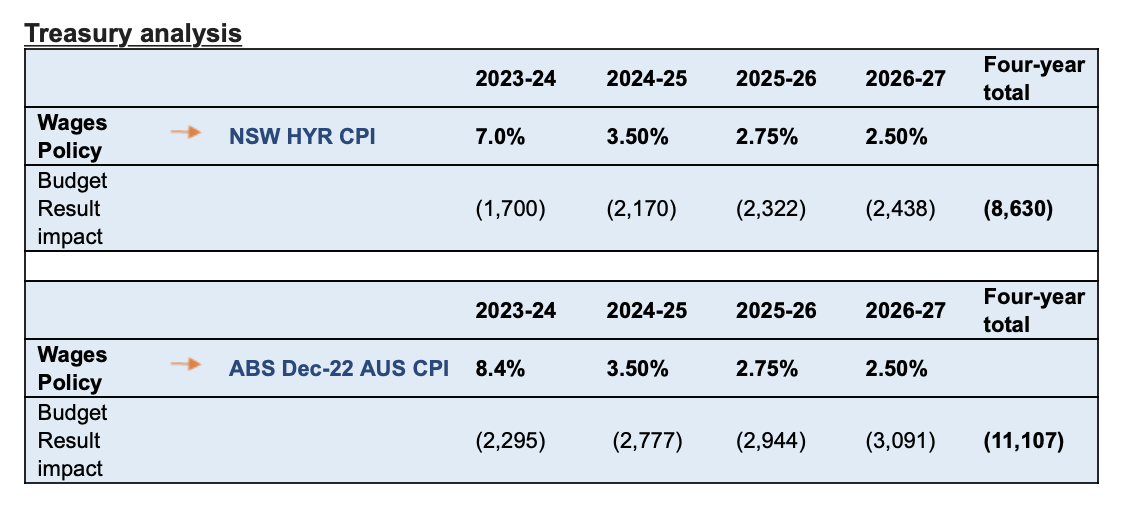
NSW Labor’s plan to scrap the public sector wages cap would blow an almost $9 billion black hole in the state’s budget, according to analysis from NSW Treasury.

Chris Minns will be forced to cut infrastructure projects or increase taxes to make up the shortfall given he has repeatedly said that public sector wages should keep up with inflation, otherwise they would amount to a pay cut.

Treasury analysis shows that if wage rises were in line with the current inflation forecast in the Half-Yearly Review it would blow an $8.6 billion black hole in Labor’s budget.

If NSW Labor used the latest ABS CPI indicator, it would cost $11.1 billion over four years.

Premier Dominic Perrottet said removing the wages cap and aligning wages with inflation would have disastrous consequences for the entire state.

“Our long-term economic plan will continue to provide record investments in road and rail projects that generate jobs and help future-proof our state,” Mr Perrottet said.

“The Liberal and Nationals have funded the biggest infrastructure program in NSW history because of hard fought financial management.”

Labor leader Chris Minns told media a fortnight ago: “It’s really important to know that the system that we’re bringing in New South Wales is to scrap the wages cap.”

“NSW Labor are putting our record infrastructure pipeline at risk because they have multi-billion-dollar budget black hole,” Mr Perrottet said.

“NSW Labor will need to cut metros, motorways and our cost of living relief measures to pay for their public sector wage increase.

“The NSW Labor plan to unleash public sector wages is a recipe for economic disaster that will stall our economy and take NSW backwards.”

Treasurer Matt Kean said Labor’s Daniel Mookhey had ruled out increasing borrowings and raising taxes which begged the question of how Labor would pay for its wages policy.

“As Treasurer I know the damage a multi-billion-dollar black hole would do to the budget, the economy and the opportunities for future generations – and it’s a price not worth paying,” Mr Kean said.

“If Labor is true to its word then it will have submitted its policy of CPI wage increases to the Parliamentary Budget Office and it should come clean on how it plans to fund the billions of dollars it will cost.

“If Labor has back-flipped on its promise, then it needs to be truthful and explain why. If it hasn’t, it needs to explain exactly which projects and services will be cut to meet the $8.6 billion shortfall.”

NSW public sector workers have experienced real wages growth over the past decade. The current 3 per cent cap plus an additional 0.5 per cent for productivity measures is far more generous than Labor-run Victoria.

Treasury-Analysis.png

Over 400 scholarships awarded to state’s budding interpreters

The state’s pool of language professionals has grown substantially over the past four years thanks to the NSW Government exceeding its election commitment to fill 400 positions through the Multicultural NSW Interpreting Scholarship Program.  

Facilitated by a number of educational institutions, including TAFE NSW, University of NSW and RMIT, the program has enabled people speaking more than 50 different languages and dialects to join the NSW Government’s interpreting ranks. 

Minister for Multiculturalism Mark Coure said the Interpreting Scholarship Program empowers people to use their language skills as a career and help their communities access government information and services.

“We have seen through the latest Census data that more and more people are speaking a language other than English at home, including new and emerging languages that weren’t prominent in communities five, ten or even fifteen years ago,” Mr Coure said. 

“We have worked with various universities and TAFE NSW so the program could evolve to train those who speak these languages and have them become qualified interpreters.

“By doing this, we have been able to bolster our interpreting ranks with a greater breadth of language capabilities and ensure we have the people available to support our state’s diverse communities.”

The program’s most recent graduates include TAFE and university-trained interpreters speaking Amharic, Dari, Hazaragi, Kannada, Karen, Mongolian, Swahili and Tamil.

NSW Federation of Community Language Schools president Lucia Johns said the program was further evidence of the value of multi-lingual study.

“Language is one of NSW’s greatest cultural, social and business assets. So it cannot be ignored and must be fostered and developed. By teaching children languages at community language schools throughout the state we are protecting and guaranteeing our future linguistic skills,” Mrs Johns said.

“Children who learn a second language at community languages schools will have the option of developing a career in interpreting and translation which benefits all aspects of our society.”

Mr Coure added that the program had attracted a great mix of people of various ages across the state interested in using their language skills as a career, including from regional NSW. 

“More than 20 per cent of students participating in the program are from regional NSW, which shows our multicultural state isn’t in one city or suburb,” Mr Coure said.

“We have also had many people from refugee backgrounds use their language skills to gain employment and support their community. This year alone, 30 per cent of scholarship participants were on refugee or special humanitarian visas.

“Everyone who completes the program and attains their certification can join our expert panel of language professionals.”

Through the 2022-23 NSW Budget, $16 million was secured over two years to improve the state’s whole-of-government language service. 

“The NSW Government understands that a strong and robust language service is key to a future without barriers for diverse communities, and ensure no one is restricted in accessing information or services because of the language they speak,” Mr Coure said. 

For more information about the Multicultural NSW Interpreting Scholarship Program, visit multicultural.nsw.gov.au.  

Languages Spoken by Scholarship Students
AmharicFilipinoKurdish- KurmanjiThai
ArabicGreekMacedonianTibetan
Arabic/SudaneseHakha ChinMalayalamTigrinya
AssyrianHazaragiMongolianTongan
BurmeseHmongNepaliTurkish
ChaldeanHungarianPersianTwi
Chinese HakkaIgboPortugueseUkrainian
Chinese-Chiu ChowIndonesianSamoanUrdu
Cook Islands MaoriItalianSerbianUyghur
CreoleKannadaSomaliVietnamese
DariKarenSpanishZomi Chin
DinkaKhmerSwahili 
EweKinyarwandaTamil 
Fiji HindiKirundiTelugu 
FijianKrioTemne 

Bonnyrigg’s multimillion dollar housing boom

The NSW Liberal and Nationals Government’s $855 million Bonnyrigg Renewal Project is moving into its next delivery phase in stages 8 to 11, following the appointment of a development partner to deliver 275 more homes including 65 new social homes for Western Sydney.

Minister for Planning and Minister for Homes Anthony Roberts said 702 dwellings, including 256 social homes had already been completed in earlier stages 1 to 7 of the state-significant urban renewal project.

“This is an ambitious project that is transforming the former Bonnyrigg social housing estate in Western Sydney to become a vibrant, mixed-tenure precinct, by taking 833 ageing social properties and creating 3,000 new homes for residents, 900 of which are dedicated for social housing,” Mr Roberts said.

Minister for Families and Communities and Minister for Disability Services Natasha Maclaren-Jones said the NSW Liberal and Nationals Government is committed to creating secure communities for the state’s most vulnerable.

“We are not only investing in housing where it’s needed most, but we’re creating a safe place for people to live and work. This precinct is providing more than just a roof over people’s head, it is providing a new community centre, open space, and town centre with a village green so residents can thrive,” Mrs Maclaren-Jones said. 

The project also makes great use of the existing Parramatta to Liverpool rapid bus transitway that is nearby.

Following a competitive procurement process to the market, the NSW Land and Housing Corporation (LAHC) has appointed Sydney-based developer Traders In Purple to deliver these next stages of the Bonnyrigg Renewal project.

LAHC Chief Executive Simon Newport said the Bonnyrigg Renewal displays how partnerships can deliver more homes for the community.

“We were able to secure $26.4 million of Commonwealth funding through the National Housing Infrastructure Fund, which unlocks critical infrastructure such as improvements to the road network that are crucial to delivering this type of project,” Mr Newport said.

“When all levels of government, community housing providers and industry come to the table with a shared vision to deliver more and better homes for the people who need it most, we can achieve great things and the transformation underway at Bonnyrigg is a shining example of that.”

As part of the earlier stages of the renewal project, Landcom has also managed the construction and completion of a $7 million 841 square metre community centre, using funds from LAHC under its voluntary planning agreement with Fairfield City Council.

Fairfield City Council Mayor Frank Carbone said the new community centre will be called The Hub @ Bonnyrigg (Dhanawi) and it will become a central focal point for all aspects of community life for local residents, with a large hall for social and cultural activities, meeting rooms, a kitchen and play areas for children. Council will own and manage the new facility moving forwards.

“The Hub @ Bonnyrigg (Dhanawi) will allow people to come together to meet and celebrate, with fully accessible facilities and a community garden. We are proud to have worked together with LAHC to design and deliver this facility for our community,” Mr Carbone said.

The transformation of the Bonnyrigg Estate is a major 30-year project that will be delivered over 18 stages, creating 4,275 jobs and delivering homes for more than 9,000 residents.

Works on the latest stage of the development are set to commence in April 2023.

For more information, please visit www.dpie.nsw.gov.au/land-and-housing-corporation/greater-sydney/bonnyrigg-estate