Counter-terrorism financing sanctions review

The Australian Government has reviewed and relisted 27 persons and 36 entities for counter-terrorism financing sanctions due to expire in 2022, as part of our commitment to preventing terrorism at home and abroad.

The sanctions constrain terrorists and terrorist entities from obtaining arms, funds, and other material support which is crucial to the conduct of terrorism activities and attacks.

It is a serious criminal offence, punishable by up to 10 years in prison and substantial fines, to use or deal with assets of, or make assets of any kind available to, listed persons or entities.

The sanctions will next be reviewed in 2025.

Australia also lists 256 persons and 91 entities subject to the United Nations’ ISIL (Da’esh) and Al-Qaida counter-terrorism sanctions regime.

The 2022 review was undertaken in line with Australia’s obligations under United Nations Security Council Resolution 1373 (2001), affirming Australia’s commitment to international frameworks and a rules-based order.

Australia is committed to our domestic and international obligations to suppress terrorism and will freeze the assets of those involved in terrorist activities.

A consolidated list of sanctions is available on the Department of Foreign Affairs website: Consolidated List | Australian Government Department of Foreign Affairs and Trade (dfat.gov.au)

Fraud costs NSW pharmacist two years in jail

NSW pharmacist Felix Chan has been sentenced to two years imprisonment yesterday by the Queanbeyan District Court after pleading guilty to defrauding taxpayers of almost $290,000 by lodging false Pharmaceutical Benefits Scheme (PBS) claims.

Mr Chan was found to have made 99 false or misleading PBS claims between 1 January 2018 and 31 July 2020 for the supply of pharmaceutical benefits which were not provided to patients.

Appearing in court on 29 August 2022, Mr Chan pleaded guilty to three counts of offences resulting in a fraud value of $288,595. The pharmacist has since repaid the entire amount.

This outcome is a culmination of the strong collaboration between the Department of Health and Aged Care and the Commonwealth Director of Public Prosecutions (CDPP), after investigating information obtained using the department’s tip-off line.

In the past 12 months, the department has received a significant number of tip-offs of suspected non-compliance or fraud of Government health payments. It shows that Australians are willing call out those in the health care sector who try to defraud taxpayers. 

The Department of Health and Aged Care takes allegations of Medicare non-compliance by health care providers very seriously and all tip-offs are examined in accordance with the Department’s compliance assessment procedures.

The Department has a strong health provider compliance program that’s protects Australia’s health payments system through the prevention, identification and treatment of incorrect claiming and fraud by health care suppliers.

Any concerns can be referred to the Department’s tip-off form at www.health.gov.au/fraud-tip-offs and will be reviewed.

ESCAPING VIOLENCE? WAIT 28 BUSINESS DAYS

Today in Estimates we learned that women are being forced to wait an average of 28 business days to access the Government’s $5,000 Escaping Violence Payment, the majority of which is as vouchers – an approach initiated by the Morrison government and retained by Labor.

Greens leader in the Senate and spokesperson for women, Senator Larissa Waters said:

“For too many women, economic insecurity is a significant barrier to escaping an abusive relationship. Many are forced to choose between staying in a violent home or escaping into poverty and homelessness.

“To learn that women are waiting 28 business days to receive the Government’s $5,000 Escaping Violence Payment is shocking. Victim-survivors do not have 28 business days to decide whether to leave an abusive relationship, they need immediate support to ensure their safety.

“The fact that these payments continue to be provided as predominantly vouchers ($3,500) is patronising and cruel, adding unnecessary anxiety for women already dealing with the stress of leaving a violent situation.

“While it is good to hear that the Department of Social Services are undertaking research to determine this model of payment, reporting isn’t due until June 2023. So that’s 28 business days for vouchers now, and at least a year before anything changes.”
 

GREENS CALL ON LABOR TO PREFERENCE GREENS AND PROGRESSIVE INDEPENDENTS ABOVE LIBERALS; URGE MAJOR PARTIES TO PUT FAR-RIGHT AND RELIGIOUS RIGHT LAST

The Victorian Greens have called on all parties running in the state election to put the far-right and religious right last in their preferences before early voting begins on Monday.

The Greens are also calling on Labor to preference the Greens and other progressive independents ahead of the Liberals this election.

The Greens are focused on pushing the next government to go further and faster on climate action, housing affordability and integrity.

With the Liberal party lurching further and further to the right, the Greens will preference Labor above the Liberals in every seat across the state.

The Greens say that due to the undemocratic voting system in the Upper House there is a very real chance that a far-right candidate could be elected to the next cross-bench.

The voting system allows micro-parties to game the system by paying tens of thousands of dollars to ‘preference whisperers’ who then coordinate group voting tickets.

Victoria’s last state election saw a number of candidates with very small primary votes elected to the upper house, at the expense of others who had received ten times as many votes.

The Greens say with a number of far-right and religious right parties registered for the upcoming November 26 election, there is a risk that one of them could get elected even if it is against the will of the overwhelming majority of voters.

This election the Greens will be putting One Nation, United Australia Party, Freedom Party, Family First and the DLP last.

Leader of the Victorian Greens, Samantha Ratnam MLC said: 

“Parties like One Nation, United Australia Party and Freedom Party are anathema to the vast majority of Victorians. 

“The Greens-initiated inquiry into the far right earlier this year exposed how their conspiracy-driven Trumpian politics is a danger to our political system.

“Family First and DLP are running on explicitly transphobic and homophobic campaigns and their politics of hate has no place in the Victorian Parliament. 

“The failure of Labor to reform the corrupt group voting ticket system means a party can get elected into parliament on as little as 0.5% of the vote.

“To keep these hateful parties out of our parliament they need to be put last on everyone else’s group voting tickets this year.

“The Greens will be recommending preferences to Labor ahead of the Liberals in every seat in Victoria. If Labor is serious about a progressive parliament, they must commit to preferencing the Greens and progressive independents ahead of the Liberals across the state.

“What the Liberals do is up to the Liberals. We have not met with them and there is no Greens-Liberal deal. We’ll direct preferences to Labor and progressive parties across the state, and we’re calling on Labor to do the same.”

NO PRIVATE SCHOOL FUNDING TRANSPARENCY? NO WORRIES!

The Department of Education has admitted during Estimates that they have no visibility on how public funding to private schools is being spent.

Under questioning from Greens Senator Penny Allman-Payne the Department conceded that they have “no line of sight” from the “cheques” they give to Independent and Catholic authorities in each state and territory to where and how that money is used.

The Department also acknowledged that even though recurrent funding to the private and public sector is determined by the Schooling Resource Standard, a needs-based model that takes into account loading for students with additional needs, funding is being distributed on entirely different models in each jurisdiction.

Greens spokesperson on schools, Senator Penny Allman-Payne said:

“Not only is the federal government giving private schools more than the Schooling Resource Standard requires, they don’t even know how that money is being spent.

‘We have elite private schools spending money on plunge pools for headmasters, but the Department of Education can’t tell us where all of those billions of dollars in private sector funding are going and whether they’re being used to support students who need it the most.

“We have public schools in crisis across the country, yet we’re giving private schools $70 billion over the next four years to do whatever they want with it.”


You can watch the full exchange here.

Humanitarian support to Myanmar and Bangladesh

As part of the Albanese Government’s commitment to supporting the humanitarian response in Myanmar and Bangladesh, Australia will provide $135 million in2022-23 to assist with the delivery of life-saving food, water and shelter through partner organisations.

The package of support will also deliver essential protection, education and health services for those most in need, including women, girls and people with disabilities.

Since the military coup in February 2021, the number of people in humanitarian need in Myanmar has surged from 1 million to an estimated 14.4 million.

Australia commends Bangladesh’s ongoing support to over 919,000 displaced Rohingya who rely on humanitarian assistance to survive. We also recognise the ongoing impact on communities hosting the Rohingya.

Australia’s humanitarian assistance will be delivered through the United Nations, the International Red Cross and Red Crescent Movement and non-government organisations.

All partner organisations have proven capacity to deliver neutral and independent humanitarian assistance and reach those most in need. They are carefully chosen to ensure that Australia’s assistance does not directly benefit or legitimise the military regime in Myanmar.

The package of support builds on $480 million provided since 2017 to people across Myanmar, and Rohingya refugees and host communities in Bangladesh.

Further information on development and humanitarian programs in Myanmar and Bangladesh can be found on the DFAT website.

Independent Review into the Afghan Locally Engaged Employee program

As part of the Albanese Government’s commitment to standing by those who helped Australia, today we announce Dr Vivienne Thom AM will lead an Independent Review into the Afghan Locally Engaged Employee (LEE) program.

Established in 2012, the program gives eligible Afghan LEE, who are at risk of harm due to their employment in support of Australia’s twenty-year mission in Afghanistan, priority under Australia’s Humanitarian Program. Since 2012, more than 2,300 Afghan LEE and their families have arrived in Australia.

We have been clear in opposition and in government that the Morrison Government failed to apply the instrument consistently and in accordance with its original intent.

The Senate Inquiry into Australia’s Engagement in Afghanistan confirmed this and recommended a review of the operation of the Afghan LEE program to ensure that programs of this nature are improved.

The Albanese Government is acting on this recommendation with Dr Thom’s review, which will examine how program decisions were made, including the application and appeals process, record keeping and departmental resourcing. It will also consider whether the legislative instrument that underpins this program remains fit for purpose.

Dr Thom AM has substantial experience leading public inquiries and is also leading the Afghanistan Inquiry Implementation Oversight Panel.

Dr Thom AM will report her findings to the Australian Government in early 2023.

The Australian Government is committed to supporting the Afghan community, with 16,500 additional places allocated for Afghan nationals under the Humanitarian Program. This builds on the 10,000 places already allocated for Afghan nationals under the Humanitarian Program, and will be delivered over the next four years in addition to the annual intake.

In total, the Government is committed to fulfilling its allocation of 31,500 resettlement places for Afghan nationals – comprising 26,500 places under the Humanitarian Program and 5,000 places under the Family stream of the Migration Program.

Deputy Prime Minister, Minister for Defence, the Hon Richard Marles said:

“Our current and former ADF personnel have been clear about the painful impact of leaving people behind in Afghanistan.

Dr Thom’s review is critical to ensuring our ADF personnel can have confidence that Australia will stand by those help us.”

Minister for Foreign Affairs, Senator the Hon Penny Wong said:

“We know that those attempting to leave Afghanistan face a very difficult set of circumstances, not least because border crossings out of the country are difficult and dangerous.

But Australia has a moral obligation to help those who helped us and we are focused on doing everything we can to assist those people whose safety is at risk.”

Minister for Immigration, Citizenship and Multicultural Affairs, the Hon Andrew Giles said:

“We have a duty to ensure that our humanitarian efforts focus on those whose safety is most at risk, especially those who may face harm due to their involvement in our mission in Afghanistan.

The Government remains resolute in our commitment to prioritise the grant of visas for Afghan Locally Engaged Employees and their immediate families.”

ADDRESSING STRATEGIC, ECONOMIC AND CLIMATE CHALLENGES WITH WORLD LEADERS

Prime Minister Anthony Albanese will join world leaders at premier international and regional summits in Cambodia, Indonesia and Thailand from 11–19 November.

The Prime Minister will meet with counterparts at the East Asia, ASEAN, G20 and APEC Summits to discuss the most pressing strategic, economic and climate challenges facing the region and world.

The Prime Minister will travel to Phnom Penh from 11–14 November to attend the East Asia Summit, the region’s premier leader led forum for strategic discussion.

In Phnom Penh, the Prime Minister will also attend the 2nd Annual ASEAN-Australia Summit. Australia’s engagement with ASEAN is longstanding – as ASEAN’s first dialogue partner and Comprehensive Strategic Partner – and supports regional resilience, jobs and economic growth.

From 14–17 November the Prime Minister will attend the Bali G20 Summit in Indonesia – the world’s top table for international economic cooperation. In Bali, the Prime Minister will work with G20 leaders to chart a pathway to achieving the international conditions needed to ease economic pressures at home.

While in Bali, the Prime Minister will join Indonesian President Widodo and Indian Prime Minister Modi to deliver a keynote address at the Business 20 Summit, which will bring together more than 1,000 CEOs, investors and senior executives from Australia, the Indo-Pacific region, and across the world.

The Prime Minister will then travel to Bangkok from 17-19 November to attend the 29th APEC Economic Leaders’ Summit. The Summit will focus on practical action to support regional economic integration and an open trade and investment environment.

Alongside summit commitments, the Prime Minister will meet bilaterally with a range of other leaders to discuss international developments and identify new opportunities for cooperation, including on regional security, energy transition and climate action.

Prime Minister Albanese said:

“Australia has always been an outward facing nation and we have never shied away from facing up to global challenges.

“The global economic outlook is stark, and Russia’s invasion of Ukraine has exacerbated the challenges of food insecurity, rising energy prices, rising inflation and cost of living pressures globally. 

“Australia strongly supports ASEAN’s central role in the region and its vision for the region is closely aligned with our own.

“My role at these summits will be one of advocacy for not only Australians, but also for those of our Pacific neighbours who face many of the same pressures that we do.

“At each summit I will emphasise Australia’s commitment to the global transition to net zero, and our vision for a stable, peaceful, resilient and prosperous region.

“I will remain, on behalf of the Australian people, a fierce opponent to Russia’s immoral and illegal invasion of Ukraine.

“I look forward to engaging my counterparts in Phnom Penh, Bali and Bangkok in the next week.”

FUTURE FUND HOLDS $3.4 BILLION OF SHARES IN THE WORLD’S TOP 50 POLLUTING COMPANIES

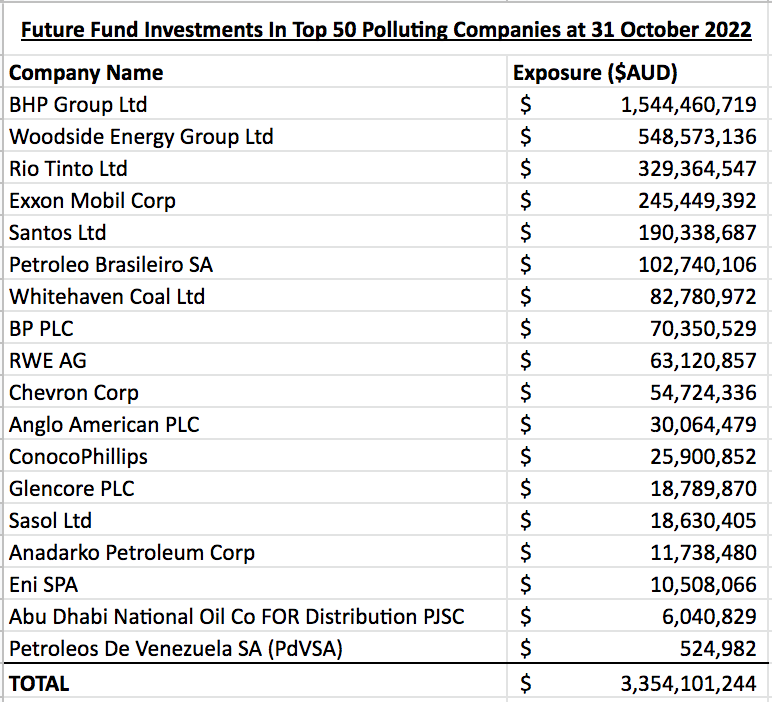
Answers to Questions on Notice provided to Greens Senator Barbara Pocock show the publicly owned Future Fund is invested heavily in those very companies that threaten Australia’s future, with a total $3.4 billion in the biggest polluting companies in the world.

In Senate estimates, Senator Pocock pressured the Future Fund to use its shareholding power to force the coal, oil and gas companies it invests in to diversify away from selling planet-destroying products. 

Pocock questioned the Future Fund about its discussions with Rio Tinto over the destruction of Juukan Gorge, arguing that there is nothing stopping the Fund from similarly engaging directly, or through their fund managers, with coal, oil and gas corporations making record profits from climate destroying activities.

Further, the Government’s Disaster Ready Bill, currently before the Senate, will use proceeds from the Future Fund to pay for infrastructure to ‘mitigate’ climate damage. But at $200 million a year, when the cost to protect us from storm surges alone is $600 million a year, there is a huge gap between what is needed and what is offered.

And there is a deep irony in the government relying on dividends from the world’s biggest polluters to pay for infrastructure to deal with the escalating damage those very same companies are causing through their fossil fuel investments.

Senator Pocock said:

“The Future Fund is invested in companies that have absolutely no intention to diversify away from coal and gas, with $549 million directly invested in Woodside, $190 million in Santos and $83 million in Whitehaven.

“The government’s Disaster Ready Bill is proposing only a third of the climate infrastructure funding we need to keep Australians safe from natural disasters, all the while investing billions into the same greedy corporations driving climate destruction and Australia’s natural disasters.

“These Australian companies need all the pressure the Future Fund can bring to bear on them and if the Fund doesn’t intend to do that, the Labor government must direct a sell off of that stock and send a message that the Future Fund’s focus is on a safe and secure future.

“While Australia is attending COP27 to mitigate against climate disaster, and is asking the world to let us host a climate summit, our government is sinking money into the world’s biggest polluters.

“If the Future Fund is entrusted with paying for the public works needed to keep Australian communities safe from floods, fires, storm surges and cyclones moving south – then it needs to stop profiting from those companies making these natural disasters worse. ”

Questions on Notice and Answers

Table of Investments 

A table containing Future Fund Investments In Top 50 Polluting Companies at 31 October 2022

ACT RESIDENTIAL EATING DISORDER FACILITY SITE CONFIRMED

Minister for Mental Health Emma Davidson has announced the ACT Residential Centre for eating disorders will be built in Coombs.

A tender for the construction of the Centre will be released in the coming weeks and the Centre is on track for completion in 2023-24. The location is Block 3, Section 17 in Coombs.

Minister Davidson says the Centre forms part of the ACT Government’s stepped care model of care for eating disorders, which links services together so that everyone can access the right support at the right time.

“The location in Coombs is close to nature, overlooks green spaces and a pond and is in a residential setting. These elements support a home-like environment to help people on their recovery journey and live well in the community,” Minister Davidson said. 

“People with lived experience, clinicians and non-government organisations have been clear that this centre will fill a significant gap – providing a calming home-like environment with specialised therapeutic support for people with eating disorders who sit between care delivered in the community and acute clinical care in hospital.

“It is a critical addition to Canberra’s eating disorder services, which has been scarce and led to many not being able to receive the right support in the ACT. Over the past years, significant work has been undertaken to expand services and better coordinate them with existing support. For instance, the Clinical Hub, which launched in January this year, has seen patient waiting times reduce from an average 644 days in December 2021 to 56 days in October 2022.”

An early design on the Coombs site has been completed and the Preliminary Sketch Plan Phase is now underway, with the aim of having a Development Application (DA) lodged before the end of 2022. The draft designs for the Centre continue to undergo consultation throughout the DA process, which will run until construction commences in 2023. 

The Commonwealth Government has agreed to fund $13.5 million over three years starting in 2021-22 for the development of the Centre.

The Clinical Hub better coordinates resources, services, and clinical expertise to ensure people with eating disorders are quickly connected with health and community services that best support their individual needs.