
Building Australia’s future

This is a responsible Budget that helps with the cost of living, while Building Australia’s Future.

We are delivering more tax relief for every Australian taxpayer, more energy bill relief and cheaper medicines.

We are strengthening Medicare, investing in housing and education, advancing reforms to make our economy stronger, and building a Future Made in Australia.

The Budget builds on the strong foundations we have laid, helping to secure our nation’s future at a time of global uncertainty.

We know Australians have made sacrifices, and the Albanese Labor Government remains focused on delivering for households.

We’re providing relief now and investing in the future, while delivering the biggest improvement to the bottom line in a single parliamentary term.

This means smaller deficits and much lower debt compared to what we inherited.

The Budget forecasts an improvement in the bottom line over the forward estimates, and a lower deficit in 2025-26.

Treasury also expects inflation to return sustainably to the RBA’s target band six months earlier than previously expected.

Today, because of the work Australians have done together, our economy is turning the corner.

Inflation is down, unemployment is low, real wages are growing again, and interest rates have started to come down.

We’ve achieved this the Australian way – looking after each other, and working together.

Our responsible Budget helps Australians now and builds Australia’s future by:

  • Delivering cost of living relief.
  • Strengthening Medicare.
  • Making it easier to buy and rent a home.
  • Investing in every stage of education.
  • Building a stronger economy.

Easing the cost of living 

The world has thrown a lot of challenges at Australia over the past few years, and helping every Australian with cost of living remains the Government’s top priority.

This Budget delivers:

  • New tax cuts for every Australian taxpayer.
  • Another $150 energy rebate for every household and small businesses.
  • Even cheaper medicines by reducing the PBS co-payment.
  • Higher wages for aged care nurses.
  • A fair go for Australian consumers.

Strengthening Medicare

More bulk billing means less pressure on households.

This Budget delivers:

  • $7.9 billion to increase bulk billing so Australians can see a GP for free.
  • 50 more Medicare Urgent Care Clinics across Australia.
  • $1.8 billion to fund public hospitals.
  • $793 million invested to deliver more choice, lower costs and better care for women.
  • Hundreds more training places for doctors and nurses.

Making it easier to buy and rent a home

The Budget takes the Government’s total new housing commitments to $33 billion to help us build more homes for Australians.

This Budget includes:

  • An expansion of Labor’s Help to Buy scheme.
  • $54 million to accelerate the uptake of modern methods of construction to build more homes faster.
  • A ban on foreign investors from purchasing existing homes.
  • Incentives to train more construction workers.

This is a responsible Budget that helps with the cost of living, while Building Australia’s Future.

We are delivering more tax relief for every Australian taxpayer, more energy bill relief and cheaper medicines.

We are strengthening Medicare, investing in housing and education, advancing reforms to make our economy stronger, and building a Future Made in Australia.

The Budget builds on the strong foundations we have laid, helping to secure our nation’s future at a time of global uncertainty.

We know Australians have made sacrifices, and the Albanese Labor Government remains focused on delivering for households.

We’re providing relief now and investing in the future, while delivering the biggest improvement to the bottom line in a single parliamentary term.

This means smaller deficits and much lower debt compared to what we inherited.

The Budget forecasts an improvement in the bottom line over the forward estimates, and a lower deficit in 2025-26.

Treasury also expects inflation to return sustainably to the RBA’s target band six months earlier than previously expected.

Today, because of the work Australians have done together, our economy is turning the corner.

Inflation is down, unemployment is low, real wages are growing again, and interest rates have started to come down.

We’ve achieved this the Australian way – looking after each other, and working together.

Our responsible Budget helps Australians now and builds Australia’s future by:

  • Delivering cost of living relief.
  • Strengthening Medicare.
  • Making it easier to buy and rent a home.
  • Investing in every stage of education.
  • Building a stronger economy.

Easing the cost of living 

The world has thrown a lot of challenges at Australia over the past few years, and helping every Australian with cost of living remains the Government’s top priority.

This Budget delivers:

  • New tax cuts for every Australian taxpayer.
  • Another $150 energy rebate for every household and small businesses.
  • Even cheaper medicines by reducing the PBS co-payment.
  • Higher wages for aged care nurses.
  • A fair go for Australian consumers.

Strengthening Medicare

More bulk billing means less pressure on households.

This Budget delivers:

  • $7.9 billion to increase bulk billing so Australians can see a GP for free.
  • 50 more Medicare Urgent Care Clinics across Australia.
  • $1.8 billion to fund public hospitals.
  • $793 million invested to deliver more choice, lower costs and better care for women.
  • Hundreds more training places for doctors and nurses.

Making it easier to buy and rent a home

The Budget takes the Government’s total new housing commitments to $33 billion to help us build more homes for Australians.

This Budget includes:

  • An expansion of Labor’s Help to Buy scheme.
  • $54 million to accelerate the uptake of modern methods of construction to build more homes faster.
  • A ban on foreign investors from purchasing existing homes.
  • Incentives to train more construction workers.

Investing in every stage of education

This Budget invests in every stage of education to support students and build the workforce of the future.

This Budget includes:

  • Investments in public schools to put them on a path to full and fair funding.
  • $5 billion to expand access to early education and care and fund a historic wage rise for early educators.
  • Cuts to student debt and lowering repayments.
  • Funding for 100,000 Free TAFE places every year from 2027.

Building a stronger economy

The Albanese Government is building a stronger, more productive and more resilient economy.

This Budget delivers:

  • Competition reforms like progressing national occupational licensing for electrical trades.
  • Reforms to non-compete clauses for low and middle-income workers to lift affected workers’ wages by up to four per cent or $2,500 a year.
  • More support for small businesses, taking Labor’s total targeted small business commitments in this term of Parliament to more than $2 billion.
  • More than $3 billion to unlock investment in green metals and manufacturing.
  • $17.1 billion to deliver vital infrastructure.
  • Up to $3 billion to complete the NBN rollout, supporting suburbs and regions.

Responsible economic and fiscal management 

Our responsible economic management has improved the budget position, paid down Liberal debt and made room for the investments that matter to Australians like tax cuts for every taxpayer, a stronger Medicare and more housing.

  • The Budget position has improved by $207 billion over the seven years to 2028-29 – the biggest turnaround in the budget in a Parliamentary term.
  • We’ve turned two big Liberal deficits into two Labor surpluses in our first two years and the deficit in our third year of $27.6 billion is almost half what was forecast at the last election.
  • The deficit in 2025-26 is projected to be $42.1 billion, lower than MYEFO and what we inherited.
  • Debt is $177 billion lower in 2024-25 than what was forecast at the last election, helping us avoid around $60 billion in interest costs.

This Budget continues the Albanese Government’s economic plan which is focused on finishing the fight against inflation, delivering responsible cost of living relief and building a stronger economy and stronger budget.
This Budget invests in every stage of education to support students and build the workforce of the future.

This Budget includes:

  • Investments in public schools to put them on a path to full and fair funding.
  • $5 billion to expand access to early education and care and fund a historic wage rise for early educators.
  • Cuts to student debt and lowering repayments.
  • Funding for 100,000 Free TAFE places every year from 2027.

Building a stronger economy

The Albanese Government is building a stronger, more productive and more resilient economy.

This Budget delivers:

  • Competition reforms like progressing national occupational licensing for electrical trades.
  • Reforms to non-compete clauses for low and middle-income workers to lift affected workers’ wages by up to four per cent or $2,500 a year.
  • More support for small businesses, taking Labor’s total targeted small business commitments in this term of Parliament to more than $2 billion.
  • More than $3 billion to unlock investment in green metals and manufacturing.
  • $17.1 billion to deliver vital infrastructure.
  • Up to $3 billion to complete the NBN rollout, supporting suburbs and regions.

Responsible economic and fiscal management 

Our responsible economic management has improved the budget position, paid down Liberal debt and made room for the investments that matter to Australians like tax cuts for every taxpayer, a stronger Medicare and more housing.

  • The Budget position has improved by $207 billion over the seven years to 2028-29 – the biggest turnaround in the budget in a Parliamentary term.
  • We’ve turned two big Liberal deficits into two Labor surpluses in our first two years and the deficit in our third year of $27.6 billion is almost half what was forecast at the last election.
  • The deficit in 2025-26 is projected to be $42.1 billion, lower than MYEFO and what we inherited.
  • Debt is $177 billion lower in 2024-25 than what was forecast at the last election, helping us avoid around $60 billion in interest costs.

This Budget continues the Albanese Government’s economic plan which is focused on finishing the fight against inflation, delivering responsible cost of living relief and building a stronger economy and stronger budget.
New cost of living tax cuts under Labor

The Albanese Government will deliver two more tax cuts to every Australian taxpayer in 2026 and 2027, adding to the first round that Labor delivered in July last year. 

Every Australian taxpayer gets another tax cut from next year – all 14 million, not just some. 

This will give a top up to every taxpayer, right up and down the income scale. 

Labor’s new tax cuts are modest but they will make a difference. 

Combined with Labor’s first round of tax cuts, the average tax cut is expected to be around $43 per week or more than $2,200 in 2026-27, and around $50 per week or more than $2,500 in 2027-28.  

It’s a bit of extra help for every taxpayer and it tops up our tax cuts that started flowing on 1 July 2024. 

Labor’s new tax cuts will be phased in over two years, ensuring our fiscal settings are consistent with inflation remaining sustainably in the target band. 

Last year, we cut two rates and lifted two thresholds to deliver tax cuts for all Australian taxpayers, including around three million people who would have missed out completely under Scott Morrison’s policy from before the election.  

The Albanese Labor Government will cut income taxes further over two years:

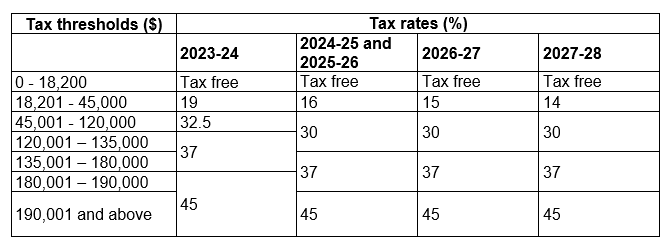
  • From 1 July 2026, we will reduce the 16 per cent tax rate to 15 per cent (for income between $18,201 and $45,000).
  • From 1 July 2027, this tax rate will be reduced further to 14 per cent.

As a result of these changes: 

  • All 14 million Australian taxpayers will receive a tax cut, on top of our tax relief that’s already rolling out.
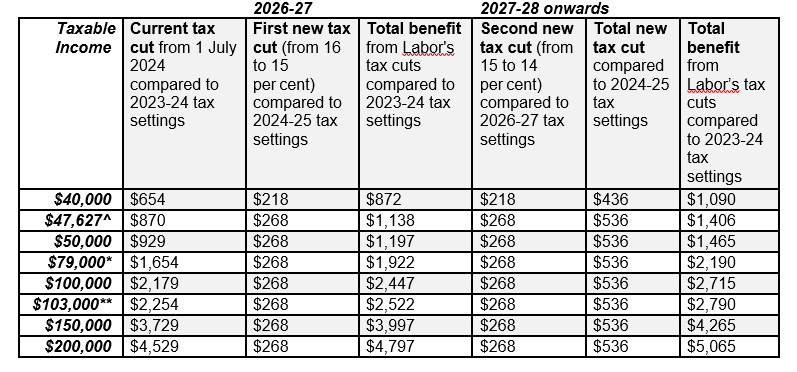
  • Every Australian taxpayer earning above $45,000 (around 80 per cent of taxpayers) will get an extra tax cut of $268 in 2026-27 and $536 from 2027-28, compared to 2024-25 settings.
  • A worker on average earnings ($79,000) will get an extra tax cut of $268 in 2026–27 and $536 per year from 2027–28.
  • Every Australian taxpayer earning between $18,201 and $45,000 will get an extra tax cut of up to $268 in 2026-27 and up to $536 from 2027-28, compared to 2024-25 settings.
  • A person earning $40,000 will get an extra tax cut of $218 in 2026-27 and $436 every year from 2027-28.

Combined with Labor’s first round of tax cuts:

  • The average tax cut is expected to be around $43 per week or more than $2,200 in 2026-27, and around $50 per week or more than $2,500 in 2027-28, compared with 2023-24 settings.
  • An average earner will receive total tax relief of $1,922 in 2026–27 and $2,190 per year from 2027–28, compared to 2023–24 tax settings.
  • The average income earner will pay around $30,000 less in tax to 2035-36, compared to 2023-24 settings.

The Government’s personal income tax reforms lower the first tax rate from 19 to 14 per cent, the second tax rate from 32.5 to 30 per cent, and lift two thresholds. 

Our changes to the bottom tax rate under the new tax cuts will bring this rate to its lowest level in over 50 years.  

In addition, the Government will increase the Medicare levy low-income thresholds from 2024-25. 

This will benefit more than a million Australians, ensuring people on lower incomes continue to pay a reduced levy rate or are exempt from the Medicare levy. 

Labor’s tax cuts return bracket creep, increase the financial rewards from work and boost labour supply. 

Whether you’re a truckie, a teacher or a tradie, whether you’re in manufacturing, mining or the care economy, you will earn more and keep more of what you earn. 

Our new tax cuts for every Australian taxpayer come on top of our substantial and responsible cost of living relief including:

  • Cost of Living Tax Cuts from 1 July 2024;
  • Energy bill relief for every household and for small businesses;
  • Strengthening Medicare with more bulk billing;
  • Cheaper medicines, with a script to cost Australians no more than $25 under the Pharmaceutical Benefits Scheme;
  • Cheaper child care;
  • Cutting student debt and repayments;
  • Free TAFE;
  • Increased rent assistance and working age payments;
  • Building more homes;
  • Higher wages.

The changes to the personal income tax system will cost $17.1 billion over the forward estimates.  

The increase to the Medicare levy low-income thresholds will cost $648 million over the forward estimates.  

The Albanese Government’s responsible economic and fiscal management has allowed us to fund important priorities like this tax relief for every Australian taxpayer. 

Our economic plan is all about helping Australians earn more and keep more of what they earn and that’s what these tax cuts will help to achieve. 

To find out how much the Government’s tax cuts will benefit you, use the calculator on the Budget website: budget.gov.au

Table 1: New personal tax rates and thresholds 

Table 1: New personal tax rates and thresholds

Table 2: Summary of tax benefits 

Table 2: Summary of tax benefits

^ The national minimum wage is $47,627, set by the Fair Work Commission under the Fair Work Act as of 1 July 2024. 
* Annualised average weekly earnings is around $79,000, based on $1,510.90 per week in November 2024 (ABS data release), which captures average gross wages across all employees, including full- time and part-time workers. 
** Average ordinary full-time earnings is $103,000, based on $1,975.80 per week in November 2024 (ABS data release), which captures average gross wage income across full-time employees only, and excludes any income earned from overtime. 

Responsible cost of living help

Cost of living is front of mind for most Australians, and front and centre in the Budget.

The Albanese Government is delivering responsible and meaningful cost of living relief for Australian families.

We’re providing more hip pocket help for households.

The centrepiece of the Budget is more tax cuts for every taxpayer, which will benefit 14 million Australians.

Helping Australians earn more and keep more of what they earn is a central part of our economic plan.

The new tax cuts will top up the relief that started flowing for workers last year.

They will help with the cost of living while delivering broader economic benefits – like returning bracket creep and boosting labour supply.

But there are several other significant initiatives as well that will make a meaningful difference for Australians.

We’re delivering energy bill relief to every household, even cheaper medicines, historic investments in Medicare, higher wages and a fairer go for consumers.

The families of middle Australia are the biggest beneficiaries of this cost of living help. The combined benefit for an average household will be more than $15,000 from our two rounds of tax cuts and energy bill relief over the four years to 2027-28.

Labor’s plan to help with the cost of living includes:

  • A new tax cut for every taxpayer – every Australian taxpayer gets another tax cut from next year – all 14 million, not just some.
  • More energy bill relief – $1.8 billion to extend energy bill relief to the end of the year for every household and small businesses.
  • Growing wages – $2.6 billion for a well-deserved wage increase for aged care nurses and stopping unfair non-compete clauses that are holding back Australian workers from switching to better, higher-paying jobs.
  • Even cheaper medicines – Reducing the maximum price of PBS medicines to $25 and $1.8 billion to list more life-changing medicines on the PBS.
  • Cutting student debt – wiping 20 per cent off all student debts and lifting the repayment threshold for graduates.
  • Strengthening Medicare – $8.5 billion to make more GP visits bulk billed for all Australians and train more doctors and nurses, as well as $657.9 million to open another 50 Medicare Urgent Care Clinics and expand existing services.
  • Making it easier to buy and rent a home – lifting the income and property price caps for Help to Buy to help more Australians into a home with a lower deposit and smaller mortgage, supporting innovative construction to build more homes sooner and delivering financial incentives to apprentices in the housing construction sector.
  • Permanent Free TAFE – making 100,000 Free TAFE places available across Australia every year.
  • A fair go for families and farmers – getting people a better deal at the checkout by strengthening the ACCC’s powers, fighting shrinkflation and helping suppliers stand up to the big supermarkets.
  • Delivering more affordable and accessible child care – establishing the Three Day Guarantee so families are eligible for at least three days of subsidised early education and care, and building more child care centres across Australia.

Under Labor, inflation is down, incomes are growing, unemployment is very low, interest rates are coming down and growth has rebounded solidly as well – but we know Australians are still doing it tough.

This Budget helps people with the cost of living and finish the fight against inflation, strengthen Medicare and builds a stronger economy.

Building a stronger economy

The Albanese Labor Government is securing Australia’s future during a time of global uncertainty by making our economy more productive and more resilient.

Our best defence against global pressures is a stronger economy, and that’s what we are building in this Budget.

We’re making our economy more dynamic by advancing National Competition Policy reforms and investing in productivity-enhancing infrastructure, including the National Broadband Network.

We’re building a Future Made in Australia – creating jobs and opportunity for generations of Australians as we continue the work of making our country an indispensable part of the global net zero transformation.

We are also backing hardworking local businesses by investing $20 million to encourage consumers to buy Australian made products through the Buy Australian campaign.

The world has thrown a lot of challenges at Australia over the past few years.

It’s clear the rules that underpinned global economic engagement for more than 40 years are being rewritten. Our economic plan is all about ensuring Australians are beneficiaries, not victims, of this churn and change.

Budget commitments to build a stronger economy include:

  • Investing more than $3 billion to support local green metals production to help build a Future Made in Australia.
  • Unlocking an expected $6 billion of additional private investment in renewable energy and low emissions technologies through a $2 billion expansion of the Clean Energy Finance Corporation.
  • Support for small businesses, including extending energy bill relief for around one million small businesses and cracking down on unfair trading practices.
  • $7.1 million over two years to strengthen enforcement of the Franchising Code.
  • $165 million in tax relief for hospitality venues, brewers, distillers and wine producers including a two-year freeze on the indexation on draught beer excise.
  • Supporting local businesses including $20 million to encourage consumers to buy Australian made products through the Buy Australian campaign.
  • $17.1 billion over 10 years for road and rail projects to improve the productivity and resilience, liveability and sustainability of our cities, regions and communities.
  • Up to $3 billion to complete the National Broadband Network to deliver access to faster and more reliable broadband services to a further 622,000 premises nationwide.

Our reforms in this Budget reduce red tape for businesses and workers.

The Government is also accelerating productivity-enhancing reforms as part of our revitalised National Competition Policy. This Budget includes:

  • Banning non-compete clauses for low and middle-income earners to boost workers’ wages. Research shows that reforms to these clauses could lift the wages of affected workers by up to four per cent or $2,500 for workers on average wages and lift GDP by $5 billion per year.
  • Progressing the design of a national licensing scheme for electrical occupations to cut red tape for businesses, save tradies time and money and enable electricians to work seamlessly across borders. The Productivity Commission suggests licensing reforms across a range of industries would provide long-term benefits, including a boost to GDP of up to $10.3 billion.

The Government is also ensuring Australia has a highly skilled workforce for the future by putting public schools on a path to full and fair funding and making Free TAFE permanent.

Our economic plan is already helping to strengthen Australia’s economy and this Budget will help to ensure we continue to make progress.

We saw growth in our economy rebound solidly at the end of last year, with the private sector taking its rightful role as a key driver of growth.

Treasury expects growth in our economy to pick up in the period ahead, with the private sector driving more of the growth.

In an increasingly uncertain global economic environment, this Budget invests in our people and productivity to make our economy stronger and more resilient.

Australia-Korea Foundation Board appointments and grants

Today I announce the appointment of Dr Scott Watkins as Chair of the Australia-Korea Foundation (AKF), as well as new board members to support the Foundation’s work.

The AKF works to strengthen economic, strategic and personal links between Australia and the Republic of Korea (ROK).

Dr Watkins has been a Board Member since 2022 and is active in forging networks between Australian and South Korean youth. He is the Chief Sustainability Officer at KISCO, a South Korean chemicals and inks manufacturer, and previously worked for CSIRO.

I am pleased to announce the appointment of three new board members who each bring extensive experience to support the objectives of the AKF:

  • Professor Gordon Flake, founding CEO of the Perth USAsia Centre
  • Ms Julianne Lee, Vice President of Voice of Korean Australian Businesses and Director a Rosecello Pty Ltd
  • Mr Sung Ho Lee, Partner at Johnson Partners.

I have reappointed Ms Robyn Bryant, from Bryant Family Grazing in Southern Queensland, for a second three-year term from March 2025.

I greatly appreciate the efforts of outgoing Chair Peter Coleman and Board Member Ms Karen Halbert for their substantial contribution the Australia-ROK relationship and thank them for their work supporting the AKF.

Today I am also delighted to announce that grants have been awarded to 22 recipients in the 2024-25 AKF Grant Round. These are listed on the AKF website and include:

  • The Australia-Korea Academic Maritime Security Dialogue in South Korea, convened by La Trobe University and the University of Western Australia, to promote discussions on maritime-related issues in our region.
  • An Australia-Korea Business Council initiative to connect female leaders in Australia and South Korea through networking and panel discussions, to promote leadership skills, cross-cultural exchanges and mentorships.
  • Supporting 10 Australian scientists to attend the Federation of Asian and Oceanian Biochemists and Molecular Biologists’ Young Scientist Program in South Korea, to enhance bilateral scientific ties.

Applications are now open for the 2025-26 Grant Round. For more information visit the Australia-Korea Foundation.

Australia-Japan Foundation grant recipients 2024-25

I am pleased to announce the 22 recipients of the Australia-Japan Foundation (AJF) grant round for 2024-25.

The AJF advances Australia’s foreign and trade policy interests with Japan by supporting partnerships in areas of shared interest and increasing Australian engagement with Japan.

The grant recipients in 2024-25 include:

  • The Australian Antarctic Program Partnership at the Institute for Marine and Antarctic Studies, University of Tasmania, to develop new pathways for Japanese and Australian scientific collaborations in Antarctic and Southern science.
  • An Australian Strategic Policy Institute (ASPI) workshop to convene leading Pacific experts from Australia, Japan and the Pacific, focusing on improving Pacific resilience to new security challenges.
  • The University of Queensland’s initiative to advance higher education on sustainable construction in Australia and Japan through teaching workshops, a public guest lecture series, and a presentation at Expo 2025, Osaka, Kansai.
  • A Drift Consulting project to bring together Australian and Japanese experts to exchange knowledge and progress the use of Australian seaweed in livestock feed to reduce emissions.

A full list of successful grant recipients is available on the AJF website.

Foreshore Park playspace to become flagship destination for inclusive recreation

Construction will begin this year on Newcastle’s first purpose-built inclusive playspace and waterplay area should councillors award a tender for the Foreshore Park project on Tuesday evening.

The regional-level playground has been developed following more than five years of input from the community and the Touched by Olivia Foundation, a charity dedicated to the creation of inclusive playspaces across Australia.

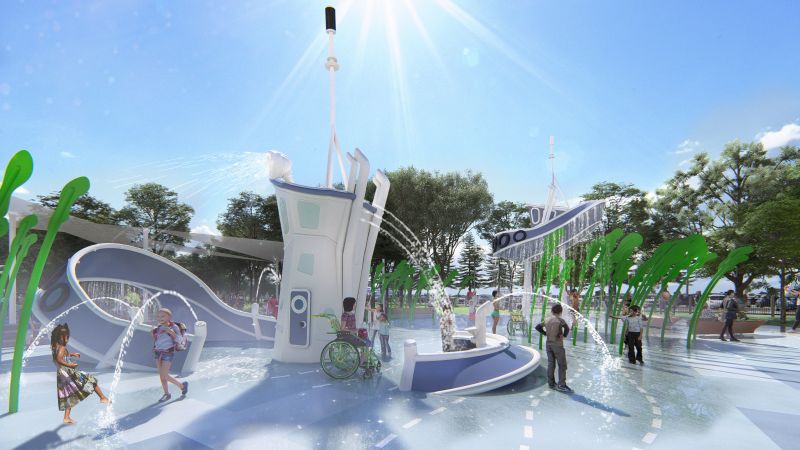
An artist's impression of the waterplay area, which is part of the inclusive Foreshore Park playground project.An artist’s impression of the waterplay area, which is part of the inclusive Foreshore Park playground project.

It was designed in accordance with the NSW Government’s Everyone Can Play guidelines and will promote intergenerational, inclusive play, with opportunities for visitors of all ages and abilities.

“Quality community spaces play a significant role in enhancing the lives of people of all ages, backgrounds and abilities,” Cr Pull said.

“When completed, this will be by far one of the best facilities in our city, and I am very proud that our city is in a position to deliver such a fantastic project. 

“This will create a flagship inclusive playspace that will become a thriving hub for intergenerational community building, positively supporting the physical and mental wellbeing of residents and visitors.”

Councillor Declan Clausen, who has submitted two notices of motion to Council this term supporting the delivery of the Foreshore Park playspace, said it would be a valued community facility. 

“City of Newcastle has been engaging with the community since 2020 to create a shared vision for the Foreshore Park precinct, to ensure it meets the needs and expectations as our premier regional park, for all Newcastle residents, workers and visitors to enjoy,” Cr Clausen said.

“We are committed to creating accessible and inclusive public spaces, ensuring high-quality playgrounds and park facilities are available to all Novocastrians.”

The playspace is the centrepiece of the Harbour Foreshore Masterplan and will be located at the western end of Foreshore Park.

It will have four separate zones including junior and toddler areas, water and nature-based play areas and quiet spaces, connected via accessible paths, seating, shade, gardens and lawns.

Bespoke playground equipment will add to its distinctly Newcastle character, including a central whale-themed swing and picnic area paying tribute to the city’s Worimi and Awabakal heritage.

The waterplay area will be linked to Newcastle’s maritime history and coastal ecologies, while an elevated “nuts and bolts” play structure will symbolise Newcastle’s strong industrial ties and include an accessible ramp to the first level of the tower.

An accessible slide, sandpit, carousel and sensory pathway are among the other key features of the inclusive design. Navigation through the space will be made easier with a logical and accessible path of travel, while charging points for wheelchairs and mobility devices are also included.

Final detailed designs will be completed by the successful tenderer before construction kicks off later in the year. 

Justine Perkins, Founder of Touched by Olivia, and Livvi’s Mum, said play is important and beneficial for everyone. 

“Creating (play)spaces that are fun, safe, welcoming and enjoyable by children, youth and adults alike, is what we are about,” Ms Perkins said.

“This Livvi’s Place design is truly inclusive and intergenerational and has a wonderful connection to place. 

“The nuts and bolts play tower features ramps and graduated stairs so all children and adults can join in the fun on the upper play decks, the incredible pathways and accessible routes for fun and adventure throughout, and the multitude of challenge and choice, will ensure there are many, many play hours for us all at Foreshore Park. 

“The design is subtle and seamless and shows how creative inclusive design can be. 

“City of Newcastle has been a fantastic partner. They have been committed to really listening to the children, youth and community and ensuring co-creation from the start. 

“This playspace is a testament to their understanding that we all want to and need to be able to get outdoors and play together, with others, in our community to ensure we live happier, healthier lives.”

Access Inclusion Advisory Committee Co-Chair Councillor Elizabeth Adamczyk said the Foreshore Park playspace will contribute to an even more liveable, sustainable and inclusive Newcastle.

“The playspace project is a wonderful example of collaboration between City of Newcastle, our community and Touched by Olivia,” Cr Adamczyk said.

“Accessibility considerations have been incorporated into all aspects of the design, from the way users navigate through and interact with the space, to the choice and layout of the equipment and the inclusion of quiet areas to cater for everyone.

“The playspace and water play area will transform the Harbour Foreshore into an even more inviting recreational space that is inclusive and accessible for all members of the community, enabling children and youth of all abilities and ages to play side by side.”

Newcastle mother Amanda Robertson, who is also a community representative on City of Newcastle’s Access Inclusion Standing Committee, said her family was excited about the playspace. 

“As a family, we struggle to find safe accessible spaces for our twins who have a disability to play, explore and connect with the community,” Ms Robertson said.

“Not only will this playspace provide a unique opportunity for our children, and other children with disabilities, to enjoy playing outside, it’s also a step towards creating a more inclusive community. We are excited and grateful to have this opportunity available to us.”

The playspace will be complemented by a fully accessible amenities building and kiosk, which is currently under construction in Foreshore Park. It includes unisex ambulant toilets, a parent’s change room, and a Changing Places facility.

The Foreshore Park projects are supported by the NSW Government, Variety the Children’s Charity, the Touched by Olivia Foundation and the Newcastle Port Community Contribution Fund.

$6.15 million for upgrades to community facilities across New South Wales

Dozens of sports grounds, community halls, theatres and cultural centres from Broken Hill to Bellingen, Camden to Carathool, Fairfield to Forbes will share in more than $6.15 million in funding to upgrade their facilities under the latest round of the Minns Labor Government’s Infrastructure Grants Program.

A total of 37 projects will receive support in this second round of the program for the 2024/25 financial year, building on the $6.44 million delivered to fund 46 projects in July 2024.

The Infrastructure Grants Program is made possible by ClubGrants Category 3, a fund which directs profits from registered clubs’ gaming machines into community projects, while clubs receive a tax concession in return.

Since 2013, more than 880 community projects have been awarded $152 million under the funding program.    

Projects supported in this latest funding round include:

  • $250,000 for the fit-out of the BCF Mobile Food Vans for the Bill Crews Charitable Trust. The foundation’s mobile services operate across Sydney offering food and crisis support for disadvantaged community members
  • $200,000 for the construction of the Winhanga-durinya-dhuray, Wambuul Memorial Garden by Bathurst Regional Council, including the commissioning of a public artwork along the Wambuul-Macquarie River to celebrate the continued role and resilience of the Wiradyuri people
  • $300,000 for the installation of LED lighting on playing fields for the Kurri Kurri Minor Rugby League club to enhance safety and allow for night games and events
  • $168,667 for an upgrade to the Southern Life Church Hall used by the Southcoast Health and Sustainability Alliance to help the hall serve as a heatwave and bushfire haven during extreme weather.

For the complete list of Infrastructure Grants Program recipients, visit www.nsw.gov.au/grants-and-funding/clubgrants-category-3-fund/clubgrants-infrastructure-sport

Minister for Gaming and Racing David Harris said:

“It’s so pleasing to see this round of Infrastructure Grants go to a large number of worthy groups who are working hard for their communities in such a variety of ways across the state.

“ClubGrants Category 3 improves large community infrastructure projects that bring people together, helps them prepare for and recover from disasters, and promotes participation in sport, recreation and the arts.

“It’s particularly pleasing to see there was a big boost in the number of arts and culture applications this financial year, resulting in $1.6 million being delivered to 13 community organisations including Outback Arts and the Young People Theatre Newcastle this round.

“I am also pleased to see two community groups – the Trangie Local Aboriginal Land Council and Walgett Aboriginal Medical Service Limited – projects that specifically address Closing The Gap targets.

“Congratulations to all the successful applicants, I look forward to seeing your completed infrastructure works and the impacts they have on your local communities.”

NSW visitor economy shines at 2024 Qantas Australian Tourism Awards

The NSW visitor economy triumphed at the 2024 Qantas Australian Tourism Awards, with eight NSW businesses recognised across nine categories—including Balloon Aloft Australia, which took home double Gold.

It was a particularly strong result for the NSW North Coast in the wake of Cyclone Alfred, with the region securing five awards. The Tweed Tourism Company claimed Gold, Northern Rivers Rail Trail and Love Lord Howe received Silver, while Port Macquarie Museum and Potager earned Bronze. 

Other NSW businesses celebrated on the night included Sierra Escape, which won Gold, and Mt Hay Retreat, which received Silver. 

Hosted by the Australian Tourism Industry Council, the awards showcase the outstanding achievements of businesses and individuals across the visitor economy, with 24 operators from Bathurst to Broken Hill, Wagga Wagga to Sydney, and Batemans Bay to Byron Bay among the nominees. 

The Qantas Australian Tourism Awards are a benchmark of excellence, recognising those who demonstrate innovation, commitment, and leadership in delivering exceptional visitor experiences. 

The Minns Labor Government’s Visitor Economy Strategy review has set an ambitious target of $91 billion in annual visitor expenditure by 2035. To help drive this growth, Destination NSW continues to support visitor economy operators through initiatives such as the NSW First and Choose

Tourism programs, which provide workshops, webinars and online resources to strengthen industry capability. 

Minister for Jobs and Tourism Steve Kamper said: 

“I want to congratulate all the NSW winners and nominees at the 2024 Qantas Australian Tourism Awards who are helping make NSW the destination of choice for travellers. 

“Thanks to their hard work and innovation, more people from all over the country and all over the world are visiting NSW to enjoy exceptional natural and cultural experiences. 

“Destination NSW is committed to working hand in hand with industry, celebrating our world-class experiences, supporting and upskilling providers and championing new ideas.”  

Acting Destination NSW CEO Karen Jones said:  

“The success of NSW businesses at the Qantas Australian Tourism Awards reflects the outstanding passion, professionalism and commitment of our tourism operators. Their dedication to world-class customer service is what makes NSW a leading destination for visitors from around the world. 

“Creating fresh and immersive visitor experiences is central to positioning NSW as a premier global destination. By leveraging our state’s diverse natural and cultural assets, we can build a stronger, more resilient visitor economy that delivers benefits for businesses, communities and visitors alike.” 

NSW WINNERS IN THE 2024 QANTAS AUSTRALIAN TOURISM AWARDS 

GOLD

Adventure TourismBalloon Aloft Australia
Tourism Marketing & CampaignsThe Tweed Tourism Company
Unique AccommodationSierra Escape
Excellence in Accessible TourismBalloon Aloft Australia

SILVER

Tourist AttractionsNorthern Rivers Rail Trail
5 Star Luxury AccommodationMt Hay Retreat
Excellence in Food TourismLove Lord Howe

BRONZE

Cultural TourismPort Macquarie Museum
Tourism Restaurants & Catering ServicesPotager 

NSW FINALISTS IN 2024 QANTAS AUSTRALIAN TOURISM AWARDS

  • Major Tourist Attractions: Symbio Wildlife Park
  • Tourist Attractions: Northern Rivers Rail Trail
  • Major Festivals & Events: Bluesfest Byron Bay
  • Festivals & Events: Broken Hill Mundi Mundi Bash
  • Ecotourism: Kestrel Nest EcoHut at Highfield Farm & Woodland
  • Cultural Tourism: Port Macquarie Museum
  • Aboriginal and Torres Strait Islander Tourism Experiences: Bundyi Cultural Tours
  • Tourism Retail, Hire & Services: Ask Roz Blue Mountains
  • Visitor Information Services: Bathurst Visitor Information Centre
  • Major Tour & Transport Operators: Captain Cook Cruises – Sydney
  • Tour & Transport Operators: Blue Mountains Day Tours
  • Adventure Tourism: Balloon Aloft Australia
  • Tourism Marketing & Campaigns: The Tweed Tourism Company
  • Tourism Restaurants & Catering Services: Potager
  • Tourism Wineries, Distilleries & Breweries: Cupitt’s Estate
  • Caravan & Holiday Parks: Holiday Haven Lake Conjola
  • Hosted Accommodation: Black Sheep Inn
  • Unique Accommodation: Sierra Escape
  • Self-Contained Accommodation: Cedars Mount View
  • 4-4.5 Star Deluxe Accommodation: Oriana Retro Hotel & Resort
  • 5 Star Luxury Accommodation: Mt Hay Retreat
  • New Tourism Business: Beneath The Bay
  • Excellence in Food Tourism: Love Lord Howe
  • Excellence in Accessible Tourism: Balloon Aloft Australia  

For a full list of winners and runners up, visit the Australian Tourism Awards website: 

https://www.qualitytourismaustralia.com/australian-tourism-awards/

World-first land use data platform Land iQ licensed for industry use

The NSW Government will licence its world-first data platform Land iQ to industry to speed up the pre-planning process and to ensure government and industry are working from the same page. Land iQ was developed by PDNSW and brings more than 200 data sources and 75 land-use data types together to allow for faster and smarter strategic evaluations of how land can be used.

Land iQ was developed by Property and Development NSW (PDNSW) in collaboration with other NSW Government agencies and in partnership with technology companies WSP Australia, Giraffe and Aerometrex. 

This technology will help bolster the in-house capabilities of private sector organisations, ensuring consistency in data and methodologies across the public and private sectors, and support the further digitisation of the planning and property sectors. 

Land iQ has been designed to support a wide range of planning and property work. As well as supporting land assessments and management, it can assist with land valuations and improved risk assessments of climate pressures and natural hazards. 

The data will be of valuable use for the planning and property management sectors; for use by universities to support urban and regional planning research; and for Local Aboriginal Land Councils to manage their land and identify potential opportunities for future development. 

Land iQ has been used by PDNSW to lead the NSW Government’s Property Audit to analyse government land that could be used for more housing. It also played a critical role in the 2022 Northern Rivers floods by analysing land suitable for temporary emergency accommodation. 

For further information visit: www.dpie.nsw.gov.au/housing-and-property-archive/ourbusiness/advisory-and-transactions/land-iq 

Minister for Lands and Property Steve Kamper said: 

“The Minns Government is pulling every lever available to address the housing crisis. We have developed an industry-leading platform that can help speed up the pre-planning process, it only makes sense that we make this critical tool available so that everyone can benefit. 

Media Release Department of Planning and Environment “We want to build a better NSW, and effective land use is critical to support quality of life, our economy and our environment. By ensuring thoughtful development we can meet housing and infrastructure needs while balancing the preservation of our natural environment.”

“Investing in our public service can deliver results beyond what was anticipated, and I congratulate Property and Development NSW and its development partners for pioneering this exciting technology that has been serving government and will now be rolled out for licensed use by the private sector.” 

Deputy Secretary of Property and Development NSW Leon Walker said: 

“Land iQ is a world first data platform that uses smart technology to streamline land use planning and reduce timeframes for due diligence testing of the potential effects of different land-use scenarios. 

“Its extensive analysis tools and comprehensive Statewide datasets provide an excellent source of information not only for government but private sector planners, property managers, developers and the research sector.”