
Leader of the Australian Greens, Adam Bandt MP, has said the Government’s much anticipated response to growing concern about rorts in parliament looked like a protection racket for politicians that would fail to discourage and root out corrupt behaviour.
Instead of the government’s toothless model, Mr Bandt called on Morrison to allow debate on the Greens model for a Federal ICAC, which has been approved by both integrity experts and the Senate. It has already passed the upper house and could become legislation by next Monday.
“The Liberals are still running a protection racket for corrupt politicians,” said Mr Bandt.
“After 18 months of delay, the Liberals have rejected the Greens’ model.
“Instead of a tough watchdog, it’s a toothless tiger.
“In announcing his model, Christian Porter pushed back hard against the Greens’ model for a Federal ICAC and it’s not hard to see why.
“The Liberals’ model is limited only to serious criminal conduct, meaning many of the misconduct scandals involving current and former Government MPs would not be caught. It won’t hold public hearings, so politicians could escape scrutiny for years. The public sector branch won’t be able to start investigations under its own steam, so whistleblowers will need to jump through hoops to warn about political corruption.
“This consultation draft could push back action for another 12 months. This sends a green light to any corrupt minister that they’ve got another year to milk every last cent out of our democracy.
“Christian Porter warned that the Greens National Integrity Commission Bill would be too powerful for them to support, so he has come up with a defanged model.
“People are fed up with politics. Every day they see it work for big corporations and developers, but not for the public. This sham ICAC will do nothing to change that.
“With a Greens bill for a Federal ICAC with teeth already through the Senate, we could be rooting out corruption by lunchtime Monday. Bring on the Greens bill for a National Integrity Commission in the House and we can start rooting out corruption next week.”
SCOTT MORRISON MUST INTERVENE TO PREVENT REFINERY CLOSURE AND SAVE JOBS
Scott Morrison must immediately intervene to stop BP from closing its Kwinana Refinery in Western Australia.
News of the planned closure comes just six weeks after the Prime Minister said: “The Government is committed to a sovereign on-shore refinery capacity despite the threat to the viability of the industry.”
It’s not enough for Mr Morrison to say he is disappointed about this decision, which would cost 600 jobs.
He needs to get on the telephone to BP and tell them to reverse the decision.
Australia is an island nation and fuel security should be our top priority.
Despite his promises, Scott Morrison has failed to protect Australia’s fuel security, as well as our crucial refining industry and the jobs it supports. We are increasingly at risk of being a country that imports all of our fuel.
Today, Australians have once again been reminded what an announcement from this Prime Minister is worth; absolutely nothing.
He is always there for the photo op, but never there for the follow up.
Labor took a plan to the 2019 election to establish a national fuel reserve and has been calling for years for the Government to secure the future of our four remaining refineries with real fuel security policies, which Resources Minister Matt Canavan called a “thought bubble.”
After seven years of failing to deliver a critical manufacturing plan, it is now incumbent on the Government to do more to support manufacturing businesses and their workers.
Local Recovery Fund open for local jobs pathways
The Morrison Government’s Local Recovery Fund is now open for 25 select regions experiencing high unemployment to develop local and tailored projects, to help Australians get back into work and assist communities recover from the economic impact of COVID-19.
Applications are now open for local groups and organisations to apply to receive funding ranging from $10,000 to $200,000, to develop projects, including mentoring, training and reskilling, in line with local employment needs.
The Local Recovery Fund is a key component of the Local Jobs Program and will fund projects, or parts of larger projects, that are not being supported through existing programs or activities.
Minister for Employment, Skills, Small and Family Business, Senator the Hon Michaelia Cash, said the fund will help drive job outcomes in the selected regions with locally led initiatives aimed at getting more Australians back into work.
“Local Jobs is focused on reskilling, upskilling and creating employment pathways to help people move back into jobs as the economy recovers from COVID-19,” Minister Cash said.
“Projects supported under the Local Recovery Fund will be locally driven initiatives that are aligned to each regions employment related priorities, as identified in a Local Job Plan.
“I strongly encourage stakeholders in each of the eligible employment regions to work together and put forward innovative project ideas under the Local Recovery Fund.
As part of the Local Jobs Program 25 Employment Facilitators, have been engaged to help connect job seekers to local employment opportunities.
The Employment Facilitators will chair Local Jobs and Skills Taskforces across Australia. The taskforces will bring together local employers, employment and training providers and other local stakeholders, to collaborate and develop projects funded by the Local Recovery Fund to get job seekers back into work.
“We will do this by getting Australians back to work and by supporting locally-driven pathways to jobs.”
Applications for the Local Recovery Fund will open from 3 November with funding available from mid-December 2020.
The employment regions included in this program are listed below.
| State/Territory | Employment Region |
| New South Wales | Sydney South West |
| Illawarra South Coast | |
| Hunter | |
| New England and North West | |
| Mid North Coast | |
| North Coast | |
| Sydney Greater West | |
| Queensland | Gold Coast |
| Cairns | |
| Wide Bay and Sunshine Coast | |
| Townsville | |
| Wivenhoe | |
| Tasmania | Hobart and Southern Tasmania |
| North and North Western Tasmania | |
| Victoria | South Eastern Melbourne and Peninsula |
| Gippsland | |
| Western Melbourne | |
| Inner Metropolitan Melbourne | |
| North Western Melbourne | |
| South Australia | Adelaide North |
| Murray and South East | |
| North West Country | |
| Western Australia | South West WA |
| Perth South | |
| Northern Territory | Darwin and Alice Springs |
Further details on how to apply can be found at www.dese.gov.au/local-jobs-program
Record level of loans for construction of new homes, building approvals over 10,000 in September
Today’s Australian Bureau of Statistics lending indicators data for September 2020 shows the number of loans for the construction new dwellings increased by 27.1 per cent, rising to the highest amount since the ABS began collecting this data in 2002.
Also today, the ABS building approvals data for September 2020 showed total number of dwelling approvals rose by 15.4 per cent in September 2020, to be 8.8 per cent higher than a year ago.
Building approvals for private sector houses were up 9.7 per cent, with over 10,000 approvals recorded for the first time since June 2018.
These latest resounding results demonstrate yet again that the Morrison Government’s HomeBuilder programme is delivering the right support to our vital construction industry.
Housing Industry Association Chief Economist Tim Reardon said of today’s record lending figures;
“HomeBuilder was designed to provide consumers with confidence to return to the detached housing market. It has been very effective at achieving this goal.”
“It is evident in today’s data that HomeBuilder has been successful in creating work on the ground in the December quarter. This will protect jobs in the construction industry and the wider economy.”
Chief Executive of the Property Council of Australia Ken Morrison said today HomeBuilder is doing its job to stimulate activity and keep people employed;
“HomeBuilder has been the popstar of government stimulus policies released to date: highly effective, immediate and great value for money.”
“It has helped protect hundreds of thousands of jobs and stimulated activity right at the time the economy needed it most.”
Today’s record ABS lending indicators data and building approval rises are in line with other leading indicators that show HomeBuilder is working to support and protect the jobs of the one million Australians in the construction industry, for example;
- The Housing Industry Association New Home Sales data for September 2020 shows in the four months since HomeBuilder was announced, new home sales have risen 49.8 per cent compared to the four months to June 2020. The data also shows sales have been higher in each month since HomeBuilder was announced than any month in the past two years.
- HomeBuilder has seen first home buyers flood into the housing market with the number of loans to first home buyers reaching the highest number in over a decade. The total number of owner occupier first home buyer loan commitments rose 6.0 per cent, reaching 13,040, seasonally adjusted. This represents 40 per cent of the total number of owner occupier loans issued in September.
Across the board the construction industry is saying that HomeBuilder is delivering for Australia’s tradies and home buyers, which is driving stimulus in the economy at a time its needed most.
The Morrison Government is committed to doing all we can to help Australians get into a home of their own as part of our Economic Recovery Plan for Australia.
How’s Your Head Today? Campaign launched to support mental health across Australia
The Morrison Government will roll out a COVID-19 mental health campaign How’s your head today? to urge people to prioritise their mental health, raise awareness about how to identify when something is wrong, and encourage people to seek help.
The campaign will be launched on TV, radio, in shopping centres and venues, online and through social media from Sunday and will continue through to next year.
How’s your head today? encourages all Australians to check in with how they are feeling. Through animated characters, the campaign recognises the emotions many people are feeling and illustrates the actions they can take to help themselves feel better.
The campaign will be provided in 15 languages across radio and print including Vietnamese, Arabic, Mandarin, Cantonese, Greek, Italian, Korean, Spanish, Punjabi, Hindi, Khmer, Thai, Turkish, Persian and Macedonian.
COVID-19 has had a significant effect on the mental health and wellbeing of many people across the country. Victorians in particular have had it tough.
The pandemic has caused isolation, job losses and financial stress for many families, with crisis organisations and suicide prevention services experiencing higher demand.
Lifeline and Beyond Blue are reporting a significant increase in the number of people seeking help, and for more complex issues. The mental health impact of the pandemic is also borne out by Medicare statistics, which show a significant uptake of mental health telehealth services.
Minister for Health, Greg Hunt, said, “Through this campaign, Australians are encouraged to make their mental health and wellbeing a priority. We want them to know support is available, when and where they need it.”
“I encourage all Australians to seek help if experiencing mental ill-health. Talk to your GP, reach out to Beyond Blue or Lifeline, or visit the Headtohealth.gov.au,” Minister Hunt said.
“Ten additional Medicare subsidised psychological therapy sessions are available for people subjected to further restrictions in areas impacted by the second wave of the COVID-19 pandemic.
“Victorians can also access free-of-charge 15 HeadtoHelp centres across the state, or visit Headtohelp.org.au.”
National Mental Health Commission CEO, Christine Morgan encouraged Australians to stay connected, and “walk together, side by side over the coming months.”
“Everyone has and may continue to have their mental health and wellbeing impacted by the pandemic. Whether you have an existing mental illness or have had your mental health challenged, it is important to seek support and treatment as a priority for your overall wellbeing – the support and treatment is available,” Ms Morgan said.
“Staying connected to your loved ones and your community is fundamental to your mental health and wellbeing at the moment. It is one of the proactive tasks that is important for all of us to do each and every day.
“If you notice that someone has disconnected, reach out and ask them how they are doing as we walk together, side by side over the coming months.”
The Head to Health website has information, advice and links to free and low cost phone and online mental health services from some of Australia’s most trusted mental health organisations.
Head to Health has been an important resource supporting Australians especially during the COVID-19 pandemic, and significant increased traffic has continued since March when a dedicated COVID area was introduced.
Between 20 March when the COVID-19 Support page went live and 26 October, there were 380,308 unique page views of the COVID-19 support pages on Head to Health.
On 26 October 2020, for example, there were 2,873 total sessions on HeadtoHealth, well above the average sessions of around 1,200 a day. Of these, 460 (16%) were unique page views of the COVID-19 support pages.
The Morrison Government has allocated $10 million to support the How’s your head today? campaign, and will continue to prioritise mental health and suicide prevention services.
Since March 2020, the Government has made available more than $500 million in funding for direct supports to respond to the mental health impacts of the COVID-19 pandemic, with $10 million allocated to this national mental health communications campaign.
For information, advice and support services visit headtohealth.gov.au
Campaign materials are available at https://health.govcms.gov.au/resources/collections/coronavirus-covid-19-mental-health-campaign-resources
$3 Billion Northconnex Opens
NorthConnex will open to motorists this weekend with the final tests and safety checks being completed on the $3 billion Sydney mega project that will change the way drivers travel across the city.
Sydney-siders will be able to bypass 21 sets of traffic lights between the M1 and M2 motorways, completing the long-awaited ‘missing link’ in the National Highway network.
The twin nine kilometre tunnels between the M1 at Wahroonga and M2 at West Pennant Hills will provide smoother and faster journeys along Pennant Hills Road and also mean bypassing 40 sets of lights if using the Pacific Highway as a route to the CBD.
It will save people up to 15 minutes in the morning and evening commute, boosting productivity and busting congestion.
Prime Minister Scott Morrison said NorthConnex had delivered thousands of jobs to support hard-working families and now motorists would benefit for generations to come.
“NorthConnex is a game-changing piece of infrastructure that will allow drivers to travel between Newcastle and Melbourne without stopping at a traffic light, and a complete bypass of suburban Sydney,” the Prime Minister said.
“This is one of the most significant and eagerly anticipated road infrastructure projects ever delivered in Australia.”
Premier of New South Wales Gladys Berejiklian said the project has been a major driver of employment, creating around 8,700 jobs for the state.
“The project is forecast to inject around $4 billion into the economy and is proof of the government’s strong commitment to deliver major infrastructure and jobs for the people of New South Wales,” Ms Berejiklian said.
“Around 300 businesses from the Western Sydney area and another 50 from the Central Coast have also contributed to the project, highlighting the opportunities this project has created for local suppliers and contractors.”
Federal Minister for Population, Cities and Urban Infrastructure Alan Tudge said Sydney motorists will soon be experiencing the extraordinary benefits of the NorthConnex tunnels.
“NorthConnex is going to strip up to 5,000 trucks a day off the notorious Pennant Hills Road, which is one of the most congested roads in NSW,” Mr Tudge said.
“The safety benefits for so many families, getting people home safely at the end of each day, is immeasurable.”
New South Wales Minister for Transport and Roads Andrew Constance said NorthConnex reaches depths of up to 90 metres, making it Australia’s deepest road tunnel.
“Australian-first, innovative lighting displays will help keep drivers alert, with stunning starscapes, trees and native bird highlighting the transition from the rural environment of the north to the urban environment of the city,” Mr Constance said.
“NorthConnex will see air quality improve around Pennant Hills Road, safer routes for pedestrians and cyclists, and a significant reduction in traffic noise – all issues local residents desperately wanted addressed.”
The Australian and NSW Governments have also thanked the more than 20,000 residents living along the corridor for their cooperation and patience throughout work on the project.
NorthConnex is a $3 billion project which includes $577.3 million from the NSW Government, $412.3 million from the Australian Government, and $2 billion from Transurban and its private sector partners.
NorthConnex tolls are in line with the M2, at $7.99 for cars and $23.97 for heavy vehicles.
Toll Relief will apply. Drivers who spend an average of $26 a week over a year are entitled to free registration. Drivers who spend an average of $16 a week over a year are entitled to half price registration.
City's new Economic Development Strategy to play a critical role in COVID-19 recovery
City of Newcastle is developing a 10-year Economic Development Strategy, which will play a critical role in guiding the city’s COVID-19 economic recovery.
The community is invited to shape the Strategy, which will envision a future for the Newcastle economy and strive to empower, retain and attract people with skills of the future and create equal opportunity for all members of the community.
Young people will provide an important voice in the conversation, with the COVID-19 economic crisis disproportionately impacting 18-to-25-year-olds, driving the Hunter Region’s youth unemployment rate to 20.7 per cent.
City of Newcastle has partnered with TAFE NSW Newcastle, HunterNet and Hunter Young Professionals to directly engage with young people and facilitate discussion through multiple youth-specific workshops.
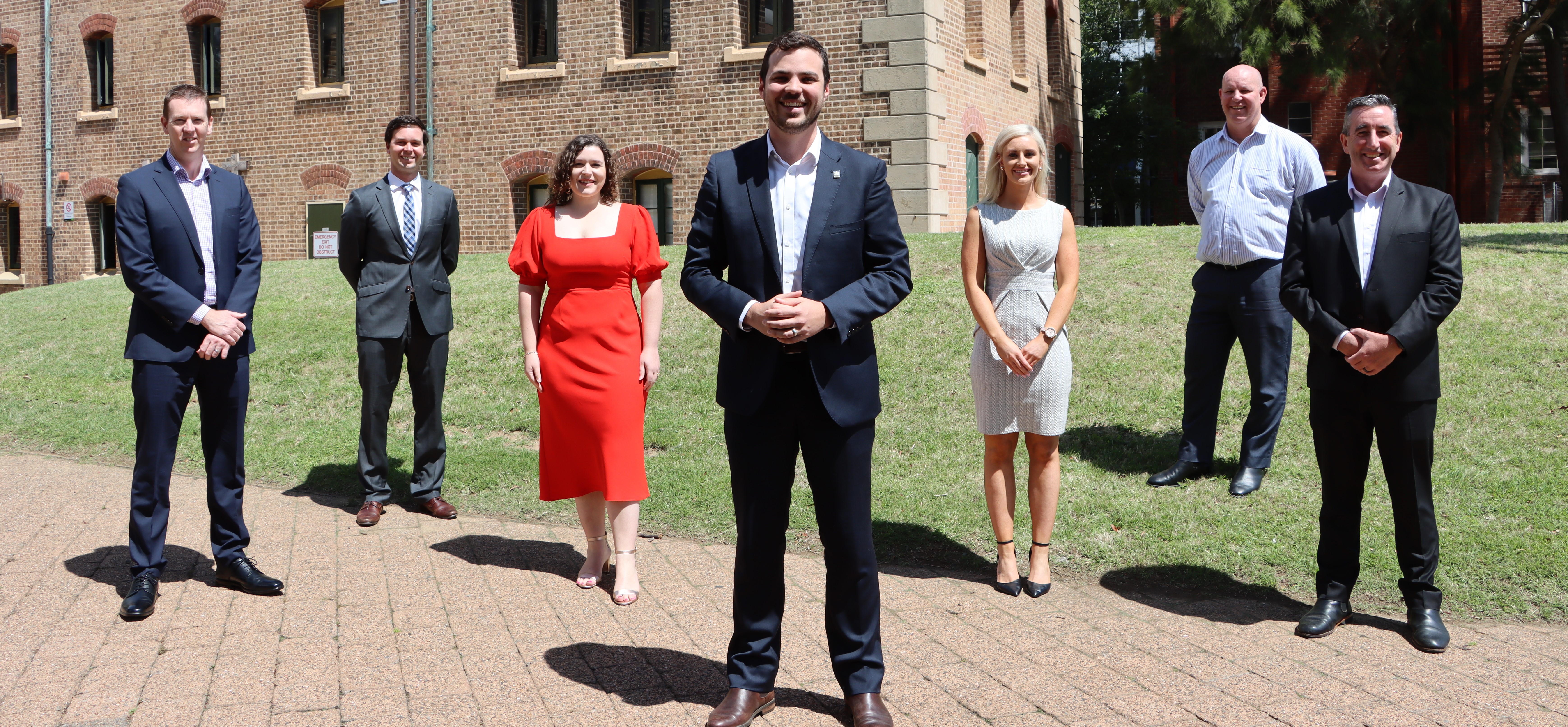 (L-R): TAFE Services Manager Newcastle and Lake Macquarie, Adrian Collins; City of Newcastle’s Economic Strategy & Government Relations Manager, Simon Massey; Hunter Young Professionals President, Kate David; Deputy Lord Mayor Declan Clausen; Hunter Young Professionals Vice-President, Danielle O’Neill; TAFE Regional General Manager, Jason Darney; and HunterNet COO, Nick Couper at Hamilton TAFE Campus.
Lord Mayor Nuatali Nelmes said with a further almost one in 10 Novocastrians currently unemployed, it was more important than ever to identify future economic opportunities across the board.
“City of Newcastle’s Economic Development Strategy will focus on long-term actions to help create new jobs, drive investment and promote innovation,” Cr Nelmes said.
“When the pandemic first hit, City of Newcastle was one of the first Councils across Australia to act, adopting a $5.5 million Community and Economic Resilience Package with a range of programs to support community wellbeing and maximise cashflow. The Resilience Package was endorsed six days before the Federal Government announced the JobKeeper wage subsidy.”
Deputy Lord Mayor Declan Clausen said the City had also provided collaborative leadership and advocacy through the facilitation of the City Taskforce.
“Now, we are turning our attention to creating new long-term opportunities for our city, and we are seeking the community’s input,” Cr Clausen said.
A range of programs will be explored under four key pillars: Enabling Skills, Enabling Innovation, City-Shaping Initiatives and Facilitating a Vibrant City.
Community members can have their say via City of Newcastle’s website until Monday 7 December. City of Newcastle will also conduct face-to-face and online workshops with stakeholders and its networks, including the City Taskforce and Strategy and Innovation Committee.
The draft Strategy will be presented to Council in the early new year for consideration to be placed on public exhibition.
Newcastle Libraries celebrate University of Third Age’s 30 years of lifelong learning
City of Newcastle is helping over 50s explore new technologies and interact with smart city innovations through a partnership with University of the Third Age (U3A) as part of their 30th anniversary celebrations.
To mark the occasion, a series of thought-provoking lectures presented by 17 guest lecturers will take place during the month that cover an array of topics including the prospects for finding life in the universe, Newcastle’s forgotten 1800s diva, the future of agriculture and a guide to 3D printing.
Newcastle U3A is a volunteer run community organisation with tutors who come from diverse backgrounds to freely share their knowledge and passion for continuous, lifelong learning.
A showcase celebration was launched at City of Newcastle’s new Digital Library at 12 Stewart Avenue today where participants explored the City’s newest community asset and were introduced to a range of state-of-the art digital technologies.
Deputy Lord Mayor Declan Clausen said the University of the Third Age’s mantra of life-long learning aligns perfectly with City of Newcastle’s Libraries model.
“Embracing a culture of lifelong learning enhances every aspect of a person’s life and is known to be beneficial in many ways.
“It is fitting that City of Newcastle Libraries has partnered with Newcastle U3A to present this program as both organisations have a common vision.
“City of Newcastle’s Library Strategy 2019-2029 outlines the essential role that libraries play in actively supporting lifelong learning.
“We applaud the work of long-standing community groups such as U3A for their dedication and service to the community.”
Newcastle University of the Third Age Newcastle Acting President Jenny Williams said the local volunteer run organisation was delighted to partner with Newcastle Libraries to celebrate the 30-year achievement.
“Many people have experienced isolation and loneliness in 2020 due to the COVID restrictions. This program enables participants to meet online, learn new skills and make meaningful connections, as we transition back to a more normal face-to-face learning environment.
“The showcase is a tribute to the tutors’ dedication, perseverance, and commitment to the ideals of the U3A of providing ongoing education, for learning new skills, and fostering self-reliance and independence among members of the ‘third age’.
The community is invited to discover what the Newcastle U3A and the new digital library have to offer. For a full schedule of lectures, visit www.newcastle.nsw.gov.au/library
NSW BUDGET TO HELP HOUSE ROUGH SLEEPERS
Hundreds more people experiencing homelessness will be helped off the street and into secure housing with a $29 million expansion of the NSW Government’s Together Home project, as part of the 2020-21 NSW Budget.
Treasurer Dominic Perrottet said the additional funding brings the NSW Government’s total investment in the Together Home project to $65 million.
“We are helping break the cycle of homelessness and the upcoming Budget will continue our investment in crucial programs to help get people back on their feet and transform the lives of some of the most vulnerable in our society,” Mr Perrottet said.
“The Together Home project is delivering great social outcomes by providing people a place to call home while also supporting jobs in the community services sector at a pivotal time in our economic recovery from COVID.”
The program involves securing homes from the private rental market and delivers intensive tailored supports to meet the complex needs of the people in the program. An additional 400 dwellings, with wraparound supports, will be secured as part of this investment.
Together Home provides support to maintain a tenancy and services like case management, drug and alcohol services and mental health support.
More than 645 people previously sleeping rough across the state have secured housing since April. This includes 274 who are already receiving housing and wrap around support through the Together Home initiative.
Minister for Families, Communities and Disability Services Gareth Ward said the support delivered would help put people on a pathway to housing independence.
“The needs of rough sleepers are often highly complex. This initiative is delivering life-changing outcomes by providing them with a roof over the head, combined with the wraparound support services to break the cycle of homelessness,” Mr Ward said.
“This initiative will address homelessness not only in the city, but right across our state, as we help people improve their health and wellbeing, and rebuild their lives.”
Together Home will be delivered in collaboration with community housing providers, specialist homelessness services and healthcare workers.
POWERING OUR PUBLIC SCHOOLS INTO THE FUTURE
Treasurer Dominic Perrottet and Minister for Education Sarah Mitchell today announced that the NSW Government is committing more than $150 million to install LED lights in public schools over the next two years.
”Retrofitting schools with energy efficient lights in classrooms, libraries, halls and administration areas delivers great outcomes for our schools. This program will benefit the environment while saving on energy costs every year,” Mr Perrottet said.
“We will target schools in communities across NSW that are yet to benefit from an infrastructure project.
“Importantly, this program will help stimulate local economies, supporting hundreds of jobs and building on the NSW Government’s COVID-19 Recovery Plan.”
Today’s announcement also includes the launch of the NSW Government’s Schools Renewable Energy Infrastructure Pilot Project, demonstrating a commitment to making our schools even more sustainable. The pilot project will assess the benefits and costs of large scale implementation of solar photovoltaic (PV) systems, batteries and demand response initiatives in NSW public schools.
“We are undertaking the single largest school building program with over $6.7 billion invested in 190 new and upgraded school projects. This announcement demonstrates our commitment to continuing to invest in our schools and make them even more sustainable,” Mr Perrottet said.
Minister Mitchell said the LED light replacement program and the solar PV pilot project will provide opportunities for local trades, job creation and support our schools to become more sustainable.
“We have already seen the success of these initiatives with a pilot at eight schools across regional and metropolitan areas delivering a reduction in energy bills,” Ms Mitchell said.
“Combined, these two significant initiatives further our commitment to exploring sustainable energy solutions for the future.
“Both of these programs will improve the sustainability of schools and take steps towards the NSW Government’s commitment to achieving net zero emissions by 2050.”
Mr Perrottet and Ms Mitchell made the announcements at Croydon Public School, which is undergoing a $35 million upgrade with new classrooms and other facilities as part of the NSW Government’s record $6.7 billion investment.
Schools will be selected for the Schools Renewable Energy Infrastructure Pilot Project, as well as installation of LED lighting in schools, next year.