
Police are appealing for public assistance after a police vehicle was rammed and a car was stolen – with the driver still inside – in Lake Macquarie today.
Just before 2.30pm (Monday 14 September 2020), officers from Lake Macquarie Police District commenced a pursuit of a Mercedes after the male driver failed to stop on Regents Street, Bonnells Bay.
A short time later, officers terminated the pursuit on Fishery Point Road, Bonnells Bay, due to safety concerns after the driver rammed their vehicle. The officers were uninjured.
Police have been the man then abandoned the Mercedes, before threatening the driver of a white Hilux utility and stealing the vehicle with the man – aged in his 20s and wearing a high visibility vest – still inside.
Officers from Lake Macquarie Police Area Command, with assistance from PolAir and the Dog Unit, have commenced a search.
As part of inquiries, police are appealing for anyone who may have seen the vehicle to contact them.
It’s described as a 2019 white Toyota Hilux utility with registration EGR36C and ‘CDA Group’ written in green and black on the side.
It was last seen driving on Grand Parade, Bonnells Bay, heading towards Fishery Point Road about 2.40pm.
Police would also like to speak with a man who may be able to assist with their inquiries.
He is described as being of Caucasian appearance, aged in his mid-20s, with short dark hair, and a medium build. At the time, he was wearing a dark grey shirt and long black pants.
Appeal to locate wanted man – Lake Macquarie
Police are seeking public assistance to locate a man wanted on an outstanding warrant.
Adam Gilham, aged 27, is wanted on a revocation warrant.
Officers from Lake Macquarie commenced inquiries into his whereabouts and are appealing for public assistance.
Gilham is described as being of Caucasian appearance, with short dark hair and a medium build.
Police have received information that he was last seen at Bonnells Bay in Lake Macquarie today (Monday 14 September 2020) about 2.30pm.
Anyone who sees him is urged not to approach him but instead call Triple Zero (000).
Anyone with information about this incident is urged to contact Crime Stoppers: 1800 333 000 or https://nsw.crimestoppers.com.au. Information is treated in strict confidence. The public is reminded not to report crime via NSW Police social media pages.
Five people charged following alleged break-in at Hunter Valley winery
Five people have been charged following an alleged break-in at a Hunter Valley winery last night.
About 6.20pm (Monday 14 September 2020), an alarm was activated from inside a winery located on Hunter Street, Muswellbrook.
Officers from Hunter Valley Police District responded and found two vehicles parked outside with boxes of wine nearby. During an external check of the property, police heard voices and saw torch lights inside.
Officers entered the building and found a man in the barrel room. The 27-year-old was arrested and taken outside where a further three people – a 23-year-old woman and two men, aged 23 and 33 – were also arrested
All four people were taken to Muswellbrook Police Station.
Following inquiries, officers arrested a fifth person, a 22-year-old man, just before 9.30pm at a fast food restaurant in Muswellbrook. He was also taken to Muswellbrook Police Station.
All five were charged with aggravated break, enter and steal, enter inclosed lands, and malicious damage.
They will appear at Muswellbrook Local Court on Monday 26 October 2020.
COVID-19 update: One person charged, another issued PIN
Police have charged a man and fined a woman in separate incidents since the last COVID-19 update.
- About 11.30am yesterday (Monday 14th September 2020), officers from Bankstown Traffic and Highway Patrol were at a home on Smith Street, Yagoona, when they were approached by a man who allegedly swore and spat at the officers. The 36-year-old man was arrested after a short struggle and charged with not comply with noticed direction (spitting/coughing) – COVID-19, resist or hinder police officer in the execution of duty, use offensive language in/near public place/school, and assault police officer in execution of duty without actual bodily harm. He has been refused bail and is due to appear in Bankstown Local Court tomorrow (Wednesday 16 September 2020).
- Officers from Murray River Police District issued a 40-year-old Wodonga woman with a $1000 PIN. She allegedly breached conditions of her border zone resident permit by travelling to a hotel on Union Road, Lavington, and playing poker machines about 11.45am yesterday (Monday 14 September 2020).
Police continue to appeal to the community to report suspected breaches of any ministerial direction or behaviour which may impact on the health and safety of the community.
Anyone with information about this incident is urged to contact Crime Stoppers: 1800 333 000 or https://nsw.crimestoppers.com.au. Information is treated in strict confidence. The public is reminded not to report crime via NSW Police social media pages.
Man assaulted with a sledgehammer – Stockton
Police are searching for two men after they attacked another man with a sledgehammer at Stockton yesterday.
Just before midnight (Sunday 13 September 2020), a 38-year-old man was on Dunbar Street when he noticed a car stop near him.
As he approached the car two men walked towards him, one armed with a sledgehammer.
He attempted to run from the men when he tripped and fell to the ground. The men struck him to the head and legs with the sledgehammer before fleeing the scene.
The injured man was able to make his way home and was taken to Newcastle Hospital for treatment for a fractured skull, abrasions and bruising and remains in a stable condition.
Officers from Newcastle City Police District attended Dunbar Street and established a crime scene which was forensically examined.
One of the men is described as being of Caucasian appearance, about 20-30 old, with thin a thin build. The other man is described as being of Caucasian appearance, aged in his mid-40s with greying hair.
Investigations are ongoing.
All attendees of private gatherings now liable for $1000 PINs under changes to Public Heath Order
With warmer weather and longer days ahead, amendments have been made to the Public Health Order – most significantly relating to private gatherings; with all attendees now risking $1000 Penalty Infringement Notices (PINs) if the gathering exceeds the allowed 20-person limit.
Where previously, only the organiser of a gathering was liable to receive a fine if the number of people at the premises breached the Public Health Order, every person in attendance will now be held individually responsible for the breach.
The changes, which came into effect at midnight (Monday 14 September 2020), aim to ensure the safety of the community ahead of an expected increase in gatherings associated with Christmas and end-of-year festivities.
Operation Corona Virus Commander, Assistant Commissioner Tony Crandell, said that as with the previous restrictions, these amendments have been made with community safety in mind.
“Coming into the warmer months, and with end-of-year festivities around the corner, it’s only natural that people will have additional reasons to want to gather and get together,” Assistant Commissioner Crandell said.
“These amendments aim to ensure that an increase in expected gatherings doesn’t mean an increase in COVID-19 cases.
“The new changes come in addition to other restrictions which remain in place, including a limit on numbers at outdoor gatherings and licensed premises.
“NSW Police will continue to work with the community to ensure compliance to all restrictions under the Public Health Order.
“While the vast majority of people within NSW are doing their part, we will continue to target those who don’t,” Assistant Commissioner Crandell said.
Other amendments have also come into effect that impact places of worship, auctions/open homes, weddings, and party buses. To view the restrictions on gatherings and movement in full, please visit the following link: https://www.nsw.gov.au/covid-19/what-you-can-and-cant-do-under-rules
Greens call for ABC and SBS to be included in News Media Code
The Greens have today said the Morrison Government’s Media Code plan is incomplete, calling on the government to include the public broadcasters in the Mandatory Code, ensure the survival of the AAP newswire and protect smaller players.
Australian Greens Spokesperson for Communications and Media Senator Sarah Hanson-Young has said any Code must protect public broadcasting and public interest journalism.
“The ABC is Australia’s most trusted news source and should be included in any reform to tackle the greed of the big tech giants. It was a deliberate decision to lock the public broadcasters out of the draft code, allowing Facebook and Google to profit from their content for free – the Government should reverse this and drop their relentless attack on the ABC.
“The power and greed of the tech giants is threatening journalism and public access to news. The government’s mandatory ACCC code could be part of the solution but the draft needs fixing and additional measures brought to the table.
“Australia’s media landscape is facing unprecedented challenges. Public interest journalism, reliable local news and trustworthy and informed analysis is essential for a robust and accountable democracy. The power imbalance between the big tech giants and Australian news organisations is unsustainable.
“It is therefore important that key parts of Australia’s media landscape are protected as part of this process. There is no reason for the ABC and SBS to be excluded from the Code. Public broadcasters deserve a fair return for what they produce and what the tech platforms benefit from.
“At the same time it is important that Australia’s fact based independent newswire service is supported. It would be unconscionable for the Government not to find a way of supporting AAP while introducing a code that supports other media players. AAP is key media infrastructure that helps new players into the market and diversity across Australia’s media landscape.
“The ACCC’s draft Mandatory Code must guarantee simple and cost effective benefits for small and independent media players, through effective collective bargaining arrangements.
“If the aim of this code is to ensure the viability of Australia’s media, then the Government should ensure ABC is included, that AAP doesn’t fail and that small and independent publishers don’t miss out.
“Public interest journalism is under threat in Australia, whether it be from funding cuts to the ABC, loss of advertising revenue for commercial outlets or the threat of heavy-handed police action that we have seen lately. The Greens’ changes would see the mandatory code go some way to protecting public interest journalism in Australia.
“The Greens reserve our final position on the Mandatory Code until we have seen the legislation.”
Boosting Australia’s Fuel Security
The Morrison Government is taking action to secure Australia’s long-term fuel supply, keep prices low for consumers and create over 1000 new jobs with a $211 million investment in building new domestic fuel storage and backing local refineries to stay open wherever commercially possible.
As part of our 2020-21 Budget, the Government will enhance Australia’s fuel security and bolster local industry through a $211 million investment in new domestic diesel storage facilities, reforms to create a minimum onshore stockholding, and measures to support local refineries.
This will be delivered through a combined market and regulatory framework, with three key elements:
- Investing $200 million in a competitive grants program to build an additional 780ML of onshore diesel storage
- Creating a minimum stockholding obligation for key transport fuels; and
- Backing the refining sector by entering into a detailed market design process for a refinery production payment.
Prime Minister Scott Morrison said Australia’s fuel security was essential for our national security and that we had been fortunate to not have experienced a significant fuel supply shock in over 40 years.
“Our positive changes to the fuel market will ensure Australian families and businesses can access the fuel they need, when they need it, for the lowest possible price,” the Prime Minister said.
“Fuel security underpins our entire economy. Not only does it keep Australia moving, the industry supports thousands of people across the country and this plan is also about helping keep them in work.
“Like all sectors of the economy, the COVID-19 pandemic is having an impact on Australia’s fuel industry. The events of 2020 have reminded us that we cannot be complacent. We need a sovereign fuel supply to shield us from potential shocks in the future.”
Minister for Energy and Emissions Reduction Angus Taylor said the Government recognised that Australian refineries are under significant financial pressure and is committed to working with the sector to ensure it has a long-term future.
“Almost all Australians are reliant on fuel and it is the lifeblood of so many sectors in our economy. Our farmers and miners rely heavily on diesel to do their jobs and provide services, while the transport sector sources 98 per cent of its energy from liquid fuels,” Minister Taylor said.
“That’s why it is critical that Australia has control over its fuel security arrangements and the Government is making sure of that.”
The construction of diesel storage will not only secure our diesel supplies but will support up to 950 jobs, along with 75 new ongoing jobs, many in regional areas.
A minimum stockholding obligation will act as a safety net for petrol and jet fuel stocks, and increasing diesel stockholdings by 40 per cent.
The Government will work with industry over the next six months on the legislative and regulatory design of the package.
Refineries play an important role in securing Australia’s fuel security and putting downward pressure on fuel prices for consumers. Modelling has shown that a domestic refinery capability is worth around $4.9 billion (over 10 years) in value to Australian consumers in the form of price suppression.
The Government is committed to a sovereign on-shore refinery capacity despite the threat to the viability of the industry. This is why we will design a market system for a production payment that recognises those fuel security benefits. It has been designed to protect Australian families and businesses from the around 1 cent per litre increase that modelling shows will hit fuel if all refineries close in Australia. For refineries to receive support, they will be required to commit to stay operating in Australia.
The Government recognises that the future refining sector in Australia will not look like the past. However, this framework will protect Australian families and businesses from higher prices and will secure jobs in the fuel sector and in fuel-dependent industries, such as our farmers, truckers, miners and tradies.
Additional measures will also be introduced to reduce the burden on industry and improve fuel market information.
This includes modernising the online fuel reporting system to make it easier for industry to report stock levels to Government and improve the timeliness of data. The Government will also remove the application fees for fuel standard variation requests.
This domestically-focused package builds on Government action to purchase up to $94 million of crude oil at record low global prices to be stored in the US Strategic Petroleum Reserve for access during a global emergency.
Supporting our refineries will ensure Australia has the sovereign capability it needs for any event, protect families and businesses from higher prices and support thousands of jobs across the economy as we recover from COVID-19.
Government Launches New COVID-19 Mental Health Clinics In Victoria
From Monday 14 September 2020, Victorians will have access to additional mental health support with 15 new dedicated mental health clinics opening to the public.
The clinics, announced on 17 August as part of a $31.9 million federal government mental health package to support Victorians during the COVID-19 pandemic, have been rapidly rolled out across the state at a cost of $26.9 million.
There will be nine HeadtoHelp clinics located in Greater Melbourne and six in regional Victoria. The locations are:
- Greater Melbourne: Berwick, Frankston, Officer, Hawthorn, Yarra Junction, West Heidelberg, Broadmeadows, Wyndham Vale, Brunswick East
- Regional Victoria: Warragul, Sale, Bendigo, Wodonga, Sebastopol and Norlane.
Our Government recognises that the ongoing restrictions are having a significant impact on the wellbeing and mental health of individuals and communities in Victoria, and is committed to ensuring that support is available.
These new clinics, branded with the HeadtoHelp logo, are a free service and, over the next 12 months, will provide a place within the community for people to access mental health care as early and as conveniently as possible.
The clinics are staffed by multi-disciplinary teams of mental health professionals which may include GPs, mental health nurses, psychologists, psychiatrists, social workers and/or other allied health workers.
The HeadtoHelp clinics will provide on-site mental health support, and will also connect to other mental health services in their region, including intensive mental health care or social supports, to ensure people get the help they need when they need it.
The clinics will play a key role in supporting our GPs, emergency departments, and hospitals by providing easily accessible mental health care.
The rapid establishment of the clinics has been overseen by a joint federal and state Mental Health Pandemic Response Taskforce co-chaired by Dr Ruth Vine, the Australian Government Deputy Chief Medical Officer for Mental Health, and Pam Anders, CEO Mental Health Reform Victoria.
This collaboration between the Commonwealth and Victorian governments is ensuring that the new clinics will be integrated with local services and will support other enhancements to Victoria’s mental health system.
The clinics are being delivered by the Commonwealth Government’s Primary Health Networks (PHNs) which play a critical role in commissioning mental health services at a regional level.
In addition to the clinics, $5 million in funding is being provided to enhance existing digital and phone services for specific groups that are experiencing significant challenges during the restrictions in Victoria.
These services providers include The Butterfly Foundation, Eating Disorders Families Australia (EDFA), Q-Life, Perinatal Anxiety & Depression Australia (PANDA), and Victorian Aboriginal Health Service (VAHS) Yarning SafeNStrong helpline.
This new support builds on the more than $500 million additional funding provided by our Government for mental health and suicide prevention during the COVID-19 pandemic, including 10 additional Medicare subsidised psychological therapy sessions for people subject to further restrictions.
We continue to demonstrate our firm commitment to the mental health and wellbeing of all Australians, with estimated annual federal expenditure on mental health services and suicide prevention estimated to be a record of $5.7 billion in 2020-21 alone.
Anyone concerned about their mental health can visit these clinics in person or call 1800 595 212 to talk to a health professional or connect to a service near them.
More information on how to access the HeadtoHelp clinics and additional digital supports can also be found at health.gov.au/resources or headtohelp.org.au.
HeadtoHelp Mental Health Clinic Locations.
| Greater Melbourne | |
| North Western Melbourne Primary Health Network | |
| DPV Health | 42-48 Coleraine Street Broadmeadows, Victoria, 3047 |
| IPC Health | 510 Ballan Road Wyndham Vale, Victoria, 3024 |
| Clarity Healthcare | 3/55 Nicholson Street Brunswick East, Victoria, 3057 |
| South Eastern Melbourne Primary Health Network | |
| Berwick Healthcare | 76 Clyde Road Berwick, Victoria, 3806 |
| Healius t/a Young Street Medical and Dental Centre | 89-97 Young Street Frankston, Victoria, 3199 |
| Officer Medical Centre | 4 Cardinia Road Officer, Victoria, 3809 |
| Eastern Melbourne Primary Health Network | |
| Access Health and Community | 378 Burwood Road Hawthorn, Victoria, 3122 |
| Access Health and Community | 2444 Warburton Highway Yarra Junction, Victoria, 3797 |
| Banyule Community Health | 21 Alamein Road West Heidelberg, Victoria, 3081 |
| Regional Victoria | |
| Western Victoria Primary Health Network | |
| Ballarat Community Health | 260 Vickers Street Sebastopol, Victoria, 3356 |
| Barwon Health | 155 Princess Highway Norlane, Victoria, 3214 |
| Murray Primary Health Network | |
| Bendigo Community Health Service | 165-171 Hargreaves Street Bendigo, Victoria, 3550 |
| Gateway Community Health Service | 155 High Street Wodonga, Victoria, 3690 |
| Gippsland Primary Health Network | |
| Warragul Specialist Centre | 197-199 Sutton Street Warragul, Victoria, 3820 |
| Inglis Medical Centre | 10 Inglis Street Sale, Victoria, 3850 |
Centenary celebrations come early as Newcastle’s No.1 Sportsground upgrade commences
A major redevelopment of Newcastle’s No.1 Sportsground is underway and expected to be complete in time for the facility’s 100th anniversary next year.
The project, which includes enlarging the playing field, upgrading the lighting and building new tiered seating, is scheduled for completion in mid-2021 and will be position the region to attract elite sporting events.

Newcastle Lord Mayor Nuatali Nelmes said redeveloping No.1 Sportsground so it can return to its former glory of hosting elite cricket and AFL is an apt way to celebrate the facility notching up its ‘maiden century’.
“We’re eagerly anticipating the sportsground entering its centenary year in 2021 and look forward to being able to celebrate this milestone moment with a significantly upgraded facility,” Cr Nelmes said.
“This project will not only benefit those within our community who utilise it for grassroots and regional level sport, but will also have a wider-reaching impact on Newcastle’s economy through its potential to attract and host first class cricket and pre-season AFL fixtures.”
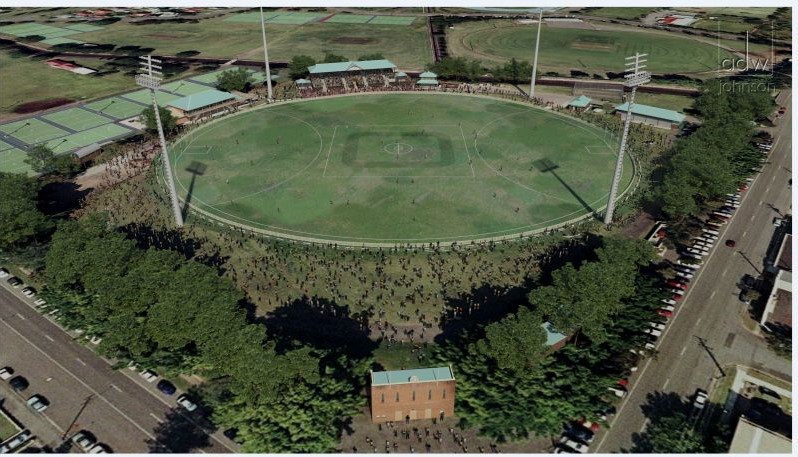
The staged works include increasing the size of the playing field to achieve the minimum standard required for a first grade AFL match, constructing seven new cricket wickets and re-building the entire playing surface.
A new sub-soil irrigation and drainage system will provide a high quality, consistent playing surface, while the installation of six new 40 metre light poles will upgrade the lighting to a standard suitable for night-time games.
New sight screens, player dug-out benches and oval fencing will also improve the playing experience, while the construction of new four-tier concrete bleachers to seat an additional 390 spectators will almost double the ground’s current seated capacity.
City of Newcastle has worked closely with the various clubs affected by the ground’s closure, with arrangements made for alternative venues during the 2020/21 summer and 2021 winter sporting seasons.
No.1 Sportsground History
No.1 Sportsground sits within the 20-hectare National Park, one of Newcastle’s largest and oldest sportsgrounds and open space reserves.
It was built on land previously owned by the Australian Agricultural Company, which from 1865 until the early 1900s was leased by the Newcastle Racing Club as the site of the city’s original racecourse.
National Park Sports Ground, as it was originally known, was designed by City engineer JF Shine in 1921, with its playing oval replicating the size of the Sydney Cricket Ground.
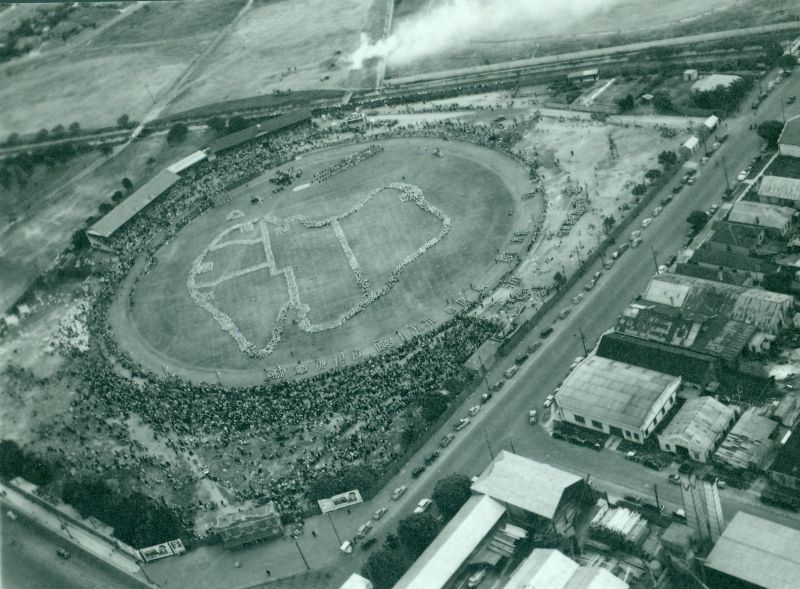
Its original two-storey timber grandstand was completed in October 1921 and could accommodate between 200 and 300 people, with dressing rooms, stores and locker rooms in the lower level.
The sportsground was officially opened on 16 September 1922, with City of Newcastle changing its name two years later to Newcastle Sports Ground.
In 1989 the Newcastle Earthquake caused major structural damage to the original timber grandstand, which resulted in it being almost completely reconstructed with concrete stands, which remain today. This was the last significant upgrade to take place at the ground.
No.1 Sportsground has a history of playing host to top level sporting events including international fixtures covering all codes of football, hockey and cricket.
It has however been more than a decade since the most recent international level match when the Australian women’s cricket team defeated South Africa in March 2009 during the group stages of the ICC Women’s World Cup.
The last first class cricket match played at the ground was in February 2015, when Western Australia beat NSW by seven wickets in their Sheffield Shield clash.
Other codes have also made the most of No.1 Sportsground over the years, including a rugby union clash between New South Wales and New Zealand in 1935, while the Newcastle rugby league team defeated Great Britain 23-18 in front of 22,750 fans in 1962.
The venue has been utilised for a range of non-sporting events as well, including Anzac Day celebrations in 1946 and a Schools Jubilee and Pageant in 1951 that saw 6,000 school children form a living map of Australia in the centre of the field, while Scottish pop-rock icons Simple Minds headlined the Newcastle 500 Supercars concert at the ground in 2018.