
Two men have been charged with drug offences after officers dismantled a clandestine lab in the Hunter.
Last month, officers attached to the Port Stephens-Hunter Police District commenced an investigation into the alleged manufacture and supply of methylamphetamine in the Maitland area.
Following extensive inquiries, Port Stephens-Hunter Police – assisted by officers from the Northern Region Operational Support Group – executed a crime scene warrant at a home on Hunter Street, Maitland, at 2.30pm on Tuesday (1 December 2020).
Police located a clandestine laboratory at the rear of the property, including equipment and chemicals consistent with the supply and manufacture of prohibited drugs.
Officers from the State Crime Command’s Drug and Firearm Squad Chemical Operations Unit attended to dismantle the lab and continued yesterday (Wednesday 2 December 2020).
Other items seized during the warrant include liquid believed to be a precursor for the manufacture of prohibited drugs, an electronic stun device, two pistols, a rifle scope, and a set of nunchucks.
Two men – aged 47 and 39 – were arrested at the home and taken to Maitland Police Station.
Both men were charged with possess precursor intend to use in manufacture/production, supply large commercial quantity prohibited drug and possess unauthorised pistol.
They were refused bail to appear at Maitland Local Court yesterday (Wednesday 2 December 2020), where they were formally bail refused to reappear at the same court on Thursday 21 January 2021.
CLIMATE EMERGENCY DECLARATION PUT TO BOTH HOUSES: LIBERALS OPPOSE, LABOR SPLIT
The Liberals and Labor have combined forces to block a Climate Emergency declaration in Australia, on the day our closest neighbours have declared a climate emergency at their Labour Prime Minister’s request.
The Australian Greens put Climate Emergency Declaration motions before the House and Senate today, with the Government blocking the vote in the House, and Labor and the Government blocking in the Senate.
Meanwhile, across the Tasman, the New Zealand Parliament today joined the many nations to declare a Climate Emergency, following a long and successful campaign from the NZ Greens.
“The first step to dealing with a problem is admitting you’ve got one. Last summer’s disastrous season of bushfires has made it abundantly clear that we’re rapidly speeding towards a climate cliff,” Mr Bandt said.
“This was a chance for Australia to show it is serious about climate action ahead of next week’s international climate summit. Thanks to the Liberals and Labor, we have failed.
“We are running out of time to stop the climate emergency, and every day counts. When the Australian population is at threat, when there is a threat to the safety and the livelihoods of our people and our country, parliament should drop everything to deal with it. Instead, the government is refusing to accept the truth about our climate.
“Declaring a Climate Emergency forces Scott Morrison to tell the truth that our current targets and the world’s current targets are not enough.
“Current projections from the Bureau of Meteorology confirm that our attempts to limit global warming to just 2 degrees are failing. Australia’s on track for 4 degrees of heating unless we increase our ambition, and do it quickly.
“This government clearly has a problem with this truth and the Greens are trying to hold them to account, but the opposition doesn’t know where it stands on the defining issue of our time. “We’re running out of time to take action. I wish Labor would decide where they stand and join us in holding this government of climate criminals to account instead of siding with the Liberals to protect Scott Morrison.
“The Labor-Green government led by Jacinda Ardern knows where they stand on the climate emergency and we welcome New Zealand joining the declaration club.
National accounts show government spending must continue
Today’s national accounts figures show that government support for people who need it most must continue, Greens economic justice spokesperson Senator Nick McKim says.
“These figures show it was government spending that propped up the rest of the economy,” Senator McKim said.
“And even then, we are still way behind where we were before the pandemic hit. Millions of Australians are unemployed or underemployed.”
“As the OECD has made clear, now is not the time for the government to cut spending.”
“Our economy being technically out of a recession means very little for the millions of Australians who are living below the poverty line because of decisions taken by this government.”
“Income support will not only save lives and save people from despair, it will help ensure a fairer, quicker economic recovery.”
Pfizer vaccine emergency approval in the UK
We welcome the emergency approval given to the Pfizer COVID-19 vaccine in the UK. This is particularly so given the over 1.6 million cases and tragic loss of over 59,000 lives in the UK.
I have again spoken to the Australian CEO of Pfizer, they remain on track for vaccine delivery once it is approved for use in Australia by the independent regulator.
Pfizer continues to work with the Therapeutic Goods Administration, providing data for safety and efficacy as part of the approval process.
Our advice remains that the timeline for a decision on approval is expected by the end of January 2021, and our planning is for first vaccine delivery in March 2021.
Pfizer is one of four vaccines the Australian Government has purchased for a total projected supply of 134.8 million units.
In addition we will have access to up to 25.5 million units under the international COVAX facility.
Safety is our number priority and Australia is well placed both for a thorough, but rapid safety assessment and early rollout of a free, voluntary but entirely universally available COVID-19 vaccine program.
Today is an important step for the world.
Legislation to boost protection for Senior Australians in care
The Australian Government has today introduced legislation into the Parliament to support the establishment of the Serious Incident Response Scheme (SIRS) for residential aged care.
Minister for Aged Care and Senior Australians, Richard Colbeck, said the Government, through this bill, is providing safe and quality care as a priority and is putting in place stronger measures to help prevent elder abuse to protect the health and wellbeing of senior Australians.
“The Australian Government’s quality reform agenda is strengthening protections and improving delivery of safe, quality care,” Minister Colbeck said.
“The Serious Incident Response Scheme will commence from 1 April 2021 and expands the responsibilities of aged care providers to identify, record, manage, resolve and report assaults and a broader range of serious incidents in residential aged care.”
“Prioritising implementation of the SIRS is part of the Government’s rapid response to the Aged Care Royal Commission’s recommendations into COVID-19 to increase protection for residents,” Minister Colbeck said.
“It will drive quality and safety improvements in residential aged care at the individual service and broader system level.
“It will require aged care providers to manage all incidents, with a focus on the safety and wellbeing of people in aged care. Importantly, providers will need to put measures in place to prevent similar incidents from reoccurring.”
The Aged Care Quality and Safety Commission will have additional resources to administer the SIRS, including receiving reports and taking proportionate regulatory action. The new legislation strengthens the Commission’s enforcement powers with civil penalties, infringement notices, enforceable undertakings, and injunctions across a range of provider responsibilities. This aligns the Commissioner’s powers with contemporary regulatory best practice.
“Significantly, the scheme will remove the current reporting exemption of incidents of abuse and aggression between aged care recipients where the alleged perpetrator has an assessed cognitive or mental impairment,” Minister Colbeck said.
The Government has invested more than $1.7 billion to support senior Australians in aged care since the start of the COVID-19 pandemic, which includes a further investment of $132.2 million as part our response to the Aged Care Royal Commission into Aged Care Quality and Safety’s recommendations on COVID-19.
The Government has accepted and is acting on all six recommendations made by the Royal Commission in relation to COVID-19, including an additional $11.1 million investment in the Serious Incident Response Scheme, taking total investment to date to $67.9 million.
“The introduction of the SIRS legislation demonstrates the Government’s ongoing commitment to improving care for senior Australians and keeping them safe,” Minister Colbeck said.
City Hall to come alive with love songs and serenades
Novocastrians can soak in the grandeur of City Hall’s grand Concert Hall while being entertained by local talent performing a range of opera, jazz, and classical repertoire, all in the space of their lunch break.
City of Newcastle will host the City Hall Concert Series where music lovers can enjoy the unique opportunity to see world class artists live on stage in a string of free and ticketed shows throughout December.
In the main attraction of the series,multi-award-winning Teddy Tahu Rhodes will be joined by internationally acclaimed flautist Jane Rutter on Saturday 5 December for a sublime concert of love and romance where audiences will be swept away with the passion of Italian opera.
Tahu Rhodes is Australia’s favourite leading man of the operatic and concert stage, dazzling audiences with his extraordinary voice and presence. The pair will unite their musical genius to raise people’s spirits and pull at heartstrings with some of the world’s greatest love songs.
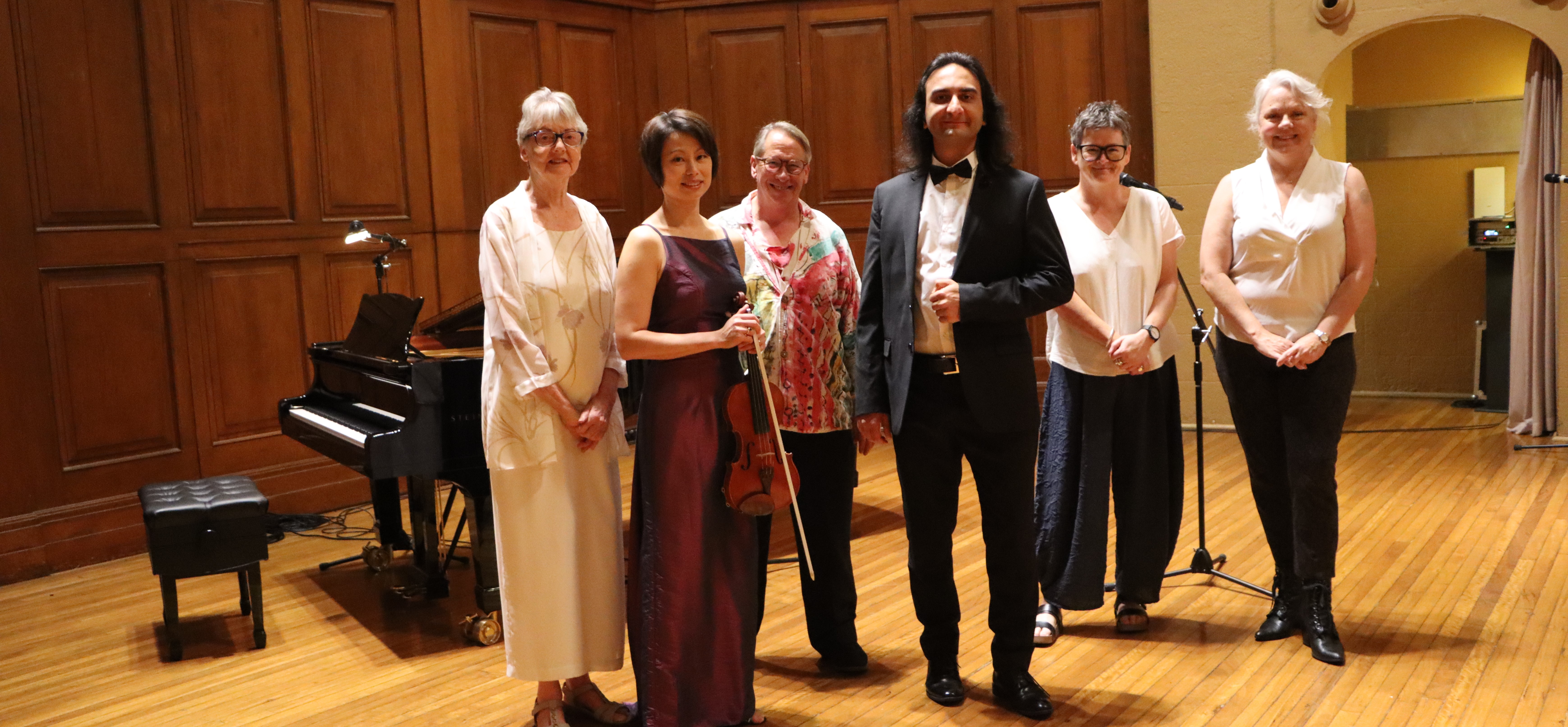
Today saw the first of four free lunchtime concerts in December with Hunter Opera taking the stage with Iranian born tenor Sam Elmi performing alongside Catherine Sheng Cooper (Violin) and Mercia Buck (piano).
Councillor Carol Duncan said the concert series invites the community to experience City Hall in all its glory and that midday performances hark back to an earlier time in Newcastle.
“Our city’s historic civic building is a stunning setting for musical performance. Lunchtime performances were held in City Hall in the 1920s so it’s special that contemporary audiences continue to embrace such a timeless pastime.
“By hosting free concerts that can be enjoyed by people during their lunch break, we are making City Hall and music culture accessible to all.
“I encourage people to make the most the opportunity to see world renowned acts in one of the City’s most iconic venues.”
The Wandering Hearts concert featuring acclaimed soprano, Eleanor Lyons, and her conductor and pianist husband, Vladimir Fanshil scheduled in November has been postponed until 10 March.
Love songs and Lullabies – Saturday 5 December, 7pm Tickets on sale now
Brilliant bass baritone Teddy Tahu Rhodes and internationally acclaimed flautist Jane Rutter will unite for a sublime concert of love and romance.
FREE LUNCH TIME CONCERTS
Damian Wright – Thursday, 10 December 12.30pm
Heather Price – Soulful Sounds – Wednesday, 16 December 12.30pm
Terence Koo – Jazz Musician Wednesday, 23 December 12.30pm
City explores public space connecting the Harbour and the Cathedral
A new public space, inspired by Rome’s Spanish Steps, is proposed as part of the redevelopment of Hunter Street Mall and Iris Capital’s East End and in the process create a stunning view corridor of Christ Church Cathedral from Newcastle foreshore.
The ‘Stairway to Heaven’ concept, first developed fourteen years ago by a group of prominent Novocastrian architects, proposes to link Christ Church Cathedral to the Harbour via a grand staircase.
The plan seeks to open-up connections and view lines from Newcastle foreshore and the Hunter Street Mall to Christ Church Cathedral, aligning with long held strategic objectives of the City of Newcastle and the Revitalising Newcastle program to connect the city to the waterfront.
City of Newcastle proposes to demolish the 59-year old Mall Car Park, which closed on 20 April 2020 due to its poor structural condition, to make way for the project.
CEO Jeremy Bath said the proposed demolition of the Mall Car Park presents a once-in-a-lifetime opportunity to reimagine the future use of the car park site.
“The option of demolishing the existing Mall Car Park has allowed us to bring back to the table the concept of the ‘Stairway to Heaven’, an idea that was first imagined well over a decade ago.
“By introducing a grand staircase with wide pedestrian access, active shop fronts, landings and courtyards, it would bring a European Quarter feel to this part of the city, highlighting the character of Newcastle’s historic CBD and re-establish a link to the Harbour.
“Given the poor structural condition of Mall Car Park, the significant costs associated to rectify and bring the carpark up to current standards, the City does not intend to repair or reconstruct it.
“Instead we are now exploring the best use for the site, including the potential to integrate the site with the adjoining Iris Capital East End development which would involve undertaking a range of feasibility studies for the next phase of the development.
“The proposed feasibility analysis and discussions with Iris Capital will ensure essential public car parking requirements are factored into the next phase of planning and that the best outcome is achieved for the Mall Car Park site and city.
“I will be asking the elected Council next Tuesday to refer the concept to the Asset Advisory Committee and the Urban Design Consultative Group for advice. The Newcastle Inner City Residents Alliance (NICRA) will also be formally consulted.”
Lord Mayor Nuatali Nelmes said City of Newcastle was committed to creating a more attractive and liveable city through planning opportunities such as the Stairway to Heaven concept.
“Opportunities to open up our iconic and beautiful Christchurch Cathedral to the Harbour don’t come every day, and we are constantly looking at ways to get the best future outcomes for our community through these everyday planning decisions,” the Lord Mayor said.
“We’re looking forward to working with the community and key stakeholders on how best to utilise this immensely important piece of Newcastle.”
A development application will shortly be lodged seeking approval to demolish Mall Car Park.
700 EXTRA LOCAL SERVICES & NEW FREQUENT ROUTES
A new express turn-up-and-go bus service will be introduced along Victoria Road from West Ryde to the city as part of network changes delivering an extra 700 weekly services.
Minister for Transport Andrew Constance said customers in Sydney’s North West and Lower North Shore will benefit from the timetable changes with the extra weekly services including the new West Ryde to City and Chatswood to City frequent routes introduced next month.
“From January we’ll be making changes to increase the frequency of services on key routes, with improved connections for customers travelling to the city or within the local area.
“This will include a new limited stops turn-up-and-go bus for the people of West Ryde right into the heart of the city at Hyde Park on the 500X route.
“Chatswood and Willoughby will also see regular services on route 120 into the QVB, at least every 10 minutes on every day of the week, giving customers more choice around when they travel,” Mr Constance said.
There will be some changes to existing local and city services to support the new frequent routes and to allow for better connections to other modes of public transport such as ferries.
The changes to respond to customer demand will affect some bus services in locations such as Parramatta, Carlingford, Macquarie Park, Ryde and Eastwood.
To help reduce duplication on the network, some routes will be replaced by new routes or extra services on other routes, while some current routes will be shortened but retain their current route numbers.
Existing overnight services on route 520 will operate under a new route number between Parramatta and the city.
The changes will be introduced in January 2021. A full list of changes will be available at www.transportnsw.info.
GOVERNMENT CHARGES AHEAD WITH ELECTRIC BUSES
More than 50 new electric buses will roll out across Sydney over the next year, as part of the NSW Government’s commitment to deliver faster and quieter services.
Minister for Transport and Roads Andrew Constance said the government is transitioning the state’s fleet of 8,000 buses to zero emission technology.
“I want to scale up our efforts towards tackling climate change so I am challenging Transport for NSW to aim for my goal of electrifying the state’s entire bus fleet by 2030,” Mr Constance said.
“I am excited to see us one step closer to our vision of creating a greener, cleaner and healthier future for the people of NSW, with more people now able to enjoy our electric bus fleet right across Sydney.
“Over the last 18 months we’ve been trialling five electric buses in the Inner West, and the feedback from drivers and customers has been positive.
The new electric buses are part of the Government’s fleet replacement program, with the first vehicles expected on the road during the first quarter of 2021.
They have been ordered from a range of manufacturers, including BCI, Yutong, Nexport BYD Gemilang and Nexport BYD Volgren.
They will be rolled out by several operators – Punchbowl Bus Company, Busabout and Interline in the south west, Transdev in the north, with Transit Systems making the largest order for the inner west with more than 30.
Transport for NSW’s Deputy Secretary of Greater Sydney Elizabeth Mildwater said more local manufacturers will feature in future orders of zero emission buses.
“There are a lot more zero emission buses to come and we’re delighted that local manufacturers like Bustech and Custom Buses are getting into the game with their buses currently undergoing a review to ensure they meet local standards, while Nexport is planning to set up a local plant,” Ms Mildwater said.
“Once they and other manufacturers are ready, our operators will have more choices to buy locally. In the current order, the Volgren bus is being assembled in Victoria using a chassis made by Nexport BYD overseas.”
MAJOR ROLLING BACK OF COVID-19 RESTRICTIONS IN NSW
The 2sqm rule will be expanded and venue caps will be removed under a major easing of restrictions, as NSW continues to record zero cases of community transmission.
Premier Gladys Berejiklian said the timing is right to ease restrictions and replace the 4sqm rule with the 2sqm rule, except at gyms and nightclubs.
“We are grateful to the people in NSW for their patience and understanding over what has been an incredibly difficult year,” Ms Berejiklian said.
“The rolling back of restrictions across the State is only possible because of the excellent work of the community who have followed social distancing guidelines and continued to come forward for testing.”
On Monday, 7 December, the NSW Government will ease the following restrictions allowing:
Venues including hospitality venues, retail and places of worship:
- 1 person per 2sqm (with 25 people permitted before the rule applies), except for:
- Gyms and nightclubs (1 person per 4sqm, with a maximum of 50 people allowed in gym classes or on the dancefloor at nightclubs)
Stadiums and theatres:
- Outdoors: 100 per cent seated capacity, and 1 person per 2sqm rule for unstructured seating areas.
- Indoors: 75 per cent seated capacity.
Gatherings in outdoor public spaces:
- Up to 100 people for outdoor gatherings (up from 50).
- Up to 5,000 people for outdoor events that are fenced, ticketed and seated (subject to the 2sqm rule).
- Up to 3,000 people for other organised outdoor events i.e. community sport and outdoor protests (subject to the 2sqm rule).
Dance Floors:
- Up to 50 people indoors.
Singing
- Up to 50 performers indoors, no maximum cap outdoors.
- Advice is for congregation/audience to continue wearing masks if singing.
Under the changes, maximum capacity caps will be removed subject to the 2sqm rule for:
- Bookings at hospitality venues;
- Weddings;
- Funerals;
- Regional agricultural shows;
- Corporate events; and
- Religious services.
Deputy Premier John Barilaro said the people of NSW have worked hard to keep COVID-19 under control and deserved this major easing of restrictions.
“Today is a great day for the people of NSW and great timing with Christmas fast approaching, as we will soon see larger crowds at venues and events and the expansion of the 2sqm rule state-wide,” Mr Barilaro said.
Treasurer Dominic Perrottet said under the changes most venues will be able to double their capacity, which will have an immediate and substantial impact on the economy.
“This change will make a big difference to many businesses and will provide a real boost for jobs particularly in the service industry which has been hit hard over the past nine months,” Mr Perrottet said
Health Minister Brad Hazzard said as restrictions are eased the community needs to continue playing their part and being COVID-Safe.
“Keep getting tested with even the slightest of symptoms, maintain your social distance, don’t go to work if you are unwell and wear a mask where you cannot guarantee social distancing,” Mr Hazzard said.
Minister for Jobs, Investment, Tourism and Western Sydney Stuart Ayres said the NSW Government would continue to work with business and industry to ensure they operate in a COVID-Safe way.
“We have worked closely with industry representatives throughout 2020 to safely ease restrictions and we appreciate their patience and know these changes will be incredibly well received,” Mr Ayres said.
NSW Chief Health Officer Dr Kerry Chant said despite there being no recent cases of community transmission the community should continue to be COVID-Safe.
“It is critical that people continue to come forward for testing and practice COVID-safe behaviour when out and about and catching up with family and friends,” Dr Chant said.