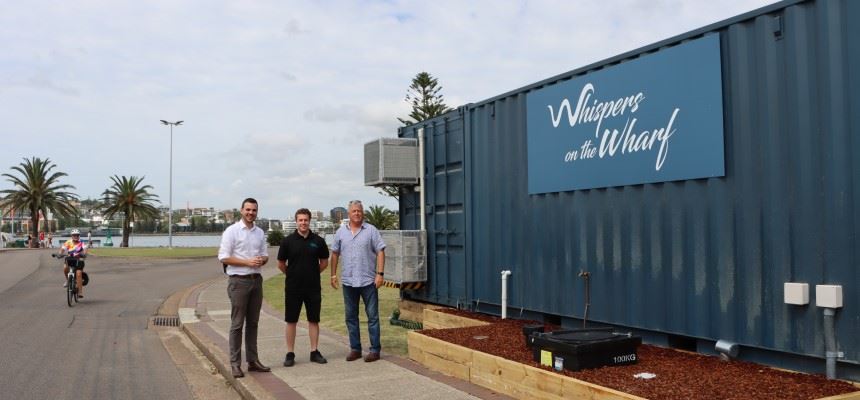
Local businesses are driving construction of the Sydney Football Stadium with almost $300 million worth of contracts awarded to 25 NSW based suppliers and contractors so far.
Acting Minister for Sport, Geoff Lee said this project has supported many small, medium and large enterprise across NSW and will continue to do so until its completion in 2022.
“The Sydney Football Stadium redevelopment project has been a key economic generator during this pandemic, boosting the NSW construction industry with direct and indirect jobs as well as the purchase of materials from suppliers across our state,” Mr Lee said.
“It’s another exciting milestone to see the start of in-factory fabrication of the stadium roof at S&L Steel in Western Sydney. The team will use over 4000 individual pieces of steel to build this significant part of the stadium,” Mr Lee said.
“They are a family owned and managed business and we’re pleased to be supporting jobs in the area.
The team at Evergreen Turf in North West Sydney will supply the grass for the project and associated services at Sydney Football Stadium, generating 200 direct and indirect jobs. Evergreen have pioneered revolutionary turf systems for stadiums around the world.
“It’s fantastic to meet-up with our stadium suppliers and see their hard work in action. I’m really proud to see this project supporting so many people, despite the challenges of this pandemic.”
John Holland General Manager, Matthew Bourne said work on site remained on schedule.
“We’re pleased to have been able to operate in accordance with the COVID-19 regulations, to keep this important project going,” said Mr Bourne.
“In coming months we’ll also see the construction of the walls and shell of the building, so it will really start to take shape.
“We look forward to delivering this remarkable Sydney icon for many spectacular sporting battles here in NSW, and in time for the 2022 NRL Grand Final.”
Approximately 2000 tonnes of structural steel will be required for the new stadium’s roof.
Owner of S&L Steel, Pablo Santos, said this project was of special interest to the family.
“We are very excited to be fabricating the steel for the new stadium’s roof. My father, who is still involved with our business, started the company back in 1974, and we’ve worked on many government projects since then, including the old Sydney Football Stadium,” said Mr Santos.
Construction will continue throughout the pandemic, with extended working hours on weekends to enable safe work practices with social distancing, no job losses or reduced hours for employees.
NSW SMALL BUSINESS MONTH TO ASSIST THOUSANDS OF BUSINESSES
Thousands of businesses across the state are set to receive a boost after one of the most challenging times in recent history as the NSW Small Business Month launches tomorrow.
Premier Gladys Berejiklian said the NSW Government initiative is the fourth annual NSW Small Business Month, which will include hundreds of free and low-cost activities across NSW and provides a chance for businesses to reboot, connect and recover.
“Business communities have faced unprecedented challenges in 2020, with drought, bushfires, floods and now COVID-19,” Ms Berejiklian said.
“NSW Small Business Month is an opportunity to celebrate our small business owners, their valuable contributions to our local communities and their resilience. We also want to focus on ways to reboot and look at ways of doing business differently to get ahead.”
This year’s NSW Small Business Month will build on the success of the past three years by collaborating with 219 local councils and chambers of commerce, as well as over 180 festival partners, across the state.
Minister for Finance and Small Business Damien Tudehope said NSW Small Business Month included a mix of online and face-to-face COVID Safe events providing a chance to connect with other businesses and agencies.
“NSW is home to more than 785,000 small businesses who make a valuable contribution; they make up 97.5 per cent of businesses in NSW and employ more than 41 per cent of the private sector workforce,” Mr Tudehope said.
“Up to $640,000 in funding was made available this year with 93 councils and 126 local chambers of commerce receiving grants to host COVID-Safe events.”
The events cover a range of innovative and diverse topics including leveraging social media and getting your brand online.
The launch event at 10am on Thursday, 1 October will be a live webcast with a top line-up of Government and business experts, including Facebook, NAB and ATO executives. For further information, visit businessmonth.nsw.gov.au
MORE CASUAL TEACHERS FOR REGIONAL SCHOOLS
A trial to provide public schools in regional NSW with more casual teachers will begin in Term 1, 2021.
Minister for Education Sarah Mitchell said the trials, using two pilot programs, aim to bring more teachers to regional NSW.
“It can be difficult to attract and retain teachers in rural and remote areas for a number of reasons including travel distances, lack of suitable accommodation close to schools and limited opportunities for teachers to access professional learning,” Ms Mitchell said.
“The hub and spoke pilot provides two teachers, employed in a ‘hub’ school, who can also address the needs of nearby ‘spoke’ schools.
“Through this pilot, up to 12 teachers will be employed and will be able to be deployed quickly to a nearby spoke school to cover classes.
“It will also provide certainty to casual teachers, knowing they have a permanent position.”
The program targets schools with the greatest reported shortages and grouping them in travel distance clusters to reduce average commuting times to less than an hour.
The in-built relief model first piloted in 2019, will be extended to a carefully selected number of schools from Term 3, 2020.
“One temporary teacher will be embedded in each school to provide relief when permanent teachers are unavailable due to professional development or illness.”
The trials will improve the proposition of working in rural or remote schools by:
- reducing commuting time; and,
- offering longer engagements,
- offering temporary or permanent appointments that include leave and other benefits,
- providing employment certainty,
- investing in professional development and learning for these teachers.
DV Funding Leaves a Third of Women At Risk
The long overdue announcement of the Safe Places Emergency Accommodation grants is welcome, but falls critically short of national demand and is no substitute for adequate funding in next week’s Budget, Greens Senate Leader Larissa Waters said.
“This funding is a fraction of the money needed to ensure women and children fleeing family violence have somewhere to go and get the support services they need,” Senator Waters, Greens spokesperson on Women, said.
“Announcing 700 new crisis places which the government contends will house 6,000 women and children nationally, when its own data shows almost 10,000 survivors were already turned away from crisis accommodation pre-Covid, means the government is condemning a third of women and children to a choice between violence or homelessness.
“Increased demand throughout Covid has meant Queensland Women’s Legal Service hasn’t been able to answer 50% of its incoming calls. Much of the ‘emergency’ funding announced by the government to address increased demand on Family and Domestic Violence services in March is yet to reach the bank accounts of frontline services.
“Funding for crisis accommodation and support services for victim-survivors has never been more critical. Yet services have been waiting months for the support promised by this government, and made clear that much more is needed.
“The Greens support the sector’s calls for a significant increase in funding to fix the domestic and family violence crisis. Next week’s Budget must fund all frontline services needed to keep all victim-survivors of violence safe, and effective primary prevention,” Senator Waters said.
$9 Million for research into cancer in children and young adults
The Morrison Government is providing $9 million to support research into the causes, biology and progression of cancer among children and young adults.
Cancer is the leading cause of death from disease among Australian children. In the decade to 2015, nearly 1000 Australian children under the age of 15 died from cancer.
Delays in diagnosing childhood cancers can limit treatment options, and for some cancers, there are currently no effective treatments.
Tragically, survival rates for some cancers among children have not improved in more than 25 years, and new analysis of records held by the Australian Childhood Cancer Registry shows the rates of several childhood cancers are slowly rising.
This $9 million investment from the Government’s ground-breaking Medical Research Future Fund (MRFF) will provide grant opportunities for Australia’s world-leading researchers to accelerate options to prevent, diagnose and treat cancer in children and adolescents.
The Grant Opportunity will fund projects in two streams of research:
- Cancers that occur in children aged 0-14 years.
- Cancers that occur in adolescents aged 10-19 years.
Funding of $3 million will be allocated to each of the two streams. The remaining $3 million will be earmarked to support the overall best research, irrespective of streams.
Consultation with The Kids’ Cancer Project and Cancer Australia, has informed the scope and priorities of the 2020 Childhood Cancer Research Grant Opportunity.
The Government’s MRFF is a $20 billion endowment fund. The MRFF is a long-term investment supporting Australia’s best and brightest researchers. Further information about the MRFF is available at www.health.gov.au/mrff.
Guidelines to apply for grants under the 2020 Childhood Cancer Research Grant Opportunity are available at https://www.grants.gov.au/
The Australian Government is seeking expressions of interest for the position of board chairperson for Sport Australia.
Minister for Youth and Sport, Richard Colbeck, said the role offers an opportunity to lead the national agency as it plays a vital part in shaping the future of the sector, with a particular focus on high performance sport.
“It has been a difficult period for sport across Australia, creating challenging circumstances for sporting organisations and athletes at every level,” Minister Colbeck said.
He said the appointment would usher in new leadership as the sporting community works its way through the new COVID-19 environment and towards the Tokyo Olympics.
“This is an exciting chance for a well-credentialed professional with a passion for the advancement of sport, as Australia begins its recovery from the impacts of the COVID-19 pandemic.”
The newly formed Sport Appointments Selection Committee will convene to consider candidates with the administration of the selection process managed by a recruitment specialist.
Its members include former Minister for Sport and Minister Assisting the Prime Minister for the Sydney Olympics, The Hon. Warwick Smith, AO, as panel chairman, Department of Health Associate Secretary Caroline Edwards, Paralympic wheelchair racer and leading coach Louise Sauvage, OAM, former Matildas’ vice-captain Moya Dodd and former Olympic and Commonwealth Games swimming champion Samantha Riley, OAM.
The successful candidate will require high level stakeholder engagement skills to ensure Sport Australian continues to create pathways for athletes to reach their potential.
The recruitment campaign follows the announcement that John Wylie, AM, will step down from his role as Chair of the Board on 5 November.
Minister Colbeck said throughout his eight year tenure Mr Wylie has displayed great dedication to developing Australia’s sport capacity, particularly through his contributions toward the National Sport Plan, Sport 2030 and supporting athletes to the Olympic, Paralympic and Commonwealth Games and numerous world championships.
“Mr Wylie’s passion and commitment to the promotion of sport and increasing involvement at all levels has been a notable highlight of his work with Sport Australia,” Minister Colbeck said.
“The Government thanks Mr Wylie for his passion and commitment to Australian sport during his role as Chair of Sport Australia.
More information about the Sport Australia role can be found here.
Expressions of interest close on 16 October, 2020.
Hundreds of millions of public funds used for Liberal-National slush fund
NSW Labor have obtained documents that reveal the NSW Liberals and NSW Nationals used around $400 million in grants as a slush fund to buy votes.
The Stronger Country Communities Fund (SCCF) was designed to fund projects throughout regional and rural NSW, however, analysis shows funding decisions were based more on political self-interest rather than the best interests of the community.
About 1550 projects received funding under rounds one, two and three, with more than 80 per cent of those located in electorates held by Coalition MPs.
In rounds one and two – announced prior to the 2019 NSW election – more than 87 per cent of grants were allocated to seats held by Coalition MPs, while projects that were clearly allocated in Labor-held seats accounted for less than four per cent.
It is unclear where some projects in council areas crossing multiple electorates were located.
$100 million worth of funds was distributed during rounds one and three, with $200 million being distributed in round two – just months before the 2019 state election.
NSW Labor Leader Jodi McKay said it was blatantly obvious the SCCF was not to assist communities throughout rural and regional NSW: “This was designed to buy the last election.”
“This taxpayers money. It is not the Liberal-National Parties’ slush fund.
“We should not normalise this type of behaviour,” she said.
Four of the largest grants in round two went to marginal seats, two to fairly safe Coalition seats, one to a National seat with changing members, one to a safe Nationals seat and one to a safe Labor seat.
The largest of all three round– a grant worth more than $3 million in round two – went to Snowy Monaro Regional Council, located in the marginal seat of NSW Nationals leader John Barilaro.
An NSW Parliament Upper House inquiry examining the NSW Liberals and NSW Nationals distribution of funds as part of certain grants, will begin on Monday, September 21. Shadow Minister for Local Government, Greg Warren, said the SCCF revelations were just the tip of the iceberg.
“The Berejiklian-Barilaro Government were elected to represent the entire state – not just areas that suited their own political agenda.”
“These were public funds meant to benefit the public – not to bolster the NSW Liberals and NSW National re-election prospects,” Mr Warren said.
Labor welcomes parliamentary inquiry into 'dysfunctional' rural & regional health
Labor is welcoming the establishment of a Parliamentary Inquiry it called for into rural and regional health in NSW.
The expansive probe will consider:
- Health outcomes for people living in rural, regional and remote NSW
- Access and availability of services
- Planning systems
- Capital and recurrent health expenditure
- Staffing challenges and allocations
NSW Labor Leader Jodi McKay said a Parliamentary Inquiry is desperately needed and long overdue.
“Health outcomes should not be determined by postcodes. We need to do much better for families living in regional NSW,” Ms McKay said.
“This is about equality, fairness and a fundamental right to healthcare. The state of healthcare across rural and regional communities is appalling. It’s systemic crisis that must be addressed now.”
Labor first called for an urgent inquiry into rural and regional health in October last year after a death at Tenterfield Hospital was reportedly linked to a lack of clinical resources.
Since then, the significant disparity in health outcomes between the city and country areas was laid bare in data from the Public Health Information Development Unit.
The analysis shows:
- Avoidable deaths can be twice as likely in rural and regional communities when compared to cities
- The median age of death for those in Sydney (79) is more than a decade higher than residents in our most remote communities (66)
- The highest rates of preventable hospitalisation and preventable chronic disease are in regional and rural areas
The Shadow Minister for Health Ryan Park said: “It’s no secret rural and regional hospitals are overstretched and under resourced. The health system can’t cope with the growing cuts and cost blowouts from the Liberals and Nationals. I hope this Parliamentary Inquiry is the wake up call the Government needs to address the dysfunctional state of rural and regional health in NSW.”
The Shadow Minister for Rural Health Kate Washington said: “Doctors and healthcare workers across regional and rural NSW have gone above and beyond to do the best they can with what they have. But the reality is, there’s a severe lack of funding and shocking staff shortages. After nine years in Government, the Liberals and Nationals are responsible for this mess.”
The Government has continued to spruik hospital upgrades but an Auditor-General’s inquiry revealed at least three regional projects are already over budget or with missed deadlines. There have been $2.2 billion blowouts in health and hospital projects including at the Dubbo and Macksville Hospitals.
A 60 Minutes investigation on Sunday exposed the dire situation across rural and regional hospitals. The program investigated a pattern of incidents and failings all over the State.
A growing number of regional and rural health practitioners have also spoken out about the unprecedented challenges they’re grappling with amid the COVID-19 pandemic, including staff shortages and limited ICU capacity.
Premier approved multi-million dollar Government slush fund, inquiry hears
A Parliamentary Inquiry has heard the Premier approved a $90 million taxpayer-funded grant for a Liberal electorate in Sydney’s north. The grant for Hornsby Shire Council was finalised within 24 hours of the Council being notified it was eligible.
The Office of Local Government chief executive Tim Hurst said his agency held no record of a written, signed approval for the project from the Premier. The Stronger Communities Fund payment for Hornsby Shire Council was approved via an email from Premier Gladys Berejiklian’s office.
Two other eligible applicants were not aware the fund existed.
NSW Labor has slammed the Government’s handling of the $250 million Fund which was supposed to support forcibly-amalgamated councils.
The Inquiry heard 95% of the money went to Councils in or near seats held by Liberal or Nationals MPs, and that the decisions were approved by either the Premier, Deputy Premier or the Local Government Minister.
NSW Labor Leader Jodi McKay said: “This Stronger Communities Fund was a quarter of a billion dollars. 95% of that went to Liberal and National seats. How is that appropriate?”
Canterbury-Bankstown Mayor Khal Asfour told the Inquiry he contacted former Local Government Minister Gabrielle Upton in July 2018 about potential funds for merged Councils. He was informed there were no State Government funds available.
In contrast, Hornsby Shire Council General Manager Steven Head said was notified by the Office of Local Government chief executive, Tim Hurst, around 5pm on 27 June 2018, informing him funds under the Stronger Communities Fund – Tied Grants were available. Their grant was finalised the following day.
Ms McKay said: “This Inquiry is incredibly important to get to the bottom of what’s been happening with grant distribution across NSW. These programs should be fair and based on merit.”
“We support grant programs to help communities across a range of portfolios but we know some are being mismanaged.
“Tax payers should have confidence that decisions are fair and transparent, not politically driven.”
Shadow Minister for Local Government, Greg Warren, said the Stronger Communities Fund – Tied Grants program was a farce.
“This was a taxpayer-funded Government slush fund,” Mr Warren said.
“Not only were councils like Canterbury-Bankstown and Inner West denied access to the program, they were actually told there was no State Government funding available when clearly there was.
“Make no mistake, this fund was a rort.”
The Inquiry into Integrity, Efficacy and Value for Money of NSW Government Grant Programs will continue on Friday, October 16.
Almost $4 billion gouged out of Western Sydney in five-year span
NSW Labor have condemned the Government for selling more than $3.7 billion worth of public assets in Western Sydney over a five-year period, while giving next to nothing back.
Documents obtained via Freedom of Information have revealed in the 2015/16, 2016/17, 2017/18, 2018/19 and 2019/20 financial years, an incredible 4428 state government-owned properties were sold in the region.
Western Sydney – the fastest growing region in the state – has been plagued by problems resulting from a lack of infrastructure since the NSW Liberals came to power in 2011.
Wait times in the region’s hospital emergency departments continue to blow out and schools continue to fill beyond capacity, while public transport is predictably unreliable and sub-standard.
NSW Labor Leader Jodi McKay condemned the privatisation-happy Government’s treatment of Western Sydney residents.
“The Government has sold electricity assets, ports, the desalination plant, the New South Wales Land and Property Information and part of the Westconnex. Enough is enough,” Ms McKay said.
“As we’ve seen in the past, sell-offs result in job losses especially in rural and regional areas. We need to put an end to this privatisation madness, especially as the state struggles through recession and high unemployment.”
Shadow Minister for Western Sydney and the Member for Campbelltown, Greg Warren, said this was proof of the NSW Liberals disdain for the people of Western Sydney.
“When it comes to Western Sydney, this Government take, take and take – but when it comes time to give something back, their keep their hands stuffed in the cash-filled pockets,” Mr Warren said.
“Almost $4 billion worth of Western Sydney public assets have been flogged off by this mob and what have Western Sydney residents got to show for it?
“The short answer is very little.
“This Government has sold off and sold out Western Sydney.”