
A significant milestone has been reached on the Mulgoa Road project, with the section from Union Road to Museum Drive in Penrith now open to traffic.
Minister for Communications, Urban Infrastructure, Cities and the Arts, the Hon Paul Fletcher MP, said the proposal is part of a broader strategy to upgrade the Mulgoa and Castlereagh Road corridor in the Penrith region, which forms the main north-south link between the Penrith CBD and M4 Motorway.
“This project has been delivered to address traffic congestion, support residential and employment growth, improve road safety and bolster freight productivity,” Minister Fletcher said.
“This is just one of many critical infrastructure projects to receive funding from the Morrison Government under our record $110 billion infrastructure pipeline, part of our Economic Recovery Plan to secure Australia’s world-leading economic recovery.”
NSW Minister for Transport and Roads, the Hon Andrew Constance MP, said the upgrade will reduce congestion and delays.
“The NSW Government has committed $120.5 million to upgrade this critical section of Mulgoa and Castlereagh roads to provide an additional lane both north and southbound between Union Road and Museum Drive,” Minister Constance said.
“We have also increased capacity at the Jane Street and High Street intersections.
“The existing rail underpass has been widened to three lanes in each direction on Castlereagh Road and a left turn lane on to Jane Street added, and when final line markings are complete there will be bus priority at the High Street intersection.”
NSW Member for Penrith Stuart Ayres said these upgrades mark the first step in the 6.5-kilometre Mulgoa and Castlereagh Road corridor upgrade.
“This is the first stretch to be upgraded in our plans to improve this very important road corridor for the people of Penrith,” Mr Ayres said.
“The project included complex and impressive work to move the new rail bridge into place, and it is fantastic to see it now fully open for the community.
“We thank the local community, surrounding business and road users who have been patient and understanding while we have built this important upgrade.”
Federal Member for Lindsay, Melissa McIntosh MP said this was part of her plan to ease congestion and improve safety on our roads.
“I want the commute to work or dropping the kids off at school to be quicker and safer,” said Ms McIntosh.
“This upgrade will cut travel times for thousands of people who rely on Mulgoa Road – and it’s just the beginning. For local businesses, it means getting our great Aussie Made products around our electorate and beyond.
“We’re putting in place the transport infrastructure our community needs, so we can make Lindsay an even better place to live, work and stay.”
Some minor work will continue over the coming months to finalise the upgrade, including line marking, footpath and landscaping work, installing road signs and fencing, and minor defect work.
The Mulgoa Road Upgrade between Union Road and Museum Drive is jointly funded, with the Australian Government committing $72.5 million and the NSW Government $120.5 million.
Author: admin
New COVID-19 restrictions for Greater Sydney
To protect the people of NSW from the evolving COVID-19 outbreak, new restrictions will be introduced for Greater Sydney from 4pm today for one week.
Following updated health advice from the Chief Health Officer Dr Kerry Chant about the growing risk to the community, the following restrictions will be introduced for Greater Sydney, the Central Coast, Blue Mountains, Wollongong and Shellharbour;
- Visitors to households will be limited to 5 guests – including children;
- Masks will be compulsory in all indoor non-residential settings, including workplaces, and at organised outdoor events;
- Drinking while standing at indoor venues will not be allowed;
- Singing by audiences at indoor shows or by congregants at indoor places of worship will not be allowed;
- Dancing will not be allowed at indoor hospitality venues or nightclubs however, dancing is allowed at weddings for the bridal party only (no more than 20 people);
- Dance and gym classes limited to 20 per class (masks must be worn);
- The one person per four square metre rule will be re-introduced for all indoor and outdoor settings, including weddings and funerals;
- Outdoor seated events will be limited to 50% seated capacity;
- Previous public transport capacity limits, represented by green dots, will be reintroduced;
- If you live or work in the City of Sydney, Waverley, Randwick, Canada Bay, Inner West, Bayside, and Woollahra local government areas, you cannot travel outside metropolitan Sydney for non-essential travel.
These restrictions are designed to reduce the risk of further community transmission.
NSW Premier Gladys Berejiklian said we are once again asking the community to do what they do best and follow the health advice to get on top of this outbreak.
“We don’t take these steps lightly and we never want to impose restrictions unless we absolutely have to,” Ms Berejiklian said.
“We know the effect this will have on residents and venues but we must take this action now to ensure we keep on top of this outbreak.”
Chief Health Officer Kerry Chant urged the community to play their part in controlling the COVID spread.
“We need really high testing rates to make sure we’re stopping any chains of transmission and we’re continuing to urge people to come forward for testing, especially if you were in Westfield Bondi Junction (including the car park) at any time between 12 June and 18 June,” Dr Chant said.
Health Minister Brad Hazzard said more than ever people need to use QR codes and wear masks when required.
“We will be increasing supervision and compliance checks to make sure everyone is doing the right thing,” Mr Hazzard said.
“This pandemic is far from over and we all have to do our bit to protect the community.”
The government and health experts will continue to monitor the situation closely and provide updated information and advice.
For more information visit www.nsw.gov.au/covid-19
Man charged for not wearing face mask in Maroubra shopping centre
A man will appear in court today charged after allegedly not wearing a correctly fitting face mask in Sydney’s east yesterday.
About 3pm (Friday 25 June 2021), officers from Eastern Beaches Police Area Command were patrolling at a shopping centre on Anzac Parade, Maroubra, when they noticed a man wearing a face mask below his chin.
When police approached the 60-year-old man it’s alleged he became aggressive and ignored directions to leave or wear the mask correctly.
He then ran away and following a short foot pursuit, he was arrested.
The man was taken to Maroubra Police Station and charged with not wear fitted face covering in retail/business premises, intimidate police officer in execution of duty, and resist or hinder police officer in the execution of duty.
The man, from Eastlakes, was refused bail to appear at Parramatta Bail Court today (Saturday 26 June 2021).
In addition, the NSW Police Force has issued a total of seven $200 infringements for failing to wear a fitted face covering.
Sydney man, woman who travelled to Hunter region among latest Public Health Order breaches
A man and woman from Sydney’s east who travelled to the Hunter region are among those issued Penalty Infringement Notices (PINs) for alleged breaches of the Public Health Order in the past 24 hours.
About 3.20pm yesterday (Saturday 26 June 2021), officers from Hunter Valley Police District attended a pony club on Bell Street, Denman, following a Crime Stoppers report by a member of the public about three people from Sydney who were at a horse trial event.
Police located a 56-year-old man, a 22-year-old woman and a 13-year-old girl in the carpark who were not wearing face masks.
Inquiries revealed the man and girl, from Paddington, and the woman, from Maroubra, had travelled to Denman in breach of the stay-at-home order issued for Waverley, Woollahra, Randwick and City of Sydney Local Government Areas at the time.
The man and woman were each issued a $1000 PIN for travel from Metropolitan Sydney area to NSW outside area and a $200 infringement for failing to wear a fitted face covering.
The girl was issued a warning.
In total, police issued seven $1000 PINs yesterday and a further eight $200 infringements for failing to wear a fitted face covering.
Police continue to appeal to the community to report suspected breaches of any ministerial direction or behaviour which may impact on the health and safety of the community.
Man and woman issued with PINs at Bondi after breaching Public Health Order
A man and woman from Sydney’s eastern suburbs have been issued with $1000 PINs after they failed to comply with the Public Health Order at Bondi Beach today.
About 10am today (Sunday 27 June 2021), officers from Eastern Suburbs Police Area Command attended Bondi Beach after reports multiple people were in breach of the current Public Health Orders.
Upon arrival, police observed a number of people sitting on a grassed area between Campbell Parade and Queen Elizabeth Drive. Officers spoke to these people and issued them with directions to leave the area, which they complied with.
A short time later, police found a 35-year-old man and a 29-year-old woman had returned to the beach.
Both were issued with Penalty Infringement Notices for fail to comply with noticed direction in relation to section 7/8/9 – COVID-19 – individual (other than face covering breaches).
Police continue to appeal to the community to abide by the public health orders, and report suspected breaches of or any behaviour which may impact on the health and safety of the community.
Anyone who has information regarding individuals or businesses in contravention of a COVID-19-related ministerial direction is urged to contact Crime Stoppers: https://nsw.crimestoppers.com.au. Information is treated in strict confidence. The public is reminded not to report crime via NSW Police social media pages.
New CEO to lead health and welfare data agency
The Australian Government welcomes the appointment of Mr Robert Heferen to lead the Australian Institute of Health and Welfare (AIHW).
With more than 30 years’ experience in the public service, Mr Heferen will take on the role of Chief Executive Officer from early July, 2021.
Mr Heferen brings a deep knowledge of policy and programs as a former Deputy Secretary in the Department of Education, Skills and Employment, the Department of the Environment and Energy, and the Department of Industry, Innovation and Science. He has also held leadership roles at the Australian Tax Office, Treasury and the Department of Families, Housing, Community Services and Indigenous Affairs.
Mr Heferen’s extensive experience will be vital to the AIHW, who continue to play a critical role in health and welfare policy and program development across Australia. The independent agency is internationally recognised for its expertise and proven track record in producing information and statistics which underpin our health and welfare systems.
The Government extends its thanks to outgoing CEO, Mr Barry Sandison, who oversaw significant reforms at the agency and has positioned AIHW successfully for the future.
Mr Sandison’s contributions have transformed the agency, expanding the suite of products and services and overseeing significant improvements in the way data is presented, making it more accessible and easier to understand.
The Government congratulates Mr Heferen on his appointment, who we expect will continue this program of reform and improvement, ensuring we have access to authoritative information and statistics to underpin our world-leading health and welfare systems.
Tuxford Park oval renamed to recognise Shortland local Bob Palmer’s contribution to community
City of Newcastle has re-named Shortland’s Tuxford Oval Number One as ‘Bob Palmer Oval’ in honour of Robert ‘Bob’ Palmer’s incredible contribution to Shortland, the Shortland Devils RLFC and to local Rugby League.
On 12 December last year, Mr Palmer was killed in his beloved suburb of Shortland leading to an outpouring of grief from the local community.
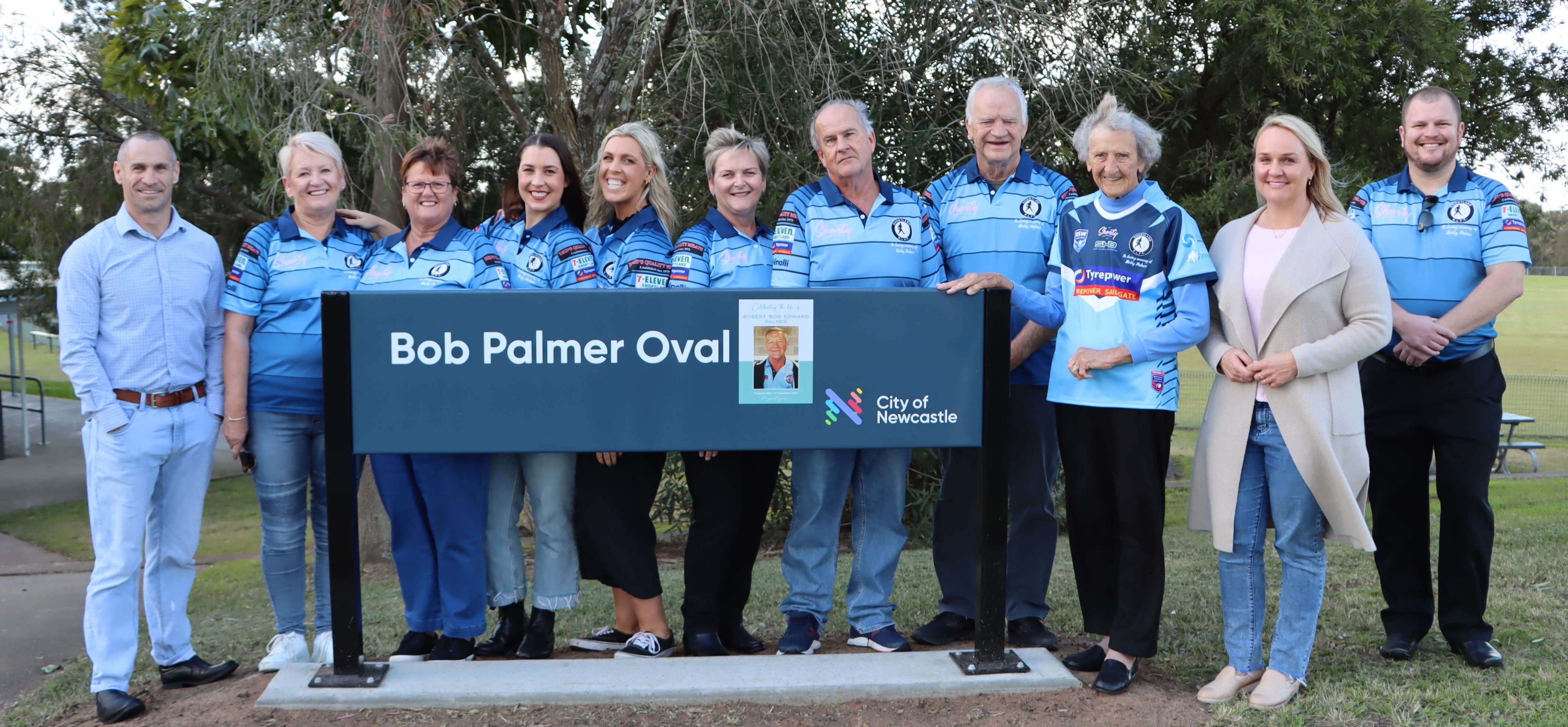 Lord Mayor Nuatali Nelmes said the renaming of the Oval was in response to a request from many people in the community to honour Mr Palmer’s lifelong commitment to the Shortland Community, and to the Shortland Devils RLFC.
“The death of Bob Palmer in 2020 saw the entire Shortland community and many people across the entire City, grieve his tragic loss, and the senseless circumstances which sadly cut his life short,” Cr Nelmes said.
“We have worked with Shortland Devils Rugby League Committee and Bob’s family to make sure Bob’s legacy as ‘Mr Shorty’ is commemorated at Tuxford Park in perpetuity.”
Mr Palmer’s daughter Mollie Palmer said the renaming of the Oval was a special gesture that was proudly welcomed by his family.
“He is sadly missed by all who were fortunate to have him as a part of their lives. Our family has great pride in the legacy he has left at the Football Club and in the Shortland community,” Ms Palmer said.
The Shortland Devils Rugby League Football Club, Mr Palmer’s family and wider community will come together on Old Boys on Saturday for a special ceremony held at 2.45pm to dedicate the ground.
President of the Shortland Devils Rugby League Football Club, Brock Johnson said the renaming of the Oval was a fitting tribute for a man who gave countless hours over many years to his beloved rugby league club.
“It is with great pride that we will officially unveil the signage for Bob Palmer Oval on our Old Boys Day,” Mr Johnson said.
“Robert “Bobby” Palmer was an extremely special member of our club, and the greater Shortland community. Bobby was and shall remain one of the true legends of Shortland.
“Bobby’s involvement in our club extends back to the 70s when he first began playing junior footy for the Devils. He continued all the way through to his passing in many different capacities.
“Bobby was passionate about our club and donated countless hours to his beloved Devils marking lines, mowing the fields, cooking barbecues, running water, coaching and time keeping.
“Bob was a stalwart of the Club and has made such an immense contribution to not only rugby league but the wider community. We are proud to keep his memory alive through this tribute.”
Boost to rural health training
The Australian Government will extend one of the nation’s premier rural health workforce initiatives, following an evaluation of the programme highlighted its effectiveness in addressing workforce shortages.
Regional Health Minister, Mark Coulton, said Rural Health Multidisciplinary Training Program will continue to provide more than $200 million per year over three years to fund a network of rural clinical schools, university departments of rural health, and regional training hubs across rural and remote Australia.
“Extending the Rural Health Multidisciplinary Training (RHMT) Program reaffirms the Government’s commitment to addressing health workforce shortages in rural areas.
“The RHMT is one of our most effective rural workforce initiatives and I’m pleased to see it continue with the funding and settings it needs to deliver better outcomes for rural communities,” Mr Coulton said.
“The evaluation demonstrates that universities continue to provide health students with quality rural clinical training experiences and that the presence of universities in regional, rural, and remote communities has social and economic benefits to these communities and their health services.”
The review’s recommendations aim to build on the success of the 20-year-old program. These recommendations recognise the teaching innovations and maturity of the program, while allowing for some areas of reform.
The reforms, to be phased in from 1 January 2022, will focus on key program outcomes such as student selection and quality placements, strengthening research networks, and responding to community and workforce need.
“The RHMT program has been with us for two decades,” the Minister for Regional Health, Mark Coulton, said. “These reforms will open a new chapter in its success story.”
“They will further enhance its key role in increasing the number of qualified health professionals in rural, regional and remote Australia, providing high quality training and helping to bridge the city-country divide in access to health services.”
“We will work with the stakeholders to further strengthen and develop rural training opportunities and to keep building on this program for the future.”
The RHMT program is one of several Commonwealth rural health workforce programs supporting more health professionals to work in the bush.
It funds a network of rural clinical schools, university departments of rural health, dental faculties offering extended rural placements, and the Northern Territory Medical Program. The RHMT program also supports 26 regional training hubs.
Twenty-one universities currently participate in the program and the Australian Government’s annual investment is more than $200 million.
A closed non‑competitive grant opportunity will be undertaken to facilitate this three-year extension.
$10.1 million to reduce number of younger people in residential aged care
The Australian Government continues to deliver on its commitment to reduce the number of younger people living in residential aged care.
Minister for Senior Australians and Aged Care Services, Richard Colbeck and Minister for Government Services, Linda Reynolds CSC said the Government is investing $10.1 million in a national network to help younger people and their families find age-appropriate accommodation and additional support.
“The aged care system was designed to best support the needs of senior Australians, not younger people,” Minister Colbeck said.
“We remain deeply determined to ensure younger people in need of care can find the support outside of the aged care environment.”
As part of the 2020–21 Budget, the Morrison Government committed to funding a national network of up to 40 Younger People in Residential Aged Care System Coordinators.
Minister Reynolds said thanks to a recent competitive grant opportunity Ability First Australia will bring the knowledge, skills and expertise to this important reform.
“Ability First will work with younger people and their families to help them access disability services, health services, housing and social supports,” Minister Reynolds said.
“This will ensure younger people who want to live on their own terms and with independence in the community will have the support they need to live their best life.”
Ability First Australia is one of Australia’s largest not-for-profit strategic alliances, with 14 member organisations working across all states and territories.
Its members have expertise in supporting and advocating for people with disability.
In its initial response to the Royal Commission Interim Report, the Morrison Government announced strengthened Younger People in Residential Aged Care targets and an intention to develop a strategy to meet those targets.
Apart from exceptional circumstances, the Government is committed to ensuring:
- Nobody under the age of 65 enters residential aged care by the end of 2022;
- No one under the age of 45 is living in residential aged care by the end of 2022; and
- No people under the age of 65 are living in residential aged care by the end of 2025.
Minister Colbeck said the latest steps illustrated the Government’s ongoing commitment to providing better options for what can be a deeply emotional and complex issue.
“We know the impact this can have on individuals and their families who have too often been left with no other choice,” he said.
Minister Reynolds said the Government is committed to ensuring the individual needs of younger people are met.
“This is an issue very close to my heart. The first Senate Inquiry I championed was into this issue as I firmly believe that no younger Australian with a disability should be forced to live in aged care because there is no alternative,” Minister Reynolds said.
More information about the Younger People in Residential Aged Care Strategy 2020–2025 can be found on the Department of Social Services website.
Hockeyroos at home at upgraded recovery centre
The opening of a new state-of-the-art change room and recovery facility has given Australia’s women’s hockey squad, the Hockeyroos, a huge boost ahead of the postponed Tokyo Olympic Games.
The “Roos’ Retreat” was officially opened by the Federal Member for Swan the Hon Steve Irons at Perth Hockey Stadium today on behalf of the Minister for Sport Richard Colbeck.
The $600,000 upgrade to the hockey facilities was funded as part of the Morrison Government’s $11.5 million commitment to high performance sport infrastructure.
The upgraded Perth Hockey Stadium at Curtin University now includes equal change rooms for the Australian men’s and women’s hockey squads as well as recovery areas with an ice-bath and spa area and a gymnasium.
It comes as The Hockeyroos are set to challenge for a podium finish and a fourth Olympic gold medal at next month’s Games.
Minister Colbeck and Mr Irons said the investment was key to support one of Australia’s best-loved and most successful teams.
“The Hockeyroos carry the status as one of Australia’s iconic sporting teams and they deserve world-class facilities, which the Morrison Government is proud to support,” Minister Colbeck said.
“This is more than an investment in bricks and mortar.
“It also signals confidence in the sporting champions who represent and continually inspire our nation.
“Our female athletes and teams are incredibly important role models, inspiring and empowering more young girls to see the benefits of sport participation.
The Australian Government, through the Australian Institute of Sport, has increased funding to the Hockeyroos for their Tokyo Olympic campaign, delivering more than $12 million since 2016 to support the national squad.
Mr Irons said the investment would cement Perth’s status as Australia’s home of high performance hockey.
“Perth has been home to Australia’s national hockey squads since 1984, which has attracted so many athletes to relocate here and become part of the community,” Mr Irons said.
“This stadium is also home to Hockey Western Australia and caters for developing players as well as national team members.
“These facilities will be a beacon for aspiring hockey players across the country who have dreams of representing Australia at the highest level.”