
The Commonwealth Government welcomes the announcement by the Victorian Premier to ease restrictions from 11.59pm on Tuesday.
Victorians have worked hard and sacrificed a lot to get to this point. We thank them for their patience and perseverance.
Today’s announcement is a reflection of the dedication and effort of Victorians – taking the next step to reopen Victorian society and the state’s economy.
After a long winter, there is light at the end of the tunnel for Victorians.
As we said yesterday – Victorians have made great progress in reducing the rate of COVID-19 infections from the second wave outbreak in Victoria.
The new National Framework to reopen by Christmas is a clear and transparent, three step national plan which provides the Australian community and businesses with a way forward where Australians can live and work in a COVID Normal Australia, ensuring that we maintain strong health protections and minimise job losses and mental health impacts.
Under the new ‘National Framework’ released last week, Victoria is now moving towards Step 1 – an important step on the pathway to COVID Normal.
Australia has been a world leader in fighting the virus to save lives and to save livelihoods and with today’s announcement, we look forward to Victoria continuing to make progress on the path to reopening and joining the rest of the country at Steps 2 and 3 in the national plan.
It will be important for the Victorian Government to provide even more clarity to Victorians in the coming days and where restrictions do not have a health basis that they are removed quickly.
We congratulate Victorians – this was the announcement that they were expecting and one they have worked hard to achieve.
It is important for Victoria to safely open and stay safely open.
The Prime Minister and Premiers Berejiklian, Marshall and Andrews will continue to take advice regarding hard border restrictions.
The Commonwealth Government will continue to support Victoria through this crisis.
Author: admin
New round of Commonwealth VET scholarships open for young Australians
Young Australians who live in 10 selected regions experiencing high youth unemployment can now apply for a Vocational Education and Training (VET) qualifications scholarship.
Round 3 of the Commonwealth Scholarships Program for Young Australians is open in select regions, offering up to $5,000 a year to undertake an approved course of study.
Minister for Employment, Skills, Small and Family Business, Senator the Hon Michaelia Cash, said the scholarships offered a life-changing opportunity to study a VET qualification and complete an internship.
“We know that our youth have been disproportionately affected by COVID-19,” Minister Cash said.
“The Morrison Government is committed to ensuring young Australians can upskill and reskill to secure a job.”
Assistant Minister for Vocational Education, Training and Apprenticeships, the Hon Steve Irons MP, said these scholarships are about improving skills to connect young people in areas of high youth unemployment to training pathways and real jobs.
“We want to support young Australians to enter the vocational education and training sector which will help to create strong pathways to jobs in areas of skills needs and real outcomes,” Assistant Minister Irons said.
“Scholarship winners will receive industry-based workplace learning and gain qualifications in growth industries.”
The Commonwealth Scholarships Program for Young Australians is part of the Australian Government’s $585 million Delivering Skills for Today and Tomorrow package.
It will award around 400 young Australians from 10 regional locations with high youth unemployment up to $5,000 a year to study a qualification and an additional $3,000 to complete an internship.
Applications are sought from people who are not in full-time work, who are aged 15 to 24 years or people who have left the Australian Defence Force in the past two years.
Scholarships will target occupations identified in projected growth industries and occupations identified as in-demand in 10 regional locations:
| State | Region |
| New South Wales | Grafton |
| Gosford | |
| Northern Territory | Alice Springs |
| Queensland | Maryborough |
| Townsville | |
| South Australia | Port Pirie |
| Tasmania | Burnie |
| Victoria | Shepparton |
| Western Australia | Wanneroo |
| Armadale |
For more information and eligibility requirements please visit: https://www.employment.gov.au/commonwealth-scholarships-program-young-australians
$28 million to support jobs and protect Queensland's environment
From turtle protection and feral pig control in Cape York, to cleaning up beaches across the Fitzroy region, the Morrison Government has announced up to $28 million in funding to support regional jobs and empower reef communities to protect Queensland’s coastal environment.
Funding will be provided under the Reef Trust to support six new on ground projects that help protect our iconic species and improve the health and resilience of the Great Barrier Reef’s ecosystems.
Minister for the Environment Sussan Ley said that these initiatives will be delivered by people who understand their region and have a proven track record of achieving environmental results.
“The projects are being led by six Reef based Natural Resource Management (NRM) groups through the National Landcare Program Regional Land Partnerships Program, ensuring local knowledge and practical outcomes that help protect on shore environments and the Great Barrier Reef,” Minister Ley said.
“In the Burnett Mary area, sea rangers will work with local communities to protect marine turtles by relocating nests, using cages to deter predators and helping to prevent shoreline erosion to improve water quality.
“Across the coastlines of the Mackay-Whitsundays, invasive pests will be controlled and native vegetation will be restored to protect seabirds and shorebirds. Important beach habitats for marine turtles will also be rejuvenated.
“In Cape York, the community will be supported to monitor turtle nesting sites on priority beaches, install egg protection cages, and control weeds and feral pigs to reduce threats to native species.
“The Wet Tropics region will focus on healthy wetlands and fishways, removing weeds and blockages to ensure fish can have a smooth journey from river to the sea.
“Groups in the Burdekin will install fish ladders in important waterways to help reconnect species like barramundi to the freshwater systems they desperately need to complete their life cycle.
“The Fitzroy region will manage numerous activities including a clean-up of marine debris along the coast, improving regional fire management in the lead up to summer, and controlling feral pigs and foxes.”
Special Envoy for the Great Barrier Reef Warren Entsch said that this important work will help improve awareness and volunteer engagement in Landcare activities and strengthen partnerships with local communities and Traditional Owners.
“This is about working with people and backing local communities and the result will be cleaner beaches, thriving habitats, healthier coastal ecosystems and species, and a more resilient Great Barrier Reef,” Mr Entsch said.
“Work is already underway with people from local communities getting out and about to safely protect Queensland’s coastlines despite the challenges of COVID-19.”
The new investment complements many others made by the Australian Government to support regions and the environment such as the $443.3 million Reef Trust Partnership with the Great Barrier Reef Foundation, the $100 million Environment Restoration Fund and the $1 billion investment under phase two of the National Landcare Program.
Funding will be provided under the Reef Trust to support six new on ground projects that help protect our iconic species and improve the health and resilience of the Great Barrier Reef’s ecosystems.
Minister for the Environment Sussan Ley said that these initiatives will be delivered by people who understand their region and have a proven track record of achieving environmental results.
“The projects are being led by six Reef based Natural Resource Management (NRM) groups through the National Landcare Program Regional Land Partnerships Program, ensuring local knowledge and practical outcomes that help protect on shore environments and the Great Barrier Reef,” Minister Ley said.
“In the Burnett Mary area, sea rangers will work with local communities to protect marine turtles by relocating nests, using cages to deter predators and helping to prevent shoreline erosion to improve water quality.
“Across the coastlines of the Mackay-Whitsundays, invasive pests will be controlled and native vegetation will be restored to protect seabirds and shorebirds. Important beach habitats for marine turtles will also be rejuvenated.
“In Cape York, the community will be supported to monitor turtle nesting sites on priority beaches, install egg protection cages, and control weeds and feral pigs to reduce threats to native species.
“The Wet Tropics region will focus on healthy wetlands and fishways, removing weeds and blockages to ensure fish can have a smooth journey from river to the sea.
“Groups in the Burdekin will install fish ladders in important waterways to help reconnect species like barramundi to the freshwater systems they desperately need to complete their life cycle.
“The Fitzroy region will manage numerous activities including a clean-up of marine debris along the coast, improving regional fire management in the lead up to summer, and controlling feral pigs and foxes.”
Special Envoy for the Great Barrier Reef Warren Entsch said that this important work will help improve awareness and volunteer engagement in Landcare activities and strengthen partnerships with local communities and Traditional Owners.
“This is about working with people and backing local communities and the result will be cleaner beaches, thriving habitats, healthier coastal ecosystems and species, and a more resilient Great Barrier Reef,” Mr Entsch said.
“Work is already underway with people from local communities getting out and about to safely protect Queensland’s coastlines despite the challenges of COVID-19.”
The new investment complements many others made by the Australian Government to support regions and the environment such as the $443.3 million Reef Trust Partnership with the Great Barrier Reef Foundation, the $100 million Environment Restoration Fund and the $1 billion investment under phase two of the National Landcare Program.
City’s new heritage strategy gets tick from community and Council
City of Newcastle is better placed to protect, promote and restore Newcastle’s 700 heritage items, eight heritage conservation areas and 23 archaeological sites, following the adoption of an updated Heritage Strategy.
The Heritage Strategy 2020-2030 was endorsed by Council on Tuesday night and sets the vision, objectives and measurable outcomes to protect and promote heritage in Newcastle, and provides a framework for managing the city’s historic assets.
Councillor Peta Winney-Baartz chaired the Heritage Working Party that provided advice on the strategy and said City of Newcastle was dedicated to ensuring local Indigenous and European heritage continues to be valued, enhanced and celebrated.
“Our city has a unique mix of heritage conservation areas, archaeological sites, heritage-listed buildings and places that are recognised and protected for their character and significance,” Cr Winney-Baartz said.
“With this strategy, City of Newcastle will lead by example by ensuring that heritage is given due consideration in City projects and development assessments, with decision-making informed by community engagement and facilitated by staff training.
“In addition, the updated strategy better considers and recognises the Awabakal and Worimi peoples’ ancient and ongoing connection with the land.”
Lord Mayor Nuatali Nelmes said Newcastle’s significant heritage places are a unique historical resource essential for the continuing educational, cultural and economic enrichment of the region.
“City of Newcastle will invest in the promotion and care of these assets as part of the City’s economic and cultural development,” Cr Nelmes said.
“The new strategy emphasises our rich Aboriginal and European heritage and the important role the City’s public exhibitions and performances play at our museum, art gallery, libraries and theatres, all of which celebrate our cultural heritage.
“The Heritage Strategy 2020-2030 will also place us in a stronger position to obtain funding from government and non-government sources to undertake heritage projects.”
The draft Heritage Strategy was placed on public exhibition from 15 June to 27 July 2020. Fifty-five written and online submissions were received from the community and organisations such as The National Trust.
Elements of the Strategy relating to Aboriginal Cultural Heritage were also reviewed by the Guraki Aboriginal Advisory Committee.
Feedback was supportive of the strategy’s vision and content overall, with a number of suggestions implemented to help clarify and strengthen the final document.
Ordinary Council Meeting 27 October 2020
Following is a summary of resolutions from the Ordinary Council meeting. NB: it is not a full record of resolutions, please see the webcast archive for more information.
Lord Mayoral Minutes
Special Business Rate and Newcastle Events Sponsorship Projects
A Lord Mayoral Minute that congratulated 15 successful project applicants for the 2020 Special Business Rate Program who have received a share of $935,000 in funding for diverse initiatives to activate business precincts and support local small businesses was supported. It also recognised the 16 recipients of the Newcastle Events Sponsorship program, who have received a share of $177,000 from the City of Newcastle to hold world-class events and activations across the City.
City of Newcastle submission to the Australian Parliamentary Inquiry into Australia’s creative and cultural industries
A Lord Mayoral Minute to prepare a submission, on behalf of local arts and cultural sector workers, to an Australian Parliamentary Inquiry into creative and cultural industries and institutions, was supported. The Inquiry will examine the social and economic benefits of the creative arts and how to recognise, measure and grow opportunities, as well as the impacts of COVID-19 and how to best ensure cohesive policy between all levels of government.
Ordinary business
Tabling of Register of Disclosures of Interest – Annual Report
Council voted to table the Register of Disclosures of Interest for the financial year 2019/2020 in accordance with the Code of Conduct for Councillors, staff, and Committee Members, Delegates of Council and Council Advisors respectively.
Adoption of the 2019/20 Financial Statements
Council received and adopted City of Newcastle’s 2019/2020 audited annual Financial Statements and Auditor’s Report.
Adoption of Amendments to the Newcastle Development Control Plan 2012
Council voted to adopt the amended Newcastle Development Control Plan 2012 (NDCP). This review was undertaken as a housekeeping amendment to update anomalies and inconsistencies in the NDCP 2012.
Adoption of Heritage Strategy 2020/2030
The Heritage Strategy 2020-2030 was endorsed by Councillors and sets the vision, objectives and measurable outcomes to protect and promote heritage in Newcastle, and provides a framework for managing the city’s historic assets.
Endorsement of Heritage Amendments to Newcastle LEP 2012
Council voted to amend the Newcastle Local Environmental Plan 2012 in order to address heritage matters.
Adoption of Planning Proposal to amend Newcastle Local environmental plan 2012 for land at Wickham
Councillors voted to adopt the Planning Proposal that includes amendments to the Newcastle Local Environmental Plan 2012 to implement actions identified in the Wickham Masterplan. The preparation of the Wickham Masterplan included economic and market analysis to ensure the vision for Wickham may be realised through the redevelopment of existing former industrial uses.
Public Art Reference Group update
Council received the Public Art Reference Group Annual Report 2020. Council also endorsed the continuation of the Public Art Reference Group as a ‘standing committee’ of Council to continue outside the term of the elected Council and the expansion of the membership of the Public Art Reference Group in 2021 to include up to five external experts.
Adoption of amended Community Participation Plan
Council adopted the amended Community Participation Plan (CPP). The amendment removed the requirement to give public notice of planning matters in a local newspaper.
Executive Monthly Performance Report
Council received the Executive Monthly Performance Report for September 2020.
Notices of Motion
Implementation of Live Music and After Dark Strategies – Planning Certificates
A Notice of Motion acknowledging the importance of growing the City’s night time economy was supported. Council will seek a report back on the implementation of the Live Music Strategy and After Dark Strategy item regarding planning certificate notation.
Broadmeadow Heritage Rail – NSW Government Transport Heritage Items
A Notice of Motion about the importance of the state heritage-listed Broadmeadow Rail Depot was supported. The Notice of Motion noted community concern about the removal of heritage-listed rolling stock from Broadmeadow to Chullora, in particular some 22 items considered to be of particular relevance to the rail heritage of Newcastle and the Hunter Region. The City will write to the NSW Minister for Transport ensuring that any required under Section 60 of the Heritage Act are obtained before any further removal of locomotive stock occurs and noting that City of Newcastle will not support removal of the heritage items from Broadmeadow Rail Depot.
City advocates for creative industries impacted by COVID-19
City of Newcastle has reinforced its support for creative industries decimated by the impacts of COVID-19, collaborating with the Independent Creative Alliance Newcastle (ICAN) on key advocacy work.
The City will prepare a submission, on behalf of local arts and cultural sector workers, to an Australian Parliamentary Inquiry into creative and cultural industries and institutions. The Inquiry will examine the social and economic benefits of the creative arts and how to recognise, measure and grow opportunities, as well as the impacts of COVID-19 and how to best ensure cohesive policy between all levels of government.
With a thriving arts and cultural scene and more artists per capita than any other city in Australia, Newcastle’s makers, traders, creators, artists, designers and producers contribute to a billion-dollar industry in the Hunter Region alone – the significance of which is not lost on the City of Newcastle’s COVID-19 City Taskforce.
The Taskforce, comprising of 17 leading organisations and employers including ICAN, recognises the importance of the city’s vibrant creative and cultural industries and believes more needs to be done to create new and ongoing opportunities in the Greater Newcastle area, and that addressing inconsistencies in State and Federal Government funding is critical to the sector’s recovery.
Chair, Lord Mayor Nuatali Nelmes said the City had worked closely with ICAN to develop The Newcastle Response – Arts Sector, which posed a number of policy asks to the State and Federal Governments.
“Targeted support measures are needed to ensure the sustainability of creative industries, such as the establishment of a cultural infrastructure fund that Gateway Cities like Newcastle, Wollongong and Geelong can access, therefore reducing funding inequity, and government partnership on local arts and culture infrastructure projects like the Newcastle Art Gallery expansion,” the Lord Mayor said.
“City of Newcastle’s Parliamentary Inquiry submission will note these recommendations formed in close consultation with ICAN, which has seen first-hand the devastating impacts to our arts and cultural community.”
Councillor Carol Duncan said the diversity of creative talent in Newcastle was celebrated and revered.
“The makers and creators contribute so heavily to the fabric of our city and improve social outcomes, the value of which will only grow as we chart a path to recovery from the COVID-19 pandemic,” Cr Duncan said.
ICAN Interim Chair Annette Hubber said now more than ever, creatives needed our support.
“The city’s arts and recreation businesses, of which there are more per 10,000 people than anywhere else in NSW, breathe life into our city and unify the community through storytelling,” Ms Hubber said.
“The impacts of COVID-19 restrictions have been devastating, which is why support from all levels of government is so vital to the industry’s recovery and beyond.”
Council holds first meeting in new chamber
City of Newcastle will mark a milestone with the first ‘Ordinary Council Meeting’ held at the new chambers at the City Administration Centre.
The meeting will be the first held at a location outside of City Hall and due to COVID safe precautions, will utilise a hybrid format, with Councillors having the option to attend the chamber in person or log in to the meeting remotely via video conferencing.
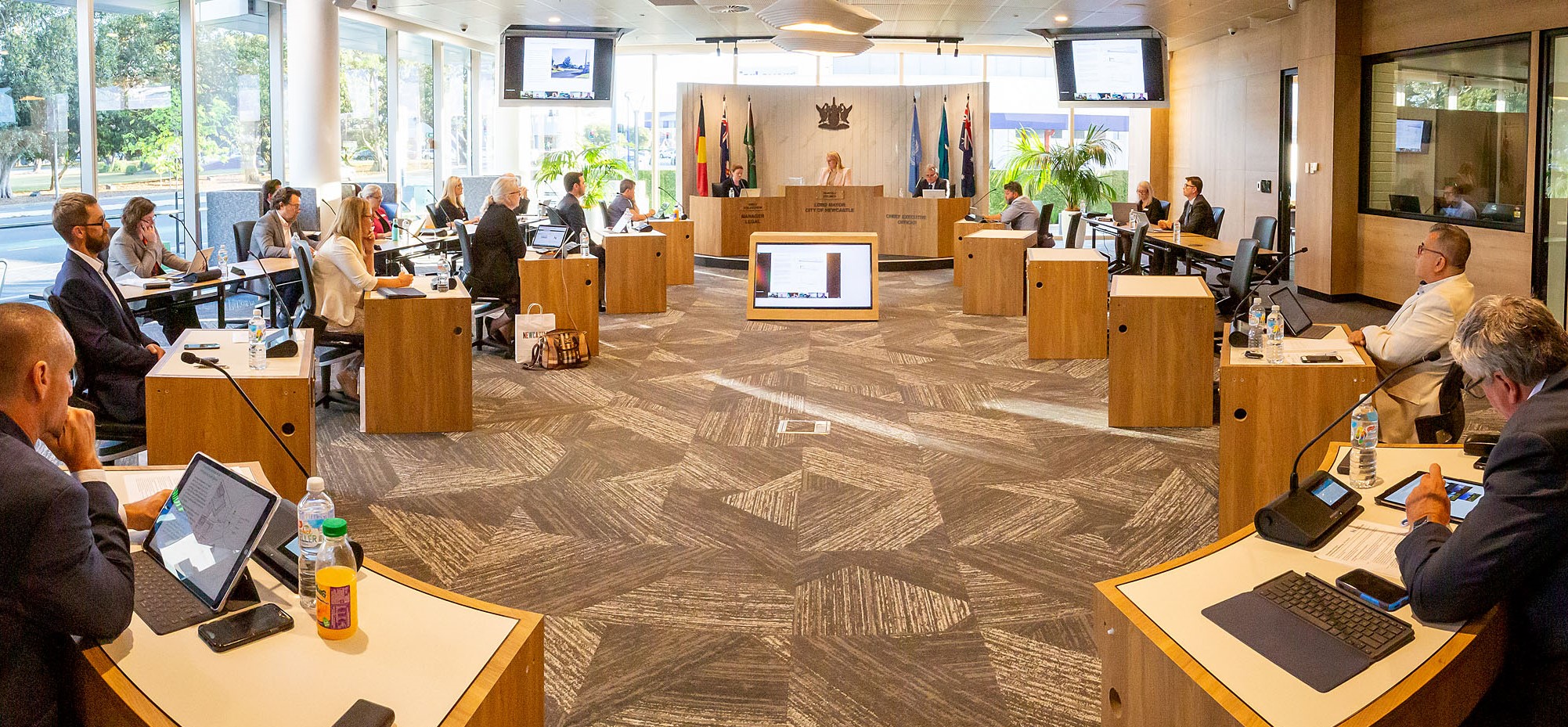
Newcastle Lord Mayor Nuatali Nelmes said the Ordinary Council Meeting is a milestone in the relocation of its City Administration Building to Newcastle West.
“Our new City Administration Centre makes the best use of every piece of space and utilises the modern design to enable staff to meet the growing demands of our ever evolving city.
“The Digital Library, co-located with our Customer Service Centre on level one, has been designed to be easily packed away to allow the space to double as the Council Chamber when meetings occur twice each month.
“The chamber was designed to enable it to be moved into storage so the space can be used by the library and community when meetings are not taking place.
“The new modern chamber is also equipped with technology that allows for an adapted meeting format to take place to accommodate COVID-19 restrictions. This technology is not available in the preserved heritage chambers at City Hall.”
Remote participants will be visible and audible to the Chamber participants on two large ceiling mounted screens and speaker system installed in the chamber.
Everyone will be able to tune in to the livestream on City of Newcastle’s website from 6pm as the COVIDSafe plan unfortunately does not allow the community to physically attend the meeting at this time.
While the change of meeting location ushers in a new era for City of Newcastle, its historic 90–year-old City Hall will continue to be used by the community.
City Hall’s historic Council Chamber will be opened to the public, community groups and still used for Council committee meetings.
The City is developing programs which promote access to the chamber and civic spaces, including information and education about the City’s civic history and the City Hall building.
BRAND NEW EDUCATION CAMPUS COMING SOON TO MURWILLUMBAH
Families in northern NSW are set to benefit from a brand new integrated education campus in Murwillumbah, the first of its kind for regional NSW, under a plan unveiled today by Deputy Premier John Barilaro and Minister for Education Sarah Mitchell.
Mr Barilaro said this multi-million-dollar investment demonstrates the NSW Government’s commitment to world-class education in regional communities.
“No matter where you live in this state, we are providing quality educational facilities to ensure our students get the best start in life,” Mr Barilaro said.
“Quality educational facilities, like the brand new campus coming soon to Murwillumbah, ensure families who live in regional and rural areas can remain there and children don’t have to move to metropolitan areas to receive a first-rate education.”
Ms Mitchell said she was delighted to announce that the NSW Government will develop an innovative new Kindergarten to Year 12 education campus for Murwillumbah.
“This incredible project will provide the community with an architecturally designed and built-for-purpose primary and secondary school conveniently located on one campus,” Ms Mitchell said.
The new Murwillumbah Education Campus will bring together students from Murwillumbah Public School, Murwillumbah East Public School, Murwillumbah High School and Wollumbin High School at the Murwillumbah High School site, which will be completely redeveloped.
The Deputy Premier and Ms Mitchell were today joined by Member for Tweed Geoff Provest and Duty MLC for the North Coast Ben Franklin at Murwillumbah High School.
“The new education campus will provide Murwillumbah with the modern, multi-purpose education infrastructure it deserves,” Mr Provest said.
Duty MLC for North Coast Ben Franklin said North Coast students will benefit from access to contemporary facilities that support the delivery of high quality educational opportunities and experiences.
“By ensuring a seamless journey for students from Kindergarten to Year 12, this education campus will set a new standard for future public school infrastructure in rural and country areas,” Mr Franklin said.
Plans for the campus also include partnering with the local community to potentially offer joint-use facilities, as well building ties with industry to offer high school students enhanced vocational training and support improved pathways to employment.
The new campus will also benefit the wider community with possible joint use of sporting, creative and health and wellbeing facilities.
“The new Murwillumbah Education Campus will truly be at the heart of the community, and I look forward to seeing it take shape over the next few years,” Ms Mitchell said.
The project’s next steps include planning and design. Community engagement will be ongoing throughout the duration of the project.
The NSW Government is investing $6.7 billion over four years to deliver more than 190 new and upgraded schools to support communities across NSW. This is the largest investment in public education infrastructure in the history of NSW.
TOP UP FOR REGIONAL SCHOOL PROJECTS
Hundreds of building projects will commence at schools across regional NSW with the announcement of the Regional Renewal Program.
The new $120 million stimulus program, part of the State’s COVID-19 Recovery Plan, will provide a government co-contribution of between 50 per cent to 80 per cent for regional school capital improvement projects including covered outdoor learning areas, science facilities, toilet blocks, administration buildings and canteens.
The NSW Government will partner with school communities to identify projects at each school, providing work for local businesses.
Deputy Premier John Barilaro said the program will target local contractors and suppliers to ensure that the impact of this stimulus is felt through the regions.
“Our students in the bush deserve access to the best quality facilities and I know school communities across regional NSW have been working hard to raise funds for these additional projects. The Regional Renewal Program will see the NSW Government top-up the funds for these projects to be delivered,” Mr Barilaro said.
Treasurer Dominic Perrottet said the program will accelerate projects nominated by school communities and help create local jobs.
“The funding will directly benefit local communities, boost businesses and create and support hundreds of jobs across regional NSW,” Mr Perrottet said.
Minister for Education Sarah Mitchell said the Government is committed to making sure local communities have access to modern facilities to support learning outcomes.
“Our regional schools have plenty of projects that they have been fundraising for, and I’m excited that this program will give them the additional funding to see projects realised,” Ms Mitchell said.
Eligible schools will be contacted by the Department of Education about the program.
$7.4 MILLION INVESTMENT TO PROGRESS NSW CLOSING THE GAP COMMITMENT
The NSW Government has announced funding of $7.4 million as a first step to begin State-based actions to support the National Agreement on Closing the Gap.
Minister for Aboriginal Affairs Don Harwin confirmed this new investment at the 400th meeting of the NSW Aboriginal Land Council (NSWALC), held at Broken Hill.
“This investment demonstrates the NSW Government’s commitment to achieving a critical priority under the Closing the Gap National Agreement – strengthening the capacity of Aboriginal Community Controlled organisations,” Mr Harwin said.
“It is the NSW contribution to a national joint funding pool targeting capacity and expansion of the Aboriginal Community Controlled organisations in the key sectors of early childhood, housing, disability and health.”
The National Agreement on Closing the Gap sets out a new way of working through partnership between Aboriginal peaks and organisations, including NSWALC, and Government. The Agreement commits parties to jointly develop a jurisdictional plan by July 2021 that will set out how NSW will meet new targets and reform goals.
“This investment represents NSW Government commitment to a new way of doing business under Closing the Gap, working with Aboriginal organisations in partnership with sharing decision making, authority and leadership” Mr Harwin said.