
The Morrison Government will provide additional targeted support for thousands of child care providers impacted by extended COVID-19 lockdowns, through new fortnightly payments.
Child care services in Commonwealth-declared hotspots will be eligible for payments of 25 per cent of their pre-lockdown revenue. Outside School Hours Care (OSHC) services will be eligible for payments of 40 per cent.
This will apply to services seven days after the hotspot is declared, where states have directed families to keep their kids at home.
Where kids are still allowed to attend, the supports will kick in four weeks after the hotspot declaration.
The measure is in addition to the existing Commonwealth supports, including gap fee waivers which allow Commonwealth Child Care Subsidy to continue even when children are not attending.
The new payments will immediately benefit child care services in affected areas of Sydney and the ACT and OSHC services in Metropolitan Melbourne.
All other services in Metropolitan Melbourne, regional Victoria and regional NSW will become eligible after seven days of lockdown, and payments will be backdated to today.
The supports will also be available for services who meet the criteria in any future extended lockdowns.
Prime Minister Scott Morrison said the payments would immediately help around 3,600 services caring for almost 300,000 children in Greater Sydney, as well as nearly 900 OSHC services in Metropolitan Melbourne and nearly 300 services in the ACT.
“The child care and early education sector is critically important for Australian families and our economy, and these payments will help keep services open and staff employed,” Prime Minister Morrison said.
“The sector has been doing an incredible job to provide essential care for Australian kids during the pandemic and we are backing them in while attendance rates are down.
“These payments will ensure our high quality child care and early education centres are there on the other side of these lockdowns.”
Minister for Education and Youth Alan Tudge said the payments build on the support already being provided to the sector through the Child Care Subsidy and broader economic supports.
“Giving families additional absence days and allowing gap fee waivers has kept many children enrolled and means services have still been able to receive the Child Care Subsidy even if kids haven’t attended,” Minister Tudge said.
“Importantly the new payments are targeted to services that have seen attendance levels fall by at least 50 per cent and are conditional on centres keeping staff in work and passing on support for families.
“The measures will encourage services to pass on gap fee waivers to parents, meaning those keeping their kids home during lockdown won’t be paying out‑of‑pocket costs when they aren’t using the service.
“The package recognises the impact extended lockdowns are having on the sector.”
Payments will be contingent on services:
Streamlined payments will be available to services in around two weeks.
Families in affected areas are not required to do anything.
Author: admin
Expanded vaccine access for NDIS participants
All National Disability Insurance Scheme (NDIS) participants aged 12-15 years will be able to receive a Pfizer COVID-19 vaccine from this Wednesday, 25 August. All NDIS participants aged 16 years and over became eligible in June.
Minister for Health and Aged Care, Greg Hunt, said today’s decision by the Australian Technical Advisory Group on Immunisation (ATAGI) would make a big difference to the lives of children with disability and their families.
“Today’s announcement is welcome news to the disability sector and government and will help ensure some of our most vulnerable Australians can be vaccinated as soon as possible,” Minister Hunt said.
“This is an important protection for over 40,000 children with disability and we encourage their parents and carers to book them in for a vaccination and ensure they can be protected against COVID-19.”
NDIS participants join the current cohort of children aged 12-15 to be prioritised for the Pfizer vaccine, including:
- children with specified medical conditions that increase their risk of severe COVID-19, including severe asthma, diabetes, obesity, cardiac and circulatory congenital anomalies, neuro developmental disorders, epilepsy, immuno-compromised and trisomy 21
- Aboriginal and Torres Strait Islander children
- all children aged 12–15 years in remote communities, as part of broader community outreach vaccination programs that provide vaccines for all ages (≥12 years).
Minister for the National Disability Insurance Scheme Senator the Hon Linda Reynolds CSC welcomed today’s announcement.
“I have made representations to Minister Hunt calling for eligibility to be expanded to all NDIS participants aged 12 to 15 years. I am so pleased ATAGI has now approved this expansion in the vaccine rollout for NDIS participants.
“I will continue to work with the disability sector and am passionate about ensuring our most vulnerable Australians are vaccinated as soon as possible.
“The COVID-19 vaccine rollout to the disability sector continues to increase at pace and there are now more than 8,200 vaccination points available.
“More than 123,000, or 46%, of NDIS participants over 16 years have received at least one dose of the vaccine and 28% have received two doses. This is an increase of more than 90,000 participants and a 300% increase since early June.
“More than 18,500, or 68% of NDIS participants in shared residential accommodation have received at least one dose, and almost 53% receiving two doses. This is an increase of more than 12,300, meaning we have tripled the number of people vaccinated since early June 2021.”
“Many participants require bespoke vaccination arrangements that are more complex than in the general population and aged care facilities. This includes the crucial need to ensure informed consent or appropriate decision-making for individuals before the vaccine is delivered and administered.
“There has been a concerted and sustained effort across Government and the disability sector to communicate the importance of vaccination, and to increase the points of access available to people with disability, including specialist disability vaccination hubs.”
The Government expects further recommendations regarding the use of the Pfizer-BioNTech COVID-19 vaccine for the remainder of children aged 12 to 15 shortly.
Parents and carers should check the COVID-19 eligibility checker from 25 August to book in their child’s vaccination.
Newcastle Ocean Baths pool designs finalised
City of Newcastle has called for construction tenders for the first stage of Newcastle Ocean Baths’ revitalisation including the pools and lower promenade.
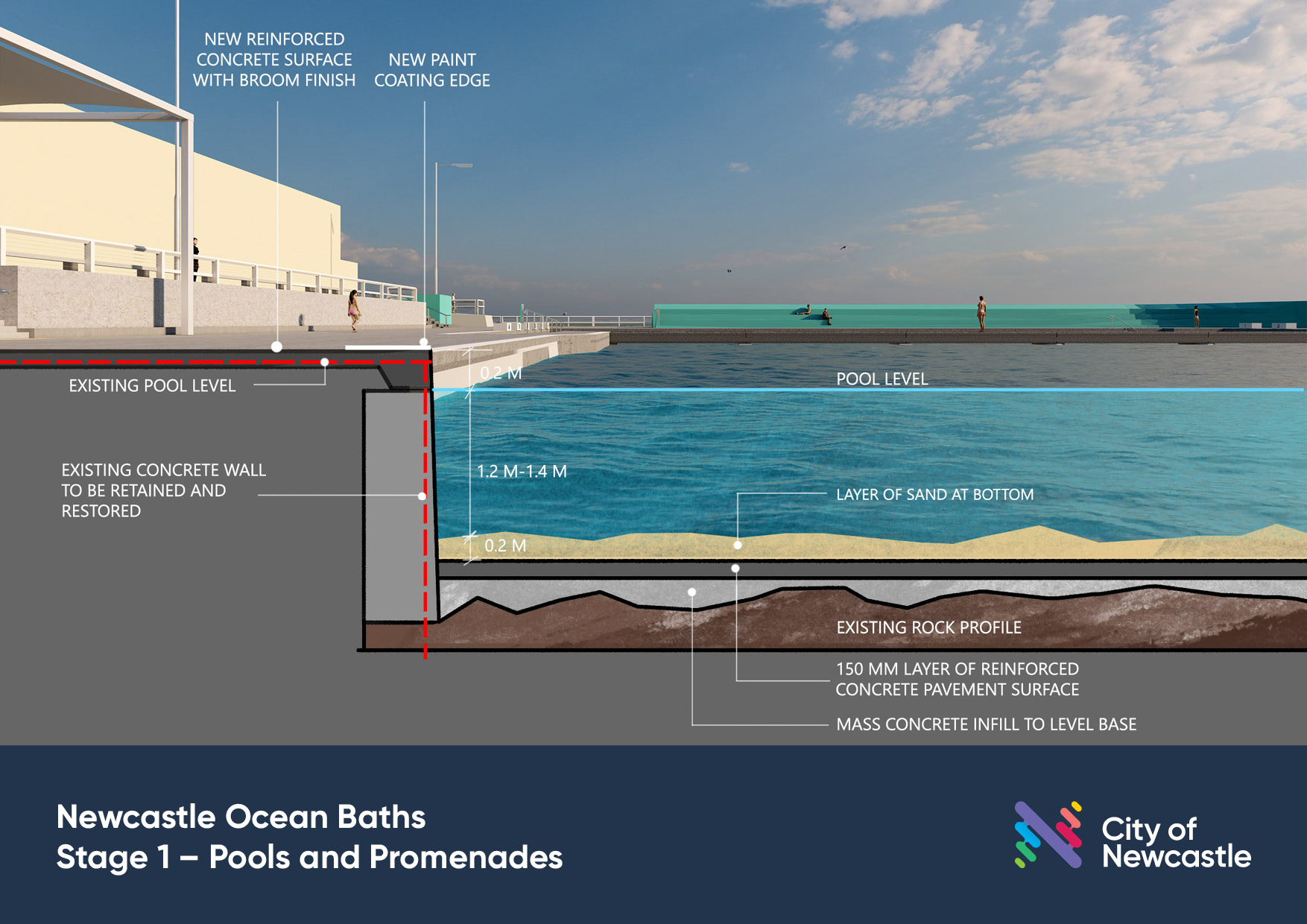
‘Stage 1’ of the upgrade project addresses key safety, accessibility and water-quality issues that have been identified through detailed community engagement and engineering advice.
As part of the upgrade, the iconic bleacher seating will be retained, the boardwalk will be renewed, and a new pump station installed that can replace the water of the baths within six hours, improving water quality. The undulating rock bottom of the pool will be capped with concrete to improve safety and water quality, and sand will continue to build up on the floor by the same processes as today.
Lord Mayor Nuatali Nelmes said the community engagement had been key to finalising the designs for Stage 1, with feedback shaping elements such as the location of ramp access, replacement of art-deco circular stairs, and boardwalk material.
“The final design for Stage 1 captures what the community told us was important to them, and we’ve worked with our expert consultants to also ensure the design meets accessibility, safety and health requirements,” Cr Nelmes said.
“This is a generational investment in the Newcastle Ocean Baths, which will celebrate its 100th birthday next year, which is why City of Newcastle have meticulously worked with both the community and experts to ensure what’s delivered meets the needs of current and future users.
“I’d like to thank everyone who has shared feedback to date and especially our Community Reference Group who have helped shape a range of upgraded features including access ramps, the appearance of the lifeguard lookout, how to incorporate the iconic circular stairs, and even materials we use for railings and the boardwalk.”
City of Newcastle Acting Director of Infrastructure and Property, Joanne Rigby, said the project team would work with preferred tenderers to ensure overall disruption to Baths users was limited.
“Newcastle Ocean Baths is an important community asset enjoyed by a range of users ranging from tourists, families, lap swimmers and those committed to a daily dip,” Ms Rigby said.
“We’re asking tenderers to come up with a construction program that will see the least possible disruption to the thousands of people who enjoy Newcastle Ocean Baths every year.”
The Stage 1 final designs also deliver significant improvements for people with a disability or low mobility. The design includes ramp access and improved handrail support into the pool and the route from a vehicle at the entrance to the facility and down into the pool has also been considered.
Chair, Hunter Regional Committee of the National Trust, Mark Metrikas, said heritage had been considered through the design process.
“I was actually delighted that the circa 1937 art deco bleachers and 1948 boardwalk are retained, and in the case of the boardwalk, improved,” Mr Metrikas said.
“It took a bit of work to get the design right to retain these important elements and we’ve worked alongside City of Newcastle to provide that input.”
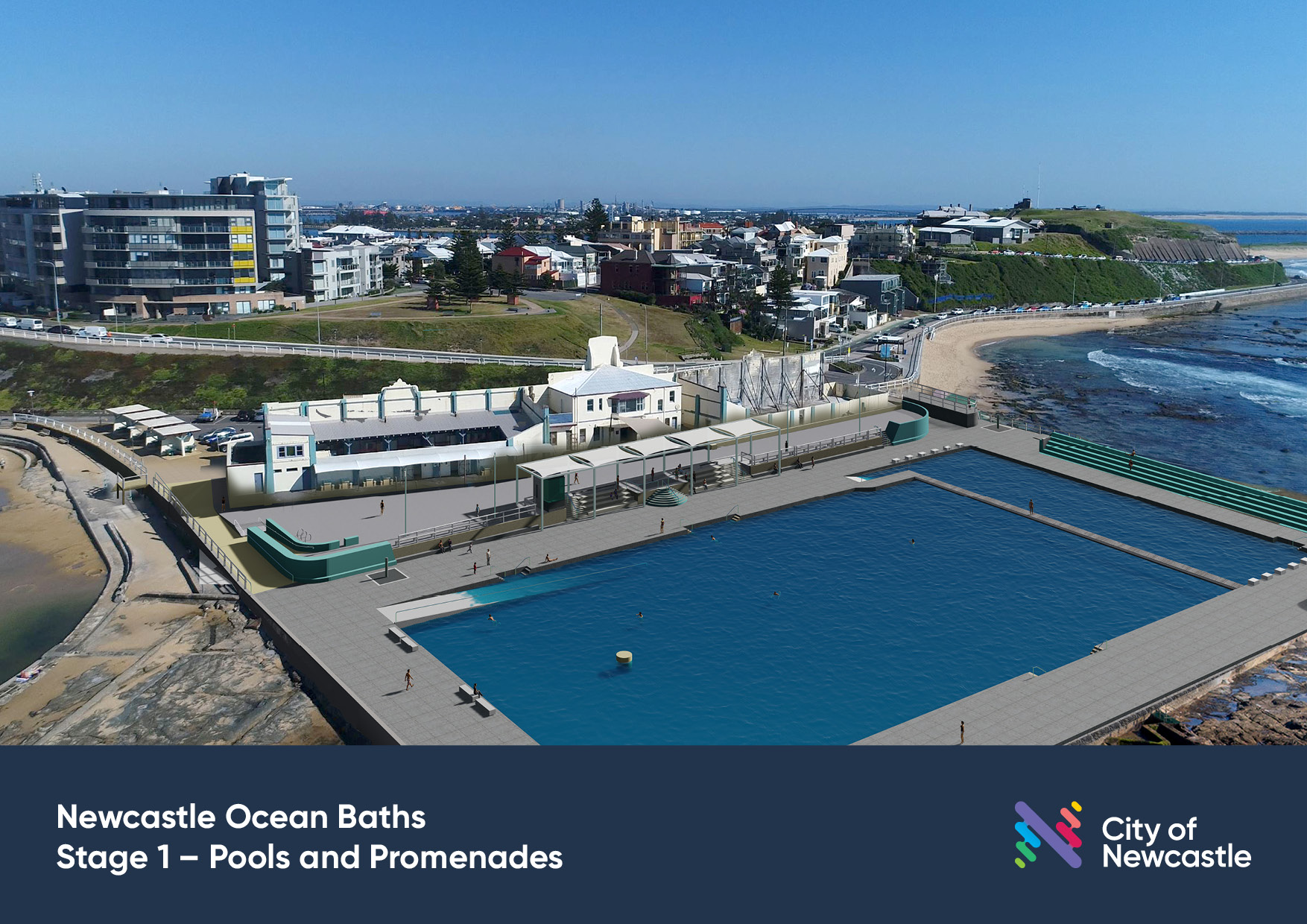
‘Stage 1’ of the upgrade project addresses key safety, accessibility and water-quality issues that have been identified through detailed community engagement and engineering advice.
As part of the upgrade, the iconic bleacher seating will be retained, the boardwalk will be renewed, and a new pump station installed that can replace the water of the baths within six hours, improving water quality. The undulating rock bottom of the pool will be capped with concrete to improve safety and water quality, and sand will continue to build up on the floor by the same processes as today.
Lord Mayor Nuatali Nelmes said the community engagement had been key to finalising the designs for Stage 1, with feedback shaping elements such as the location of ramp access, replacement of art-deco circular stairs, and boardwalk material.
“The final design for Stage 1 captures what the community told us was important to them, and we’ve worked with our expert consultants to also ensure the design meets accessibility, safety and health requirements,” Cr Nelmes said.
“This is a generational investment in the Newcastle Ocean Baths, which will celebrate its 100th birthday next year, which is why City of Newcastle have meticulously worked with both the community and experts to ensure what’s delivered meets the needs of current and future users.
“I’d like to thank everyone who has shared feedback to date and especially our Community Reference Group who have helped shape a range of upgraded features including access ramps, the appearance of the lifeguard lookout, how to incorporate the iconic circular stairs, and even materials we use for railings and the boardwalk.”
City of Newcastle Acting Director of Infrastructure and Property, Joanne Rigby, said the project team would work with preferred tenderers to ensure overall disruption to Baths users was limited.
“Newcastle Ocean Baths is an important community asset enjoyed by a range of users ranging from tourists, families, lap swimmers and those committed to a daily dip,” Ms Rigby said.
“We’re asking tenderers to come up with a construction program that will see the least possible disruption to the thousands of people who enjoy Newcastle Ocean Baths every year.”
The Stage 1 final designs also deliver significant improvements for people with a disability or low mobility. The design includes ramp access and improved handrail support into the pool and the route from a vehicle at the entrance to the facility and down into the pool has also been considered.
Chair, Hunter Regional Committee of the National Trust, Mark Metrikas, said heritage had been considered through the design process.
“I was actually delighted that the circa 1937 art deco bleachers and 1948 boardwalk are retained, and in the case of the boardwalk, improved,” Mr Metrikas said.
“It took a bit of work to get the design right to retain these important elements and we’ve worked alongside City of Newcastle to provide that input.”
Ordinary Council Meeting Tuesday 24 August 2021
Ordinary Council Meeting Tuesday 24 August 2021
Following is a summary of resolutions from the Ordinary Council Meeting of Tuesday 24 August 2021. NB: it is not a full record of resolutions.
Lord Mayoral Minutes
City of Newcastle COVID-19 Community and Economic Resilience Package 2.0 and protecting local jobs
A Lord Mayoral Minute was received by Councillors that acknowledged City of Newcastle’s 2020 Community and Economic Resilience Package which saw $5.5 million invested across the City, including interest free payment plans for residential and business rates, free online training packages, a significant community grants program to support vulnerable and emerging at-risk community members and targeted industry support initiatives.
Councillors supported re-initiating a Community and Economic Resilience Package, including an ongoing commitment to assisting local residents and businesses with financial hardship support for rates, a community grants programs to support vulnerable and emerging at-risk community members, support for affected local industries including the arts, entertainment, hospitality and tourism sectors, as well as continuing to build on the City’s successful business innovation support programs such as NewSkills and the Product Development Mentoring Program.
The Lord Mayoral Minute also noted that the unemployment rate in Newcastle has risen significantly in 2021. More than $100 million was successfully invested into the City’s capital works program in 2020/21, generating hundreds of local jobs and increasing the local economy’s economic output by more than $200 million, with capital works projects brought forward to assist in stimulating the local economy and protect our workforce.
The Minute recognised that the current works program for 2021/22 is $90.4 million, at least $10 million less than that delivered by staff last year as part of an adopted COVID-19 employment stimulus program.
Councillors supported a review of the City’s adopted 2021/22 Budget, to ensure that all necessary measures are taken to protect jobs, while identifying any capital works projects that could be expedited or re-prioritised to have maximum impact on stimulating the local economy.
Ordinary Business
Public exhibition of draft Gregson Park Masterplan and amendments to the Heritage Places Plan of Management for Gregson Park
Councillors resolved to place the draft Gregson Park Masterplan and draft amendments to Heritage Places Plan of Management for Gregson Park on public exhibition for 28 days, prior to final consideration by Council.
Tabling of Register of Disclosures of Interest – 1 May to 31 July 2021
Councillors noted the tabling of the Register of Disclosures of Interest, for the period 1 May to 31 July 2021, by the Chief Executive Officer.
Advisory Committees’ Annual Performance Reviews
Councillors received the annual performance review from City of Newcastle’s advisory committees.
Variations to Development Standards Report – Second Quarter 2021
Councillors received the report on approved development variations between 1 April 2021 and 30 June 2021 in accordance with the Department of Planning, Industry and Environment’s concurrence to vary development standards in the Newcastle Local Environment Plan 2012 (NLEP 2012).
Public exhibition of City of Newcastle draft Development Contributions Plan
Councillors resolved to publicly exhibit the draft Section 7.11 and Section 7.12 Development Contributions Plans for 28 days, prior to final consideration by Council.
Executive Monthly Performance Report
Councillors received the Executive Monthly Performance Report for July 2021, which reports on City of Newcastle’s monthly performance.
Notices of Motion
12 Stewart Avenue Contract administration costs
A Notice of Motion requesting an itemised break-down of the four separate projects associated with the fit-out of 12 Stewart Avenue was received. Councillors supported a Director’s comment as an amendment.
Infrastructure Contributions Bill
Councillors supported A Notice of Motion to join numerous other local Councils in calling on the NSW Government to withdraw the Environmental Planning and Assessment Amendment (Infrastructure Contributions) Bill 2021 from the NSW Parliament.
Councillors voted to affirm its support to Local Government NSW (LGNSW) and requests that LGNSW continue advocating on City of Newcastle’s behalf to protect local government from any amendments to infrastructure contributions which leave councils and communities exposed to expending ratepayer funds on new infrastructure made necessary by new development that is currently the responsibility of developers.
New Weather Station Newcastle
A Notice of Motion acknowledging correspondence received from Nat Jeffery, long standing former weather presenter on NBN Television, concerned about the location and operation of an automatic weather station for Newcastle, was noted by Councillors.
Councillors also noted the history of weather stations near the coast and that the responsibility for this service rests with the Bureau of Meteorology (BoM).
Councillors supported a Notice of Motion to write to the BoM to advocate for a new weather station in the Newcastle LGA and offer to investigate possible council owned sites around Newcastle, to provide data that is relevant to the city’s urban growth corridors.
Public Safety – Young Street, Cooks Hill
A Notice of Motion acknowledging concerns made by residents of Young Street Cooks Hill, was noted by Councillors.
Councillors also noted suggestions made by residents to address the issues which require a coordinated and multi-agency response.
Councillors supported a Notice of Motion to facilitate a meeting to discuss strategies and an action plan to improve amenity in the area with residents, City of Newcastle employees and Councillors, NSW Police, Telstra, and NSW Department of Communities and Justice.
Following is a summary of resolutions from the Ordinary Council Meeting of Tuesday 24 August 2021. NB: it is not a full record of resolutions.
Lord Mayoral Minutes
City of Newcastle COVID-19 Community and Economic Resilience Package 2.0 and protecting local jobs
A Lord Mayoral Minute was received by Councillors that acknowledged City of Newcastle’s 2020 Community and Economic Resilience Package which saw $5.5 million invested across the City, including interest free payment plans for residential and business rates, free online training packages, a significant community grants program to support vulnerable and emerging at-risk community members and targeted industry support initiatives.
Councillors supported re-initiating a Community and Economic Resilience Package, including an ongoing commitment to assisting local residents and businesses with financial hardship support for rates, a community grants programs to support vulnerable and emerging at-risk community members, support for affected local industries including the arts, entertainment, hospitality and tourism sectors, as well as continuing to build on the City’s successful business innovation support programs such as NewSkills and the Product Development Mentoring Program.
The Lord Mayoral Minute also noted that the unemployment rate in Newcastle has risen significantly in 2021. More than $100 million was successfully invested into the City’s capital works program in 2020/21, generating hundreds of local jobs and increasing the local economy’s economic output by more than $200 million, with capital works projects brought forward to assist in stimulating the local economy and protect our workforce.
The Minute recognised that the current works program for 2021/22 is $90.4 million, at least $10 million less than that delivered by staff last year as part of an adopted COVID-19 employment stimulus program.
Councillors supported a review of the City’s adopted 2021/22 Budget, to ensure that all necessary measures are taken to protect jobs, while identifying any capital works projects that could be expedited or re-prioritised to have maximum impact on stimulating the local economy.
Ordinary Business
Public exhibition of draft Gregson Park Masterplan and amendments to the Heritage Places Plan of Management for Gregson Park
Councillors resolved to place the draft Gregson Park Masterplan and draft amendments to Heritage Places Plan of Management for Gregson Park on public exhibition for 28 days, prior to final consideration by Council.
Tabling of Register of Disclosures of Interest – 1 May to 31 July 2021
Councillors noted the tabling of the Register of Disclosures of Interest, for the period 1 May to 31 July 2021, by the Chief Executive Officer.
Advisory Committees’ Annual Performance Reviews
Councillors received the annual performance review from City of Newcastle’s advisory committees.
Variations to Development Standards Report – Second Quarter 2021
Councillors received the report on approved development variations between 1 April 2021 and 30 June 2021 in accordance with the Department of Planning, Industry and Environment’s concurrence to vary development standards in the Newcastle Local Environment Plan 2012 (NLEP 2012).
Public exhibition of City of Newcastle draft Development Contributions Plan
Councillors resolved to publicly exhibit the draft Section 7.11 and Section 7.12 Development Contributions Plans for 28 days, prior to final consideration by Council.
Executive Monthly Performance Report
Councillors received the Executive Monthly Performance Report for July 2021, which reports on City of Newcastle’s monthly performance.
Notices of Motion
12 Stewart Avenue Contract administration costs
A Notice of Motion requesting an itemised break-down of the four separate projects associated with the fit-out of 12 Stewart Avenue was received. Councillors supported a Director’s comment as an amendment.
Infrastructure Contributions Bill
Councillors supported A Notice of Motion to join numerous other local Councils in calling on the NSW Government to withdraw the Environmental Planning and Assessment Amendment (Infrastructure Contributions) Bill 2021 from the NSW Parliament.
Councillors voted to affirm its support to Local Government NSW (LGNSW) and requests that LGNSW continue advocating on City of Newcastle’s behalf to protect local government from any amendments to infrastructure contributions which leave councils and communities exposed to expending ratepayer funds on new infrastructure made necessary by new development that is currently the responsibility of developers.
New Weather Station Newcastle
A Notice of Motion acknowledging correspondence received from Nat Jeffery, long standing former weather presenter on NBN Television, concerned about the location and operation of an automatic weather station for Newcastle, was noted by Councillors.
Councillors also noted the history of weather stations near the coast and that the responsibility for this service rests with the Bureau of Meteorology (BoM).
Councillors supported a Notice of Motion to write to the BoM to advocate for a new weather station in the Newcastle LGA and offer to investigate possible council owned sites around Newcastle, to provide data that is relevant to the city’s urban growth corridors.
Public Safety – Young Street, Cooks Hill
A Notice of Motion acknowledging concerns made by residents of Young Street Cooks Hill, was noted by Councillors.
Councillors also noted suggestions made by residents to address the issues which require a coordinated and multi-agency response.
Councillors supported a Notice of Motion to facilitate a meeting to discuss strategies and an action plan to improve amenity in the area with residents, City of Newcastle employees and Councillors, NSW Police, Telstra, and NSW Department of Communities and Justice.
Funding boost for female sports leaders
Promoting women into leadership roles at sporting organisations will be actively supported by a further $600,000 from the NSW Government.
Minister for Sport Natalie Ward said the funding package will increase the number of exciting new leadership opportunities for women in sports-based roles both on and off the field.
“I am a passionate supporter of women being involved in all levels of sport, and this package will help open the door for those who aspire to leadership positions,” Mrs Ward said.
“Funding will go towards initiatives that promote women in roles such as coaching, officiating, board directorship and developing inclusive sporting cultures.”
The funding boost is in addition to $640,000 recently announced through the Her Sport Her Way Grant Program.
“The Her Sport Her Way strategy acknowledges the importance of female leaders and mentors in the sector as coaches, officials and administrators,” Mrs Ward said.
“This investment will enable education programs and support organisations in embedding equitable leadership at all levels of sport, from grassroots through to boardrooms.”
Sport NSW will deliver gender inclusive training to sporting organisations and support professional development programs for female leaders.
Sport NSW Chief Executive Officer Ross Bidencope said the funding would support the sector in increasing the number of women in leadership roles and on boards.
“This funding will allow us to expand on programs that promote women in leadership and equip aspiring females with the tools and confidence they need to take on these roles,” Mr Bidencope said.
“There will also be a focus on supporting sporting organisations to shift thinking and cultivate positive change so female representation on boards increases.”
Other initiatives to be delivered include the development of mentoring programs, female coaching and leadership programs, mental health networks and youth leadership programs for girls from culturally and linguistically diverse backgrounds.
Cycling NSW Chief Executive Officer Graham Seers said the grant would help create more female leaders in the sport.
“Through our partnership with AusCycling’s She Rides program, this funding will empower more women to step into mentoring roles,” Mr Seers said.
“These new female mentors will teach, guide and inspire beginners, helping them overcome barriers such as fear of traffic and lack of practice, and getting more women riding confidently.”
Football NSW Chief Executive Stuart Hodge said his organisation was committed to developing the skills of the sport’s female leaders.
“Football NSW, working in conjunction with Football Australia, has identified the wonderful opportunity provided by our co-hosting of the 2023 FIFA Women’s World Cup, to shine a light on the need to develop, support and empower the many wonderful women involved across all facets of our game,” Mr Hodge said.
“Working with our clubs and associations, it is our intention to provide capability building programs to further the leadership skills for some of our champions in women’s football, be they coaches, referees, administrators or volunteers.”
To find out more about the Her Sport Her Way Strategy, visit: www.sport.nsw.gov.au/hersportherway
End to blanket bans on pets in strata
During the current lockdown pets are more important than ever, and from 25 August the NSW Government’s new laws will to put an end to blanket bans on animals in strata.
The changes follow a detailed review of the Strata Schemes Management Act 2015 (the Act) and extensive public consultation, focusing on the keeping of animals in strata schemes.
Minister for Better Regulation Kevin Anderson said the new laws reflect broad community sentiment from the review, and demonstrate a balanced approach for both residents and owners corporations in keeping furry friends in strata.
“A lot has changed since the Act commenced in 2015, including a huge shift to apartment living as more and more people in NSW are choosing to buy and rent in higher density areas,” Mr Anderson said.
“On top of that, research tells us that Australia has one of the highest rates of pet ownership in the world, with 61 per cent of households including a pet in their family, and 91 per cent of households owning a pet at some point in their lives.
“Following extensive feedback from the community we have implemented fair and sensible regulations that prevent schemes from introducing blanket bans on keeping pets in apartments, while ensuring owners corporations can refuse pets where they unreasonably impact other residents.”
From 25 August 2021, the new regulations will prescribe a limited list of specific grounds where an owners corporation can refuse a lot owner from keeping an animal in a strata scheme or take steps to remove an existing animal from the scheme. These circumstances include repeated damage of the common property, menacing behavior, persistent noise and odour.
Owners corporations will also be able to set reasonable conditions through their own by-laws on how pets are kept in their scheme, for example whether they have to be supervised on common property or enter and exit through a dedicated entrance or lift.
“As a dog owner myself I understand how important pets are for families in this state, and their companionship cannot be understated, particularly during the current pandemic,” Mr Anderson said
“Living in strata is becoming more popular and while we don’t want strata residents deprived of the benefits of owning a pet it’s also important the amenity of neighbours and others in the building isn’t impacted. Our new laws have been designed to strike the right balance for everyone living in strata communities, putting an end to blanket bans on pets while giving owners corporations clear guidance on how they can set rules to ensure other owners aren’t impacted.”
NSW Fair Trading will be offering support, advice and mediation services for residents and owners corporations who are unsure about the new rules and how they apply within their scheme. Unresolved disputes can also be escalated to the NSW Civil and Administrative Tribunal where appropriate.
For more information around the new laws, visit: https://www.fairtrading.nsw.gov.au/housing-and-property/strata-and-community-living/strata-schemes/by-laws-in-your-strata-scheme
Far-right military infiltration shocking but not surprising
The Greens say that reports of far-right extremists and neo-Nazis in the Australian military should not come as a surprise, but do further spur the need for a national plan to tackle far-right extremism and white supremacy.
Senator Mehreen Faruqi, Greens spokesperson for Anti-racism, said:
“I’m sure I’m not the only one terrified by the idea of organised fascists with access to military training and weaponry. But these reports are hardly surprising.
“In many countries, including the US, Germany and Britain, we’ve seen clear and indisputable evidence of far-right individuals and groups infiltrating national militaries and police.
“White supremacy poses an existential threat to multicultural Australia. It can’t be denied and it has to be dealt with head-on.
“Government has had its head in the sand on this for far too long. We clearly need a national plan to tackle far right-extremism and a renewed national anti-racism strategy that encompasses organisations and individuals.”
Senator Jordon Steele-John, Greens spokesperson for Peace and Disarmament, said:
“A culture of white supremacy within the Australian Defence Force is totally unacceptable and must be tackled head on.
“These reports outlining a culture within the ADF that has allowed Neo-Nazis to exist within it are alarming. We urge the ADF to take urgent action to address the culture and the ADF Leadership should be held to account for allowing this culture to exist.”
Get behind our Paralympians ahead of the Tokyo Games
The Morrison Government is urging all Australians to get behind the nation’s Paralympians as they prepare to compete at the Tokyo Games.
Minister for Sport Richard Colbeck said the Tokyo Paralympic Games represented another important opportunity for Australians to unite to celebrate the individual efforts of athletes who had overcome extraordinary odds.
“Just like their Olympic counterparts, the Australian Paralympic Team is a source of enormous pride and inspiration to us all,” Minister Colbeck said.
“The path to Tokyo has not been easy and our athletes have showed great determination and spirit to overcome the challenges of COVID-19 to compete on one of the biggest sporting stages in the world.
“We are all looking forward to watching these Paralympic Games and the pride of Australia will be on show for the whole world to see.”
The team in Tokyo will be Australia’s largest ever at an overseas Paralympic Games and the biggest since Sydney 2000, with 179 athletes to compete across 18 sports including the debut disciplines of Para- taekwondo and Para-badminton.
Minister Colbeck said the size and depth of talent within the team is a credit to the Australian high performance sport sector.
“This is a team that includes soon-to-be seven-time Paralympians Danni de Toro and Christie Dawes, as well as 84 athletes making their Games debut,” he said.
“The success of our athletes very much depends on the team behind the team and the Australian Institute of Sport must be commended for its leadership in assisting sports and athletes manage the challenges of the COVID-19 pandemic.”
He said the achievements of the team was also a reflection of the enormous contribution from Paralympics Australia board members including President Jock O’Callaghan, CEO Lynne Anderson, Chef de Mission Kate McLoughlin and all of the Paralympic Australia support staff.
Minister Colbeck said the Morrison Government is proud to support our athletes in achieving their Paralympic dreams.
“Over 85 per cent of athletes competing in Tokyo have received direct grants through the AIS,” he said.
“In this year’s budget, our Government announced an additional $245.8 million for sport over and above our regular sports funding commitments, which includes an extra $136.3 million to support Australia’s high performance sport system and programs.”
The additional funding in recent years for Paralympics Australia and para-athletes includes:
- $3.5 million in 2021-22 to support Paralympics Australia to fund the additional costs associated with COVID-19 for athletes participating in the 2021 Tokyo Paralympic Games.
- $4.5 million in 2020-2021 and 2021-22 in increased funding direct to 13 Paralympic high performance programs in national sporting organisations to enhance preparations for Tokyo and beyond
- $8 million over three years from 2018-19 to support the Australian Paralympic Team prepare for the Tokyo 2020 Paralympic Games.
- $4 million over two years from 2018-19 to construct new facilities for para-athletes at the Essendon Football Club’s ‘The Hangar’ facility, which is also Paralympic Australia’s Victorian base.
- $310,370 over four years from 2018-19 for eligible Paralympic athletes who may have had their Disability Support Pension impacted as a result of training for events overseas.
“On behalf of the Australian Government, I would like to congratulate Paralympics Australia Chef de Mission Kate McLoughlin and Chief Executive Lynne Anderson for their dedication and hard work in making these Games a reality,” Minister Colbeck said.
“I would also like to extend our thanks to the Government and people of Japan, who are preparing to once again warmly welcome our athletes to their shores.
“To our Paralympians, good luck. We will all be on the edge of our seats cheering you on.”
Get behind our Paralympians on social media:
@AUSParalympics across Facebook, Instagram, Twitter and LinkedIn;
@AUSParaTeam on YouTube.
#ReadySetTokyo
#AusSquad
#Tokyo2020
City supports Aspen Medical disability vaccination hub

City of Newcastle has worked with Aspen Medical to establish a Newcastle disability vaccination hub at Wallsend Library.
The vaccination hub will operate from today for eligible individuals within the disability sector including people with a disability and disability support workers.
Eligible people with a disability include:
The vaccination hub will operate from today for eligible individuals within the disability sector including people with a disability and disability support workers.
Eligible people with a disability include:
- NDIS participants aged 12 and over
- Those who have a significant disability or underlying medical condition aged 12 and over
- Residents living in a group home with two or more people
Eligible people working in disability include:
- Carers of NDIS participants aged 12 and over
- Staff, carers, infrequent visitors and volunteers in a residential care setting
- Workers who provide in-home and community disability and aged care, including centre-based care
The clinic will cater for at least 50 customers at one time and plans to vaccinate up to 200 eligible people a day.
City of Newcastle is pleased to be able to support Aspen Medical to continue their rollout of the COVID-19 vaccination.
When Aspen Medical approached City of Newcastle for support to locate a suitable venue to accommodate the disability vaccination hub, its emergency management team worked quickly to identify Wallsend Library as a location which met Aspen Medical’s operational requirements.
Wallsend Library has wheelchair access, disabled parking and room to facilitate vaccinations with ample space for safe waiting areas.
Ineligible walk-ins to the vaccination hub are unable to be accommodated. Bookings can be made by registering interest with Aspen Medical by emailing nswbookings@aspenmedical.com
More free training options during lockdown
The NSW Government has announced an additional 3000 training places for people across NSW to skill up at home during lockdown.
An extra 60 short courses are now on offer to study for free including business skills, mental health, marketing, finance and IT skillsets.
Minister for Skills and Tertiary Education Geoff Lee said the courses are an expansion of the 10 free skillsets recently announced by TAFE NSW.
“We know there is great demand for training at the moment, which is why we have added additional free courses and more training places so people can come out of lockdown with skills they can take with them into the workplace,” Mr Lee said.
“The free courses are available to anyone across the State who is unable to work due to public health orders.”
“We have specifically targeted those LGA’s and suburbs in lockdown and are working with local communities and industry to understand what skills are in demand and where shortages exist.”
“There has never been a more crucial time to upskill or reskill through the pandemic and the NSW Government is here to support the people of NSW every step of the way.”
“This isn’t just about upskilling though. In these difficult times, the opportunities provided by these courses can have a hugely beneficial impact on the well- being of participants.”
Training will be funded through the JobTrainer program, which has already seen more than 120,000 people in NSW skill up since it was announced in October last year.
For more information and to see full eligibility, please visit: https://bit.ly/37DYSvq