
On the basis of scientific advice, the Australian Government has secured an additional 20 million doses of the promising AstraZeneca COVID-19 vaccine, strengthening Australia’s position for whole-of-population vaccination.
This will mean a total delivery of 53.8 million Astra Zeneca vaccine doses in 2021, covering the whole of population requirements.
The extra 20 million doses of the Astra Zeneca vaccine will be produced within Australia by CSL.
Our advice remains that Australia remains on track for first vaccinations in March, and completion of whole of population in 2021.
In addition, a further 11 million doses of the Novavax vaccine will be purchased, bringing the total for this vaccine to 51 million. This provides an additional whole-of-population vaccine for Australia if proven safe and effective.
A purchasing agreement is also in place for the Pfizer/BioNTech COVID-19 vaccine, with 10 million doses scheduled for early 2021.
The Australian Government is also part of the international COVAX Facility which allows the purchases of over 25 million doses of a range of other potential vaccines.
Investment in the portfolio of vaccines is based on advice from the expert Science and Industry Technical Advisory Group (SITAG), which is continually monitoring and assessing each of the vaccines to ensure that Australia remains well prepared for the roll-out when the regulatory health and safety approvals have been granted.
As a result of further medical advice to the Australian Government, the University of Queensland’s research into a possible COVID-19 vaccine which has undergone phase one clinical trials will not be proceeding to phase three.
As part of all clinical trials, assessments are made before expanding to the next phase of research.
This decision is based on how the vaccine interacts with a testing system and has not been based on the safety or effectiveness of the vaccine candidate.
The evidence from the University of Queensland’s phase one clinical trials shows the vaccine to be safe – and that it produces a strong immune response able to neutralise the COVID-19 virus.
This is something the University of Queensland researchers should be very proud of.
Further work is required to address the discrepancies occurring in test results due to the construction of the vaccine.
Australia’s response to the COVID-19 pandemic remains the envy of the world – and we are making decisions, based on best medical advice, about vaccines, in our national interest.
We have deliberately not put all of our eggs in the one vaccine basket.
Our Government has strong confidence a COVID-19 vaccine is likely to be available to Australians from as early as next March and that we can achieve our goal of providing a vaccine to all Australians who seek to be vaccinated before the end of 2021.
The University of Queensland utilised a “molecular clamp” vaccines design based on a highly promising technological platform, and has the potential be used to vaccinate against a number of potential viruses.
As part of the vaccine’s design, the university’s researchers included a small fragment of a protein taken from the HIV virus, known as glycoprotein 41 (gp41). This has been used to create a “molecular clamp” to hold the vaccine’s synthetic virus in place.
Although the university’s researchers have confirmed the protein fragment poses absolutely no health risk to people who have taken the vaccine, they have identified a partial antibody response to it among trial participants.
This has the potential to interfere with some HIV screening tests that look for these antibodies – leading to a false positive test result.
It is this impact on HIV screening – and in the context of other promising vaccine candidates becoming available – that has led to the Government’s decision. The decision was based on the unanimous advice of SITAG.
Importantly, pathology testing that directly looks for the HIV virus has confirmed negative results for the trial participants who have taken the vaccine.
Participants were informed the protein formed part of the vaccine before they consented to taking part in the trial – and HIV screening tests were carried out before and after vaccination.
Participants will continue to be monitored to establish if the antibody response to the protein decreases over time.
The Government will continue to support UQ is in its ongoing research due to this new platform providing such a promising breakthrough in vaccinations.
Author: admin
High Commissioner honoured with a Key to the City
The City of Newcastle realised a former Novocastrian’s long-held ambition to become an ambassador for the city today, awarding a Key to the City to Her Excellency the Honourable Patricia Forsythe AM, in recognition of her lifelong service to democracy, diplomacy and business.
Appointed as the Australian High Commissioner to New Zealand, Cook Islands and Niue in March 2019, Mrs Forsythe began her remarkable career in public service in Newcastle as a secondary history teacher at Jesmond High School and Newcastle Grammar School, before being elected to the NSW Parliament as a Member of the Legislative Council in May 1991.
As a Member of the NSW Upper House, Mrs Forsythe also served on the Opposition Frontbench in prominent roles such as the Shadow Minister for Education and Women’s Affairs.
In her maiden parliamentary speech, Mrs Forsythe paid homage to her hometown.
“Newcastle, a city I will be proud to serve,” Mrs Forsythe said. “In my vision for the future, I want to see an outlook not of them and us, but a shared outlook, where the economic potential of the Hunter is realised.”
“I look forward to being an ambassador for the city… Newcastle has given me much.”
Mrs Forsythe acknowledged the unwavering support of the Forsythe and Wingrove families, some of whom were present for the Key to the City ceremony and Mrs Forsythe’s induction to the City of Newcastle Ambassador Program, almost three decades later.
Lord Mayor Nuatali Nelmes was delighted to present Mrs Forsythe with a Key to the City during a diplomatic visit to Newcastle.
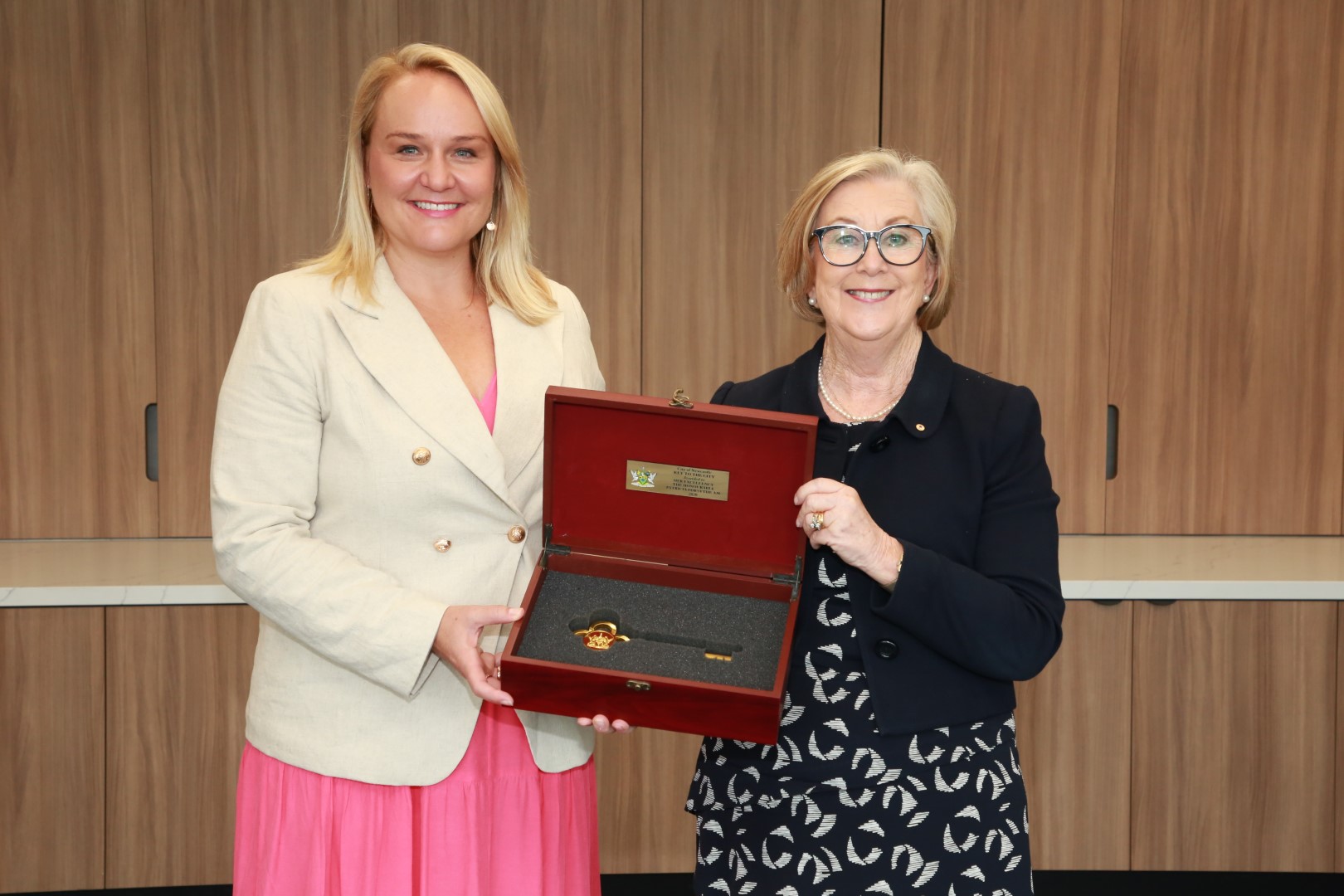 Lord Mayor Nuatali Nelmes presents the Key to the City to the Australian High Commissioner to New Zealand, Cook Islands and Niue, Her Excellency the Honourable Patricia Forsythe AM.
“It was a pleasure to conduct such a special ceremony on behalf of the City with the company of Mrs Forsythe’s closest family members,” the Lord Mayor said.
“Some of the most significant advancements of Newcastle institutions are owed to Mrs Forsythe’s advocacy work, including the establishment of the University of Newcastle’s medical faculty in the early 1970s, for which she was a major champion. Mrs Forsythe also helped lobby for a taxation office in Newcastle in the 1980s.
“The City of Newcastle looks forward to continuing to work with Mrs Forsythe as a city ambassador in her current capacity as High Commissioner, as she continues to take an interest in Newcastle and advocate for the city, not least of which through the health and economic challenges of the COVID-19 pandemic.”
Mrs Forsythe is the ninth individual or organisation to receive a Key to the City of Newcastle since the Ambassador Program’s inception in 2017.
She joins the ranks with Director of the National Gallery of Australia Nick Mitzevich, Naval Officer Anita Sellick, former University of Newcastle Vice-Chancellor Caroline McMillen, Breast Cancer Trials, Newcastle Eye Hospital Foundation, the Honourable Michael Kirby AC CMG, Youth With a Mission medical vessel The Ruach, and businesswoman and media personality Jackie Gillies.
An official biography for the Hon. Patricia Forsythe AM, Australian High Commissioner to New Zealand, Cook Islands and Niue, is available at the Australian Government Department of Foreign Affairs and Trade website here.
PYRMONT’S FUTURE PROSPERITY TAKES SHAPE
The final strategy for Pyrmont and Ultimo envisages a global entertainment and cultural hub with enhanced streetscapes, parklands and more open space.
Minister for Planning and Public Spaces Rob Stokes said the final Pyrmont Peninsula Place Strategy provides more certainty and clarity regarding the future of the CBD’s western gateway.
“We’ve listened to community and business feedback and have adapted the plan so that Pyrmont remains a prosperous and unique part of Sydney,” Mr Stokes said.
“Striking a balance in planning is never easy and the unique geography and history of Pyrmont’s settlement pattern provided a particular challenge. Our fundamental task was to encourage economic development while enlivening the peninsula, boosting jobs and providing for more quality public open spaces for everyone to enjoy.
“Our plan will unlock public access to Sydney’s foreshore from Blackwattle Bay to Woollomooloo Bay since the 1800s.
“The pandemic has shown us the importance of public space and this strategy provides hectares more open space, uninterrupted foreshore and plenty of community infrastructure to support new and existing development.”
Treasurer Dominic Perrottet said the Place Strategy confirmed the importance of the peninsula as a hub for economic growth.
“Pyrmont is the real gem of Sydney and for too long its potential has been overlooked and underutilised,” Mr Perrottet said.
“This strategy will boost the economy and at the same time ensure we improve the area and build a gateway from the western harbour, through Barangaroo and the CBD, all the way to the Opera House.”
The Department of Planning, Industry and Environment will now prepare master plans for the Pyrmont Peninsula’s seven sub-precincts – Pirrama, Darling Island, Blackwattle Bay, Tumbalong Park, Wentworth Park, Pyrmont Village and Ultimo.
Details in the final strategy include:
Blackwattle Bay
- A new active transport link from Blackwattle Bay to the Fish Market Light Rail Station
- Building heights limited to 120m – 156m
- ‘Low-line’ beneath the Anzac Bridge pylons and Western Distributor overpass, including a ribbon of public, recreational space
Wentworth Park
- Facilitate the return of the Wentworth Park greyhound track land and the temporary pop up school once their terms expire as newly activated, publicly accessible open space as part of a larger and enhanced parkland
- A working group with government agencies and stakeholders to be established to assist in identifying a suitable alternate site for greyhound racing
Harbourside
- Publicly accessible open space on rooftop areas
- Protection of sunlight on the harbour foreshore
- Building heights below 170m
The Star
- A 110m tower on the northern end, on the condition it is a six-star hotel (maximum height of 60 metres to remain in place for any other development type)
- Tower on southern end of site maximum 140m
- Improved public spaces ie landscaping, increase in tree canopy
- Reduced street parking and relocated tourist bus lay overs on site
- Fund upgrades in surrounding public spaces, including improved landscaping, additional greenery, increase in tree canopy and upgrade to public seating and congregation spaces
More details are available in the final Pyrmont Peninsula Place Strategy is available at: www.planning.nsw.gov.au/pyrmontpeninsula
NEW METRO STATION FOR PYRMONT
The NSW Government will build a new metro railway station at Pyrmont as part of the mega Sydney Metro West project, greatly enhancing plans to revitalise the inner city precinct to encourage jobs, investment and economic growth.
Minister for Transport Andrew Constance said the new station will deliver major benefits to the Pyrmont community and create an unparalleled opportunity to support the Government’s plans to transform the suburb.
“This is so much more than somewhere to catch a train,” Mr Constance said.
“It will become the centre of the community and the western gateway to the Sydney CBD providing not only world-class transport options but opportunities to support new jobs and homes.
“Modelling also predicts this will be one of the busiest stations on the Sydney Metro West line and will provide customers with more choice.”
A Sydney Metro station at Pyrmont will:
- Create 500 direct and 1700 indirect jobs.
- Ease congestion at key CBD railway stations like Central and Town Hall.
- Relieve demand on the Dulwich Hill Light Rail Line by about 10 per cent.
- Serve major events and entertainment activities, including those around Darling Harbour and the Sydney International Convention Centre.
- Support Pyrmont as a diverse, desirable, vibrant and accessible inner urban precinct.
- Provide customers with about a 26-minute saving between Parramatta and Pyrmont, with the trip taking just 18 minutes.
A value share contribution mechanism will be applied to the Pyrmont Peninsula once the Sydney Metro West project opens.
It will require some commercial property owners, other than small businesses, that benefit from increased land values associated with the new station to make an annual contribution to offset the cost of building the station.
A one-off Transport Special Infrastructure Contribution will also be applied to certain new developments in the Pyrmont Peninsula in advance of the station opening.
The Pyrmont metro station location is subject to further planning and design work.
Sydney Metro has worked with the Department of Planning, Industry and Environment and other stakeholders to ensure the plans for a metro station at Pyrmont are consistent with the planning work being undertaken to unlock innovation and investment in the Pyrmont Peninsula.
The Metro project forms part of the NSW Government’s record $107 billion infrastructure pipeline, a key part of the COVID Recovery Plan.
WORLD-CLASS NEW UNIVERSITY CAMPUS AT PARRAMATTA/WESTMEAD
A world-class multi-disciplinary university campus will be able to be delivered within the Westmead Health and Innovation District with the signing of a framework agreement between the NSW Government and the University of Sydney.
The new University campus will build on the District’s role as one of the largest health, education, research and training precincts in Australia.
Minister for Jobs, Investment, Tourism and Western Sydney Stuart Ayres said the agreement was an important step for the long-term future of the Westmead Health and Innovation District.
“A globally recognised University campus in the Central River City at the core of the Westmead Health and Innovation District will drive innovation and catalyse future growth, ensuring we become a world leader in lifelong education and research partnerships that save lives and cure diseases,” Mr Ayres said.
Mr Ayres said over the next 30 years, the NSW Government’s vision for the District is expected to create more than 20,000 new jobs and contribute an additional $2.8 billion of economic output per year to the NSW economy.
“Having the University at the core of the Westmead Health and Innovation District will help transform the district into a powerhouse of invention, creativity, and commercialisation, and home to world-leading enterprises, start-ups, researchers and students,” Mr Ayres said.
Mr Ayres paid tribute to the vision of the outgoing Vice-Chancellor and Principal of the University of Sydney, Dr Michael Spence AC, to expand the University’s presence in Western Sydney over coming decades, contributing to the economic, social, cultural and intellectual growth of the area and the broader Sydney metropolis.
Dr Spence, who will become President and Provost of University College London in January 2021, said he was delighted the University of Sydney and NSW Government had agreed to develop a shared vision for a mixed-use University campus at Parramatta/Westmead.
“This once-in-a-century opportunity in Western Sydney would build on our 40-year history at Westmead and create a genuinely multidisciplinary major campus that enables new partnership and innovation opportunities for all of Sydney,” Dr Spence said.
“We are committed to offering students in Western Sydney more opportunity to study and pursue research with our incredible academics to help solve some of the world’s most challenging problems.”
Pending final agreement around the size and timings of the campus development, the University hopes to attract more than 25,000 students and 2,500 staff by 2055 and provide affordable student and staff accommodation.
Minister for Health and Medical Research Brad Hazzard said the NSW Government and the University of Sydney are committed to working together as health will continue to be a strong focus throughout Westmead and the future of the site.
“Westmead Health and Innovation District will continue to deliver world-class health services for the communities of Western Sydney by developing new and innovative models of health care.”
Minister for Skills and Tertiary Education and Member for Parramatta Geoff Lee said the agreement was a win for Parramatta and Western Sydney.
“Westmead is already the largest biomedical precinct in Australia. The commitment by University of Sydney today will transform the precinct by offering a comprehensive suite of university courses beyond health studies. Parramatta City has established itself to be the education capital of Western Sydney,” he said.
The agreement marks the next step in exclusive negotiations between Government and the University which commenced in November 2018. It confirms the University of Sydney as the ‘educational anchor’ for the Government’s planned innovation district, based on the University’s leading status as a top-100 global university. It also confirms a site for the new campus in Parramatta North adjacent to the Westmead hospitals, and a process for ongoing engagement once land for the proposed campus becomes available for development.
For more information please visit here.
Man charged over alleged aggravated break and enter – Shortland
A man will face court today charged over an alleged aggravated break and enter in Newcastle at the weekend.
About 3am on Sunday (6 December 2020), an 84-year-old woman was asleep at a home on Marsden Street, Shortland, when she was woken by an unknown man standing in her room.
The man spoke to the elderly woman before she called to family members for assistance and the man left the home.
The elderly woman wasn’t injured.
Later that morning, police were called and officers from Newcastle City Police District commenced an investigation.
Following extensive inquiries, police attended a separate home on Marsden Street and arrested a 19-year-old man on Wednesday (9 December 2020)
He was taken to Waratah Police Station and charged with aggravated break and enter commit serious indictable offence with people there.
He was refused bail to appear at Newcastle Local Court yesterday (Thursday 10 December), where he was formally bail refused to reappear at the same court today (Friday 11 December 2020).
Anti-money laundering laws
The Government and Labor have again wasted an opportunity to include real estate agents, accountants and lawyers subject to mandatory reporting of money laundering.
“We have been waiting 14 years for this badly needed reform,” Greens Economic Justice spokesperson Senator Nick McKim said.
“Dirty money is flooding Australia’s property market, helping to push house prices even higher, and making owning a home even more difficult for too many Australians.”
“The Greens’ amendment would have forced the Government to introduce legislation to include real estate agents, accountants and lawyers in the mandatory reporting scheme.”
“Such measures have been introduced in all but six countries around the world and have been promised since 2006.”
“Labor promised this reform before the last election, but they have squibbed it at the first hurdle.”
“This is a huge wasted opportunity to get serious about tackling dirty money in Australia.”
“The Greens’ amendment did not specify how real estate agents, accountants and lawyers should be regulated, just that the government should introduce legislation that would do so.”
“This was so as to give the government scope to design laws to avoid any unintended consequences including jeopardising client legal privilege.”
$11 million to reduce rates of heartbreaking stillbirths
The Morrison Government will provide $11 million to fast track a new national plan to reduce the number of stillbirths, ensuring families affected get the respectful bereavement care they need.
Tragically, there are six stillbirths each day in Australia. That means suffering and loss for more than 2,000 families every year.
Such loss is particularly hard as mothers and fathers prepare to welcome a new life into their families. A time of joy is replaced with heartbreak.
Despite increasing evidence that many stillbirths can be prevented, there has been little change in the stillbirth rate in Australia over the past two decades.
The Morrison Government’s National Stillbirth Action and Implementation Plan’s primary goal is to reduce stillbirths by 20 per cent or more over the next five years. The plan has a 10-year timeframe and includes further short, medium and long-term actions.
To change these sobering statistics, over the next four years the Australian Government will provide:
- $4 million to support stillbirth education and awareness initiatives, particularly for groups at higher risk of stillbirth
- $2.1 million to adapt the Safer Baby Bundle program for those priority populations, including Aboriginal and Torres Strait Islander women and women from culturally and linguistically diverse backgrounds
- $0.5 million to develop new Clinical Care Standards and update existing clinical care guidelines relating to stillbirth
- $0.5 million for data improvement and activities to enable long-term research on stillbirth
- $1.7 million to develop a monitoring and evaluation framework for the Plan
- $1 million for state and territory governments to take immediate steps to increase the uptake of stillbirth autopsies and investigations
- $1 million through a National Health & Medical Research Council grant to Monash University to conduct a trial of a wearable, low-cost device to monitor fetal movements to prevent stillbirths.
The plan was informed by consultation with bereaved parents, new parents, and groups at increased risk of stillbirth, including Aboriginal and Torres Strait Islander women, migrant, refugee and rural and remote communities.
Further, the plan has been developed in collaboration with state and territory governments, and the hardworking organisations that are helping to reduce stillbirths and provide high quality support for Australian families impacted by stillbirth.
These include the Stillbirth Centre for Research Excellence, Red Nose (including Sands), Still Aware and Stillbirth Foundation Australia.
This work builds on the Morrison Government’s commitment to supporting maternal and perinatal health, which includes an investment of $88.4 million over seven years from 2018‑19 in perinatal services and support.
The Commonwealth will continue to lead work to implement the Plan and looks forward to ongoing collaboration on activities that will ultimately save lives and prevent other families from experiencing this heartbreak.
I am also pleased to announce that the Commonwealth Chief Nurse and Midwifery Officer will play a key role in overseeing the implementation of actions that have been agreed under this Plan.
The National Stillbirth Action and Implementation Plan is available on the Department of Health website at www.health.gov.au/maternity.
Development supports shared funding of local community infrastructure
More than $10 million will be invested into priority community projects throughout the remainder of this financial year as contributions continue to flow from the city’s development boom.
Council this week adopted the updated the 7.12 Local Infrastructure Contributions Plan, which allows for the collection of development levies across the City and nominates how they will be spent.
Newcastle Lord Mayor Nuatali Nelmes said the updated Contributions Plan will allow the City of Newcastle to invest development contributions back into the community through new and upgraded social infrastructure, which is essential for the health, well-being and economic prosperity of communities and the liveability of our City.
“Newcastle’s unprecedented development boom is not only helping to transform the city on the back of our progressive, future-focussed vision, it’s also contributing to the vital infrastructure needed to support our growing population,” Cr Nelmes said.
“Our population is forecast to increase by 20% to 200,000 residents by 2041, which in turn requires the provision of additional public facilities to meet increasing demand over time.”
Cr Nelmes said the list of projects to be funded had been updated in line with the City’s adopted capital works budget priorities and includes projects such as the next stages of Bathers Way, the delivery of the National Park Plan of Management, local centre upgrades in Stockton, Wallsend and Shortland, and the Throsby Creek shared pathway.
“This Contributions Plan provides an essential mechanism through which we can collect funds from approved developments to provide for new or enhanced community infrastructure such as roads, shared paths and cycleways, parks, playgrounds and many other public places to support our City,” Cr Nelmes said.
“Funding mechanisms such as this support our capital works program, which plays a major role in creating jobs and increasing the economic output of the local area, which has become even more important in the wake of COVID-19.”
City of Newcastle approved 1,171 development applications in 2020 with a value of $568 million across the city.
HORNSBY HOSPITAL’S PHARMACY GOES ROBOTIC
Hornsby Ku-ring-gai Hospital has become the first public hospital in NSW with a robotic pharmacy, with the $265 million Stage 2 redevelopment on track for completion next year.
Health Minister Brad Hazzard, along with Member for Hornsby Matt Kean, saw the robotic dispensing and stocktaking system in motion today and toured the newly opened 12-bed Intensive Care Unit.
“The $265 million Hornsby Ku-ring-gai Hospital Stage 2 redevelopment will provide a superior experience for patients, carers, staff and visitors, with a larger emergency department and an Intensive Care Unit about three times the size of the previous one,” Mr Hazzard said.
“The new, state-of-the-art pharmacy is also more than double in size and, thanks to its advanced robotics, can select and dispense medications and conduct stocktakes faster, reducing errors and wastage and allowing pharmacists to spend more time with patients.”
Mr Kean said the new Intensive Care Unit opened less than a month ago and is a modern, purpose-built department that includes single patient rooms, with large observation windows and a large staff station.
“This new Intensive Care Unit brings Hornsby Ku-ring-gai Hospital into the 21st century by ensuring the building matches the superior care the clinicians deliver. There is vast space for clinicians to provide outstanding care, with patients’ needs at the centre of its design,” Mr Kean said.
“There is more natural light which is important for the patient’s recovery, more privacy for patient care and family discussions and every room can be an isolation room if required, meaning better infection control.”
Other departments to have opened as part of the redevelopment include Outpatients, Paediatrics and Medical Imaging.
The $265 million Stage 2 redevelopment will deliver a new Clinical Services Building, due for completion next year, and a refurbished and expanded Emergency Department.
The Clinical Services Building will include:
- A combined Intensive Care and High Dependency Unit;
- Combined Respiratory/Cardiac and Coronary Care beds co-located with a Cardiac Investigations Unit;
- Ambulatory Care Centre (Outpatients Department);
- Medical Imaging;
- Paediatrics;
- Medical Assessment Unit;
- Inpatients Units (including general medicine, rehabilitation, stroke and dementia/delirium beds);
- Co-located education space with The University of Sydney
- Helipad
The redevelopment will also deliver a refurbished and expanded Psychiatric Emergency Care Centre, new day chemotherapy unit and renal dialysis unit for the first time at Hornsby, expansion of oral health services and integration of community health services.