
The Greens will vote against the Online Safety Bill because it is poorly drafted and could lead to widespread, unintended consequences.
“This Bill would make the eSafety Commissioner the sole arbiter of internet content in Australia ,” Greens Digital Rights spokesperson Senator Nick McKim said.
“It creates extraordinary powers for any one person to hold, let alone an unelected bureaucrat.”
“It also fails to provide for timely reviews or appeals of decisions made by the eSafety Commissioner.”
“We are concerned that people opposed to sex work, pornography and sexual health for LGBTIQ+ people could abuse the complaints process to seek to have lawful online adult content removed.”
“Public interest news that involves violent imagery, such as footage of police violence, could also be taken down.”
“However, the Greens recognise the need to stamp out online abuse, violence, racism and far right extremism, so we call on the government to withdraw this Bill and redraft it.”
Author: admin
Senate supports Greens motion calling for a National Strategy on Climate Change, Health and Well-being
The Senate has today recognised that the climate crisis is the greatest threat to our health this century.
“The fact is, the climate crisis is a health emergency”, Greens spokesperson on Health Senator Rachel Siewert said.
“The Government acted on the science when it came to the COVID crisis and yet for decades they have refused to act on the science when it comes to the climate crisis.
“In Parliament today there are over 30 health leaders, including two former chief state health officers, calling for a National Strategy on Climate Change, Health and Wellbeing.
“We urgently need a National Strategy on Climate Change, Health and Well-being to protect our community and our future generations.”
The motion reads:
I give notice that on the next day of sitting I shall move that the Senate –
- Notes that the World Health Organization has acknowledged climate change to be the greatest threat to health this century;
- Recognises that acting on climate change is the greatest opportunity to improve health;
- Also recognises the Australian Government, as a signatory to the Paris Agreement, has an obligation to consider health in its climate change response;
- Applauds the growing calls from the health sector to act on climate to protect our health, including the 30 health leaders in Parliament today meeting with representatives to discuss climate change and health; and
- Calls on the Government to urgently develop a ‘National Strategy on Climate Change, Health and Well-being’, which is supported by more than 50 health, social welfare and conservation groups.
Australia has an obligation to refugees who have contracted COVID
Refugees that the Australian Government exiled to Papua New Guinea contracting COVID should prompt their immediate evacuation to Australia, Greens Immigration spokesperson Nick McKim says.
“For years, Labor and Liberal Governments have deliberately withheld adequate medical treatment from people in their care,” Senator McKim said.
“The refugees who have contracted COVID need to be medevacced to Australia, and all other refugees in PNG need to be brought to Australia to prevent them contracting the illness.”
“With COVID now out of control in Papua New Guinea, all remaining refugees must be brought to Australia.”
“Their immune systems have been damaged by eight years of brutality, and they are particularly susceptible to disease.”
“It is unconscionable for Peter Dutton to continue to try to wash his hands of responsibility for refugees who sought Australia’s protection and remain in his duty of care.”
Former Defence Minister Pyne hosts invite-only drinks with weapons firm at Parliament House
An invite-only drinks at Parliament House with Elbit Systems – Israel’s largest privately-owned weapons company – has been facilitated by former Defence Minister Christopher Pyne, highlighting the urgent need for reforms in Australian politics to stop the revolving door of politicians becoming lobbyists.
Australian Greens peace and disarmament spokesperson Senator Jordon Steele-John said Elbit Systems – a worldwide purveyor of advanced unmanned aircraft (drones), and advanced surveillance and electronic warfare equipment, including weapons considered illegal under international laws of war such as white phosphorous and cluster bombs – have no place in the halls of Australia’s parliament.
“Elbit systems was awarded contracts worth roughly $89 million between August 2018 and May 2019 when Christopher Pyne was Defence Minister. Now, barely 18 months later, he is here inside Parliament House spruiking weapons on their behalf at an invite-only event for sympathetic MPs!” Steele-John said.
“Christopher Pyne’s lobbying firm – Pyne and Partners – now lists Elbit Systems as one of its major clients, a relationship that was clearly forged when he was Defence Minister.
“As our Defence Minister he was paid by the taxpayers to make decisions in the public interest, not to network for his own personal financial gain. This is one of the most egregious and sickening examples of the revolving door of former politicians becoming lobbyists for their big corporate mates that I have seen.
“Elbit is a company that markets their weaponry as being ‘field tested’ by the Israeli Defence Force, a reference to the extensive use of Elbit Systems equipment in Palestine where they have profited from the ongoing occupation and oppression of Palestinian people.
“In taking Pyne to task for this association, the Greens join a growing international outcry.
“Those who have divested from Elbit include the Norwegian Pension Fund, Danish financial watchdog Danwatch, the French investment firm AXA Investment Managers, and global banking giant HSBC. Norwegian Minister of Finance Kristin Halvorsen was clear in his views, saying ‘We do not wish to fund companies that so directly contribute to violations of international humanitarian law’, violations that Christopher Pyne overlooks in his pursuit of personal profit.”
$15 million for development of innovative therapies for mental illness
The Government is launching a $15 million competitive grant round to kick start Australian clinical trials exploring the use of potential breakthrough combination therapies for the treatment of debilitating mental illnesses.
It is estimated four million Australians experience a mental health disorder ever year, and almost half of all Australians will be affected at some point in their lifetime. The most prevalent mental illnesses are anxiety disorders – affecting more than 14 per cent of adults each year – depression and substance abuse disorders. Evidence also suggests that up to 12 per cent of Australians experience PTSD during their lifetime
Many of the standard treatments for these illnesses can have varied efficacy and recovery rates, and there have been few advances in novel pharmaceutical discoveries in recent years.
However, there is now a strong and emerging body of international evidence that shows that substances such as ketamine, psilocybin, and 3,4-methylenedioxymethamphetamine (MDMA), when used in a controlled environment and supported by psychological/ psychiatric care, offer a promising new approach to effectively treating pernicious mental illnesses that are resistant to first-line treatments.
Several have been granted ‘Breakthrough Therapy’ status for treatment of post-traumatic stress disorder (PTSD) and major depressive disorder by the US Food and Drug Administration (FDA).
The Government’s $15 million Innovative Therapies for Mental Illness Grant Opportunity under the Medical Research Future Fund (MRFF) will accelerate global efforts by supporting Australian-led research into the use of these approaches to combat resistant illnesses such as PTSD, major depressive disorder, addiction disorders and eating disorders that are impacting the lives of so many Australians.
Minister for Health and Aged Care, Greg Hunt, said the Government’s MRFF is helping ensure that Australia’s medical research sector remains at the forefront of global innovation.
“The early results of trials in Australia and internationally are extremely encouraging, but more research is desperately needed before these approaches can be used by psychiatrists outside of controlled clinical trials. It is vital that we continue to support the search for new and better treatments for mental illness.”
“This grant opportunity will boost local research into potentially life-saving therapies and offers hope all those suffering from mental illness, including our Veterans and emergency service personnel dealing with the devastating effects of PTSD,” Minister Hunt said.
Assistant Minister to the Prime Minister for Mental health and Suicide Prevention, David Coleman, said mental health and suicide prevention is one of our Government’s highest priorities.
“The prevalence and impact of mental illness is devastating for individuals, families and communities. This bold initiative is about ensuring that we explore every avenue of potential treatment for Australians diagnosed with a mental illness,” Assistant Minister Coleman said.
The MRFF is a long-term, sustainable investment in Australian health and medical research helping to improve lives, build the economy and contribute to the sustainability of the health system. It is also a capital preserved fund, which matured at $20 billion in July 2020.
Through the MRFF, the Australian Government has committed $614 million to support and encourage clinical trials.
Funding for the 2021 Innovative Therapies for Mental Illness Grant Opportunity will be over three years from 2021–22, with project activity up to five years.
Applications for grants for Australian clinical trials to assess innovative therapeutics, including ketamine, psilocybin, and MDMA, supported by psychological/ psychiatric care, are now open via GrantConnect (www.grants.gov.au) and close on 21 July 2021.
Further details are available on the Department of Health website.
Australians encouraged to pursue aged care opportunities
The Morrison Government has welcomed the launch of a new campaign encouraging Australians to consider jobs in aged care.
The campaign, “Bring your Thing”, commissioned by the Aged Care Workforce Industry Council, highlights the diverse range of skills and professions employed in aged care, including chefs, hair stylists, maintenance workers, and social coordinators.
Minister for Senior Australians and Aged Care Services, Senator Richard Colbeck, said he hoped more Australians will consider a career in aged care.
“One of the great messages in the campaign is that working in aged care, where human connections are at the core of the roles, is meaningful and rewarding,” Minister Colbeck said.
“If you’re looking for work while you study, or want flexibility in a job that’s interesting and meaningful, the support and care sector might be just what you’re looking for.”
The campaign coincides with the Government’s substantial boost to the aged care workforce around the country to meet increasing demand for services, particularly for home care.
“Over the next two years, our Government will invest $92 million to attract, train and support 18,000 new personal care workers to the home and residential care sector,” Minister Colbeck said.
“As one of the five pillars of our response to the Royal Commission into Aged Care Quality and Safety, our workforce initiatives will ensure there are sufficient opportunities for the right workers to gain the necessary skills and training to work in aged care.”
Minister Colbeck said the campaign is an achievement against strategic action 1 in A Matter of Care: Australia’s Aged Care Workforce Strategy.
“This is yet another achievement for the council against the recommendations in the Strategy,” Minister Colbeck said.
It follows the launch of the council’s Voluntary Industry Code of Practice last month.
Developed in consultation with consumers, providers, and peak bodies, the code provides a framework for a culture of proactive reform from aged care providers.
“The work of the Council is critical to boosting the aged care workforce, which is why the Government funded this campaign as part of an investment of $10.3 million to the Council in the last budget,” Minister Colbeck said.
Labor Calls for an Independent Investigation into Lebanon Explosion
Labor is calling on the Morrison Government to work with Lebanon and the international community to deliver an independent, impartial and transparent investigation into the explosion at Beirut Port on the 4th of August, 2020.
Australians were all deeply shocked and distressed by the blast, which killed 200 people, including two-year old Australian Isaac Oehlers, wounded 7,000 people and left 300,000 people displaced.
That shock was compounded by reports that there had been multiple and repeated warnings of the danger posed by 2,750 tonnes of ammonium nitrate being stored at Beirut Port.
Despite ongoing Lebanese inquiries into the explosion, and despite around 50 separate calls for an independent, impartial and transparent investigation, the prospect of an outcome that delivers real justice for the victims seems as remote as ever.
This is simply not good enough and amounts to a deep betrayal of the rights of the victims of this unprecedented and terrible event.
It is time the Australian Government stepped up to rally the international community to ensure that the Lebanese people get the answers they deserve.
Today in Geneva, Legal Action Worldwide and Human Rights Watch will host a side event on the proposal in the margins of the Human Rights Council. Issac’s mother Sarah Copland will participate, but the Australian Government will not be formally represented at the event.
This is yet another disappointment for Australia’s interests in getting to the bottom of how the events of that day transpired.
The Oehler family, and the many Lebanese Australians who were impacted by this tragedy, deserve better from the Morrison Government – it needs to act now.
Labor calls on the Government to support publicly such an inquiry and work with like-minded states to deliver it.
Shadow Foreign Minister Senator Wong has written directly to Foreign Minister Marise Payne on this matter, but we have seen no sign of action
General Practices join the Phase 1B COVID-19 vaccine rollout
More than 1,000 general practices will join the COVID-19 vaccination program from next week further strengthening the Commonwealths capacity, and ensuring an efficient and equitable distribution of vaccines across the country.
Services will come online from 22 March and progressively increase in number to more than 4,000 by the end of April – as part of Phase 1B of Australia’s COVID-19 vaccine program.
This staged scale up will align with the supply of the locally produced AstraZeneca vaccine, and as more vaccine becomes available more services will come online.
Over 100 Aboriginal Health Services and 130 Commonwealth operated GP-led Respiratory Clinics, who have been instrumental partners in the COVID-19 response to date will also be progressively added as additional vaccine providers.
This rollout for Phase 1B complements the significant vaccination program underway to protect our most vulnerable citizens in Phase 1A, with approximately 200,000 vaccinated by the end of Tuesday.
Australians eligible for Phase 1B will be able to find a vaccination provider through the new national vaccination information and location service, at the Department of Health website.
This will enable people to locate their nearest general practice providing General Practice Respiratory Clinic vaccinations and link through to their online booking system or phone number to make the appointment.
General practices will play a major role in ensuring all Australians who seek to be vaccinated have access to safe and effective COVID-19 vaccines.
Phase 1B includes vulnerable groups, such as older people and people with certain underlying medical conditions. No-one is better placed to support these people than our general practices.
Appointments on the service finder will increase as general practices establish their systems and vaccine supply. More appointments will become available as more clinics come on-board.
People will still be able to book their vaccine appointments directly at a participating general practice – as they do now, for instance, to get a seasonal flu vaccine.
We are committed to making sure that every Australian that wants a vaccine will be able to be vaccinated.
As the rollout moves into Phase two, additional general practices and selected community pharmacists will also participate in the program. No-one will miss out, whether they live in a city or country town or a very remote area.
Vaccines are the game changer in our fight against the COVID-19 virus and I urge everyone in Australia to come forward and get vaccinated when they are able to. It will protect themselves, their family, and their community.
There will be six million Australians in Phase 1B, and not all will be able to be vaccinated immediately. We recognise that every Australian will have the opportunity to be vaccinated over the coming months and we thank you for your patience.
FAQ
Where do I go and how do I book in?
Go to Department of Health website. Using the Eligibility Checker, you can find out which phase of the rollout you are in. If you are eligible, you will be able to view vaccination clinics and book an appointment online or via phone. If you are not yet eligible, you will be able to register your interest so that you can be notified when you are able to book.
If you prefer not to use the online option, you can call the National Coronavirus and COVID-19 Vaccination Helpline on 1800 020 080.
Will I be able to choose where I can book?
You will be able to view and select clinic locations based on the postcode you enter.
What happens if there are no clinics or appointments in my area?
A list of Commonwealth vaccination clinics, participating General Practices, and state and territory vaccination clinics will be made available as they come online.
Do I have to use the Eligibility Checker in order to book?
The checker is a helpful tool to help you find out if you are currently eligible to book.
The checker will guide you through to a simple way to find and book vaccine appointments, or help you register to be notified if you are part of a later phase. If you prefer to book appointments directly at a participating general practice or Commonwealth state vaccination clinic, you can contact them directly to do so.
Services will come online from 22 March and progressively increase in number to more than 4,000 by the end of April – as part of Phase 1B of Australia’s COVID-19 vaccine program.
This staged scale up will align with the supply of the locally produced AstraZeneca vaccine, and as more vaccine becomes available more services will come online.
Over 100 Aboriginal Health Services and 130 Commonwealth operated GP-led Respiratory Clinics, who have been instrumental partners in the COVID-19 response to date will also be progressively added as additional vaccine providers.
This rollout for Phase 1B complements the significant vaccination program underway to protect our most vulnerable citizens in Phase 1A, with approximately 200,000 vaccinated by the end of Tuesday.
Australians eligible for Phase 1B will be able to find a vaccination provider through the new national vaccination information and location service, at the Department of Health website.
This will enable people to locate their nearest general practice providing General Practice Respiratory Clinic vaccinations and link through to their online booking system or phone number to make the appointment.
General practices will play a major role in ensuring all Australians who seek to be vaccinated have access to safe and effective COVID-19 vaccines.
Phase 1B includes vulnerable groups, such as older people and people with certain underlying medical conditions. No-one is better placed to support these people than our general practices.
Appointments on the service finder will increase as general practices establish their systems and vaccine supply. More appointments will become available as more clinics come on-board.
People will still be able to book their vaccine appointments directly at a participating general practice – as they do now, for instance, to get a seasonal flu vaccine.
We are committed to making sure that every Australian that wants a vaccine will be able to be vaccinated.
As the rollout moves into Phase two, additional general practices and selected community pharmacists will also participate in the program. No-one will miss out, whether they live in a city or country town or a very remote area.
Vaccines are the game changer in our fight against the COVID-19 virus and I urge everyone in Australia to come forward and get vaccinated when they are able to. It will protect themselves, their family, and their community.
There will be six million Australians in Phase 1B, and not all will be able to be vaccinated immediately. We recognise that every Australian will have the opportunity to be vaccinated over the coming months and we thank you for your patience.
FAQ
Where do I go and how do I book in?
Go to Department of Health website. Using the Eligibility Checker, you can find out which phase of the rollout you are in. If you are eligible, you will be able to view vaccination clinics and book an appointment online or via phone. If you are not yet eligible, you will be able to register your interest so that you can be notified when you are able to book.
If you prefer not to use the online option, you can call the National Coronavirus and COVID-19 Vaccination Helpline on 1800 020 080.
Will I be able to choose where I can book?
You will be able to view and select clinic locations based on the postcode you enter.
What happens if there are no clinics or appointments in my area?
A list of Commonwealth vaccination clinics, participating General Practices, and state and territory vaccination clinics will be made available as they come online.
Do I have to use the Eligibility Checker in order to book?
The checker is a helpful tool to help you find out if you are currently eligible to book.
The checker will guide you through to a simple way to find and book vaccine appointments, or help you register to be notified if you are part of a later phase. If you prefer to book appointments directly at a participating general practice or Commonwealth state vaccination clinic, you can contact them directly to do so.
Independent report commends City of Newcastle’s rapid response to COVID-19
City of Newcastle’s timely and targeted response to COVID-19 has been praised as best practice crisis leadership delivering clear and measurable benefits to the community and local business.
An independent assessment by the Hunter Research Foundation (HRF) Centre at the University of Newcastle the City “acted quickly and decisively” in developing its Community and Economic Resilience Package (CERP), which was announced on 20 March last year, almost two weeks before NSW went into lockdown.
The $5.5 million package was unanimously endorsed by Councillors on 24 March, a week before the Federal Government announced its own rescue package for workers with the JobKeeper program.
Commissioned by the City of Newcastle, the HRF Centre report said the “well-rounded” nature of the package was one of its key strengths, giving careful consideration to those most likely to be affected by the pandemic including vulnerable populations, the unemployed and small business.
Newcastle Lord Mayor Nuatali Nelmes said she was proud of the way the City responded to what was the single largest social and economic crisis since World War Two.
Since adopting the initial support package, City of Newcastle has continued to invest significantly to assist the community’s recovery from COVID-19, with an additional $2.5 million added to a second phase of the CERP. The City pivoted a range of existing programs, grants and sponsorships to best serve the most vulnerable populations affected by COVID-19, while events such as New Annual provided a significant economic boost for the local arts sector and the community.
“Newcastle has a history of pulling together when faced with challenges, from the 1989 earthquake and closure of BHP to the devastation of the Pasha Bulker storms in 2007,” Cr Nelmes said.
“When the threat of COVID-19 began to take shape early last year, we very quickly considered how we could deliver social, economic and well-being outcomes that would support our community through the unknown impacts that were still to come
“It was important to give our community confidence that City of Newcastle was stepping up and leaning in at a time when there was so much social and economic disruption.
“The outstanding efforts of City of Newcastle staff meant that with early planning and quick mobilisation of resources, we were able to put together a meaningful package of actions that could be implemented swiftly to help those who needed it most.”
The CERP included 10 programs across a range of financial relief, business and community support:
- Rapid Response Grants provided urgent funds to assist local organisations servicing the most vulnerable community members with $172,466 for food, care packages and counselling.
- Boost Our City Community Grants provided 32 organisations with $512,172 to assist with increased demand for services including scaling food preparation and distribution, technology assistance for vulnerable communities and increased counselling.
- Rent Relief Program provided $732,000 in rent reductions for 60 local businesses and community organisations.
- Financial Hardship Program provided $1.25M in financial relief to 761 ratepayers.
- Lean in Newy enabled 2,349 members of the community to provide ‘acts of kindness’, with 60 businesses financially benefiting from rewards earned by participants.
- Online training programs provided 149 residents with access to tailored training packages during a time when businesses were unable to operate.
Cr Nelmes said the CERP was the catalyst for calling on 17 city leaders from business, industry, creative arts, social services and government to come together as the City Taskforce.
Meeting monthly to identify critical local issues, the Taskforce developed both immediate interventions as well as detailed analysis shared with State and Federal Government on the local impacts and opportunities for Government to provide meaningful and focused support.
The Taskforce demonstrated how City of Newcastle could provide community leadership by collaborating with institutions and service providers to help them do what they do best for the benefit of the community.
This included $500,000 in targeted support for the hardest-hit industries through the Industry Response Program, as well as the establishment of the Greater Newcastle Youth Employment Charter that provided a symbolic and tangible way for business to signal to our youth, the group most impacted by COVID-19, that we had their backs.
Dr Anthea Bill, HRF Centre Lead Economist and co-author of the report, said the City was an early mover, designing and presenting to Council executive almost two weeks before NSW went into lockdown.
“The approach was two-pronged: broad support for Newcastle residents generally, and targeted support, which anticipated larger impacts for particular parts of the community,” Dr Bill said.
“Targeted support included the City’s rapid roll-out of community grants to assist organisations helping those in urgent need. Feedback from the evaluation shows this enabled select not-for-profits to better meet the needs of their clients during the early-phase of the pandemic.”
Cr Nelmes said the legacy impacts from COVID are real and that the City was continuing to support the economic recovery and growth across the community, with the Economic Development Strategy, currently on public exhibition, outlining 68 actions to support local people and business.
A copy of the HRF Centre can be accessed online via the City of Newcastle website.
City and Fort Scratchley Historical Society pledge to uphold Newcastle’s military history
Formalising a long-standing relationship, City of Newcastle has signed a Memorandum of Understanding (MoU) with Fort Scratchley Historical Society (FSHS) Incorporated, in a shared commitment to uphold the significant military history and cultural importance of Newcastle’s iconic Fort.
The MoU was signed today by Newcastle Lord Mayor Nuatali Nelmes and FSHS President Frank Carter in the presence of Newcastle Councillor Peta Winney-Baartz, who represents City of Newcastle on the FSHS Committee.
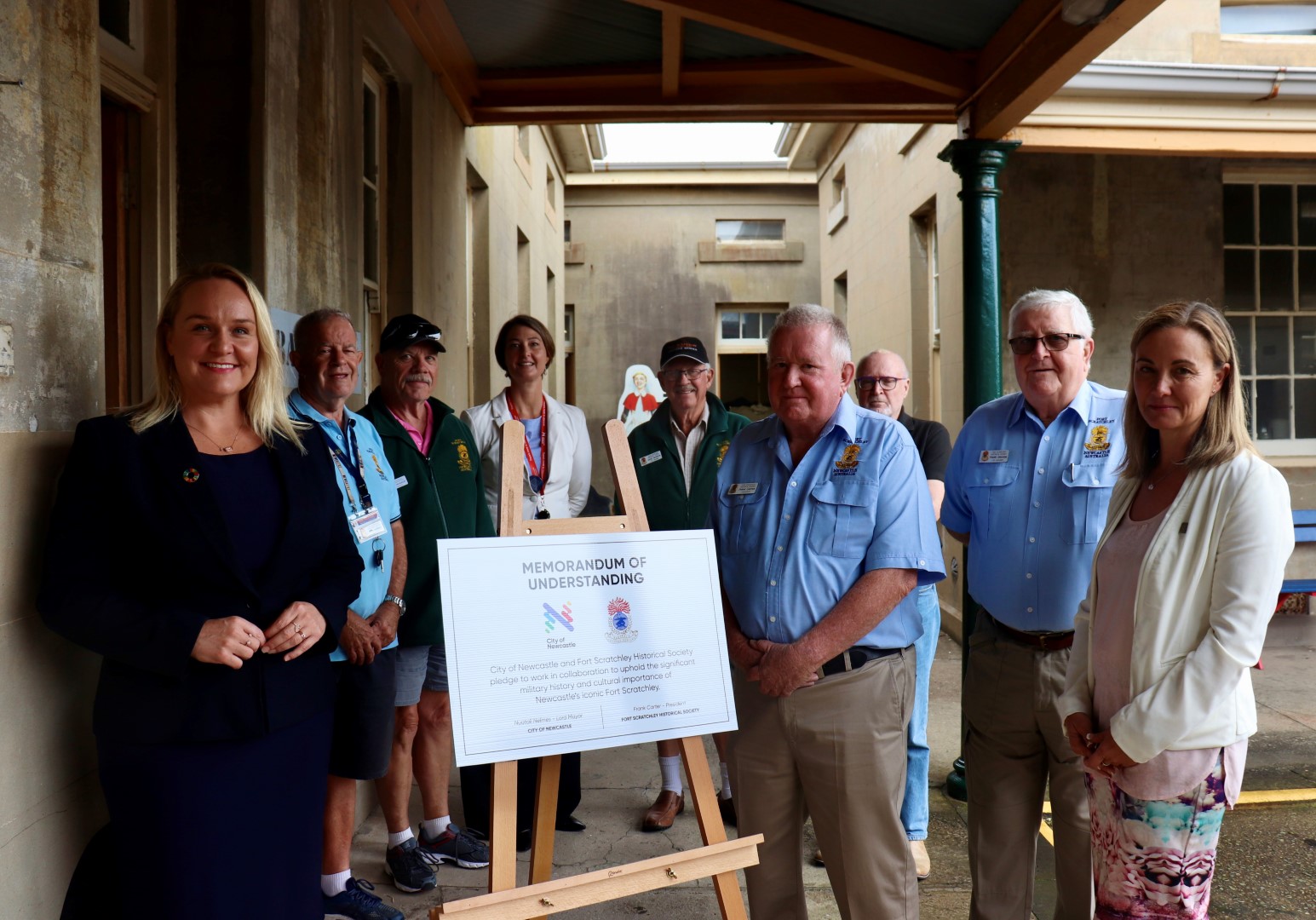
The MoU sets out to guide the joint partners on how they will work together to uphold Fort Scratchley as a treasured part of Newcastle’s military history as well as being an important city tourist attraction.
Newcastle Lord Mayor Nuatali Nelmes said the City looked forward to continuing to build on the momentum established over the years with FSHS, in a new shared commitment to jointly uphold the cultural significance of the landmark site to the benefit of the community.
“Fort Scratchley is consistently recognised as one of Newcastle’s premier cultural tourist destinations,” Cr Nelmes said.
“It is important that both the community and visitors can experience one of Newcastle’s most iconic landmarks for generations to come and learn all about the role the Fort has played in our city’s military history.
“City of Newcastle will continue to play a significant role in providing FSHS with financial, promotional and management support in their work toward advocating for one of our City’s most iconic attractions.”
Newcastle Councillor Peta Winney-Baartz, who represents City of Newcastle on the FSHS Committee, said she was delighted to witness the signing of the MoU and to formalise the long-standing relationship.
“Both parties acknowledge the significant historical and cultural importance of Fort Scratchley, and the signing today formally recognises the important work undertaken by the FSHS and its dedicated volunteers,” Cr Winney-Baartz said.
“FSHS are passionate volunteers who work tirelessly to maintain the Fort’s museum rooms and offer the community guided tours, conduct tunnel tours, and fire the historic guns each day.
“City of Newcastle’s shared commitment with FSHS to uphold the Fort’s cultural significance will ensure it is preserved for future generations to experience.”