
The NSW Government is accelerating the rollout of the COVID-19 vaccine with 25 Pfizer sites across the state now taking bookings for people aged 40 to 49. 17 of these are in rural and regional NSW.
These sites are spread across both Greater Sydney and rural and regional NSW ensuring as many people as possible have access to the vaccine.
Around 23,500 people aged between 40 and 49 have already been invited to book a vaccine at a NSW Health clinic, with 12,000 people already booked for the Pfizer jab.
Premier Gladys Berejiklian said it was great to see such a positive response from the public to register for the vaccine.
“I want to thank the more than 120,000 people aged 40 to 49 who have already registered their interest to receive the Pfizer jab. We are working hard to ensure you receive the vaccine as soon as possible,” Ms Berejiklian said.
Health Minister Brad Hazzard said NSW Health has worked hard to expand its Pfizer footprint across NSW.
“We’re making it easier for people right across NSW to access COVID vaccines as quickly as possible,” Mr Hazzard said.
“The more people vaccinated sooner in our state the stronger our defence against this extremely dangerous virus.”
People aged 40-49 can register for the Pfizer vaccine here: nsw.gov.au/. People will be contacted when a booking is available.
Author: admin
NSW STUDENTS BENEFIT FROM TUTORING PROGRAM
Students in NSW schools are benefitting from the NSW Government’s history-making $337 million COVID catch up program.
Minister for Education Sarah Mitchell confirmed today that 5417 tutors have been employed in NSW public schools, with almost 99 per cent of schools already offering tutoring support to their students.
“We know COVID-19 had an impact on education during the 2020 school year. Our tutoring program is helping students catch up after those disruptions,” Ms Mitchell said.
“The tailored model is important. Schools told us they needed the flexibility to deliver this program in a way that helps their students best.”
“Helping students bridge the gaps in their education caused by COVID is part of this government’s efforts to build a safer and stronger NSW.”
The additional support is tailored by schools using both the data from last year’s Check-in Assessments and the knowledge of classroom teachers.
“We are also helping schools in regional and remote areas with access to expert educators to help them create tutoring programs for their community,” Ms Mitchell said.
“The program has had fantastic take-up by our country schools, and more than 3200 of the tutors who are delivering the program are in regional, rural and remote schools.
“This means no matter where a school is in NSW or how many students they have, they can provide a tutoring program which works for their students.”
Registrations are still open to educators interested in taking part at https://education.nsw.gov.au/teaching-and-learning/curriculum/covid-learning-support-program
Existing Department of Education staff should register interest through ClassCover.
$26.8 million investment to support young Australians
The Australian Government is continuing our support for the mental health and wellbeing of children and young Australians with a $26.8 million investment in Yourtown’s Kids Helpline.
Caring for the mental health and wellbeing of Australians, particularly children and young people, remains one of the Australian Government’s highest priorities.
It is estimated that more than three quarters of mental health conditions begin before the age of 25, and there are approximately 630,000 young people with mild to moderate mental illness nationally.
Providing early support is vital in helping young people get back on track and can minimise longer-term impacts.
Kids Helpline has played a vital role in our efforts to protect and nurture the emotional wellbeing and lives of children and young people across Australia.
The service provides a free, private and confidential 24/7 telephone and webchat counselling support, specifically for young people aged 5 to 25 years. Its unique model allows a young person to contact the same counsellor on an ongoing basis and doesn’t place a limit on the length of counselling sessions.
Kids Helpline also publishes online articles on a range of mental health and wellbeing issues, including early intervention and self-help strategies individually tailored for each age group, and provides information and referrals, one-off counselling support, and ongoing counselling and case management in conjunction with face-to-face services.
The additional funding for Kids Helpline includes $24 million to support operations over the next four years, and a further $2.8 million to meet the immediate demand caused by the pandemic.
This funding means that children and young people will continue to get the help they need to deal with issues ranging from mental health problems to family relationships, child abuse, suicide and self-harm.
Minister for Health and Aged Care, Greg Hunt, said Kids Helpline had provided lifesaving care in times of crisis, practical advice or a place to turn to so young Australians know that they are not alone.
“Never has this support been more important that in the last 18 months, with the effects of Black Summer Bushfires and the COVID-19 pandemic putting significant pressure on the mental health and wellbeing of many,” Minister Hunt said.
Assistant Minister to the Prime Minister for Mental Health and Suicide Prevention, David Coleman, said Kids Helpline’s incredible work has made a real difference in the lives of children and families across Australia.
“I would like to thank all those involved in Kids Helpline for their invaluable contributions to the health and wellbeing of children and young adults in Australia,” Assistant Minister Coleman said.
The funding is part of the Government’s $2.3 billion National Mental Health and Suicide Prevention Plan – a landmark commitment to transform the mental health system and ensure that all Australians can access the right care and essential services whenever and wherever they need.
In a first for Australia, the Plan includes a specific focus on the mental health of children under 12 and their parents and carers, including:
- $54.2 million to establish a network of Head to Health Kids mental health centres in conjunction with the states and territories
- $42.3 million to provide parenting tools and support, and
- $111.4 million to allow parents and carers to use two sessions under the Better Access initiative to discuss their child’s care needs with their treating practitioner, while supporting their own mental health and wellbeing.
These investments will ensure better social and health outcomes for our young people, giving them the opportunity to reach their full potential in life, and safeguarding the long-term future of our country.
The funding reinforces our Government’s strong commitment achieving better mental health for all Australians, and will complement the existing investment of $6.3 billion in mental health services in 2021-22.
Anyone experiencing distress can seek immediate advice and support through Kids Helpline (1800 55 1800), Beyond Blue (1300 224 636), Lifeline (13 11 14), or the Government’s digital mental health gateway, Head to Health (www.headtohealth.gov.au).
Additional support for sick kids and their families in Queensland
Families of sick children across Queensland will have better access to much-needed accommodation and support through the newly refurbished Ronald McDonald House in South Brisbane.
The Australian Government invested $2.57 million to renovate and modify areas of Ronald McDonald House, which will be a life saver for regional and Far North Queensland families of very sick children being treated at Queensland Children’s and Mater Misericordae hospitals.
The newly refurbished home can now cater for large family groups, families who need longer stays and immuno‑suppressed patients who have been discharged from hospital but must remain in Brisbane for ongoing care.
Providing a warm and welcoming home away from home is crucial to the care and recovery of unwell children, as well as helping to keep families together and close to the care their child needs.
Accommodation at the Ronald McDonald House is free for eligible families of seriously ill children, with priority given to families whose children have been recently diagnosed, seriously injured or who require emergency treatment, as well as families of premature babies.
The South East Queensland (SEQ) chapter of Ronald McDonald House Charities is the largest in Australia, operating in Herston, South Brisbane and inside the Queensland Children’s Hospital.
Supporting thousands of families a year since 1991, the SEQ chapter provided a total of 103,894 bed nights for 5,685 families in 2019.
80 per cent of families cared for by SEQ come from Wide Bay and Capricornia, Central Queensland, Mackay, Central West, West Moreton, Pine Rivers, Caboolture, Townsville, Cairns, Far North Queensland and Cape York.
Funding for this refurbishment was provided through the Australian Government’s Supporting our Hospitals – Additional Infrastructure and Services program.
Protecting families and businesses from higher energy prices
The Morrison Government is stepping up and building a new gas power plant in the Hunter Valley, which will create jobs, keep energy prices low, keep the lights on and help reduce emissions.
This important project delivers on the Government’s 1,000 MW target set last September, which was created to avoid unacceptable price increases following the closure of the Liddell power station in 2023.
In the 2021-22 Budget, the Government committed up to $600 million for Snowy Hydro Limited to construct a 660 MW open cycle gas turbine at Kurri Kurri in the Hunter Valley.
The Hunter Power Project will deliver an important economic boost to the region, creating up to 600 new jobs during peak construction and 1,200 indirect jobs across NSW.
This project, together with EnergyAustralia’s 316 MW Tallawarra B open cycle gas plant, will help shore up the security, reliability and affordability of electricity for consumers in NSW, with a commitment to be generating in time for summer 2023-24 when Liddell closes.
Securing reliable, affordable energy is critical to our plan to secure Australia’s recovery from the COVID-19 pandemic.
Minister for Energy and Emissions Reduction Angus Taylor said the Government had given the private sector every opportunity and is fulfilling its promise to deliver the cheap, reliable power that NSW households, businesses and industries needed to prosper and grow.
“Cheap power is crucial to ensuring families, businesses and job-creating industries in NSW can thrive, which is why we are committed to replacing the energy generated by Liddell to keep prices down,” Minister Taylor said.
“This important project is good news for NSW as well as the broader National Electricity Market.
“We were very clear from the start – we will not stand by and watch prices go up and the lights go off. This project will deliver flexible gas generation to replace Liddell and maintain reliable power alongside Australia’s world-leading investment in renewables.”
This is a responsible investment. Expected investment returns for the Hunter Power Project are strong and Snowy Hydro is on track to deliver this critical, dispatchable capacity, on-time and on-budget.
The Morrison Government has also announced a $24.9 million package in the 2021-22 Budget to support new gas generators to be hydrogen-ready, including a $5 million commitment to Tallawarra B.
The construction of two new gas power plants will create over 2,000 direct and indirect jobs. This is what the Government’s gas-fired recovery is about – helping Australia bounce back strongly from the COVID-19 recession.
Through the 2021-22 Budget, the Morrison Government is also providing up to $30 million to support early works on Australian Industrial Power’s (AIP) Port Kembla power station project as it progresses to Final Investment Decision. The project will play a crucial role in reducing market volatility risks in NSW by supporting reliable electricity supply and keeping prices low.
Progressing the AIP power station would also support the development of the Port Kembla import terminal, providing a key source of demand for imported gas. The Government will continue to work with AIP to fully assess the project and evaluate support through the Underwriting New Generation Investments (UNGI) program.
New gas supply and generation will help strengthen our economy and make energy more affordable for families and businesses, while complementing the world-leading levels of renewables in Australia.
Gas supports jobs in our important energy intensive industries that are the lifeblood of our economy and our regions.
Gas is a critical enabler of Australia’s economy and helps to support our manufacturing sector that employs over 900,000 Australians.
City develops concept design for Newcastle Ocean Baths pool upgrade following community feedback
City of Newcastle has finalised the concept design for Stage 1 of the Newcastle Ocean Baths upgrade which focuses on improving the ageing pools and lower promenades.
Lord Mayor Nuatali Nelmes said the Newcastle Ocean Baths Community Reference Group (CRG) was integral in the refinement of the concept design for Stage 1.
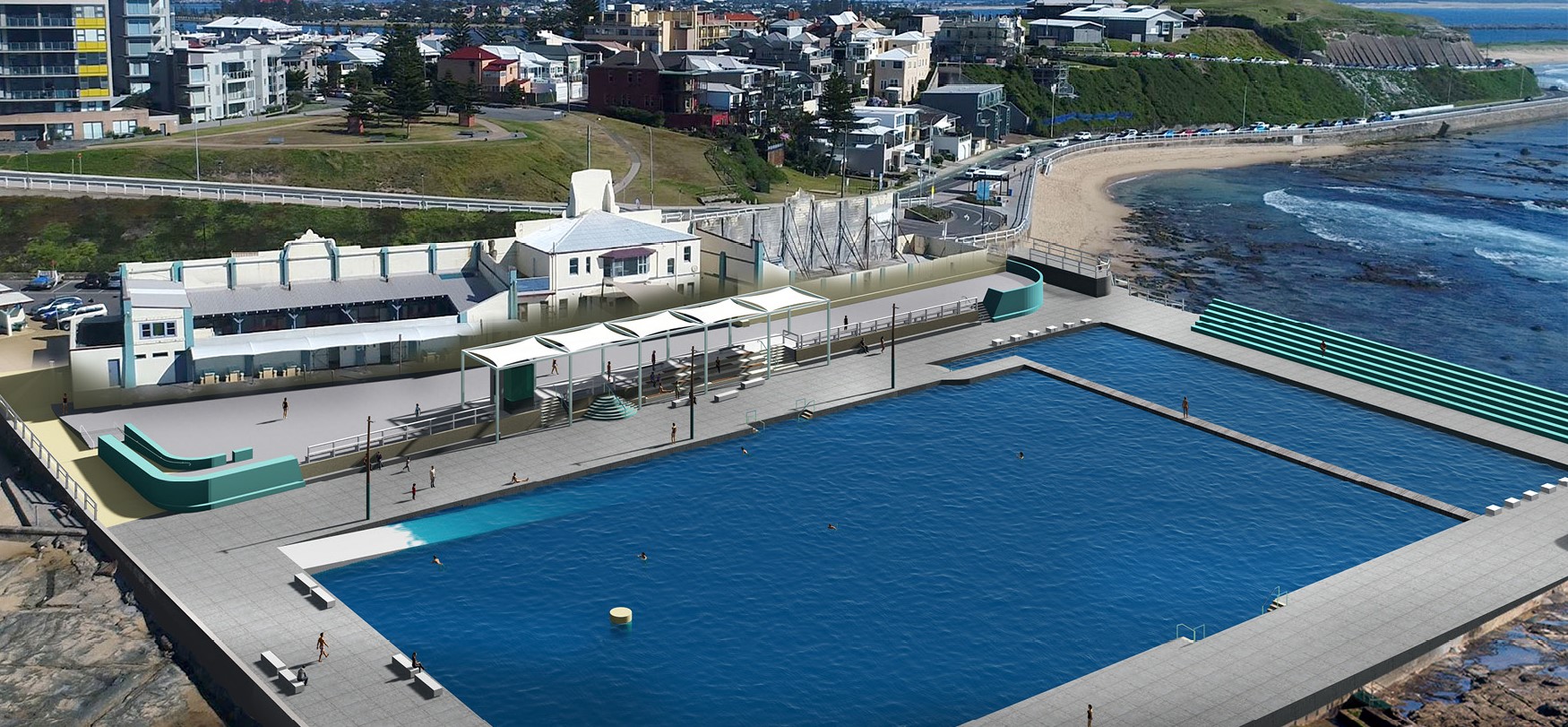 “We’ve heard valuable feedback from the Community Reference Group, which represents our broader community and Newcastle Ocean Baths users, and adjusted the design to ensure the Baths meets the needs of our community and visitors,” Cr Nelmes said.
“The big winner has been accessibility improvements, with fit-for-purpose ramps for people with a disability or mobility issue to easily get to and from the pools.
“We’ve carefully considered the location of the ramp access into the pools and following advice from the CRG and in consultation with disability advocates have realigned the new ramp to the western edge of the pool to allow long lap swimming.
“We’ve heard our community values the existing rounded central stairs and they’ll be incorporated in the new design within upgraded seating and improvements to ensure they meet modern standards.”
Co-chair, Hunter Regional Committee of the National Trust, Mark Metrikas, said City of Newcastle had genuinely consulted on elements of the concept such as the rounded stairs.
“National Trust was concerned to see the rounded heritage stairs missing from an earlier design of the Newcastle Ocean Baths Stage 1 upgrade,” Mr Metrikas said.
“City of Newcastle has worked closely with National Trust on seeking advice as to how the stairs can be incorporated into the new design, as well as sharing additional information about the engineering and safety considerations, so as we can get a better outcome for this cherished facility.”
Other changes made in response to community feedback include replacing the shade structure with a rainproof shade textile with the potential to be removed during the winter season, the colour scheme of extended bleachers and reducing the visual impact of the new lifeguard tower.
As part of the upgrade, the iconic bleacher seating will be retained, the boardwalk will be renewed and a new pump station which will enable more effective pool cleaning will be installed. The concept design also addresses the undulating rock bottom, while retaining the sand floor to facilitate cleaning of the pools and increase user safety when sand levels are low, with sand continuing to accumulate in the pools via natural ocean processes as it does currently.
The Newcastle Ocean Baths upgrade is a staged project that will begin with the restoration of the pools and promenades in the second half of 2021 as part of Stage 1. Stage 2 will focus on the upper concourse and pavilion building.
Construction on Stage 1 of the Newcastle Ocean Baths upgrade is expected to commence mid-year.
City of Newcastle is committed to funding the renewal of Newcastle Ocean Baths in full and will direct the $9.5 million recovered from the sale of the Frederick Ash Building to the project. The sale was made possible through the relocation of the City’s Administration Centre to its new staff premises at 12 Stewart Avenue, Newcastle West, in October 2019.
200,000 BUNDLES OF JOY DELIVERED
Parents of more than 200,000 newborns across NSW have benefited from a Baby Bundle of essential items given to them on the birth of their child over the last two years.
Premier Gladys Berejiklian, Member for Holsworthy Melanie Gibbons and Member for East Hills Wendy Lindsay announced the milestone while visiting Liverpool Hospital’s Maternity Unit today.
Ms Berejiklian said the Baby Bubble is valued at more than $300 and is filled with baby products and information to support the health, development and well-being of babies in NSW.
“Every baby born in NSW is eligible to receive a Baby Bundle, with more than 200,000 handed out since the initiative began in January 2019,” Ms Berejiklian said.
“The Baby Bundle not only helps reduce some of the initial costs of having a baby, it also provides useful items to support new parents give their child the best start in life.”
Ms Gibbons said this program supports new additions to a family and makes sure parents are receiving important information and supplies during what can be a happy but confusing time.
“My kids are a little older now but I know how much I would have benefited from a baby bundle and I am sure all the new parents will feel the same,” Ms Gibbons said.
Mrs Lindsay said that all children are precious and a baby brings a new dimension to families.
“The baby bundle is full of helpful goodies for your new bundle of joy and to help families celebrate their new addition,” Mrs Lindsay said.
The Baby Bundle includes a number of items including a sleeping bag, play and change mats, muslin wrap, bath thermometer and a first aid kit, along with a selection of NSW Health printed resources that complement the Blue Book.
Parents receive the Baby Bundle before being discharged from hospital, or, after registering their child with NSW Births, Deaths and Marriages.
The Baby Bundle is part of the NSW Government’s $157 million parenting package, including more midwives and family health nurses, investment in testing and treatments for children’s diseases, and practical and emotional support to parents.
For more information about the Baby Bundle go to: Baby Bundle – Maternal and newborn (nsw.gov.au)
GREENS CALL FOR URGENT HEALTH DEPT REVIEW TO ENSURE DISCRIMINATION AGAINST DISABLED PEOPLE DOES NOT PERSIST IN VACCINE ROLLOUT
Australian Greens Disability spokesperson Senator Jordon Steele-John has called for an urgent review into the Health Department to determine why disabled people have been discriminated against in the Morrison government’s response to the COVID-19 pandemic and, in particular, phase 1a of the vaccine rollout.
“Today’s evidence to the Disability Royal Commission is conclusive: disabled people and our support workers have been excluded from receiving priority vaccines as part of phase 1a of the vaccine rollout,” Senator Steele-John said.
“Since the beginning of the COVID-19 pandemic so many people in our community have been living in fear and in isolation, with little information from the Morrison government about how we would be supported.
“Because of these ongoing failures we are now in a position where there are more Olympians who’ve been vaccinated than high-risk disabled people living in residential care!
“There should not be a single Health Department document relating to the pandemic that fails to mention disabled people, yet time and again we’ve seen our community not thought of, not factored in or actively excluded.
“When asked today if she was concerned that disabled people had been overlooked in the vaccine rollout, Health Department Associate Secretary Caroline Edwards stated that she could not comment. This response from a senior public servant is completely unacceptable.
“Quite simply, the treatment of disabled people throughout this pandemic has been discriminatory.”
Recycling targets slashed as government fails to act
Australia’s plastic recycling and waste reduction targets have been slashed and rebranded in an attempt to hide inaction and failure from the Government and big polluters.
The Australian Packaging Covenant Organisation (APCO) today launched its ANZPAC Plastics Pact, which undercuts the organisation’s own 2025 National Packaging Targets.
Greens spokesperson for Waste and Recycling, Senator Peter Whish-Wilson, said the announcement is a result of the Government’s recent refusal to legislate mandated packaging targets in the Australian Senate.
“The Greens, Labor and all of the cross bench except One Nation voted to make voluntary targets mandatory in law.
“The packaging industry fought hard to stop mandatory targets, even though they always said they were confident in meeting voluntary commitments.
“Today’s announcement from APCO equates to a 27% reduction in these voluntary commitments for plastic recycling.
“APCO has also halved its commitment to increase what packaging is collected and effectively recycled.
“Just a few months ago APCO, Woolworths and the Australian Food and Grocery Council openly said at a series of Senate inquiries they didn’t need regulation and mandated targets as they would meet the voluntary targets the industry set themselves.
“Now that the spotlight is no longer on them, and genuine waste reform is off the Government’s parliamentary agenda, we get them backtracking from their commitments.
“Did they deliberately mislead the Senate in order to avoid government regulation and accountability, or did they just stuff it up?
“Either way the packaging industry and their cheerleaders in Government – including Minister Evans and Ley – have some serious explaining to do.
“We should be ramping up actions to meet waste and recycling targets, not weakening them, and the producers within the packaging industry need to play a key role in this.
“The waste and recycling industry employs over 60,000 Australians and has pushed for strong, regulated targets for the packaging industry.
“Strong, mandated targets would give the waste and recycling industry the certainty to invest in building a circular economy and creating green new jobs.
“Today’s announcement is simply more uncertainty for this critical industry. They have been let down by the Morrison Government, who lobbied hard to prevent the Senate from passing amendments that would have properly regulated the blatant self-interest of big plastic polluters.”
Aged care reforms to benefit senior Tasmanians
Senior Tasmanians, their families and carers are set to benefit from the Australian Government’s once-in-a-generation reform of aged care, announced in last week’s Federal Budget.
Minister for Senior Australians and Aged Care Services Richard Colbeck said older Tasmanians are at the heart of the $17.7 billion package.
“We are committed to ensuring that those who have contributed so much – our nation builders, our parents and grandparents, our founders and protectors– get the respect, care and dignity they rightly deserve,” Minister Colbeck said.
In response to the Royal Commission into Aged Care Quality and Safety, the Government’s unprecedented investment will improve quality care, increase viability of the sector, and provide services that respect the needs and choices of seniors.
With Australia’s fastest ageing population, Tasmania’s share of the record investment will be a major boost to aged care services.
The funding will include $630.2 million to make the aged care system more accessible for seniors with special needs, including people in regional and rural areas in Tasmania.
This new support will include $397 million for aged care providers to undertake capital works to build new and improve existing facilities, improving access to care and providing local jobs.
East Devonport’s Melaleuca Home for the Aged is one of a number of residential aged care providers across the state that will play a lead role in implementing the reform package, translating the Royal Commission’s recommendations and the Government’s response into actions.
Member for Braddon Gavin Pearce said the engagement of aged care homes like Melaleuca will be crucial in progressing the vital reforms.
“We will rely on support from the aged care sector, providers and the workforce to embrace and embed these changes, creating a better system within their business and their work,” Mr Pearce said.
Minister Colbeck said residential aged care services and sustainability was one of the five pillars of the Government’s response to the Royal Commission.
“The Government has committed $7.8 billion towards improving and simplifying residential aged care services,” he said.
“This includes $3.2 billion to support aged care providers to deliver better care and services through a new Basic Daily Fee supplement of $10 per resident per day. A further $3.9 billion will increase the amount of frontline care delivered to residents of aged care and respite services.”
“I look forward to working with aged care consumers, their families and the sector to implement these changes.”