
An off-duty police officer has been charged with high-range PCA in Lake Macquarie yesterday.
About 11.30pm (Thursday 25 November 2021), officers attached to Lake Macquarie Police District attended Palmers Road, Freemans Waterhole, after reports a white Volkswagen Amarok was parked in the middle of the road.
Members of the public observed the driver standing outside the vehicle and assisted in moving the car off the road.
The driver – an off-duty probationary constable attached to the Northern Region – participated in a roadside breath test that returned a positive result.
The 39-year-old man was arrested and taken to Toronto Police Station where a subsequent breath analysis returned an alleged reading of 0.218.
The officer, from West Gosford, was issued a Court Attendance Notice for drive with high range PCA and is due to appear at Toronto Local Court on Tuesday 18th January 2022.
His licence has been suspended
Author: admin
More action needed to eliminate violence against women
On International Day for the Elimination of Violence against Women the Greens have called for the Morrison Government to commit serious funding to frontline services, prevention programs, and short and long term housing so that women are not forced to choose between violence and homelessness.
The Greens have also endorsed the recommendations of today’s Pathways to Safety report from Aboriginal-led justice coalition Change the Record, which calls for governments to prioritise the leadership of Indigenous women and increase investment in violence prevention, support services and housing.
Greens deputy leader and spokesperson on women Senator Larissa Waters said:
“Every year on this day we recommit to ending sexual and physical violence against women around the world.
“If the Morrison Government was serious about ending this epidemic of violence they would have listened to the sector’s calls for $12 billion over the 12 year life of the National Plan, rather than the inadequate amounts they have pledged to date.
“We need expert-led prevention programs, not milkshake videos, and real work to end the gender inequality that drives violence against women.
“To eliminate violence against women the government must deliver what women’s groups have been demanding for years: proper sexual consent education in schools; addressing the causes of the gender inequality that drives violence; a massive investment in crisis, transition and long-term housing so women are not forced to choose between homelessness and violence; and a commitment of $12 billion over the 12-year life of the next national plan to ensure frontline services are fully funded and no-one seeking help is turned away.
“And we need a stand alone, self-determined First Nations National Women’s Safety Plan – as called for by today’s Pathways to Safety report from Change the Record. First Nations women know how to keep their children and communities safe, and we need a National Plan than listens to them and provides the tools they need to end violence against First Nations women and children.”
Huge RMIT wage theft bill vindicates casual staff
Australian Greens Education spokesperson Senator Mehreen Faruqi has responded to reports that RMIT will pay back up to $10 million to casual staff for work dating back to 2014.
Senator Faruqi said:
“Casual university staff are absolutely sick and tired of being underpaid, undervalued and taken for granted.
“Wage theft at our campuses is systemic and universities are finally realising they can no longer run away from this. This wage theft disproportionately affects casual staff and women.
“As universities have casualised their workforces, wage theft has been allowed to fester, and it’s now been revealed that staff at campuses in all parts of the country are affected.
“My congratulations must go to the staff and unions who continue to fight hard for the rights of university workers.
“The Senate Inquiry into Job Security, which I sit on, has made numerous excellent recommendations with respect to wage theft which should be implemented as a matter of urgency.”
Greens reject Morrison discrimination bill
The Greens have vowed to block Scott Morrison’s religious discrimination bill, saying it was a Trojan horse for hate that went well beyond a shield to protect people with religious beliefs, calling on Labor and Senators to join them in blocking it.
Leader of the Australian Greens Adam Bandt MP said:
“Scott Morrison’s bill means more discrimination, not less.
“Scott Morrison has a bill for more discrimination but no bill to stop corruption.
“The bill overrides State and Territory protections and makes bigoted hate speech legal.
“The bill goes beyond being a shield. It has many swords and they will do harm.
“The Greens call on Labor to block this harmful bill.
“The Greens support protections against religious discrimination, which is why Australia needs a charter of rights, but this bill isn’t that.”
Australian Greens LGBTIQA+ spokesperson Senator Janet Rice said:
“Scott Morrison’s discrimination bill is a Trojan horse for hate.
“Any bill that enables discrimination against LGBTIQA+ people, women, people with disabilities, minority faiths, or First Nations people is unacceptable and must be voted down.
“Under the guise of faith, bigots would be free to discriminate against people at school and universities, in the workplace, hospitals, restaurants – anywhere in public life.
“Morrison’s whole schtick is to divide Australians and create problems where none existed.
“Morrison and the Liberals are using culture wars as a distraction so people won’t notice this government has done absolutely nothing to help struggling Australians.
“While the Liberals are fighting fake cancel culture, the Greens are fighting for what Australians want – action on climate change, taxing the billionaires, raising income support, getting dental into medicare and laws that protect all of us equally.”
City trials world-leading technology in raingardens to keep waterways clean
City of Newcastle is leading the trial and implementation of a new sustainable technology that improves cleanliness of stormwater runoff through an innovative filtration system used in garden beds along our city streets.
Filter soils have been installed at test sites in Newcastle suburbs using compost soil and specially processed recycled materials like glass and green waste.
Raingardens are small garden beds located along the street featuring soil and plants that slow down and filter pollution in stormwater, so it doesn’t harm waterways and beaches.
The raingardens are usually found on street corners where cars can’t park and have more grass-like shrubbery than usual roadside plantings and are set in lowered beds over drains.
Recycled glass and green waste is now being used as a filter material that creates a healthy environment for plants increasing biodiversity in the suburbs. In addition to filtering the water, the raingardens also create a habitat for flora and fauna and absorb heat, meaning our streets are cooler in summer.
Data collected from these test sites will be verified by University of Newcastle as part of a Memorandum of Understanding (MoU) between the Centre for Organic Research and Education (CORE) and City of Newcastle.
City of Newcastle is the first council to use the biofilter material that contains recycled products within the soil mix, such as crushed recycled glass instead of virgin sand, and organic composted waste products instead of artificial fertiliser and clay.
The unique material can remove pollutants such as sediment and heavy metals that come from our tyres and brake pads as they wear down; grease, oil, petrol and air conditioner coolant that drips from motor vehicles; and excess nutrients from parks and gardens that can cause algal blooms.
The water is carried away through drains, pipes and channels to local creeks, wetlands, estuaries and finally to the ocean, which is a great outcome for the environment.
Biofilter raingardens have now been installed at sites in Cooks Hill, Merewether, Mayfield West, Stockton, The Junction and Wallsend. Existing systems in Beresfield and Fletcher will soon be renewed with biofilter material.
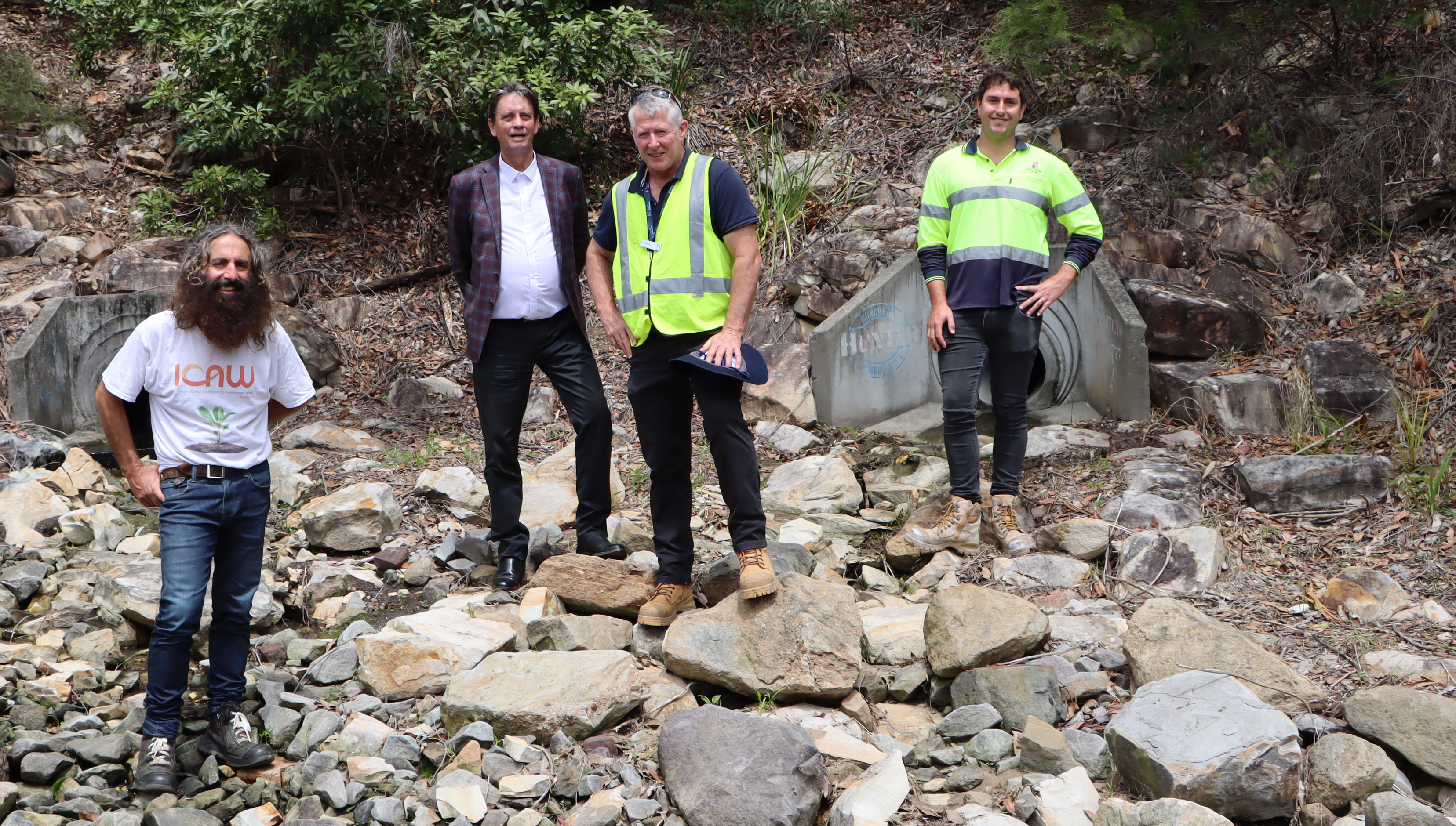 Costa Georgiadis, Chair Centre for Organic Research and Education Eric Love, City of Newcastle Asset Services Manager Peter McMurray and City of Newcastle Asset Engineer Luke Jaszczyk at a biofilter raingarden in Wallsend.
City of Newcastle welcomes improvements to Infrastructure Contributions Bill after advocacy
City of Newcastle has welcomed the NSW Government’s decision to amend its unpopular infrastructure contributions scheme following the Council’s advocacy.
Planning Minister Rob Stokes has confirmed that proposed reforms to the State’s infrastructure contributions scheme will be modified to ensure City of Newcastle and other local councils can continue to fund community infrastructure from developer contributions.
Advocacy led by Local Government NSW and City of Newcastle had raised concerns about the potential impacts of the proposed reforms on councils’ financial sustainability if the funds had been redirected for distribution by the NSW Government as originally proposed.
The modified reforms will also ensure state contributions are spent in the region where they are collected rather than be spent in regions at the discretion of the NSW Government.
City of Newcastle CEO Jeremy Bath welcomed the changes as a win for Newcastle and communities across the state.
“I would like to thank the Minister for Planning and Public Spaces for listening to feedback from City of Newcastle and working with Local Government NSW to address our concerns,” Jeremy Bath said.
“Newcastle will welcome 23,000 new residents and house 11,500 new dwellings by 2036. Developer contributions provide vital funds that help deliver community infrastructure such as cycleways, bus shelters, parks and playgrounds, sporting grounds, recreation facilities and town centre public domain improvements.
“We need to ensure public infrastructure keeps pace with growth and is equitably funded, while also protecting current ratepayers from being financially burdened by the infrastructure requirements that result from future development.”
The NSW Government’s Environmental Planning and Assessment Amendment (Infrastructure Contributions) Bill 2021 was introduced into NSW Parliament with the NSW Budget.
A Notice of Motion moved at City of Newcastle’s August Council meeting called on the NSW Government to undertake further consultation with the local government sector on any proposed reforms to the infrastructure contributions system.
$20 million to boost support for domestic violence victim-survivors
More domestic violence victim-survivors will receive critical support with a $20 million relief package for more than 180 NSW specialist frontline services being delivered, as an annual international violence prevention campaign kicks off today.
This is the first tranche of new Commonwealth funding under the Domestic and Family Violence National Partnership Agreement 2021-23. The new Commonwealth funding will complement existing investments from the NSW Government for domestic violence services.
The investment also comes amid the 16 Days of Activism Against Gender-Based Violence, an annual international awareness campaign that begins today (25 November) – the International Day for the Elimination of Violence against Women – and runs until World Human Rights Day on 10 December.
Attorney General and Minister for Prevention of Domestic and Sexual Violence Mark Speakman said this package forms part of the additional $140 million funding boost over two years from the NSW and Commonwealth Governments.
“Our frontline providers have been facing greater need for their life-saving services and support from women and children fleeing domestic abuse during and following lockdowns necessitated by the COVID-19 pandemic,” Mr Speakman said.
“This flexible funding will help services retain highly-skilled staff and support their wellbeing, provide additional brokerage to assist victim-survivors with essentials such as furniture, and cover COVID-19 cleaning and interpreter costs.”
Federal Minister for Families and Social Services Anne Ruston thanked the dedicated service providers for their commitment to keeping women and children safe under the challenging circumstances of the pandemic.
“Women who are socially isolated often face extra barriers when trying to leave violent partners. This, combined with the financial and mental stressors of the pandemic has increased the complexity of many cases,” Senator Ruston said.
“This investment will better support victim-survivors who come forward to report abuse – both during lockdowns and now that restrictions have eased.”
The package provides extra funding for existing specialist domestic and family violence services, including:
- Staying Home Leaving Violence to reduce victim-survivor homelessness;
- Women’s refuges to support women and children in need of crisis accommodation;
- The Integrated Domestic and Family Violence Services Program, to provide women and their children with the emotional and practical support they need to recover from domestic and family violence;
- Domestic Violence Response Enhancement to provide after-hours crisis support services for victim-survivors;
- Women’s Domestic Violence Court Advocacy Services to help women and children escaping violence with their legal, social and welfare needs;
- Specialist workers to provide trauma-informed support for children and young people in 20 priority refuges;
- Men’s Behaviour Change Programs and other perpetrator interventions; and
- Local Support Services for male victim-survivors.
Minister for Women Bronnie Taylor said addressing domestic and family violence requires many, varied responses, which is what this support package aims to deliver.
“Domestic and family violence needs to be addressed on multiple fronts – with immediate supports like crisis accommodation, housing and legal help, as well as preventative measures like men’s behaviour change programs,” Mrs Taylor said.
“The Government is also very pleased to be delivering further tailored support for children as part of this package, which will help ensure they’re given the specialist care they need.”
Delia Donovan, CEO of Domestic Violence NSW, welcomed the funding, which she said is essential to helping women and children who found it harder to access support during the COVID-19 lockdowns.
“The danger of domestic abuse is heightened behind closed doors. If women are forced to stay at home, they have fewer chances to seek help,” Ms Donovan said.
“We expect waitlists to rise again now that the NSW lockdown has lifted, and this support package will help ensure our member services can meet the ongoing demand and need.”
The $140 million funding boost is part of the 2021-22 NSW Budget, which committed a record $687 million over four years (including $80 million in Commonwealth funding) to improve victim safety and reduce family violence reoffending.
For confidential advice, support and referrals, contact: 1800 RESPECT (1800 737 732), The NSW Domestic Violence Line (1800 65 64 63) or Men’s Referral Service (1300 766 491).
Extra bus and ferry services for L1 line customers
More replacement bus services and a new permanent ferry route will provide extra travel options for customers of the Inner West Light Rail from Monday.
Three dedicated bus routes will provide services between Dulwich Hill and Central, while a new direct ferry service will link Blackwattle Bay to Barangaroo.
Minister for Transport and Roads Rob Stokes said the new bus and ferry services were planned using travel data and feedback from the Inner West community.
“We have developed this enhanced travel plan to provide customers with more options in addition to regular train, bus and ferry services,” Minister Stokes said.
“The bus services will operate every 10 minutes in peak periods and 15 minutes outside of peak and on the weekend. The ferry service will run every 30 minutes Monday to Friday.
“Transport for NSW will have customer service staff at key locations along the L1 Line to provide information on travel options and the replacement services.
“I thank the community for their patience as we work to restore the Inner West Light Rail.”
Customers using L1 line replacement bus services will automatically receive a 50 per cent discount on their fare from next week, while the discount on the initial replacement bus services is being backdated to 8 November 2021.
The new F10 ferry service will only accept payments made with credit or debit cards, with full adult ferry fares charged as this is a permanent service.
Transport for NSW continues to work with Transdev, Altrac, CAF and the rail safety regulator to assess the 12 light rail vehicles, detect cause of the cracking and complete repairs as soon as possible. An updated program of works will be released in due course.
For more details on the replacement services customers can visit https://transportnsw.info.
Update on further easing of restrictions
The NSW Government has updated the roadmap for easing restrictions after the State reaches the 95 per cent double dose vaccination target or 15 December, whichever comes first.
Adjustments to previous settings scheduled for this milestone include:
- Masks will only be required on public transport and planes, at airports, and for indoors front-of-house hospitality staff who are not fully vaccinated (previously all indoors front-of-house hospitality staff regardless of vaccination status). Masks will be strongly encouraged in settings where you cannot social distance;
- No density limits (previously one person per 2sqm);
- COVID safety plans will be optional for businesses and will be supported by SafeWork NSW;
- QR check-ins will only be required at high-risk venues including hospitals, aged and disability care facilities, gyms, places of worship, funerals or memorial services, personal services (e.g. hairdressers and beauty salons), limited hospitality settings (including pubs, small bars, registered clubs and nightclubs), and for indoor music festivals with more than 1,000 people; and
- Proof of vaccination will no longer be required by Public Health Order for most activities (businesses can still require proof at their own discretion). Proof of vaccination will still be required for indoor music festivals with more than 1,000 people.
With more than 92 per cent of people over 16 now vaccinated ahead of the summer festive season, NSW is continuing to take a responsible and measured approach to reopening.
To maintain high levels of immunity across the community, NSW Health is rolling out a booster vaccination program at its clinics to individuals aged 18 and older who received their second dose of a COVID-19 vaccine six months or more ago.
Premier Dominic Perrottet said the easing of restrictions was only possible because NSW is amongst the highest vaccinated populations in the world and the introduction of the booster shot program.
“We’re leading the world when it comes to vaccinations and that is a tremendous achievement we can all be proud of because it has allowed us to return to normal as quickly and safely as possible,” Mr Perrottet said.
“The easing of these restrictions will allow people to get out and enjoy summer providing a boost for some of our hardest industries as we do everything we can to ensure we keep people safe as we learn to live with COVID.”
Deputy Premier Paul Toole said the roadmap was a staged and considered approach which ensured Regional NSW was able to welcome back visitors in a COVID safe way.
“Regional NSW is open for business thanks to high vaccination rates right across the state. I’d remind visitors to our beautiful beaches, countryside and outback this summer to be respectful and ensure they are abiding by safety measures, which include wearing masks on public transport, planes and at airports.”
Minister for Jobs, Investment and Tourism Stuart Ayres said the updated plans for the next stage of the roadmap was great news for businesses still impacted by the remaining restrictions.
“This is a timely boost for businesses just before the busy Christmas and summer holiday periods,” Mr Ayres said.
“I want to encourage everyone to go out and support NSW businesses – whether it’s a meal out, booking a regional trip or holiday shopping at your favourite local store, this is a prime time to enjoy the new freedoms and help NSW businesses bounce back.”
Minister for Health Brad Hazzard said COVID booster shots would be an important part of keeping the community safe through the summer and new year.
“If you had your second COVID vaccination jab six months or more ago, you should book a booster right now. Don’t’ forget if you haven’t been vaccinated at all go and get the jab to protect yourself and your family,” Mr Hazzard said.
“By stepping up for a jab and a booster shot you help protect yourself and everyone around you, including the elderly, those with underlying health conditions and young children who aren’t yet eligible for vaccinations.
“We will also need to continue to get tested if we develop COVID symptoms, regardless of vaccination status, and continue to follow public health advice.”
The NSW Government will continue to review the roadmap settings and make any appropriate changes based on the current case numbers and vaccination rates.
People aged 18 years and older can receive the Pfizer booster dose at least six months after receiving their second dose of any of the COVID-19 vaccines registered for use in Australia. You can book your COVID-19 vaccine or your booster shot, via www.nsw.gov.au/covid-19/vaccination/get-vaccinated.
More information about the next stage of easing of restrictions is available at nsw.gov.au.
Removing disruptions for schools and families
Close contacts of COVID cases at schools and outside school hours care services will no longer need to isolate as a result of changes in school COVID settings announced today by the NSW Government.
The changes were made following recent Doherty Institute and NSW Health advice, and will take effect from Monday 29 November.
From 29 November, students who are close contacts of a positive case will be required to get a PCR test as soon as possible after being notified of exposure. If the PCR test is negative, the student may return to school immediately, so long as they provide negative Rapid Antigen Home Test (RAHT) results for the next seven consecutive days.
In line with community settings, schools will no longer need to close while contact tracing occurs due to successful cohorting of year groups on school sites. The only exception may be if there are multiple cases at a school or complex settings in place.
NSW Health has also advised that schools do not need to close for deep environmental cleans as the enhanced cleaning in place at schools is sufficient.
Mask settings remain the same, meaning they are required for all staff and high school students, and are recommended for primary school students.
Further restrictions on music have also been lifted, with instruments that rely on breath and singing and chanting allowed to go ahead outdoors, within cohorts, and in line with other COVID-safe school settings from Monday.
Premier Dominic Perrottet said the changes give parents the confidence that schools will no longer be closing and their children will not be required to isolate at home.
“The people of NSW have worked hard to get to this point, and the government made a commitment that whenever possible we would reduce the disruption to schools,” Mr Perrottet said.
“Schools have managed the pandemic extremely well, I want to thank all staff for the way they have conducted themselves and the efforts they have made to reduce the impacts of COVID on their students.”
Minister for Education and Early Childhood Learning Sarah Mitchell said parents and students were keen to see less disruption in schools.
“I’m delighted we can reduce the disruption for students and families, while still maintaining the safety measures for students and staff on school sites,” Ms Mitchell said.
“Students already in isolation can return to school from Monday under this new approach.”