
National Cabinet Statement

The National Cabinet met today to discuss Australia’s COVID-19 response, recent outbreaks of COVID-19 and the Australian COVID-19 Vaccine Strategy.
National Cabinet continues to work together to address issues and find solutions for the health and economic consequences of COVID-19.
National Cabinet discussed the outbreak in Greater Sydney and the additional measures introduced by the New South Wales Government to stop the spread of the virus. All leaders expressed their full support for NSW to get on top of the outbreak. National Cabinet noted the Commonwealth’s extension of the COVID-19 Disaster Payments for Greater Sydney.
Since the beginning of the pandemic there have been 30,955 confirmed cases in Australia and, sadly, 910 people have died. More than 21.7 million tests have been undertaken. Testing has increased nationally over recent days with 727,763 tests reported in the past 7 days.
Globally there have been over 185.4 million cases and sadly over 4 million deaths, with 514,654 new cases and 9,457 deaths reported in the last 24 hours. The COVID-19 pandemic continues to surge in many countries around the world. National Cabinet noted the Commonwealth PPE and vaccine support for the Pacific and Indonesia to address growing outbreaks.
Australia’s COVID-19 vaccine roll out continues to expand. As of yesterday, 8,871,572 doses of COVID-19 vaccines had been administered in Australia, including 164,773 doses in the previous 24 hours. In the previous 7 days, 901,419 vaccines have been administered in Australia.
To date, more than 32.2 per cent of the Australian population aged 16 and over have now had a first dose of a COVID-19 vaccine, including over 55 per cent of over 50 year olds and over 72 per cent of over 70 year olds. More than 10 per cent of Australians 16 years of age are fully vaccinated including more than 20 per cent of Australians over 70 years of age.
Chief Medical Officer Professor Paul Kelly provided an update on current outbreaks of COVID-19 in a number of locations and of both the Alpha and Delta variants.
Professor Brendan Murphy noted that Australia has built significant health system capacity since the beginning of the pandemic with over 2,000 ventilator capacity and 7,500 ICU bed capacity.
Lieutenant General John Frewen, Coordinator-General of Operation COVID Shield, provided a detailed briefing on the vaccination program.
National Cabinet welcomed the increased Pfizer supplies and detailed supply plans provided to states and territories. Australia will bring forward Pfizer doses to around 1 million per week from 19 July, this is an increase from an average of 300,000 to 350-000 per week in May and June. Pfizer supplies will increase from 2.8 million doses for July to 4.5 million doses for August 2021. This will mean increased access for Australians through state and territory vaccination clinics, Commonwealth vaccination clinics and 1,300 primary care vaccination sites.
All leaders reiterated the importance of Australians, especially those in vulnerable groups, to get a COVID-19 vaccination.
National Cabinet agreed to meet next on Friday, 16 July 2021.
National Plan to transition Australia’s National COVID Response
The Secretary of the Commonwealth Department of the Prime Minister and Cabinet, Phil Gaetjens, provided an update on the COVID-19 Risk Analysis and Response Taskforce report and the Doherty modelling for the National Plan to transition Australia’s National COVID Response. To take into account economic and other perspectives, Secretary Gaetjens’ work is being coordinated with Commonwealth, state and territory Treasuries, Health Departments and First Secretaries Departments.
Aged Care Workers
All state and territory leaders, with the exception of Victoria, agreed to implement state public health orders or similar state and territory instruments to mandate vaccination of aged care workers by mid-September 2021, with limited exceptions. This is consistent with the approach taken for mandating influenza vaccinations for aged care workers.
In Victoria, an independent decision on mandating COVID-19 vaccinations for aged care workers rests with the Chief Health Officer in Victoria.
National Cabinet noted that the Commonwealth’s tender for aged care remains open for facilities to provide on-site vaccinations and this is expected to provide more than 25,000 workers, with a further process underway to support localised hubs in partnership with the aged care sector.
Mandatory Vaccinations for Disability Workers
National Cabinet agreed to the Australian Health Protection Principal Committee’s (AHPPC) advice encouraging residential disability support workers to have their COVID-19 vaccination as soon as possible, and in August 2021, consider mandating vaccination for disability workers by 31 October 2021.
The National Cabinet:

  • strongly encourages all disability support workers to get vaccinated against COVID-19 to protect their own health and the health of the people for whom they are caring
  • notes the AHPPC will consider the evidence for mandatory vaccination for disability support workers in August 2021 following redoubled efforts to encourage uptake of COVID-19 vaccines, including by giving disability support workers priority for appointments and improving communications to the sector, and taking into account an updated assessment by AHPPC of COVID-19 risk in a range of disability residential settings
  • notes in August 2021 the AHPPC will consider making it mandatory for disability support workers who support NDIS participants in high risk disability residential settings, to have had at least their first dose of COVID-19 vaccine by 31 October 2021.

Vaccination arrangements for mobile workforces
National Cabinet agreed to the AHPPC advice strongly encouraging vaccination in sectors with high mobility, such as aviation, resources and freight. The Coordinator General of Operation COVID Shield, Lieutenant General John Frewen DSC AM, continues to discuss the vaccination rollout with business groups and will continue to engage with the sectors to maximise uptake.
International passengers
National Cabinet noted progress to implement decisions taken at its last meeting regarding international passenger arrivals.
The Commonwealth has informed airlines that international air passenger arrival caps will be temporarily halved by 14 July 2021. The following cap arrangements will commence by 12.01am Wednesday 14 July and end by 11.59pm Tuesday 31 August 2021, subject to review by the National Cabinet before the end of August:

  • New South Wales – 1,505 per week (215 per day);
  • Queensland – 650 per week (including surge capacity);
  • Victoria – 500 per week;
  • South Australia – 265 per week; and
  • Western Australian – 265 per week.

The Commonwealth has increased the number of facilitated commercial flights (FCFs) into Darwin for quarantine at the Centre for National Resilience at Howard Springs. To support returning Australians to access flights, 29 FCFs are being arranged for July and August.
The Commonwealth is closely monitoring the impact of the temporary cap reductions and will provide additional support as necessary through the International Freight Assistance Mechanism to ensure the maintenance of essential freight lines.
National Cabinet agreed that COVID-19 vaccinations are recommended and should be available for all outbound travellers under the Australian Vaccination Strategy.
Quarantine arrangements for returned travellers
National Cabinet noted the AHPPC paper on quarantine arrangements for vaccinated returned travellers (AHPPC Statement for Public Health Management of Persons Fully Vaccinated against SARS-CoV-2) and agreed to commence National Cabinet pilots of home quarantine for fully vaccinated travellers who had been vaccinated in Australia, with an Australian approved vaccination, arriving from low and medium risk countries..
South Australia has committed to commence the first trial.
To enable these trials the Commonwealth will update the Australian Travel Declaration (ATD) from 16 July 2021 to include information on inbound arrivals vaccination status. This will include date, country, brand and dose of COVID-19 vaccination. This ATD information will be provided to states and territories through the National Incident Centre from 16 July 2021 as per existing protocols, supporting decisions on pilot quarantine arrangements by states and territories.
Data Sharing Intergovernmental Agreement
National Cabinet today agreed and signed the Intergovernmental Agreement on Data Sharing (IGA), developed by Data and Digital Ministers. The IGA gives effect to National Cabinet’s commitment to share data across jurisdictions as a default position, where it can be done safely, securely and lawfully. The work program will be finalised by Data and Digital Ministers in consultation with portfolio ministers.
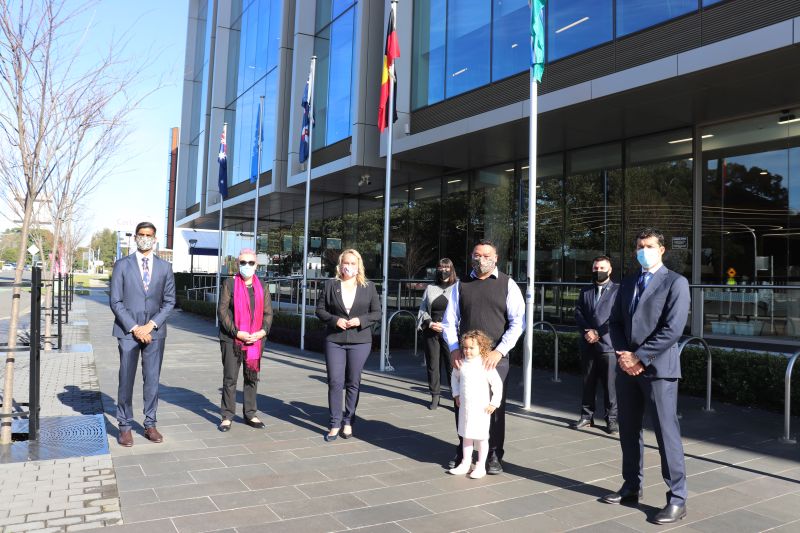
Inspirational Newcastle citizens raise flags at City Administration Centre

City of Newcastle’s 2021 Citizen of the Year Award recipients have led the inaugural flag-raising ceremony at 12 Stewart Avenue in recognition of their significant roles in our community.
The flagpoles were installed with specialist lighting as part of the fit-out of the City Administration Centre, allowing the flags to fly permanently day and night.
The flags were raised for the first time outside City of Newcastle's City Administration Centre today by (front L-R) 2019 Young Citizen of the Year Dr Bhavi Ravindran, Senior Citizen of the Year Jaci Lappin, Newcastle Lord Mayor Nuatali Nelmes, Citizen of the Year Professor Kelvin Kong and his four-year-old daughter Ellery, City of Newcastle CEO Jeremy Bath and (rear L-R) Community Group of the Year representatives Janice Musumeci and Evan Reid from Hamilton Business Association Inc.
It follows the raising of all six flags at Newcastle City Hall in May, including, for the first time, the Torres Strait Island flag, following the five year project to restore the façade of City Hall.
Lord Mayor Nuatali Nelmes and City of Newcastle CEO Jeremy Bath were joined by Citizen of the Year Professor Kelvin Kong and his four-year-old daughter Ellery, Senior Citizen of the Year Jaci Lappin, 2019 Young Citizen of the Year Dr Bhavi Ravindran, and Community Group of the Year representatives Janice Musumeci and Evan Reid from Hamilton Business Association Inc, in raising the Australian, Aboriginal, Torres Strait Island, United Nations, New South Wales and City of Newcastle flags for the first time at the City’s new headquarters.
Lord Mayor Nuatali Nelmes said it was a proud and historic moment to see all six flags flying at both of the City’s civic buildings.
“Newcastle’s City Hall was the first civic building in the country to fly the Aboriginal flag when the then Lord Mayor Joy Cummings raised the flag in 1977, and earlier this year the Torres Strait Islander flag was raised atop City Hall for the first time,” Cr Nelmes said.
“I am proud of our city’s legacy, and to be able to share this moment today with our Citizens of the Year, who are each creating their own legacies for Newcastle.”
The flag-raising ceremony completes the City Administration Centre’s move to Newcastle West to deliver a new era of services in one central location, including office space for 450 administrative staff and award-winning Community and Civic Hub, with the co-located Digital Library, Council Chamber and Customer Service Centre winning first place in their respective categories at the recent New South Wales Local Government Awards.
It also features a purpose-built Local Emergency Operations Centre, providing a dedicated space where City of Newcastle can work with emergency services including Police, SES, Fire and Rescue NSW, NSW Ambulance and others to deliver a coordinated response to natural disasters and other incidents.
Co-locating a range of facilities at the new City Administration Centre is resulting in more efficiencies and better customer service, as well as access to one of the most digitally advanced libraries in NSW.

Expanded Covid-Safe Check-In mandate takes effect

Customers and businesses are reminded that from today the use of the NSW Government’s COVID-Safe Check-In will be mandatory at most workplaces and retail businesses in the State.
Minister for Digital and Customer Service Victor Dominello said check-in information from these additional venues is critical to support the work of NSW Health contact tracing teams in the fight against the highly contagious Delta variant of COVID-19.
“This is a proportionate and critical step in bringing the pandemic under control and getting the community out of lockdown. We need to think of checking in as a reflex action when visiting venues,” Mr Dominello said.
“These measures will enable us to identify exposure sites with greater precision and speed and ensure contact tracers have instant access to reliable customer records to help keep the community safe.
“The Service NSW app is easy to use, safe and fast. It only takes seconds to scan the QR code and for businesses to check the green tick.”
The expanded check-in rules will also apply to staff and visitors such as maintenance workers, cleaners, and delivery drivers.
Hospitality businesses will also need to extend the use of the COVID-Safe Check-In to all customers including for takeaway orders.
Businesses that fail to comply with the new Public Health Order requirements may be subject to fines and in case of repeated breaches, temporary closure orders.
“While most businesses and customers do the right thing, anything less than gold standard is not good enough. We have a shared responsibility to keep the community safe,” Mr Dominello said.
“We will not tolerate businesses and customers who refuse to comply with the mandate. Inspectors have been asked to monitor the situation alongside the NSW Police.
“Customers are ready for this. There are more than 5.7 million active users of the Service NSW app, which is the overwhelming majority of the adult population.”
The information captured by the COVID-Safe Check-In can only be accessed by NSW Health for the purpose of contact tracing. It is deleted after 28 days.
More information regarding the expanded COVID-Safe Check In mandate including affected businesses and industries can be found on nsw.gov.au.
Businesses who need to register for the NSW Government QR code can find the application form and more information at https://www.nsw.gov.au/register-your-business-as-covid-safe
For those without a digital device, businesses must provide a tablet or other device to assist customers complete the online check in form.

Drivers reminded to slow down in school zones

Drivers are being reminded to slow down and take extra care with school zones back in force across New South Wales from today.
Minister for Transport and Roads Andrew Constance said while most students in Greater Sydney are learning from home this week, schools remain open for those who need to attend and school zones are still enforced from the first day of term.
“The 40 kilometre an hour school zones are now in force and we need everyone to be vigilant as schools will remain open for students and families who need it,” Mr Constance said.
“Drivers will need to slow down and stick to the reduced speed limit. It’s also important to remember when you see those flashing lights on the back of a bus, slow down and keep an eye out for children.”
Executive Director of the Centre for Road Safety Bernard Carlon said while school zones are one of the safest places on the road network, there have been two school zone crashes over the past two years, resulting in the deaths of two children.
“Students in regional NSW are back in the classroom this week and its important drivers remember the zones are in place at all schools across the state from this morning, even if there is a pupil free day,” Mr Carlon said.
“Every NSW school has at least one set of flashing lights to help keep children safe around schools but we still need everyone to pay extra attention when driving in these zones.”
Higher fines and demerit points also apply to certain driving and parking offences committed within school zones.
The Government is also investing $18.5 million to provide 300 new School Crossing Supervisors, 275 of which are already on the ground offering more protection for children and improved visibility of crossings for drivers.

Supply drop for schools as Term 3 begins

More than a thousand schools now have access to extra equipment to assist online learning for the start of Term 3.
Minister for Education Sarah Mitchell said a major operation has been undertaken so that thousands of devices and supplies are available for schools across the state.
“We have acquired an additional 12,000 devices and are currently distributing thousands of them to the schools that need them,” Ms Mitchell said.
“Last term, we surveyed schools to make sure they were still prepared for learning from home. This proactive approach allowed us to identify and rapidly plug any gaps in technology access, devices, and support in our schools.
“I’m confident in our schools’ ability to continue managing the pandemic, and in our teachers’ commitment to putting the education of their students first.”
The Department of Education has secured an additional 7000 laptops and 5000 dongles. This is in addition to the more than 13,000 devices and 8,000 dongles provided to support learning from home in 2020.
“We are working with vendors to secure even more equipment, should it be required,” Ms Mitchell said.
More hygiene and safety supplies are also being sent to schools across NSW so they can operate in a COVID-Safe way throughout the Term.
“All schools are receiving top-up supplies for Term 3, including packs of masks, hand sanitiser and surface wipes,” Ms Mitchell said.
“The health of students and staff during the pandemic has always been our priority, and parents should feel confident their child’s school is well equipped to keep them as safe as possible.”
Deliveries are underway and all schools will receive a starter pack by today.
In total, these include approximately:

  • Masks –  440,000
  • Hand sanitiser – 250,000 bottles
  • Wipes – 320,000 wipes
  • Gloves – 320,000 wipes
  • Hand Soap – 130,000 bottles

An additional 9.3 million masks will be sent to schools across the state by the end of next week.

Conscious decisions to breach Public Health Orders continue to put community at risk

Police have issued more than 100 Penalty Infringement Notices (PINs) for breaches of the Public Health Act in 24 hours, including 30 related to three separate gatherings.
About 3.30pm yesterday (Saturday 10 July 2021), officers from Inner West Police Area Command received information that a group had gathered at a premises on Marrickville Road, Marrickville.
Police attended and found 15 men sitting around a table playing cards in a smoke-filled room.
The men – aged between 56 and 89 – were all issued $1000 PINs for fail to comply with noticed direction 7/8/9 COVID-19 and directed to return home.
Just after 11pm, officers from Cumberland Police Area Command attended an underground carpark on Arthur Street, Merrylands West, following a noise complaint.
On arrival, police could hear music and voices coming from behind a closed garage door. When the occupants opened the door, it revealed five men in their 20s, playing PlayStation.
The men, who were from various suburbs across Sydney, were directed to return home immediately and will be issued with $1000 PINs.
In a third incident, Auburn Police attended a unit on Olympic Boulevarde at Sydney Olympic Park, about 12.30am today (Sunday 11 July 2021), after reports of a party.
Police located ten people, aged between 18 and 20, hiding throughout the unit and established they were celebrating an 18th birthday stating they were unaware of the current public health orders.
After advising partygoers they’d all receive $1000 PINs, police shut the party down and sent them home.
State Emergency Operations Controller, Deputy Commissioner Gary Worboys, said people are still making a conscious decision to not stay at home and not comply with the Public Health Orders.
“These examples highlight incredibly selfish and irresponsible behaviour, which we cannot and will not tolerate,” Deputy Commissioner Worboys said.
“We have said all along police will be firm but fair, but we are now in the position where we need to be more firm than fair.
“Police will continue to be visible right across the state and we simply ask people to work with us and do the right thing.”
In total, 106 PINs were issued yesterday, with 43 of those $200 infringements for failing to wear a fitted face covering.
A further 16 people were charged with failing to comply with Public Health Orders. All of those charges were associated with other criminal offences.
Anyone who has information regarding individuals or businesses in contravention of a COVID-19-related ministerial direction is urged to contact Crime Stoppers: https://nsw.crimestoppers.com.au. Information is treated in strict confidence. The public is reminded not to report crime via NSW Police social media pages.

Police urge community compliance with Public Health Orders as COVID case numbers increase

High-visibility police operations are continuing across NSW to ensure compliance with current restrictions under the Public Health Act.
State Emergency Operations Controller, Deputy Commissioner Gary Worboys, said the geography of the police operation would expand in line with the spread of cases across Sydney.
“By the accounts of police on the ground yesterday, there were high levels of compliance across Sydney’s south-west, which is promising for reducing the risk of contracting COVID in those areas,” Deputy Commissioner Worboys said.
“As we have seen an increase of cases in other areas, including Sutherland and Hurstville, we will be allocating resources to ensure compliance in those areas and surrounds.”
Further to the deployment across Sydney’s south-west, additional proactive operations were conducted across the Greater Sydney area.
Part of police operations in Sydney CBD includes conducting guest compliance checks at hotels and last night, six guests at a hotel on Kent Street were found to be in breach of the current public health orders. Checks revealed one woman – aged 26 – was wanted on an outstanding warrant and charged to appear in court today (Saturday 10 July 2021).
“Disappointingly, we did see some concerning incidents of people flouting the rules – including a gathering at a home at Randwick and a birthday party at The Entrance.
“This type of behaviour is nothing short of disrespectful – we’ve already seen how easily the virus spread following the unlawful party at Waterloo.”
About 1.20pm yesterday (Friday 9 July 2021), officers from Eastern Beaches Police Area Command attended a home on Arthur Street, Randwick, after being told of a potential gathering.
Police spoke with two men outside the property, one of whom said he was delivering a package, but did not have a package.
A total of eight men – aged between 31 and 50 – were located around the home, including one man hiding behind a shower curtain in the bathroom.
Inquiries revealed three men were residents, while the other five resided in Sydney’s south west. As all were breaching current Public Health Orders, all eight were issued $1000 Penalty Infringement Notices (PINs), with the five non-residents sent home.
About 9.40pm yesterday, officers from Tuggerah Lakes Police District responded to reports of a house party on Norberta Avenue, The Entrance.
On arrival, police spoke with six people – aged between 17 and 22 – who were drinking and celebrating an 18th birthday, which was in breach of the Public Health Orders.
The 17-year-old girl was issued a warning under the Young Offenders Act, while the other five people were issued $1000 PINs.
In total, 167 PINs were issued yesterday, with 76 of those $200 infringements for failing to wear a fitted face covering.
A further ten people were charged with failing to comply with Public Health Orders. All of those charges were associated with other criminal offences.
Anyone who has information regarding individuals or businesses in contravention of a COVID-19-related ministerial direction is urged to contact Crime Stoppers: https://nsw.crimestoppers.com.au. Information is treated in strict confidence. The public is reminded not to report crime via NSW Police social media pages.

Royal Commission Into Defence and Veteran Suicide

The establishment today of the Royal Commission into defence and veteran suicide is welcome news.
Veterans, their families and Labor have been calling for this since 2019.
Since the announcement of the Royal Commission on 19 April 2021, we have called for the Morrison Government to come up with broad and flexible Terms of Reference (ToR), and to ensure the voices of veterans and families are heard.
It is encouraging that the investigation will enquire into systemic issues related to defence and veteran suicides, including the possible contribution of pre-service, transition, separation and post-service issues.
It is concerning, however, that the Government wants to retain its flawed National Commissioner for Defence and Veteran Suicide Prevention alongside the Royal Commission while the National Commissioner legislation is stalled in the Senate.
Labor, along with many in the veteran community, has said we are open to a permanent body to implement the recommendations of the Royal Commission, but only if this is a recommendation.
Further, Labor had called for the Government to appoint Commissioners who are of the right standing and independent from the Australian Defence Force, such as a current or former senior judge, in order to ensure trust and confidence in this process.
We broadly welcome the appointment of former NSW Deputy Police Commissioner Nick Kaldas as lead commissioner and former Queensland Supreme Court Judge James Douglas QC and mental health expert Dr Peggy Brown AO as the other two commissioners.
It is disappointing, however, the Government has not consulted Labor on the ToR or the appointment of commissioners, and has failed to appoint any of the eminent individuals recommended by an expert advisory group convened by veteran advocate Julie-Ann Finney.
It is important that this Royal Commission now be a bipartisan issue.

Defence and Veterans Suicide

Today the Government has formally established a Royal Commission into Defence and Veteran Suicide following approval by the Governor-General.
Prime Minister Scott Morrison said the Royal Commission recognised the unique nature of military service, and the ongoing effects on the physical and mental health of members and veterans as a result of their service.
“We recognise the contribution and sacrifice of the men and women who have served our country,” the Prime Minister said.
“The death of any Australian Defence Force member or veteran is a tragedy that is deeply felt by all Australians. As a Government we are committed to addressing the ongoing impact of service, including preventing future deaths by suicide and providing opportunities for healing.”
The inquiry will be led by Mr Nick Kaldas APM, former Deputy Commissioner of the New South Wales Police Force, where he commanded around 14,000 staff members and a budget of more than $2 billion. Mr Kaldas also has extensive international experience in law enforcement and peacekeeping, including as Director of Internal Oversight Services for the United Nations Relief and Works Agency, and as Chief of Investigations for the United Nations Organisation for the Prohibition of Chemical Weapons in Syria.
Mr Kaldas will be supported by:

  • The Hon James Douglas QC, an esteemed former Judge of the Supreme Court of Queensland and respected member of the legal community, and
  • Dr Peggy Brown AO, a consultant psychiatrist and national leader in mental health policy with extensive experience in health and mental health service planning, governance and administration.
  • Lifeline Australia – 13 11 14
  • Suicide Call Back Service – 1300 659 467
  • Open Arms (current and ex-serving ADF personnel and their families are able to seek this free and confidential support) – 1800 011 046
  • ADF Mental Health All-hours Support Line (for current serving ADF personnel and their families) – 1800 628 036.
  • Safe Zone Support (for current and ex-serving ADF personnel and their families) – 1800 142 072. When you call Safe Zone Support, you do not need to identify yourself if you do not want to.

The Royal Commission will inquire into systemic issues and common themes related to defence and veteran death by suicide, including the possible contribution of pre-service, service, transition, separation and post-service issues, and other matters believed by the Royal Commission to be relevant to its inquiry.
The Royal Commission will be able to inquire into any previous death by suicide, including suspected suicide. It will be conducted independently of Government, including the Departments of Defence and Veterans’ Affairs.
In making recommendations on systemic issues, the Royal Commission will be informed by the individual experiences of defence members, veterans and their families and support networks.
The Royal Commission will conduct its inquiries in a trauma-informed way and private sessions will be available to those who wish to share their story in private.
A legal financial assistance scheme will be available to people called as witnesses to the Royal Commission. An independent legal advisory service, counselling and support services will also be made available to people engaging with the Royal Commission.
The Terms of Reference have been informed by feedback received during an extensive public consultation process and views from states and territories. Over 3,000 submissions were received during the consultation on the themes.
“I thank all those who provided feedback on the themes for the Terms of Reference. Each piece of feedback received during this process was integral in informing the final Terms of Reference,” the Attorney General, Michaelia Cash, said.
Minister for Veterans’ Affairs and Defence Personnel Andrew Gee welcomed today’s announcement and said he hoped the Royal Commission became a seminal moment in Australia’s care of veterans and their families.
“The Royal Commission is a crucially important piece of national work that I hope can be a catalyst for positive change in the treatment and care of veterans and their families, both now and for future generations,” Minister Gee said.
“Our country asks so much of the men and women of the ADF and we owe it to them and our veterans to make sure that this Royal Commission and its findings lead to lasting results.”
The National Commissioner for Defence and Veteran Suicide Prevention Bill, currently before the Parliament, will be amended to ensure that the National Commissioner will complement, and not duplicate, the Royal Commission’s important work. The National Commissioner will be the permanent body responsible for implementing the Royal Commission’s recommendations. These landmark measures will together reduce deaths by suicide of defence members and veterans.
The proposed amendments will provide for the commencement of the National Commissioner’s functions and powers following the conclusion of the Royal Commission, or at an earlier point in time if recommended by the Royal Commission.
The Royal Commission is due to provide an interim report on 11 August 2022 and a final report on 15 June 2023.
Further information on the Royal Commission, including the Terms of Reference and information on how to make a submission will be available at https://defenceveteransuicide.royalcommission.gov.au
The Australian Government is committed to supporting the health and well-being of those who have served our nation in the defence forces. $11.7 billion in federal funding supports more than 325,000 veterans and their families each year.
If you, or someone you know, need support, you can contact:

Two City iconic venues set for a refresh

The final touches are being applied to two of the City’s most iconic coastline venues at Shepherds Hill Cottage and the Dixon Park Beach kiosk on Bathers Way, before the search starts for operators to bring the spectacular spaces to life.
City of Newcastle Lord Mayor Nuatali Nelmes said the upgrade and subsequent openings of these two venues under new operators will give locals and visitors a new opportunity to appreciate the coastal environment.
“The view from both these facilities is incredible, and it’s exciting for these sites to be opened up and enjoyed by the community,” Cr Nelmes said.
“I encourage potential operators to express their interest when applications open, it’s a fantastic opportunity to bring these venues back to life and attract visitors.”
“Both venues are situated on the Bathers Way. The 6km pathway stretches from Merewether Ocean Baths to Nobbys Beach, and enjoys thousands of walkers each week.”
Conservation works to the State listed historical Shepherds Hill Cottage in King Edward Park are nearing their final stage, following the recent removal of a former radio communications tower located on the site, enabling the final steps of the building’s transformation to commence.
Reconstruction of the historic external toilets and construction of a new separate outdoor storeroom, construction of a new accessible parking area and new driveway access from The Terrace, and finalisation of landscaping is anticipated to be completed in the coming months.
Following the completion of the works City of Newcastle will run an Expression of Interest to identify a preferred operator that best delivers the objectives and permitted uses authorised in the Plan of Management. These objectives and uses also reflect the endorsed Conservation Management Plan for this important heritage site.
A similar Expression of Interest will be called in late July for an operator for the long dormant kiosk at Dixon Park Beach following construction of the upgrades which commenced in April, after earlier provision of power, water and sewage infrastructure in 2020.
Upgrades include the addition of public seating, shelters and landscaping, as well as the relocation of a portion of the building’s faded mural. Work on the Mark Richards mural, which City of Newcastle committed to restoring in a new location on the kiosk, commenced this week.