
Australia to pursue nuclear-powered submarines through new trilateral enhanced security partnership

Australia, the United Kingdom and the United States have agreed to the creation of an enhanced trilateral security partnership – AUKUS.
The security challenges in the Indo-Pacific region have grown significantly. Military modernisation is occurring at an unprecedented rate and capabilities are rapidly advancing and their reach expanding. The technological edge enjoyed by Australia and our partners is narrowing.
AUKUS will build on the three nations’ longstanding and ongoing bilateral ties, and will enable the partners to significantly deepen cooperation on a range of emerging security and defence capabilities, which will enhance joint capability and interoperability. Initial efforts under AUKUS will focus on cyber capabilities, artificial intelligence, quantum technologies, and additional undersea capabilities.
This is an historic opportunity for the three nations, with like-minded allies and partners, to protect shared values and promote security and prosperity in the Indo-Pacific region.
AUKUS will complement Australia’s network of strategic partnerships, including with our ASEAN friends, our Pacific family, our Five Eyes partners, the Quad and other like-minded partners.
First initiative under AUKUS
The first initiative under AUKUS is for Australia to acquire nuclear-powered submarine technology, leveraging decades of experience from the US and UK.
Under AUKUS, the three nations will focus immediately on identifying the optimal pathway to deliver at least eight nuclear-powered submarines for Australia.
Over the next 18 months, Australia, the UK and US will intensely examine the full suite of requirements that underpin nuclear stewardship and demonstrate a clear pathway to becoming a responsible and reliable steward of this sensitive technology. Australia will establish a Nuclear-Powered Submarine Taskforce in the Department of Defence to lead this work.
Nuclear-powered submarines do not have the same limitations that face conventional submarines on weapons storage, speed and endurance. They can stay completely submerged for many months, limiting the opportunities for detection by adversaries.
As a three-ocean nation, it is necessary for Australia to have access to the most capable submarine technology available. As a nation, we are ready to take the step to pursue the most advanced submarine technology available to defend Australia and its national interests.
Australia has no plans to acquire nuclear weapons and this proposal will remain consistent with Australia’s longstanding commitment to nuclear non-proliferation. All three nations are deeply committed to upholding leadership on global non-proliferation.
The Government’s intention is to build the nuclear-powered submarines in South Australia, maximising the use of Australian workers.
Building the submarines in Australia is the best way to develop a strong and effective sustainment industry, which will enable us to meet every requirement to safely operate and maintain nuclear-powered submarines.
Attack class submarine program
The pursuit of nuclear-powered submarine technology means that Australia will no longer proceed with the Attack class conventional submarine program with Naval Group.
The Government would like to thank the Attack class submarine workforce, Naval Group, the Government of France and Lockheed Martin Australia for their efforts to date. However, accelerating changes to regional security make conventional submarines unsuited to our operational needs in the decades ahead.
The Government will actively work with industry to ensure the people and skills developed under the existing program are not lost to the Government’s Naval Shipbuilding Enterprise as we establish a new program to support the delivery of nuclear-powered submarines to the Navy.
The existing submarine workforce are prime candidates for the unprecedented work that needs to be performed across the Enterprise over the coming decades, where we will rely on their expertise more than ever.
The Government will partner with our Australian-owned sovereign shipbuilder, ASC, to manage and implement a new Sovereign Shipbuilding Talent Pool.
The Government is committed to finding a role within the Sovereign Shipbuilding Talent Pool for each and every skilled shipbuilding worker impacted by this announcement.
The Sovereign Shipbuilding Talent Pool will re-deploy the existing shipbuilding workforce throughout current and new shipbuilding programs, while building the nuclear-powered submarine skills that will be crucial for the success of the nuclear-powered submarine program.
This decision was not taken lightly. Our partnership with the Government of France and Naval Group on the Attack class conventional submarine program would have resulted in the most capable and lethal conventional submarine ever built.
As likeminded liberal democracies, Australia and France share a common commitment to the rules-based global order that has delivered stability and prosperity to the Indo-Pacific.
We look forward to continuing to work closely and positively with our French counterparts. France is a key friend and partner to Australia and the Indo-Pacific.
Other capabilities
The Government will also acquire additional long-range strike capabilities for the Australian Defence Force.
Throughout the decade, Australia will rapidly acquire long-range strike capabilities to enhance the ADF’s ability to deliver strike effects across our air, land and maritime domains.
These include:

  • Tomahawk Cruise Missiles, to be fielded on our Hobart class destroyers, enabling our maritime assets to strike land targets at greater distances, with better precision.
  • Joint Air-to-Surface Standoff Missiles (Extended Range) will enable our F/A-18 A/B Hornets and in future, our F-35A Lightning II, to hit targets at a range of 900km.
  • Long-Range Anti-Ship Missiles (Extended Range) (LRASM) for the F/A-18F Super Hornet.
  • Continuing collaboration with the United States to develop hypersonic missiles for our air capabilities.
  • Precision strike guided missiles for our land forces, which are capable of destroying, neutralising and supressing diverse targets from over 400km.
  • Accelerating $1 billion for a sovereign guided weapons manufacturing enterprise – which will enable us to create our own weapons on Australian soil.

These capabilities, coupled with the planned Life-of-Type Extension of Australia’s Collins class submarine fleet, will enhance Australia’s ability to deter and respond to potential security challenges.
The management of this transition, and other capability acquisition options that will meet Australia’s strategic requirements, will be at the forefront of consultations through AUKUS over the next 18 months.
Joint Leaders Statement on AUKUS

The Hon. Scott Morrison MP
Prime Minister of Australia
The Rt. Hon. Boris Johnson MP
Prime Minister of the United Kingdom
Joseph R. Biden, Jr.
President of the United States of America
JOINT MEDIA STATEMENT
As leaders of Australia, the United Kingdom, and the United States, guided by our enduring ideals and shared commitment to the international rules-based order, we resolve to deepen diplomatic, security, and defense cooperation in the Indo-Pacific region, including by working with partners, to meet the challenges of the twenty-first century. As part of this effort, we are announcing the creation of an enhanced trilateral security partnership called “AUKUS” — Australia, the United Kingdom, and the United States.
Through AUKUS, our governments will strengthen the ability of each to support our security and defense interests, building on our longstanding and ongoing bilateral ties. We will promote deeper information and technology sharing. We will foster deeper integration of security and defense-related science, technology, industrial bases, and supply chains. And in particular, we will significantly deepen cooperation on a range of security and defense capabilities.
As the first initiative under AUKUS, recognizing our common tradition as maritime democracies, we commit to a shared ambition to support Australia in acquiring nuclear-powered submarines for the Royal Australian Navy. Today, we embark on a trilateral effort of 18 months to seek an optimal pathway to deliver this capability. We will leverage expertise from the United States and the United Kingdom, building on the two countries’ submarine programs to bring an Australian capability into service at the earliest achievable date.
The development of Australia’s nuclear-powered submarines would be a joint endeavour between the three nations, with a focus on interoperability, commonality, and mutual benefit. Australia is committed to adhering to the highest standards for safeguards, transparency, verification, and accountancy measures to ensure the non-proliferation, safety, and security of nuclear material and technology. Australia remains committed to fulfilling all of its obligations as a non-nuclear weapons state, including with the International Atomic Energy Agency. Our three nations are deeply committed to upholding our leadership on global non-proliferation.
Recognizing our deep defense ties, built over decades, today we also embark on further trilateral collaboration under AUKUS to enhance our joint capabilities and interoperability. These initial efforts will focus on cyber capabilities, artificial intelligence, quantum technologies, and additional undersea capabilities.
The endeavour we launch today will help sustain peace and stability in the Indo-Pacific region. For more than 70 years, Australia, the United Kingdom, and the United States, have worked together, along with other important allies and partners, to protect our shared values and promote security and prosperity. Today, with the formation of AUKUS, we recommit ourselves to this vision.

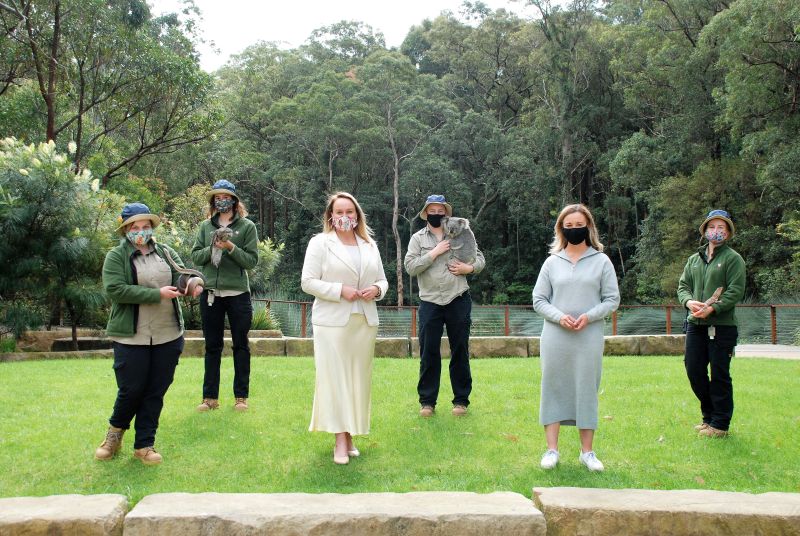
Work continuing behind the scenes at Blackbutt Reserve

As one of Newcastle’s most popular open green spaces, Blackbutt Reserve has remained a haven for locals looking for COVID safe exercise options during lockdown.
But the walking trails haven’t been the only site of activity across the popular reserve, with ongoing essential work required to look after its animals and maintain its 182 hectares of bushland.
Lord Mayor Nuatali Nelmes and Cr Peta Winney-Baartz with Blackbutt staff members (L-R) Beth Woodhouse with Romeo the snake, Abbey Johnston with Carla the tawny frogmouth, Jemma Gosper with Kirra the koala and Abbie Ferris with Frida the frilled-neck lizard.
Newcastle Lord Mayor Nuatali Nelmes said Blackbutt’s staff have continued to feed and care for the animals in the wildlife exhibits throughout lockdown, while City of Newcastle crews were also forging ahead with almost $200,000 worth of improvement projects to enhance the facility’s natural environment and visitor experience.
“As one of Newcastle’s most popular tourist attractions, Blackbutt Reserve is a jewel in the city’s crown, much-loved by locals and visitors alike,” Cr Nelmes said.
“But looking after the environment and its inhabitants is no small task. Our rangers are responsible for two koalas, eight emus, 10 kangaroos, 19 wallabies, a dozen species of reptile, two species of frog, ‘Wally’ the wallaroo, ‘Sally’ and “Clyde” the wombats, and over 40 species of bird.
“It’s a lot of mouths to feed every day and looking after all of them takes time and care. Our rangers work hard and should be commended because they do a wonderful job.”
Councillor Peta Winney-Baartz said City of Newcastle staff had been busy during lockdown maintaining the site and undertaking a range of improvement projects.
“Throughout the COVID-19 lockdown, City of Newcastle staff have continued to undertake regular maintenance across the reserve to ensure it’s in top shape when it reopens to visitors,” Cr Winney-Baartz said.
“They have also been using this time to deliver some significant projects, which will enhance the natural environment and visitor experience at Blackbutt now and into the future.”
Crews have begun installing two new irrigation systems at Richley Reserve and modernising the existing system, which will significantly improve water efficiency and the user experience of this area.
In the coming months, work will start on improving sections of the boardwalk that flow through the wildlife animal exhibits. The boardwalk project also incorporates replacement of supports at the koala enclosure, which delivers a truly unique visitor experience.
Improvements to the carparks at Carnley Avenue and Richley Reserve have been completed, including line marking, installation of wheel stops and new signage.
The gates at Blackbutt Reserve will be open from tomorrow for groups of up to five fully vaccinated people to participate in outdoor recreation like picnics, in line with NSW Government advice. Blackbutt’s animal enclosures will remain closed until restrictions ease further.
To find out more about Blackbutt reserve, visit www.newcastle.nsw.gov.au/blackbutt-reserve

$484 Million win for schools and boost for business

More than 250 schools across NSW will receive upgrades, including improvements to playgrounds, science facilities and canteens, providing hundreds of jobs for local businesses.
The $484 million Minor Capital Works program will upgrade and renew school facilities and security, as well as improve accessibility for students with additional needs.
Deputy Premier and Minister for Regional NSW John Barilaro said more than half the schools to benefit are in regional and rural NSW.
“This government is investing record amounts into our schools to ensure that every child, no matter where they live, has access to excellent schools and education facilities,” Mr Barilaro said.
“This investment will also provide a welcome boost for regional economies, by creating jobs and providing work for local tradespeople at a time when it is needed most.”
Minister for Education Sarah Mitchell said the program will be a boost for businesses as NSW exits lockdown, with $76 million going directly to local businesses.
“The NSW Government is investing record amounts into our schools, and as we begin our journey back to normal life schools will be central to our recovery. I’m thrilled this investment is a boost for both students and businesses,” Ms Mitchell said.
“These school improvement projects can have an incredible impact on the look and feel of our schools and through this government’s investment in programs such as this as well as Cooler Classrooms, LED Lighting Upgrade, Regional and Metro Renewal and Roof Replacement, schools right across NSW are experiencing the benefits.”
The Department of Education has more than 2,200 NSW public schools and delivery of these projects ensures that schools across the state have access to modern facilities to support learning outcomes.
Projects funded as part of the Minor Capital Works Program include an admin and staff upgrade at Dee Why Public School, a toilet upgrade at Millfield Public School, a science lab upgrade at Deniliquin High School and an integration project of access works at Heathcote High School.
The NSW Government is investing $7.9 billion over the next four years, continuing its program to deliver 215 new and upgraded schools to support communities across NSW. This is the largest investment in public education infrastructure in the history of NSW.

Quality Time for Teaching

A new plan aimed at changing the way teachers work at school, giving them more quality time to spend preparing and teaching students, was released today.
Teachers and school staff are being called on to provide feedback on the NSW Government’s Quality Time Action Plan which sets an ambitious agenda for reducing duplicative, repetitive, and low-value administrative tasks in schools.
Minister for Education Sarah Mitchell said leveraging technology and digital tools to streamline teaching tasks is at the centre of the plan.
“We know that quality teachers have the biggest impact on student outcomes – by streamlining and simplifying the work done outside of the classroom we can enhance the experience and outcomes within the classroom,” Ms Mitchell said.
“The department needs to always support teachers to do their best work. This plan is about asking teachers to help shape the solutions they need from the system.
“While lesson planning, marking and reporting are core parts of the job, we can make these processes smarter, more intuitive and high-value rather than cumbersome, repetitive and wasteful.
“Not only will this give teachers back valuable time to focus on learning, it will enable us to scale best practice resources and teaching approaches in classrooms across NSW.”
Opportunities for reform identified in the Action Plan include an overhauled assessment system allowing teachers to generate individual student focused assessments in minutes; an online tool to allow teachers to easily store, find, share and tailor lesson plans and learning programs; and streamlined administration requirements for maintaining accreditation.
“The Action Plan represents the next phase of the work to create more time for teachers, which is a core component of the School Success Model. To date, this work has saved an estimated 105 hours per principal, 10 hours per teacher and 25 hours per school administration staff member each year,” said Ms Mitchell.
The Action Plan has been released for consultation and feedback from school staff and stakeholders, enabling schools to have direct input into the reform agenda.

Innovation at heart of NSW water strategy

The Berejiklian Government has today launched the NSW Water Strategy, a 20-year blueprint to deliver resilient and sustainable water resources to communities across the state ensuring NSW is leading the charge when it comes to innovation.
The strategy coincides with the launch of the Water Project Map, a new tool for people to access information about all water infrastructure projects across NSW.
Minister for Water, Property and Housing Melinda Pavey said the Strategy is NSW’s first-ever platform for the long-term management of water, which will guide future water planning and policy, and how, where and when water infrastructure investments are made.
“This strategy, underpinned by cutting-edge climate modelling, will help our state work towards becoming a world leader in water innovation and efficiency,” Mrs Pavey said.
“In the next 12 months we’ll refocus our efforts on water conservation and leakage reduction in our cities, towns and regional centers, and deliver a state-wide water efficiency framework.
“We’ll also look for opportunities to invest in research and development, and new technologies, including recycled water opportunities for industrial and agricultural uses.”
The Government will investigate and invest in supply options including stormwater harvesting and water re-use, and look at developing a consistent approach to water restrictions.
“We’re exploring a range of options, including boosting water recycling across communities for watering crops and gardens, fighting fires, flushing toilets and reducing pollution in our waterways,” Mrs Pavey said.
Already, about 70 percent of local water utilities recycle water. Treated stormwater is being used to provide up to 25 per cent of Orange’s supply.”
These initiatives and projects are key opportunities laid out in the NSW Water Strategy, as Government prepares for future challenges – including more demand for water and a more variable climate – and sets the strategic direction for the state’s water sector over the long term.
“People living in NSW make up more than a third of Australia’s population, and over the next 20 years, our state will grow by 2.8 million. We need the right infrastructure in place to enable this growth, knowing the challenges we face with a changing climate,” Mrs Pavey said.
“The recent drought was one of the worst and most extreme on record, and it hit our communities hard. Our water supplies were stretched to their limits..
“But the drought also brought about creative and innovative ideas about infrastructure investment, with many communities having to source different means of increasing their supply.
“While many of our dams are now full or starting to spill, we know drought will come again, so now is the time to make decisions to ensure our communities, industries and environment thrive, now and into the future.”
The NSW Water Strategy sets the overarching vision for 12 regional and two metropolitan water strategies also being developed, tailored to the individual needs of each region in the state.
In addition, the new online map shows where the record investment for critical water infrastructure projects are, details of the projects and how they are helping communities.
For more information and to read the NSW Water Strategy, visit here. To view the online map visit here.

ABS data shows house prices are out of control

Australian Greens Housing spokesperson Senator Mehreen Faruqi has expressed alarm at the figures released today from the Australian Bureau of Statistics from their Residential Property Price Index. The release shows that there was an overall 6.7% rise in house prices for the June 2021 quarter with Sydney and Canberra experiencing an unprecedented rise of over 8%.
Senator Faruqi said:
“These aren’t just statistics, they represent the real experiences of families being priced out of owning their first home. If we don’t do something about this broken system soon, there will be no houses for anyone but the very rich”.
“The enormous rise in house prices is not just alarming, it is a reflection of just how dire the current state of housing is across the whole of Australia.
“The Liberal-Nationals and Labor parties continue to exacerbate the current situation through their refusal to change policies that favor investors and encourage market speculation in housing.
“House prices rose an alarming 8.1% just in the last quarter in Sydney, which means generations will be locked out of secure housing, all because both major parties have decided to favour investors who gamble on house prices.
“Every single capital city is experiencing the largest rise in house prices since 2015. This upward trend is not going to stop without serious action.
“The Greens are consistently the only strong voice calling for a fair housing system.
“We must end unfair tax breaks like negative gearing and capital gains tax discounts. The federal government has to take responsibility for making sure everyone has a secure and safe home and this means investing to build one million affordable public and community homes.”

Secret Porter donor makes a mockery of donations laws

The Greens say Christian Porter’s refusal to reveal who partially funded his defamation case against the ABC is the latest chapter in a sorry saga of blame-shifting and responsibility-dodging by the Morrison Government.
Greens deputy leader and spokesperson on women Senator Larissa Waters said:
“This is a farce. Christian Porter’s so-called ‘disclosure’ of who paid his legal fees makes a mockery of the register of interests and donations disclosure laws, and is just another instalment in a sorry chapter for parliamentary standards.
“Let’s be really clear about what’s happened here: An unknown person gave an undisclosed sum of money to a Cabinet Minister, which he used to fund a defamation case designed to silence the reporting of rape allegations made against him.
“How much was given? Who’s it from? What kind of influence does this person have over Christian Porter? If anonymous donations of unknown amounts are permitted purely because they are made via a blind trust, what is the point of donations disclosure laws at all?
“The PM has totally bungled his handling of the allegations against Christian Porter from day one. His willingness to keep an alleged rapist in his Cabinet without any attempt to determine the truth of the allegations reeks of male privilege and fundamentally misjudges the public mood.
“Morrison must instruct his Minister to reveal the amount and source of these funds and ensure the transparency that the Australian people demand.
“And he should support the Greens’ call for an independent inquiry to determine whether Christian Porter is a fit and proper person to hold a Ministerial position.”

Parliament must vote to deploy ADF troops overseas

New polling released today shows 87% of Australians are supportive of The Greens’ calls to change how Australia goes to war.

The poll of 1500 people, commissioned by Mike Smith, a journalist, former Howard Government adviser, and supporter of Australians For War Powers Reform, found that support for war powers reform has jumped 4% in less than a year.

Greens Senator Jordon Steele-John, Peace Spokesperson said:

“Right now the Prime Minister and Cabinet can unilaterally decide to follow the United States into conflicts like Afghanistan and Iraq with disastrous outcomes. Our community is overwhelmingly supportive of our Greens bill that would change the law so that a vote of both houses of parliament is needed to deploy the Australian Defence Force overseas.

“So many in our community have watched the humanitarian disaster unfolding in Afghanistan with deep sadness. At the end of the 20-year war in Afghanistan, we must immediately begin to assess and evaluate how it came to this. The proposed reform will ensure that a peace-focused approach is brought to our defence force and that members of parliament will be held to account for the consequences of sending Australians to war.

“We must never again participate in a colonial war of aggression. Our goal must always be peace.”

Additional Information:

  • • Senator Steele-John’s War Powers Reform Bill is currently being reviewed by a committee, with submissions welcome from the public. More information. 
  • • Today’s national poll results can be found here: www.mikesmithcanberra.com
  • • The 2020 Roy Morgan national poll can be found here

Bandt announces new parliamentary line-up to kick the Libs out and negotiate shared power

With the confirmation of new Senator for Western Australia Dorinda Cox today, Greens Leader, Adam Bandt, has put the Greens on election footing with a reshuffle of the Greens’ ‘shadow Ministerial’ portfolios that prioritises the party’s key campaign areas and sets the party up for ‘balance of power’ negotiations in the likely event of a minority Parliament.

Mr Bandt says the new line-up will give the Greens the best chance of kicking the government out and getting the Greens into balance of power, as well as shifting public attention to the Greens’ election priority areas of levying ‘tycoon taxes’ on billionaires and big corporations to get dental and mental health into Medicare and build more affordable housing while phasing out coal and gas.

The Greens will also campaign heavily to younger people, focusing on climate, mental health and affordable housing.

A full list of portfolios is attached below.

“This is the most important election in a generation. It will decide whether we can turn the climate crisis around, make billionaire corporations pay their fair share of tax and fix the housing market, or whether the Liberals will get away with robbing millions of people of their future,” Mr Bandt said.

“The next election will be much closer than people think. We are only a few hundred votes away from kicking Scott Morrison out and putting the Greens in balance of power, where our new Greens line-up will push the next government to go further and faster on climate action, stop skyrocketing economic inequality and tax the billionaires and big corporations.

“The new Greens line-up will focus on phasing out coal and gas, making billionaire corporations pay their fair share of tax, getting dental and mental health into Medicare and building more affordable housing.

“I’m proud to be part of a team that reflects the community we’re fighting for. The future of our country should not be just dictated by yet more old, white men. It’s vital that our political representatives reflect the incredible makeup of our country.

“The public sector has helped get us through the pandemic, and growing publicly-owned renewable energy will be a part of Larissa Waters’ push to kick Pauline Hanson out of the Senate in Queensland and elect Penny Allman-Payne.

“Scott Morrison has completely failed young people, leaving them locked down, locked into low wages, and locked out of housing. As the youngest person in Parliament, Senator Jordon Steele-John will take on both the Health and Youth portfolios as part of the Greens’ fight to get mental health and dental health fully into Medicare, whilst also ensuring that at-risk communities are not left exposed by the government’s flawed vaccination strategy.

“I’m looking forward to seeing Senator Dorinda Cox tear into West Australia’s mining billionaires, making them pay their fair share of tax and think twice about destroying First Nations culture for profit. Dorinda will join Lidia Thorpe in continuing to put justice for First Nations people and Treaty at the heart of our work in the coming months.

“With the Community Services portfolio, Senator Janet Rice understands best how 227 days of lockdown have pushed many Victorians to breaking point. She’ll be a fierce advocate to make sure there is no poverty in a rich country, building on Senator Rachel Siewert’s incredible legacy.

“The urgency of rebuilding Australia’s car manufacturing sector has only grown, and Senator Sarah Hanson-Young will drive the Greens’ push to make electric vehicles in South Australia, capitalising on the state’s rich renewable energy opportunities and providing sorely needed jobs. Electrifying our transport options will be essential in the fight to reduce climate pollution and stopping dangerous global warming.

“In the crucial state of NSW, where the fight will be between the Greens and One Nation in the Senate, Mehreen Faruqi will lead the campaign to build 1 million new homes for people locked out of housing.

“Nick McKim will continue to lead the charge on getting billionaires and big corporations  to pay their fair share of tax, and Senator Whish-Wilson will continue to lead the fight to protect Tasmania’s forests, rivers and oceans.

“This team builds on the expertise the Greens have brought to Parliament over my time as Leader. The Australian Greens parliamentary team is set to be bigger than we’ve ever been after the next election, and this is the team to get us there.”

MP PORTFOLIOS
Australian Greens Leader
Adam Bandt
Member for Melbourne
• Climate Emergency
• Energy
• Employment & Workplace Relations 
Co-Deputy Leader &
Australian Greens Leader in the Senate
Larissa Waters
Senator for Queensland
• Women
• Democracy (covers Local Government)
• Lead on Climate Emergency & Energy (Senate)
• Public Sector
Co-Deputy Leader, Party Whip &
Australian Greens Deputy Leader in the Senate
Nick McKim
Senator for Tasmania
• Treasury, Finance & Economic Justice
• Immigration & Citizenship 
• Digital Rights, I.T. & NBN
Sarah Hanson-Young
Senator for South Australia
• ArtsMedia & Communications
• Environment & Water
• Tourism
• Gambling
• Transport & Infrastructure
Peter Whish-Wilson
Senator for Tasmania
• Agriculture & Rural Affairs 
• Healthy Oceans
• Waste & Recycling
• Consumer Affairs
• Small Business
Party Room Chair
Janet Rice
Senator for Victoria
• Foreign Affairs
• Multiculturalism
• Forests
• LGBTIQ
• Family, Ageing & Community Services
Jordon Steele-John
Senator for Western Australia
• Disability Rights & Services
• Youth
• Peace & Disarmament (covers Defence)
• Nuclear
• Veterans’ Affairs
• Health (including Dental & Mental Health)
Temporary Senate Chair
Mehreen Faruqi
Senator for New South Wales
• Housing
• Education
• Animal Welfare
• Industry
• International Aid & Development
• Anti-Racism
• Lead on Employment & Workplace Relations (Senate)
Lidia Thorpe
Senator for Victoria
• First Nations
• Justice
• Sport
Dorinda Cox
Senator for Western Australia
• Mining & Resources
• Trade
• Science, Research & Innovation