
Parramatta, Sydney’s CBD of the West, is filling up with thousands of workers with the opening of a new, high rise work tower – part of the NSW Government’s commitment to expand its workforce west, reduce office costs and boost the economy.
NSW Premier Dominic Perrottet said the new 6 & 8 Parramatta Square building is easily accessible, with efficient transport options including trains and light rail, metro, buses, ferries and the WestConnex.
“Signature skyscrapers like these show our state has a bright future and the CBD doesn’t stop at Glebe,” Mr Perrottet said.
“Parramatta Square is a major contributor to our economic engine room and these premium office buildings will host an exceptional workforce in the beating heart of Western Sydney.
“Tomorrow, I will be attending the Bradfield Oration where big ideas for the future of NSW are discussed. It’s projects like Parramatta Square that inspire us to take our state from good to great.”
Minister for Water, Property and Housing Melinda Pavey said Walker Corporation’s 6 Parramatta Square adjoins tower 8, which has reached structural completion at 225 meters tall to become the tallest building in Sydney’s West and ready for tenants in 2022.
“Building these towers has created 4,000 construction worker jobs, giving Sydney’s west a much needed economic boost and this will continue as public and private sector employees settle into their new office digs and spend locally,” Mrs Pavey said.
“Despite the impacts of COVID-19, this workforce has risen to the challenges of this pandemic, safely continuing work on site and completing level after level, all the way to the top, to where we stand here today, some 55 floors later.”
Using technology designed to withstand earthquakes, an incredible skybridge now connects 4 and 6 Parramatta Square to form the NSW Government Campus Hub – the largest public sector office workplace hub in Australia, accommodating around 9,500 workers.
Parramatta Square is one of Australia’s largest commercial business precincts integrating commercial office space with convenient retail and will eventually cater for over 30,000 workers and students, as well as many more visitors.
“Parramatta truly is the beating heart of Western Sydney, and these towers are a symbol of this great region’s resilience and strength,” Mrs Pavey said.
Some of Australia’s most highly regarded blue chip companies have signed long-term leases alongside the NSW Government towers, at 4 & 6 Parramatta Square.
Walker Corporation Executive Chairman Lang Walker AO said the tower will be a beacon of success to the people of Western Sydney.
“It’s not only the tallest in Western Sydney, it’s the biggest too, with the largest Gross Floor Area of any commercial office building in Australia.”
NSW Government staff from the Department of Communities and Justice and the Greater Sydney Commission have started the move into 6 Parramatta Square. Already, tower 4 is the office for the Department of Planning, Industry and Environment and Department of Customer Service.
Author: admin
Disaster assistance extended following severe weather and flooding in NSW
Disaster assistance is now available in 18 additional local government areas in regional NSW following severe storms and flooding from Tuesday 9 November 2021.
The additional LGAs are Bourke, Coonamble, Dubbo, Glen Innes Severn, Kyogle, Lithgow, Liverpool Plains, Lockhart, Muswellbrook, Narromine, Orange, Parkes, Singleton, Snowy Monaro, Snowy Valleys, Tamworth, Walgett and Warren.
These areas are in addition to the 20 Local Government Areas that are already receiving assistance as a result of the Australian and New South Wales Governments.
Assistance is being provided through the jointly funded Commonwealth-State Disaster Recovery Funding Arrangements (DRFA).
Minister for Emergency Management and National Recovery and Resilience, Senator the Hon Bridget McKenzie said the ongoing severe weather has caused significant widespread damage across regional NSW.
“Continued heavy rain and flooding has resulted in damage to major roads and residential properties, with the impacts unlikely to become clear until flood waters start to recede.”
“We continue to stand shoulder to shoulder with these communities to assist in repairing the damage caused by these events,” Minister McKenzie said.
“Again, I urge people to check local emergency advice and alerts, and never, ever drive through flood waters,” Minister McKenzie said.
New South Wales Minister for Police and Emergency Services the Hon David Elliott said further flooding in the Upper Hunter region over the weekend had led to several evacuations and flood rescues.
“The assistance being announced today will help ensure councils and individuals impacted by this event have the support they need to get back on their feet.”
Assistance available under the DRFA may include:
- Help for eligible people whose homes or belongings have been damaged (eligibility criteria apply)
- Support for affected local councils to help with the costs of cleaning up and restoring damaged essential public assets
- Concessional interest rate loans for small businesses, primary producers and non-profit organisations
- Freight subsidies for primary producers, and
- Grants to eligible non-profit organisations.
For information on personal hardship and distress assistance, contact Service NSW on 13 77 88 or online at www.service.nsw.gov.au
To apply for a concessional loan or grant, contact the NSW Rural Assistance Authority on 1800 678 593 or visit www.raa.nsw.gov.au
Information on disaster assistance can be found on the Australian Government’s Disaster Assist website at www.disasterassist.gov.au
NSW families win in December double
Parents are being urged to take advantage of the state’s popular Active Kids program, with tens of millions of dollars worth of vouchers still to be redeemed this year due to the COVID lockdown.
And in a December double, Premier Dominic Perrottet also encouraged NSW families to dive into the new First Lap learn to swim program, which starts today.
“Now that sport is back up and running, we’re keen to remind parents to use these excellent NSW Government cost-saving measures so kids can get back to playing sport and learning to swim without breaking the family budget,” Mr Perrottet said.
“With COVID restrictions stopping sport for several months, around 430,000 children are yet to use their Active Kids vouchers this year, meaning there is around $86 million worth of vouchers still up for grabs.”
Every school-enrolled child in NSW is eligible for two $100 Active Kids vouchers per year towards the cost of sport and active recreation fees.
Minister for Digital and Customer Service Victor Dominello said the $100 First Lap learn to swim voucher and Active Kids program are among dozens of NSW Government savings to help to ease cost of living pressures for households.
“Every cent counts when it comes to balancing the family budget and claiming the First Lap voucher is now at your fingertips and available via the Service NSW app,” Mr Dominello said.
Minster for Sport Natalie Ward said the First Lap program, which provides an annual $100 voucher per child, has been expanded to include not just pre-school children but also those in kindergarten in 2021 and 2022.
“With summer officially starting today, there’s no better time to dive into the First Lap program and make sure your child learns vital safety skills,” Mrs Ward said.
For more details or to download a voucher, visit the Service NSW website.
Massive rise in racism concerns must impel action
Australian Greens Anti-racism spokesperson Senator Mehreen Faruqi has said the findings of the latest Mapping Social Cohesion report, which highlight a substantial increase in Australians’ concerns about racism, should drive government action. 60% of people now say racism is a big problem, up from 40% just last year.
Senator Faruqi said:
“People are more and more worried about rising racism in the community.
“Increasing community awareness has aligned with the continued growth of far-right, racist movements. The impacts of racist hatred on minority communities can no longer be denied.
“Meanwhile, the Morrison government’s head is firmly planted in the sand. The government hasn’t funded a national anti-racism strategy since 2015.
“Just because a conservative government full of white men doesn’t feel the brunt of racism doesn’t mean it doesn’t exist.
“ASIO is now saying up to 50 per cent of its domestic counter-terrorism caseload is taken up by ideologically-motivated extremism, which has been driven by a rise in right-wing extremism.
“We urgently need federal government investment in a national anti-racism strategy and a coordinated plan to tackle the far-right.”
National emissions data shows pollution rising
Today’s quarterly emissions data reveals that emissions have risen by almost 2% this quarter and that the temporary decrease in carbon pollution during COVID-19 is wearing off.
Even more concerningly, June quarter emissions were 128 million tonnes of CO2 equivalent, the highest number since December 2019 and the beginning of the pandemic.
Leader of the Australian Greens Adam Bandt MP said this proves the only way to take genuine action on climate change is to kick the Liberals out, and put the Greens into balance of power.
Greens Leader Adam Bandt MP said:
“We’re in a climate emergency, but emissions are increasing.
“Our pollution needs to be rapidly falling but instead it’s increasing.
“Emissions are at their highest level since December 2019.
“A pandemic is not a climate plan.
“Scott Morrison has been relying on lockdowns to deliver his measly emissions cuts, but across Australia, Labor and Liberal Federal, State and Territory governments are opening more coal and gas projects, and now we’re starting to see the effect of it.
“We need to get out of fossil fuels, but Liberal and Labor are opening up more coal and gas, and now our emissions are rising instead of falling.
“What part of ‘no more coal and gas’ don’t Liberal and Labor understand? This week’s approval of $50 million to frack the Beetaloo Basin will increase Australia’s emission even further.
“We need to take genuine climate action, and we can’t take another three years of the Liberals’ lies and fudged figures. We need to kick the Liberals out and put the Greens into balance of power, where we’ll push the next government to phase out coal and gas and reduce emissions 75% by 2030.”
$37.2 million for Foetal Alcohol Spectrum Disorder support and awareness
The Morrison Government is investing more than $37 million for Foetal Alcohol Spectrum Disorder (FASD) diagnostic services to increase access and reduce waiting times, as well as launching a new National Awareness Campaign for Pregnancy and Breastfeeding Women.
FASD is a neurodevelopmental disorder resulting from prenatal exposure to alcohol. It is a preventable disorder which can have a terrible, lifelong impact on mothers, their babies and families.
FASD babies suffer increased risk of premature birth, as well as permanent damage to their brain and other critical organs. More than 2 per cent of Australian babies may be born with some form of FASD.
From November 30, in an Australian first, a new awareness campaign to increase awareness of the risks associated with alcohol consumption during pregnancy and breastfeeding. The campaign aims to support and inform women to make healthy choices while planning and during a pregnancy to reduce the risk and the incidence of FASD.
Minister for Health and Aged Care, Greg Hunt, said the Morrison Government was providing $27.4 million to the Foundation for Alcohol Research and Education (FARE), who will deliver the campaign.
“The campaign will feature messages for the general public, priority groups such as women at higher risk of alcohol exposed pregnancies, health professionals, and Indigenous populations,” Minister Hunt said.
“It also builds on our ongoing commitment to support women and families to stop drinking when trying for a baby and during their pregnancy, to prevent babies from being born with FASD, and help babies born with this condition.”
The Morrison Government is also supporting children with FASD and their families by investing $9 million to expand diagnostic services in New South Wales (including regional locations), regional Victoria and Southern and Central Queensland.
Minister for Regional Health, Dr David Gillespie, said it’s important that all families and children that need these support services can access them when and where they need them, regardless of where they live.
“The University of Sydney will receive more than $4 million to boost FASD services through the Sydney Children’s Hospital Network in multiple rural and regional communities in NSW, as well as Sydney,” Minister Gillespie said.
“The funding will also support Patches Assessment Services (NSW), the University of Queensland and the Victorian Foetal Alcohol Service (Monash Health) to deliver new services and treatment to Australians who need it.”
This funding brings total Government investment in the fight against FASD to more than
$78 million since 2014.
The funding to expand FASD diagnostic services was announced in the 2020–21 Budget as part of FASD diagnostic and support services to support the National Fetal Alcohol Spectrum Disorder (FASD) Strategic Action Plan 2018–2028.
For more information visit the Department of Health website for the National Fetal Alcohol Spectrum Disorder Strategic Action Plan 2018–2028.
| Grant Recipient | Project Description | Funding Amount (ex GST) |
| University of Sydney NSW |
The FASD diagnostic service will operate as a hub-and-spoke model based out of the Sydney Children’s Hospital Network with sites in multiple rural and regional communities across New South Wales. | $4,846,976.67 |
| Patches Assessment Services NSW |
FASD diagnostic services will be provided within the youth justice system in Newcastle, with outreach services to Port Macquarie, Lismore and Ballina. This project recognises the over-representation of people with FASD in the criminal justice system. | $2,148,163.44 |
| University of Queensland QLD |
Funding will allow for expansion of the existing University of Queensland and Children’s Health Queensland Neurodevelopmental Clinic to reduce the current 3-year waitlist for access to services. Services will be delivered in locations across southern and central Queensland via a tiered model including telehealth support and upskilling of regional practitioners. | $1,566,640.00 |
| Victorian Fetal Alcohol Service (Monash Health) VIC |
Funding will allow expansion of the existing Commonwealth-funded Victorian Fetal Alcohol Service into more regional communities across Victoria. Services will be delivered through a tiered model including upskilling of regional practitioners to diagnose FASD independently. | $1,249,218.41 |
New guidelines to help GPs care for patients impacted by violence and abuse
Australian health practitioners will be better able to care for patients and their children experiencing violence and abuse under new guidelines being released today.
The Royal Australian College of General Practitioners (RACGP) has released the 5th edition of The White Book, which contains updated, evidence-based guidelines designed to help health practitioners identify and respond in clinical practice to patients impacted by family and domestic violence and abuse.
To ensure the continued release of The White Book, the Morrison Government invested $300,000 over two years through the Improving Health System Response to Family and Domestic Violence – National Training for Primary Care Workforce initiative.
Minister for Health and Aged Care, Greg Hunt, said the initiative supports the Fourth Action Plan (2019-2022) of the National Plan to Reduce Violence against Women and their Children (2021-2022).
“We know family violence and abuse is sadly part of the lives of many Australians across the country. We also know victims and survivors often turn to their GP for support, and that their GPs response can make all the difference,” Minister Hunt said.
“The update of this key resource for GPs will ensure our nation’s doctors have best practice guidance on how to recognise and respond to people experiencing family and domestic violence.”
Minister for Families and Social Services Anne Ruston said the impacts of violence in the community cannot be ignored and often present in a health context.
“GPs are highly respected and trusted members of the community which means they are often the first person to which a victim-survivor will make a disclosure,” Minister Ruston said.
“This is an important update to The White Book which will equip GPs and other health practitioners with the latest evidence-based knowledge and make a real difference for patients who have made the courageous decision to disclose details of violence, assault or abuse.”
According to the Australian Bureau of Statistics Personal Safety Survey 2016, an estimated 1 in 6 (17%, or 1.6 million) women and 1 in 16 (6.1%, or 0.5 million) men had experienced physical or sexual violence from a current or previous cohabiting partner since the age of 15.
The White Book will be published on the RACGP website.
War on graffiti expands through youth community partnership
Young people convicted of vandalising local properties will now be required to remove graffiti from shop fronts, as well as the walls of homes and businesses thanks to a partnership between the City of Newcastle and the NSW Government.
Traditionally, young offenders have removed graffiti from Council owned properties as part of their community service order. From January, private property owners will be able to request via the City of Newcastle to have graffiti removed from their home or business at no cost, as part of a 12-month trial.
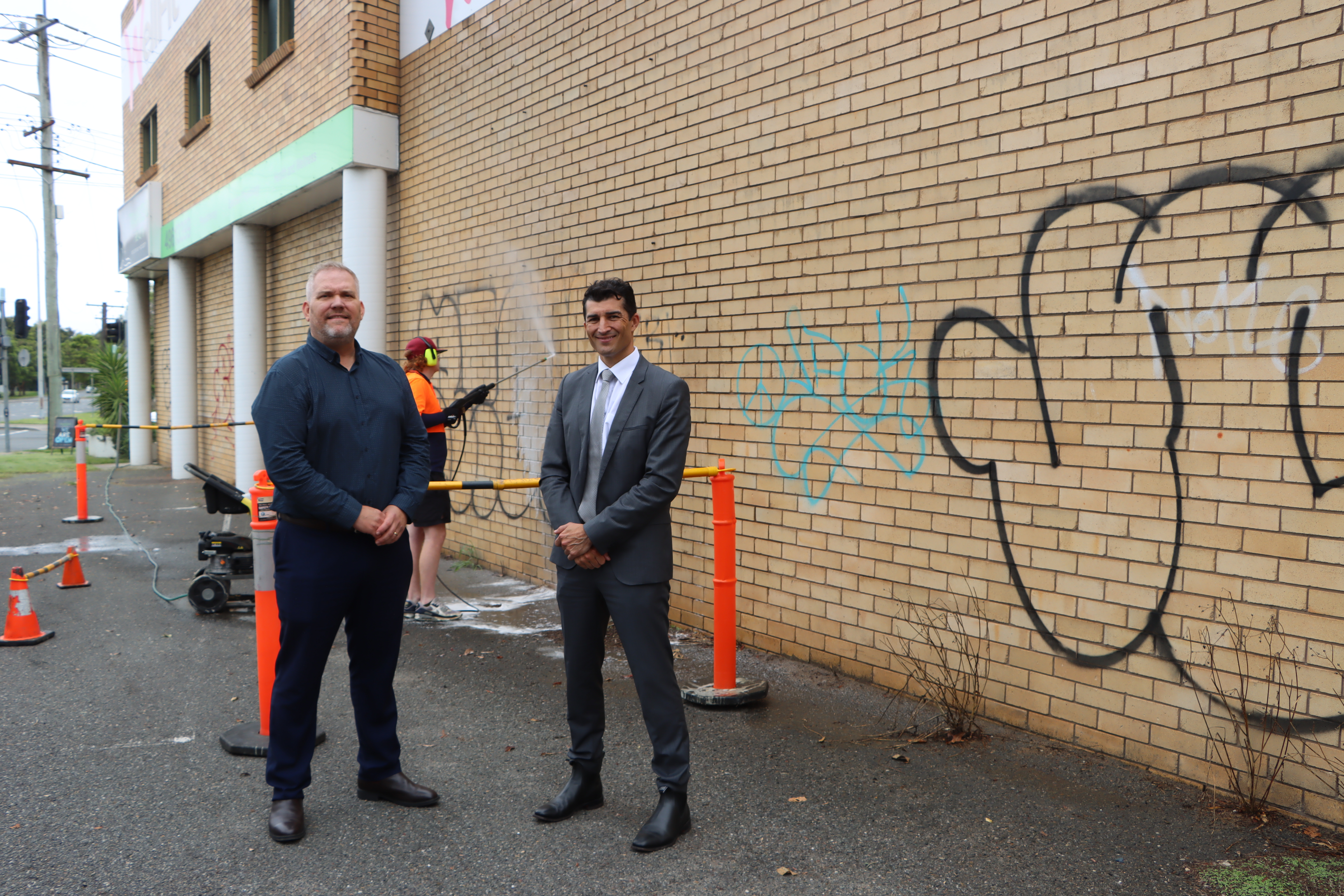
City of Newcastle CEO Jeremy Bath said the benefits of the program go far beyond cleaning vandalised property.
“Few people would be aware that for the past 20 years City of Newcastle has been supporting youth offenders through various community-based programs, with participants working side-by-side with our outdoor cleaning teams to learn new skills, including removing graffiti,” Mr Bath said.
“It’s a wonderful program that teaches young offenders that community owned buildings are often home to important community services that deserve to be respected and protected.
“Almost 1,500 young people have worked with our staff over the past two decades improving the look and cleanliness of the city CBD, and in the process learning new skills that encourage them to respect public property.
“The time is now right to expand the program so that home and business owners whose properties have been tagged can ask to have the graffiti removed at no cost to them.
“Should a resident or property owner discover graffiti, all they will need to do is complete an online form on the City of Newcastle website and a crew from the Youth Justice NSW Community Service Order Program will be in touch to confirm when they will come to remove the graffiti.”
Newcastle Youth Justice Office Area Manager Damian Baker said the graffiti removal program provides participants with an opportunity to give back to the community while developing new skills.
“Funding provided by City of Newcastle has assisted program participants with work readiness, pathways to employment and training through TAFE NSW and other job network providers,” Mr Baker said.
“Our focus is to introduce young participants to fundamental and transferrable skills required to assist in gaining an edge in a competitive job market for low skilled employment.
“Newcastle Youth Justice Community Office has received numerous commendations from both City of Newcastle and the Department of Communities and Justice in support for the continued commitment to provide reparation work and beautification to the city.”
Plans to recommence the current graffiti removal program and the added private sector service will commence from January 2022.
City of Newcastle supports Youth Justice NSW and its rehabilitation program with funding to assist with the procurement of equipment, materials and Personal Protective Equipment for participants.
For more information, visit City of Newcastle’s Graffiti Removal Program webpage
One giant step for CBD with plans afoot to create iconic Sydney Great Walk
The NSW Government is developing plans to create Australia’s greatest urban walking trail stretching along the Harbour foreshore from Lady Macquarie’s Chair, past the Opera House and Bridge, through Barangaroo and returning via the CBD.
Dubbed the Sydney Great Walk it will connect major tourism locations and attractions and feature at least two loops with the first designed to be completed in half a day and a longer full-day walk extending into Darling Harbour and back past the Chinese Garden of Friendship and Hyde Park.
The Government will conduct feasibility studies into the project, including developing routes, exploring physical wayfinding options such as signs, maps and information and undertaking consultation with key stakeholders such as the City of Sydney.
Premier Dominic Perrottet said it was imperative to find new and innovative ways to improve what was sometimes simply taken for granted.
“This route has the potential to become the greatest and most iconic urban walk in the country,” Mr Perrottet said.
“It will be something all Australians should do, and the one walk every visitor must do, when they are able to return safely to our shores.”
Minister for Jobs, Investment, Tourism and Western Sydney, and Minister for Trade and Investment Stuart Ayres, said creating an iconic walk around the Harbour front and through the middle of the CBD would build on existing initiatives designed to encourage people to enjoy NSW.
“We recently launched our Renew advertising campaign to encourage people to reconnect with our great state and developing projects such as the Sydney Great Walk fit well alongside other initiatives such as Sydney’s Longest Lunch and the six-day ELEVATE Sydney celebration to be staged on the Cahill Expressway,” Mr Ayres said.
“We want people to get out and enjoy the best NSW has to offer and if this encourages more people to visit and enjoy the city in a healthy way it’s a win-win outcome.”
The Government will also investigate utilising digital platforms as wayfinders to allow people to plan their journey and access key information on the walk about key places, facilities, sights and businesses.
Other ideas include incorporating QR codes at locations which would provide information along the route when scanned and even integrating the recently launched heritage Blue Plaques program.
Planning and Public Spaces Minister Rob Stokes said the walk would provide the opportunity to not just showcase the Harbour and some of our most iconic locations, but to incorporate art installations, soundscapes and enhanced infrastructure.
“This walk will help draw people back into the CBD and at the same time connect what are individually some of the most beautiful and recognisable places in Australia,” Mr Stokes said.
“Our aim is to enhance the liveability of our city, promote more people actively exploring the city and develop a drawcard which is on everybody’s bucket-list.”
“We will also look at developing special sections of the walk so that people may do a history component in The Rocks or a dining and eating component through the CBD.”
“It could also connect with the great work already underway on the existing Yananurala walk, a project led by the City of Sydney in collaboration with First Nation’s representatives that highlights Aboriginal history and culture at places along the Sydney harbour foreshore”.
$479 Million Ryde Hospital Forges Ahead
The existing Ryde Hospital campus will be transformed into a state-of-the-art facility with expanded and improved emergency care, critical care, community and outpatient services.
Health Minister Brad Hazzard and Member for Ryde Victor Dominello announced the existing site as most suitable after extensive consultation with hospital staff and the local community.
“We’ve listened to our doctors, nurses and allied health professionals and the community on both options of the current site or Macquarie University. Overwhelmingly, they all wanted to remain in Ryde and we are confident that this is the best way forward,” Mr Dominello said.
“With the site now chosen, the local community is set to receive a huge boost to health services and we can now move forward in bringing first-class health services to the area.
“This will preserve the historic Denistone House, retain the significant investment in rehabilitation services at Graythwaite and make best use of the current services already available at Ryde.”
Mr Hazzard said that ties to Macquarie University will also be strengthened on campus.
“The new Ryde Hospital and Macquarie University will work together in creating teaching and research opportunities alongside clinical placements,” Mr Hazzard said.
Northern Sydney Local Health District in partnership with Health Infrastructure will now begin the next phase of consultation with clinicians, staff, patients, carers, consumers and the local community on the design of the new hospital.
The team is calling for community members to join a Consumer Reference Group to help shape the direction of the redevelopment.
To register your interest please visit: rydehospitalredevelopment.health.nsw.gov.au and complete the form by Friday 10 December 2021.
Hospital planning is a complex process that involves extensive consultation with staff, patients, consumers and the community to ensure the right clinical needs are met. To find out more visit www.hinfra.health.nsw.gov.au/our-business/how-to-build-a-hospital
The NSW Government is investing a record $10.8 billion in health infrastructure over the next four years to 2024-25.