Detectives have commenced an investigation after a man presented at Muswellbrook Hospital last night with a gunshot wound to the leg.
Around 9.15pm (Wednesday 16 February 2022), officers attached to Hunter Valley Police District were contacted by staff at Muswellbrook Hospital advising that a 28-year-old man had presented with an injury consistent with a gunshot wound to his upper left thigh.
Officers later attended a home on Richmond Street, Muswellbrook, where they established a crime scene and seized a number of items for further examination.
The man was taken to John Hunter Hospital for further treatment; his injury is not considered life-threatening.
Police are investigating an armed robbery near Singleton overnight.
Officers from Hunter Valley Police District were called to a service station on Bridgman Road, Donolly, just before midnight (Wednesday 16 February 2022).
Police have been told two men – armed with knives – entered the store before they threatened a female attendant and demanded cash.
The employee handed over a sum of money before both men ran from the store and were last seen headed towards Bridgman Road on foot.
The woman was not injured during the incident.
One of the men is described as being of Caucasian appearance, aged in his late teens to early 20s, of thin build, wearing a black t-shirt, light brown pants and black joggers, with his face covered.
The second man is described as being of thin build and aged in his late teens to early 20s. He was seen wearing a white one-piece suit, with a white shirt covering his face, sunglasses and boots.
Officers attended and established a crime scene, which was examined by specialist police.
Victoria’s workers are short-changed $1.22 billion a year from their super and the state’s workers will continue to be ripped off until federal politicians act.
Industry Super Australia (ISA) analysis of the latest tax data shows more than 760,000 Victorian workers lost an average of $1,606 in 2018-19 (see table 1). Those swindled on super can end up retiring with up to $60,000 less.
In six years – from 2013-14 to 2018-19, Victoria’s unpaid super bill climbed to an eyewatering $6.7 billion.
Despite nearly a third of the state’s workforce suffering a super rip off each year, awareness of the unpaid super problem remains chronically low.
It can often take months for workers to uncover that they have been underpaid, making recovery far more difficult. Making matters worse 70% of workers don’t realise super can legally be paid just four times a year, not with their wages – despite what it says on payslips.
The outdated laws and the lack of awareness amongst workers is being exploited by some unscrupulous employers to not pay super.
Mandating that super is paid with wages will make it much easier for workers to track when payments are made and uncover underpayments quicker, making recovery more likely.
But individuals can only do so much, it is up to politicians to fix the systemic underpayment of super by mandating all employers pay super into a workers’ account when they pay wages.
Unpaid super creates an unequal playing field for businesses, as the employers doing the right thing are undercut by competitors who are ripping their workers off.
Workers must largely rely on the Australian Tax Office to recover their money as it is difficult to sue for super. But the ATO only recovers a dismal 12% of unpaid super annually and rarely issues penalties that would deter dodgy employers.
If the ATO is unwilling or unable to recover Victoria workers’ savings the law should be changed so that employees, the Fair Work Ombudsman, and others acting on behalf of workers can.
To fix Victoria’s $1.2 billion unpaid super scourge politicians should commit to:
Ø Mandating super payment at the same time as wages.
Ø Lift enforcement activity and force the ATO to issue and publicise penalties for not paying super – so dodgy employers can see there is a cop on the beat.
Ø Empower employees and representatives to recover unpaid super debts.
Ø Extend the Fair Entitlement Guarantee so workers can recoup their savings if a company goes bust – at the moment super is not included.
Industry Super Australia Chief Executive Bernie Dean said:
“This is a $1.2 billion a year rip off affecting nearly a third of Victoria’s workers, yet many of them remain unaware, assuming super is being paid because it appears on their payslip.”
“Super is your money, you should get it paid at the same time you get your wages. By not mandating the payment of super with wages, politicians are stopping Victorian workers getting what they are owed.”
“Our federal politicians get their super paid on payday, so should all Victorian workers.”
Table 1: Unpaid super by Victorian federal electorate
Electorate
Persons
Percentage of electorate
Average underpaid
Total ($m)
Melbourne
23,800
25%
$1,745
$41.5
Macnamara
24,150
28%
$1,538
$37.1
Hotham
22,250
30%
$1,649
$36.7
Gellibrand
23,300
31%
$1,573
$36.7
Lalor
27,850
34%
$1,293
$36.0
Maribyrnong
21,600
29%
$1,664
$35.9
Holt
25,600
33%
$1,398
$35.8
Corangamite
21,050
33%
$1,684
$35.5
Casey
18,450
29%
$1,905
$35.1
La Trobe
22,550
32%
$1,549
$34.9
Gorton
21,750
29%
$1,591
$34.6
Chisholm
21,950
29%
$1,561
$34.3
Mcewen
20,700
32%
$1,641
$34.0
Dunkley
20,700
32%
$1,635
$33.8
Calwell
20,500
30%
$1,578
$32.4
Fraser
18,250
27%
$1,750
$31.9
Aston
19,950
28%
$1,595
$31.8
Bendigo
18,250
31%
$1,727
$31.5
Higgins
19,950
26%
$1,577
$31.5
Cooper
20,400
29%
$1,542
$31.4
Isaacs
19,800
29%
$1,562
$30.9
Monash
18,650
31%
$1,639
$30.6
Indi
17,450
29%
$1,749
$30.5
Mallee
17,950
29%
$1,682
$30.2
Kooyong
19,650
27%
$1,535
$30.2
Gippsland
16,300
30%
$1,850
$30.1
Goldstein
18,500
27%
$1,619
$30.0
Corio
19,150
31%
$1,561
$29.9
Bruce
19,650
29%
$1,505
$29.6
Scullin
19,150
30%
$1,529
$29.3
Flinders
17,300
30%
$1,684
$29.1
Ballarat
18,050
28%
$1,588
$28.7
Deakin
18,300
27%
$1,556
$28.5
Menzies
17,800
28%
$1,588
$28.3
Nicholls
17,550
30%
$1,591
$27.9
Jagajaga
16,650
25%
$1,648
$27.4
Wannon
17,100
27%
$1,535
$26.3
Wills
19,750
27%
1,684
$33.3
State total
761,750
29%
$1,606
$1,223
Source: ISA analysis of 2018-19 2% ATO tax file and ABS data.
Driving a circular economy, harnessing nature-based solutions and taking action on climate change have been identified as priority areas for discussion as City of Newcastle (CN) develops its new Environment Strategy.
The strategy will help define CN’s key environmental objectives and initiatives during the next decade and is designed to align with the sustainability outcomes of the draft Community Strategic Plan, Newcastle 2040, which itself is on public exhibition until 28 February.
The draft Newcastle Environment Strategy will be informed by extensive community consultation before being finalised and presented to the Council for adoption.
More than 4500 pieces of feedback collected during the development of the Community Strategic Plan, quarterly surveys, Climate Action Plan engagement and a waste specific survey have already been reviewed to understand the community’s priorities for our environment.
Targeted stakeholder consultation will commence this week, with key priority areas helping to facilitate discussion during the workshops. This will include looking at the options for a circular economy that would design out waste, keep materials in use and turn waste into a resource; exploring how to build resilience to the effects of climate change; and looking at how natural solutions to social problems can allow us to protect, manage or restore our environment in a way that benefits both communities and ecosystems.
Community members will be given additional opportunities to comment on the draft strategy during its public exhibition, which is scheduled to occur later this year.
City of Newcastle (CN) is dishing up a taste of the cultural delights that will be on the menu when its flagship arts festival returns later this year.
Three of the performances originally commissioned by CN for last year’s postponed New Annual have been rescheduled in March, allowing locals to whet their appetites for the official return of the festival from 23 September to 2 October.
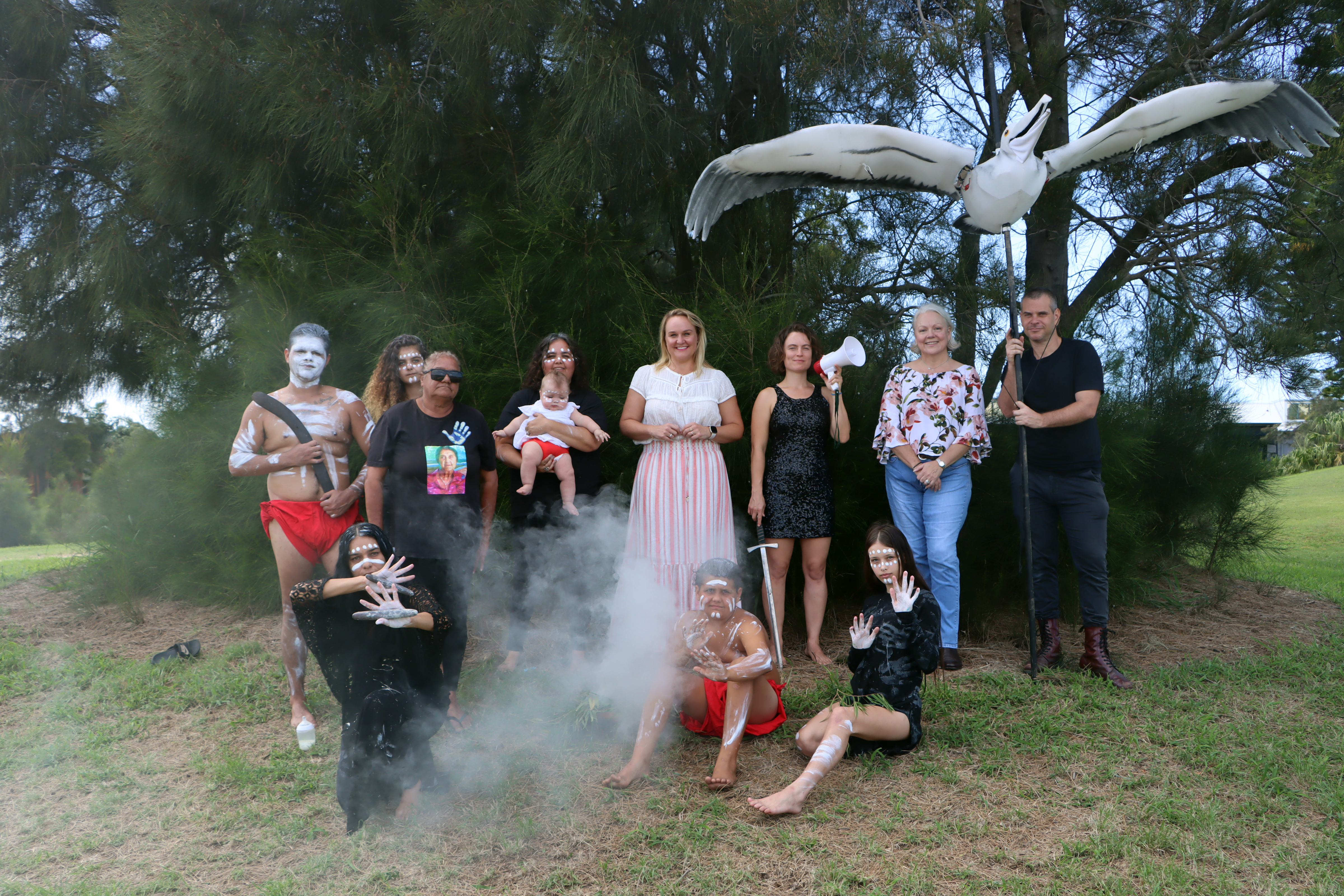
Explore the Indigenous roots of Carrington Foreshore with towering, illuminated puppets created by Curious Legends in partnership with local Worimi people, meet local artists and take part in community art projects on the Studio Arts Trail in Hamilton and check out a thought-provoking one-woman show that summons the spirit of iconic French solider and Saint, Joan of Arc.
Newcastle Lord Mayor Nuatali Nelmes said maintaining support for the local arts community had been an important consideration when the decision was made to postpone last year’s event.
“After the success of the inaugural New Annual in February 2021, City of Newcastle was looking forward to following it up bigger and better in September last year before we made the tough call to postpone it in light of the growing COVID-19 case numbers at the time,” Cr Nelmes said.
“Despite our disappointment, we were committed to maintaining support for the local arts community, who have been heavily impacted during the past two years as a result of COVID-19 lockdowns and restrictions.
“After consultations with the artists, we are thrilled to be able to include these performances and activities in March this year as an initiative of our COVID-19 Community and Economic Resilience Package.
“This decision enables upwards of 50 artists, musicians and performers to remain involved with these three events and benefit from the exposure and performance opportunities they provide.
“This will also give people a chance to soak up Newcastle’s live events atmosphere with a taste of what’s to come when the full New Annual festival returns in September.”
In collaboration with the Newcastle Worimi community, Curious Legends will present Gimbay Gatigaan, an outdoor, site-specific family-friendly production exploring Aboriginal life and stories from Onebygamba (known locally as Carrington).
Studio Arts Trail: 5 March (Hamilton precinct)
Follow the Art Trail map to discover some of the most collaborative spaces for eclectic art projects in Newcastle including Hudson St Hum, Newcastle Arts Space, Clyde St Studios and Creative Incubator.
Voices of Joan: 3-6 and 9-12 March (Hamilton North)
Voices of Joan, by Newcastle theatre maker Janie Gibson, unravels the tangled threads of misogyny and Catholicism as she searches for Joan’s story in fragments of words. What is revealed is a voice of courage amidst adversity and an ancient story about gender, truth, and power, themes that still resonate today.
Around 300,000 households across the State have taken advantage of the NSW Government’s new voucher program Parents NSW, offering $250 in vouchers as a thank you for their efforts to support learning from home in 2021.
Premier Dominic Perrottet said since its launch on 7 February, there have been more than 1.5 million vouchers issued to NSW families, totaling more than $75 million dollars in parents’ pockets.
“The State-wide uptake in just seven days is staggering,” Mr Perrottet said.
“More than 118,424 households applied for vouchers in the first 24 hours, the most successful start to a voucher program we have had to date.
“But as well as helping cut the cost of living for families, businesses are also getting a much-needed boost. In one week, parents have redeemed 12,500 vouchers spending around $970,000 in Stay NSW and Discover NSW registered businesses Minister for Customer Service and Digital Government Victor Dominello said the numbers pointed to the importance of targeted support delivered through the Service NSW app.
“This is Australian-first digital technology putting money straight into the pockets of parents,” Mr Dominello said.
“From those hundreds of thousands of customers who have already applied, the transaction has received 97 per cent thumbs up.
“If anyone is having any trouble with their application please contact Service NSW on 13 77 88 who can help with understanding the eligibility criteria and applying.”
The Parents NSW program provides each eligible household with at least one school-enrolled child where home learning took place in 2021 with five $50 vouchers which can be redeemed at Discover NSW and Stay NSW registered businesses.
It’s not too late for tourism, recreation and accommodation businesses to register. Parents NSW vouchers are valid until 9 October, 2022. For more information and details on how to apply, visit https://www.service.nsw.gov.au/parents-nsw-vouchers
The NSW Government is supporting the creation of local manufacturing jobs in Western Sydney with a $70 million investment to transition the state’s bus fleet to zero emissions technology.
Western Sydney based company Custom Denning has been awarded a contract to design, manufacture and assembly 79 new electric buses.
Premier Dominic Perrottet and Minister for Transport and Veterans David Elliott toured the St Mary’s factory this morning to inspect the production line and meet workers.
“This is a true Western Sydney success story and our Government is proud to have played a part in this business producing the first locally-built electric bus,” Mr Perrottet said.
“Custom Denning employs 160 workers at their St Mary’s factory and this investment will now provide more jobs to ensure our buses are built to the highest standard.
“Our Government is getting closer to securing a cleaner, healthier future for the people of NSW and at the same time this electric bus transition will generate hundreds of local manufacturing jobs, which is an amazing outcome for our state.”
Minister for Transport and Veterans David Elliott said the $70 million investment takes the number of bus orders placed with Custom Denning past 100, which will help drive a post pandemic jobs recovery and a boost for local manufacturing.
“The NSW Government’s commitment to transition the entire 8,000-plus bus fleet is supercharging jobs and manufacturing in Western Sydney,” Mr Elliott said.
“Bus customers are already experiencing the benefits of electric buses from Penrith to Bondi, and we will continue to back local manufacturing.
“I’m committed to exploring opportunities to secure more local manufacturing, component supply and workforce skills development to boost our economy.”
Once built, the 79 buses will operate services in Sydney’s inner west. Transport for NSW, in collaboration with its contracted bus operators, have ordered 101 electric buses from Custom Denning.
The NSW Government has announced nearly $5 million in grant funding to support Aboriginal families and communities staying safe and connected to critical services during the COVID-19 pandemic.
Minister for Aboriginal Affairs Ben Franklin said directly investing in Aboriginal communities and Aboriginal Community Controlled Organisations (ACCOs) is making a real difference to communities, many of them in remote and regional locations.
“We know that COVID has had a significant impact on our Aboriginal communities across the state,” Mr Franklin said.
“Providing funding to Aboriginal communities and ACCOs is vital to ensuring everyone across the State has access to essential services to keep them physically and socially well, while also remaining connected to the places and people most important to them.”
Mr Franklin said today the COVID-19 Aboriginal Community Response Grants Program is being extended for another three months until April 29, 2022.
Funding of between $1,000 and $10,000 will be available to ACCOs across NSW to support social, emotional and physical wellbeing, as well as responding to immediate needs in Aboriginal communities.
To date this program has funded 176 projects totaling $1.5 million to provide local responses to Aboriginal people impacted by COVID-19, particularly vulnerable community members including Elders, young people, and those with underlying chronic health conditions.
In a second program, the $3.4 million COVID-19 Aboriginal Community Partnership Support Program is supporting 19 Aboriginal organisations.
Selected Aboriginal and Torres Strait Islander organisations in NSW were invited to apply for grants of between $50,000 and $250,000 in recognition of their significant role in supporting their member organisations across the state and to continue delivering community outreach services across NSW.
Mr Franklin said grant recipients were members of the NSW Coalition of Aboriginal Peak Organisations (CAPO), NSW Stolen Generation organisations and local decision-making alliances (LDM).
BlaQ Aboriginal Corporation was funded $246,170 to provide support and connections to Aboriginal and Torres Strait Islander LGBTQ+ people across NSW.
First Peoples Disability Network (FPDN) received $250,000 funding to provide advocacy and accessible multi-media communications to Aboriginal people with a disability as well as their families.
La Perouse Aboriginal Community Alliance received $228,600 to establish a COVID Working Group to identity areas of need across their community as well as providing increased support for mental health.
“COVID-19 continues to impact Aboriginal people and the response of Aboriginal Community Controlled Organisations (ACCOs) during the past two years has been significant. These grants will build on this by enabling local community organisations to continue and grow their important work,” Mr Franklin said.
Senior Australians in residential aged care will have greater access to visitors and reduced lockdowns under new visitation guidelines response to the pandemic.
The Australian Government recognises the serious impact of social isolation on residents due to the strict requirements to manage the risk of COVID-19.
Minister for Health and Aged Care, Greg Hunt and Minister for Senior Australians and Aged Care Services, Richard Colbeck welcomed the new advice, which has been endorsed by the Australian Health Protection Principal Committee (AHPPC) and National Cabinet.
“The new advice will enable aged care providers to take a more flexible approach to visitation, and a more proportionate approach to locking down of facilities following an exposure or in the event of an outbreak,” Minister Hunt said.
“This decision will provide consistent guidance for states and territories, and we encourage them to reflect this in their public health orders.”
The new Interim Guidance on Managing Public Health Restrictions on Residential Aged Care Facilities has been developed based on expert medical advice from the Australian Health Protection Principal Committee (AHPPC).
“We need to shift the balance from restricting visitors during an outbreak to providing access by at least one visitor per resident per day. This will assist to reduce the impact of the restrictions to date and provide families with more valuable time with their loved ones,” Minister Colbeck said.
“Every effort is made to protect residents and with these processes in the place, this provides the opportunity to safely increase visitation for residents.”
The new guidance encourages increased visitation and supports aged care providers to apply the least restrictive isolation requirements on residents. It was agreed that each resident should have access to one Essential Visitor at all times (including during an outbreak or exposure).
The Government is supporting increased visitation through the provision of Rapid Antigen Tests (RATs) and Personal Protective Equipment (PPE) through the medical stockpile. Over 12.2 million RATs have been deployed to the aged care sector since August 2021.
Since 1 January 2022 the National Medical Stockpile has provided residential aged care facilities with approximately:
19.1 million masks
7.7 million gowns
23.6 million gloves
4.4 million goggles and face shields
74,544 bottles of hand sanitiser.
This Guidance will also assist all State and Territory Public Health Units to adopt a more consistent and risk-based approach to the management of COVID-19 outbreaks.
The increased transmissibility of the Omicron variant has created enormous challenges for facilities, as aged care workers have been forced to stay at home and isolate. The updated Interim Guidance on Permissions and Restrictions for Workers in Aged Care acknowledges risk of transmission cannot be eliminated and exposures will occur.
Endorsed by AHPPC, the revised document provides clear advice on how aged care facilities can take a risk-based approach to use their workforce flexibly.
The guidance provides clear criteria for aged care providers to allow a worker to continue to work if he or she has been exposed to COVID-19 but tests negative, is asymptomatic and is willing to work.
It has been updated to align with the Updated COVID-19 Test and Isolate National Protocols which limits the time required for isolation following contact. This means that providers can reduce the detrimental loss of workforce by retaining existing staff in the workplace, using steps to limit transmission.
The new Interim Guidance documents will be published on the Department of Health’s website.
The Government encourages providers to use these guidance materials to provide a better balance between protecting residents from the potentially tragic impacts of COVID-19, and supporting their mental, physical and emotional wellbeing.
Australians with diabetes will now have access to the next-generation Dexcom G6 Continuous Glucose Monitoring (CGM), ensuring they can use the latest technology to manage their diabetes.
From 1 March, 58,000 eligible Australians participating in the CGM Initiative will have the option of using the new Dexcom G6 CGM device, as the current Dexcom G5 CGM device is phased out.
Minister for Health and Aged Care, Greg Hunt, said around 1.8 million people in Australia live with diabetes and more than 120,000 Australians have developed diabetes in the past year.
“CGM measures glucose levels to gain insight into patterns and trends—day and night.
Monitoring blood glucose levels helps prevent both short-term and long-term health complications including heart attacks and strokes, amputations, kidney failure and preventable blindness,” Minister Hunt said.
“The Morrison Government remains committed to ensuring all Australians have access to the latest health care products when and where they need them.”
Funded by the Morrison Government, CGM products are available through the National Diabetes Services Scheme (NDSS) to help thousands of people manage their diabetes every day.
Thousands of Australians have successfully used the Dexcom G5 monitoring device but, due to international supply chain issues, the G5 would no longer be available in Australia.
To ensure this doesn’t impact current G5 users, the Morrison Government has been working with the product sponsor and Diabetes Australia to make sure Australians can transition to the new G6 product before the G5 supple is exhausted.
To minimise the impact of this change, the listing for the G6 has been expanded so that all people eligible to participate in the CGM Initiative can access this option.
In addition, existing G5 users—about 7,500 people—will be automatically transitioned to G6 on 1 March to avoid any delays receiving their CGM product.
All products, including the new G6, provided under the CGM initiative remain free of charge.
The Morrison Government has invested more than $300 million in the CGM Initiative over four years. In 2020-21, the NDSS delivered more than 5.9 million diabetes products worth more than $186 million and more than $709 million in medicines for diabetes were dispensed under the PBS.
Last November, the Government released the Australian National Diabetes Strategy 2021–2030 to drive real improvements in the prevention, early detection, management, and care of people with diabetes.
With approximately one in 20 Australians affected by diabetes, the new strategy will bring together the latest research and evidence to ensure people living with diabetes, their family and carers have access to care, treatments and support where and when they need it.