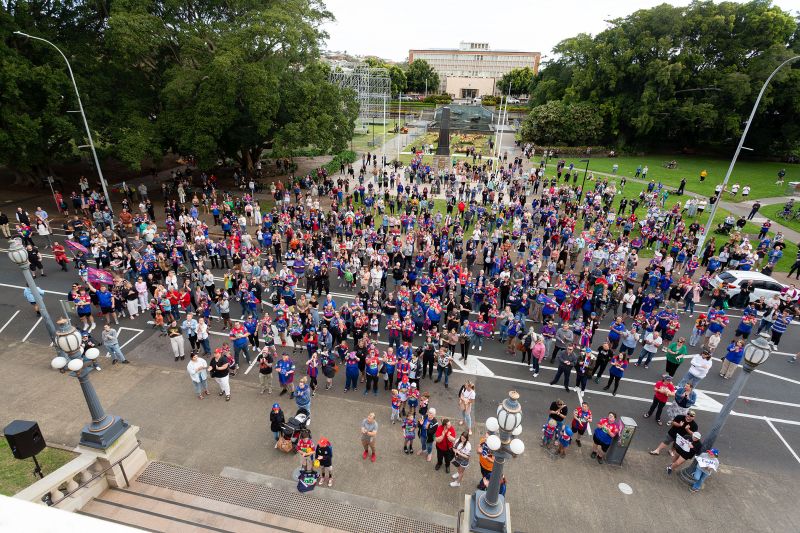
Afghan-Australians, Faith leaders, and veterans in Canberra to demand gov urgently lift Afghan intake

A delegation of faith leaders, members of the Afghanistan-Australian Advocacy Network, and veterans, are in Canberra to call on the government to offer more Afghan refugees safety, warning 15,000 over four years is not a proportionate response to the humanitarian crisis, nor in line with Australian community expectations.

Immigration Minister Alex Hawke announced in January over the next four years 10,000 humanitarian and 5,000 family visas will be set aside for those who have or are fleeing Afghanistan. However, this intake isn’t additional to Australia’s already small annual intake of 13,750 people. Further, many of the approximately 5,500 Afghans who have already arrived in Australia this past year, will now need to apply for one of those 10,000 humanitarian visa spots.

“Australians are united in their shared responsibility to the Afghan people. They want a generous intake and to welcome those in need safely. However, from what we can make of the government’s recent announcement, all we have left is 4,500 remaining humanitarian places for those fleeing Afghanistan, when there are 150,000 Afghans who have made applications to

Australia for protection,” said Mariam Veiszadeh, CEO Media Diversity Australia, AfghanistanAustralia Advocacy Network. 

“Such a tiny offering isn’t a compassionate, humanitarian response, it is not commensurate with the crisis unfolding nor does it reflect Australia’s responsibility to the Afghan people. Australians know this.

“Christian leaders, Afghan Australians, and veterans have consistently called for 20,000 Afghans to be taken in as an additional intake – we will not stop our calls. Australia’s humanitarian cap was cut by 5,000 in 2020 to 13,750 – so we’ve been progressively shrinking our intake as it is.

“We spent two decades in Afghanistan as part of the military campaign – it is our moral duty to bring as many people to safety as we can.”

More than 162,000 people have signed onto the Action For Afghanistan change.org petition, every mainline Christian denomination as well as the Australian Christian Lobby has thrown its support behind the campaign Christians United for Afghanistan. More than 300 organisations, businesses and community groups signed onto a joint letter from the Refugee Council of Australia, with all these groups urging federal parliamentarians to commit to 20,000 additional humanitarian places.

There is precedent for Australia lifting its humanitarian intake in response to significant global conflict and upheaval. In 2017, the Abbott government offered an additional 12,000 people fleeing Syria and Iraq safety, on top of the annual humanitarian intake.

The delegation will make the case to the MPs it meets that the 2022 Budget provides the ideal opportunity for the Government to reset its response to the crisis in Afghanistan. 

“Since the 2019 election, we’ve lost 28,000 lost humanitarian visas from Australia’s planned intake, due to COVID shortfalls which were then made into permanent cuts,” said Rev Tim Costello, Executive Director, Micah Australia.

“It is well within the power of this Government to make space for a special additional intake of 20,000 places for refugees from Afghanistan over the next two years.  

“As the Abbott Government illustrated in 2015, this special intake can enable Australia to give priority to refugees in Afghanistan while not forgetting refugees in need elsewhere.

“There are currently more than 84 million people forcibly displaced in the world. There is so much need, but instead of growing our intake our federal government is keeping a very tight cap on our intake.

“If you have unexpected guests arrive at your house for dinner, you don’t just cut everyone a smaller slice of pie – you bake a bigger pie, you offer what you can.” 

The delegation will meet with politicians, including Immigration Minister Alex Hawke. The delegation includes:

•        Rev Tim Costello, Executive Director, Micah Australia

•        Mariam Veiszadeh, CEO Media Diversity Australia, Afghanistan-Australia Advocacy Network 

•        Arif Hussein, Senior Solicitor for RACS, Afghanistan-Australia Advocacy Network

•        Glenn Kolomeitz, Director at GAP Veteran & Legal Services

•        Wendy Francis, National Director of Politics, Australian Christian Lobby

•        Right Reverend Chris Edwards, Bishop of North Sydney, Assistant Bishop to Archbishop of Sydney Kanishka Raffel, Metropolitan of New South Wales and ACT.

•        Dr Tim McKenna, CAPSA Advisory Group Member and Chair of the St Vincent de Paul Society Refugee Network

•        Bishop Philip Huggins, Convener of the Anglican Church working Group on Refugee and Migrant Issues

•        Matt Darvas, National Director, Micah Australia

“The scale and severity of the Afghan humanitarian crisis continues to worsen. The Catholic Alliance for People Seeking Asylum (CAPSA) reiterates its call on the Australian Government to announce a special intake of at least 20,000 humanitarian visas for vulnerable people from Afghanistan additional to our annual humanitarian intake. Catholic Church agencies, parishes, schools, and community groups are already assisting Afghan refugees. We stand ready to do our part in a more ambitious, compassionate response.” – Tim McKenna, CAPSA Advisory Group Member and Chair of the St Vincent de Paul Society Refugee Network.  

“Afghanistan is arguably the world’s largest humanitarian crisis today. The ongoing brutal treatment, particularly regarding women, girls, and minority groups, must not be ignored or forgotten. This is why the Australian Christian Lobby is renewing its call for our government to urgently increase our refugee intake from the devastated nation, as well as giving existing Afghan refugees on TPVs in Australia the assurance of permanency. We can’t rescue everyone, but we can, and must, do more.” – Wendy Francis, National Director of Politics, Australian Christian Lobby  

 “After a 20-year military engagement and blood spilt in Afghanistan, I can’t understate the impact the Afghan visa crisis is having on our veteran community. The Government and Opposition should not ignore the level of support our veterans are showing for our Afghan colleagues and the people of that country more broadly. And it’s not just Afghanistan veterans who are sharing their concerns with me – I’ve had Vietnam Veterans tell me this is reminiscent of the fall of Saigon, but many believe Vietnamese refugees were treated better by the Australian Government back then than Afghan refugees are being treated now.” – Glenn Kolomeitz, Afghanistan veteran and principal lawyer at GAP Veteran & Legal Services.

“The war in Afghanistan was the longest war in our history. In that time, we made significant promises to the people of Afghanistan that included protection of persecuted groups, and women. Australia’s current commitments to those fleeing the Taliban does not begin to recognise our relationship with the war, our moral obligation to the people of Afghanistan, the escalating humanitarian crisis in Afghanistan right now, and the contributions of the Afghan-Australian community to Australia.” – Arif Hussein, Senior Solicitor at Refugee Advice and Casework Service, Afghanistan-Australian Advocacy Network

DEFENCE SUPPORT TO AGED CARE

Australian Defence Force (ADF) personnel have deployed across Australia to residential aged care facilies in support of the Australian Government’s Department of Health.

Following induction and training, a further 38 personnel have deployed to facilities across Queensland, Victoria, South Australia and New South Wales to provide clinical and non-clinical support. There is currently 200 personnel in each state and territory available for tasking as part of Operation COVID-19 ASSIST.

These teams will supplement ADF personnel already supporting the aged care sector, including 17 personnel embedded with the Department of Health to coordinate Defence support.

Identity of Neo-Nazi Revealed to be Former Young Liberals Office Holder

The Age has revealed that a man in a propaganda video depicting three masked Neo-Nazi’s is a former Young Liberals Office Holder. In the video: the men burn an Aboriginal flag, perform sieg heil salutes and recite a white supremacist manifesto in front of a sign naming and threatening Senator Lidia Thorpe.

The Greens are calling for the Prime Scott Morrison to compel the Liberal Party to investigate the alleged Neo-Nazi’s links to the Liberal Party, whether they have any continuing role within the Party, and identify any associates of his within the Party that may share his views.

Greens Leader Adam Bandt says this is a test for Scott Morrison’s integrity – with far right nationalism on the rise, a failure to act is unacceptable.

Senator Lidia Thorpe: a proud DjabWurrung, Gunnai and Gunditjmara woman and the Greens Senator for Victoria said:

 “I notified the Australian Federal Police (AFP) about the video on the 19th of January and I have no protection, to date. I still have no answers or safety, as a First Nations woman or as a politician.

“The Prime Minister Scott Morrison apologised for how unsafe our workplace is for women this week, yet when a First Nations woman is threatened he has nothing to say. This is a clear indication that Blak lives actually do not matter to this government.”

“This situation is extremely distressing for me and my children, I do not trust the authorities to look after us.”

“Speaking to other MPs who have received other kinds of threats, that weren’t as serious as this, the authorities took immediate action. Unfortunately, I’m used to receiving threats from individuals, but this is a terrorist organisation that is threatening me. How is it that the authorities are just letting this go?”
 
Greens Leader, Adam Bandt MP said:

“It is incredibly disturbing to hear that an apparent neo-Nazi was formerly an office-holder within the Young Liberal Party,” Mr Bandt said.

“This is dangerous. This is a danger to any woman of colour, to anyone who speaks up against vile racism, and any public figure who doesn’t share neo-Nazis’ disgusting views.

“With their Nazi salutes and white supremacy these thugs call up the terrifying deaths of six million Jews and millions of others, but our political leaders remain silent. 

“Yet again, we’re seeing that the far right has connections to established political parties. When confronted with the same issue, the NSW Nationals undertook a root and branch investigation of their party to identify whether the party had been compromised by aspiring fascists.

“Scott Morrison and I will never see eye to eye on most things, but as a minimum he should agree that fascism and white supremacy have no place in our political discourse.

“As a matter of urgency, he must compel the Liberal Party to investigate and confirm that the neo-Nazi and his associates are no longer involved with the party.”

Red tape relief for NSW business

Building homes and supporting jobs in the construction, retail and hospitality sectors are at the centre of the latest tranche of regulatory relief helping NSW business get to the other side of the Omicron outbreak.
 
Changes to planning rules will allow for an extension of emergency construction hours, as well as making it easier for businesses to get much needed supplies and extending temporary measures that let pubs and restaurants continue to use carparks and bowling greens.
 
Treasurer Matt Kean said the measures were aimed at supporting some of the sectors hardest hit by the pandemic and designed to keep the economic wheels turning during the Omicron wave of the pandemic.
 
“We know that some retailers have struggled to get supplies and that impacts what people see on the shelves,” Mr Kean said.
 
“We are changing the rules to make it easier for businesses to get those critical supplies – 24 hours a day in business and industrial areas.
 
“We’ve already changed the rules to let diners onto the footpaths and public spaces and now we’re extending measures to let pubs and restaurants use privately owned car parks and open space until 30 June.”
 
These new rule changes helping NSW businesses include:

  • The extension of emergency construction hours (up until 31 March 2022) allowing construction sites to operate on weekends without the need for prior planning approval;
  • Changes to planning rules allowing 24-hour deliveries in industrial and business zones
  • The extension of measures allowing pubs and restaurants use privately owned open space and car parks for hospitality (up until 30 June 2022)

 
Minister for Planning and Minister for Homes Anthony Roberts said it’s vitally important we support the construction industry and the 340,000 jobs it supports.
 
“Construction continues to play a crucial role in our state by contributing around $47 billion each year to the economy, and supporting communities by, keeping people in jobs delivering new homes and community facilities,” he said.
 
“These changes will help us keep shovels in the ground to deliver new homes, jobs and great public spaces and keep the economy moving.”
 
No construction work will be allowed on public holidays and only quiet works can take place on Sundays. The extension of construction hours will be in place until 31 March 2022.
 
For more information visit www.planning.nsw.gov.au

All systems go for launch of National Space Industry Hub in Sydney

The NSW space industry ecosystem has been further strengthened with the official opening of the National Space Industry Hub in Eveleigh, Sydney.
 
The hub, which was officially launched last night, is part of Sydney’s Tech Central Precinct and offers office space, resources, mentoring and connections for emerging space ventures.
 
Minister for Enterprise, Investment and Trade Stuart Ayres said among the first residents of the hub are the Space Industry Association of Australia, the government-backed NSW Space Research Network and the NSW Node of the SmartSat Cooperative Research Centre (CRC).
 
“These organisations bring together industry, universities and researchers to ensure we continue to have the strongest space capability in Australia,” Mr Ayres said.
 
As part of the launch of the hub the NSW Government and Cicada Innovations launched the Fast Start intense coaching program, which aims to help companies commercialise innovative ideas.
 
Participants in the first cohort include Extraterrestrial Power, which aims to support space missions by producing advanced silicon solar cells and Amentum Aerospace, which specialises in predictive scientific modelling software to enhance operational planning for space missions.
 
Both companies will receive a six-month tailored program of mentoring and coaching, access to state-of-the-art rapid prototyping facilities and a dedicated workspace at the hub.
 
Cicada Innovations CEO Sally-Ann Williams said that the hub was ready and waiting to support the participants, through a range of virtual and COVID-safe in-person activity.
 
“NSW is a fantastic place to build a Space venture. We’re surrounded by experience, talent, capital and the community to support space entrepreneurs on their journey,” Ms Williams said.
Minister for Science, Innovation and Technology, and Minister for Skills and Training Alister Henskens said ensuring NSW has a talent pipeline of highly skilled workers was critical to ensuring NSW remains competitive in the space race.
 
“NSW already has an incredible depth of talent in the space industry however we need to continue to grow this pipeline to ensure the industry thrives,” Mr Henskens said.
 
Also launched as part of the hub’s opening was the Foundations Program, a free online learning resource for researchers, engineers and aspiring entrepreneurs looking for foundational knowledge on how to commercialise space technology.
 
The National Space Industry Hub is being delivered as part of the NSW Space Industry Development Strategy, launched in 2020. For more information, visit: https://www.business.nsw.gov.au/industry-sectors/industry-opportunities/space

A new cohort of international doctoral talent will tackle challenges of contemporary industry 

Following a global search for the next generation of research talent in spring 2021, a group of PhD candidates has begun investigating a range of topics related to the impacts of digitalisation in the workplace, including the implications it may have on business innovation and employee training.

The 15 early-stage researchers, representing 10 different countries, have enrolled in universities across Europe and in Australia as part of the European Training Network for InduStry Digital Transformation across Innovation Ecosystems (EINST4INE), funded by the Marie Skłodowska-Curie Innovative Training Networks (ITN) scheme.

“Being part of a large network of established, successful scholars will have a great impact on my research career,” said Contanze Leeb whose PhD at the University of Cambridge aims to help practitioners to tackle the large amounts of information produced by decision-making processes, for example through the use of Artificial Intelligence.

The EINST4INE research projects, complementary in nature, allow the doctoral candidates to conduct a comprehensive examination of the multi-disciplinary aspects of digital transformation.

Their aim? To generate new knowledge, tools, methods, and roadmaps to guide businesses in their digital evolution – placing them as future leaders, experts, and strategists of business and digital transformation.

Traversing the academic and business worlds, the researchers are examining the various multi-level aspects of digital transformation – defined as socioeconomic change – across individuals, organizations, ecosystems, and societies.

Sophie Altrock, an Early Stage Researcher at RMIT University, says that her research will help practitioners to understand the impact of digital innovation on workers and employee skillsets.

“I aim to provide guidance so that businesses can provide opportunities to employees to adapt to such workplace changes, and to encourage policy makers to take an active role, for example by providing an educational system that can sustain a workforce that is subject to technological developments and provide incentives for further research,” said Sophie.

The new researchers are guided in their Ph.D. journeys by world-leading experts in the areas of Open Innovation, Industry 4.0, digital transformation, and innovation ecosystems.

Dedicated training and industry secondment opportunities will allow the development of broad, multisectoral perspectives to ensure that their research is relevant and ready for implementation in the digitally minded workplace.

By 2025, EINST4INE’s doctoral researchers will be equipped with the hybrid tech-digital behavioral skills and cutting-edge knowledge to enable companies to benefit from digital innovation, and have developed tangible outputs and outcomes applicable to start-ups, large firms, low- to high-tech industries, as well as enterprises with service or product- service offerings.

Read more about EINST4INE’s Ph.D. candidates on the EINST4INE website.

EINST4INE is coordinated by RMIT Europe (Spain). RMIT Europe is the European hub of RMIT University (Australia), a global university of technology, design and enterprise.

The EINST4INE consortium comprises RMIT Europe (Spain), Lappeenranta-Lahti University of Technology LUT (Finland), Aarhus University (Denmark), University of Cambridge (UK), Universität Stuttgart (Germany), Scuola Superiore Sant’Anna (Italy) and Libera Università Internazionale degli Studi Sociali Guido Carli (Italy), as well as 15 industry and two academic partnering organizations: RMIT University (Australia) and the Garwood Center for Corporate Innovation, Haas School of Business, UC Berkeley (USA).

This project has received funding from the European Union’s Horizon 2020 research and innovation programme under the Marie Skłodowska-Curie grant agreement No 956745.

Novavax – first protein vaccine now available

Australia’s first protein vaccine, Novavax will join the national rollout from Monday through select general practices, community pharmacies and state clinics across the country.

The Australian Government has secured 51 million doses of Novavax to compliment the vaccine rollout.

Novavax is the first protein-based COVID-19 vaccine to be provisionally approved by the Therapeutic Goods Administration (TGA).

One of five vaccines now approved for use in Australia, Novavax has been proven safe and effective in protecting against severe illness or death associated with COVID-19 infection. 

Protein vaccines use a non-infectious protein component of the virus manufactured in a lab. After vaccination, immune cells recognise the vaccine protein as foreign and launch an immune response against it.

Vaccinations, including a booster dose, are without doubt our best defence against getting sick and protecting Australian communities

Despite high vaccination rates in Australia, there has been a demand for a protein-based formula. For some people, the arrival of Novavax will be the extra push they need to get their first jab and kick start their protection against COVID-19.

Australian Technical Advisory Group on Immunisation (ATAGI) recommends Novavax for people aged 18 years and older for their primary course of vaccination, with two doses to be administered three weeks apart.

Before any COVID-19 vaccine can be supplied for use in Australia it must undergo a rigorous evaluation by the TGA for safety, quality and effectiveness, including testing of every batch upon arrival in Australia. The TGA will only approve a vaccine once it has established that the benefits greatly outweigh any potential risks.

Like any other vaccine, Novavax will be required to continue providing information to the TGA on longer-term efficacy and safety from ongoing clinical trials and post-market assessment.

Novavax does not currently have approval to be used for paediatric patients, or for booster shots, but studies into its use for both are ongoing.

Please use the COVID-19 Clinic Finder and make your appointment.

Pandemic emergency measures extended to April

The human biosecurity period under the Biosecurity Act 2015 has been extended for a further two months.

The emergency period, which has been in place since 18 March 2020, will now continue until 17 April 2022.

The extension, declared by the Governor-General today, was informed by specialist medical and epidemiological advice provided by the Australian Health Protection Principal Committee (AHPPC) and the Commonwealth Chief Medical Officer.

The AHPPC has advised the current wave of Omicron cases in Australia warrants a further extension of the emergency period.

Whilst the peak of the Omicron wave has largely passed, the health advice is that this is an appropriate response while the Australian Government continues to develop and implement management strategies to mitigate the impacts of Omicron.

The extension means the five existing emergency requirements will remain in place until
17 April.  However they may be revoked beforehand if the health advice changes noting the peak of the Omicron wave appears to have passed whilst there are still areas of concern and planning is occurring to manage any increase during winter.

The requirements include:

  • Mandatory pre-departure testing and mask wearing for international flights
  • Restrictions on outbound international travel for unvaccinated Australians
  • Restrictions on the entry of cruise vessels into and within Australian territory
  • Measures to prevent price gouging on rapid antigen tests
  • Restrictions to protect remote communities in the Northern Territory.

In regards, to cruising. there was an agreement at National Cabinet that the Commonwealth, New South Wales, Victoria and Queensland agreed to work with the industry to implement new protocols to enable the resumption of cruising over coming months. The Commonwealth can remove the restrictions on cruising as soon as it is advised that it is safe to do so and the Minister will regularly review this advice.

These emergency requirements have helped Australia respond quickly to manage the number of inbound and outbound travellers, reduce the risk of COVID-19 spreading on flights and at international airports in Australia, further manage the number of cases in quarantine facilities, and ensure the accessibility and affordability of rapid antigen test kits.

It is important that the human biosecurity emergency period remains in place to ensure the appropriate legislative powers are available to the Australian Government during Omicron outbreaks, as well as to protect vulnerable communities in Australia.

The emergency requirements will be reviewed regularly to consider the latest medical advice.

National Cabinet Statement

National Cabinet met today to discuss Australia’s response to COVID-19 and the Omicron variant, the ongoing safe reopening of Australia, resumption of cruising in Australia, approaches to test, trace isolate and quarantine and the vaccine rollout and booster programme.

The Chief Medical Officer, Professor Paul Kelly, provided an update on the spread of the Omicron variant. Overall case numbers continue to decline in Australia and the Omicron case variant continues to be the predominant variant in Australia and globally. Omicron continues to show greater infectivity than the Delta variant, but with much less severity in terms of hospitalisations, ICU and ventilated patients.

National Cabinet noted that the Omicron wave has peaked in most states and territories. Since peaks in mid-January, cases have fallen to 20 per cent of peak levels, hospitalisations to 63 per cent of peaks, ICU admissions of peaks and ventilated cases to 54 per cent of peaks.

Since the beginning of the pandemic there have been 2,462,729 confirmed cases in Australia and, sadly, 4,431 people have died.

Globally there have been over 402.6 million cases and, sadly, over 5.7 million deaths, with 2,241,749 new cases and 11,664 deaths reported in the last 24 hours. The COVID-19 pandemic continues to surge in many countries around the world.

National Cabinet noted that since the COVID-19 Rapid Test Concessional Access program began, approximately 6.8 million Rapid Antigen Tests have been distributed to 1.6 million eligible concession card holders through community pharmacies.

Lieutenant General John Frewen, DSC, AM, Coordinator General of the National COVID Vaccine Taskforce (Operation COVID Shield) provided a detailed briefing on Australia’s vaccination rollout.

Australia’s COVID-19 vaccine rollout continues to expand. To date 51.8 million doses of COVID-19 vaccines have been administered in Australia, including 215,521 doses in the previous 24 hours.

In the previous 7 days, more than 1.3 million vaccines have been administered in Australia. More than 95.8 per cent of the Australian population aged 16 years and over have now had a first dose of a COVID-19 vaccine, including over 99 per cent of over 50 year olds.

More than 93.9 per cent of Australians aged 16 years and over are now fully vaccinated, including more than 98.4 per cent of over 50 year olds and more than 99 per cent of Australians over 70 years of age.

Over 9.5 million booster doses have been administered to 46.3 per cent of Australians. More than 75.7 per cent of Australians aged 70 years of age and over have had a booster in the last 14 weeks since the booster program commenced.

More than 46.4 per cent of 5-11 year olds have received a first dose of a COVID-19 vaccine in the first month of their vaccination program.

National Cabinet will meet again on Friday 11 March.

Phase D of the National Plan

National Cabinet noted the epidemiological advice that the peak of the Omicron wave has passed, with significant falls in the number of cases, hospitalisations and ICU admissions across most states and territories.

National Cabinet discussed the progress to Phase D under the National Plan to transition Australia’s National COVID-19 Response. The Commonwealth, states and territories will progressively transition to Phase D including further reopening of international borders and changes to domestic health settings to reduce restrictions on social and economic activities, while safely living with COVID-19. The Commonwealth, states and territories will make decisions over the near term on options to transition to Phase D, with further consideration by the next meeting of National Cabinet.

Resumption of Cruising

National Cabinet discussed the resumption of cruises in Australia, noting that there are shared responsibilities for the resumption of cruises between the Commonwealth, states and territories. National Cabinet agreed that following a decision by the Commonwealth to lift the bio-security orders that currently prevent cruise ships from coming to Australia that states and the Northern Territory would then determine when recommencement of cruises would occur in each jurisdiction, consistent with the previous agreement of the National Cabinet of 5 November 2021.

The Commonwealth, New South Wales, Victoria and Queensland agreed to work with the industry to implement new protocols to enable the resumption of cruising over coming months.

Managing Public Health Restrictions on Residential Aged Care Facilities – Interim Guidance

National Cabinet endorsed new Australian Health Protection Principal Committee (AHPPC) advice to improve access to aged care facilities for families of residents.

The guidance considers the current context of the pandemic, and recommends revisions to allow greater flexibility in balancing the need to reduce transmission and the impact of social isolation on residents living in residential aged care facilities.

Specifically, the guidance more effectively balances the implementation of appropriate infection prevention and control measures with a resident’s right to live their life with minimal restrictions including through increased contact with family and loved ones.

National Cabinet endorsed the AHPPC statement on mandatory booster vaccinations in aged care facilities. Implementation of booster shot mandates will be made consistent with arrangements already in place through state and territory public health orders and equivalent arrangements. Vaccinations of aged care workers is being prioritised through Commonwealth in-reach clinics, primary care and state clinics.

ATAGI advice on defining ‘up-to-date’ status for COVID-19 vaccination

National Cabinet noted that the Australian Technical Advisory Group on Immunisation (ATAGI) has updated their clinical advice to include that all individuals aged 16 years and over are recommended to receive a COVID-19 vaccine booster dose to maintain an ‘up-to-date’ status.

Consistent with current arrangements this booster dose is recommended from 3 months after the last primary dose and will now be recommended to be administered within 6 months of completing the primary schedule. Boosters are not recommended for children aged 5-15 years of age and ATAGI will continue to review the evidence on the need for a booster dose in this age cohort.

ATAGI has advised that a booster can be given safely and effectively at any time after 6 months to become ‘up-to-date’ in the event that the booster had not been received earlier.

In its advice ATAGI acknowledges that this change in definition of up-to-date status for COVID-19 vaccines may impact the status of an individual’s COVID-19 immunisation certificate, and sufficient time should be provided to support implementation of changes. ATAGI has recommended they be made effective by the end of March 2022.

National Cabinet noted ATAGI’s advice that these ‘up-to-date’ requirements be applicable for domestic situations and policy settings and noted the Commonwealth Government’s decision that the existing arrangements and definition of ‘fully vaccinated’ for the purposes of overseas travel and arrival into Australia will continue to be that individuals must have received a complete two dose primary course of a Therapeutic Goods Administration (TGA) approved or recognised vaccine to be considered ‘fully vaccinated’. People entering Australia will not be required to have had a booster dose of a COVID-19 vaccine.

Back to school

All jurisdictions provided an update on the successful return to school, supported by the Commonwealth’s 50:50 cost share with jurisdictions for rapid antigen testing.

National Cabinet further noted in the context of schools returning, that health system capacity continued to be maintained, and cases, hospitalisation and ICU numbers continued to fall across most states and territories.

Winter National COVID Preparedness

National Cabinet endorsed the Prime Minister’s recommendation for a Winter National COVID and Influenza Preparedness report for all jurisdictions to be presented to the next meeting of National Cabinet by the Commonwealth Department of Health.

Boost for mental health at work

The NSW Government has granted more than $350,000 to eight organisations undertaking initiatives to boost mental health in the workplace.

Minister for Customer Service and Digital Government Victor Dominello said the recipients of the State Insurance Regulatory Authority (SIRA) Recovery Boost grants would use the funding to help people recover at work and reduce the stigma around mental health.

“The Recovery Boost grants will allow these organisations to implement bespoke initiatives that will help prevent mental illness or aid recovery,” Mr Dominello said.

“Workplaces need tailored, practical support that respond to the unique mental health challenges they face.

“Prioritising the mental health and wellbeing of staff is more important than ever and these workplaces will benefit from additional resources that will enable them to provide greater support.”

Minister for Mental Health Bronnie Taylor said that the mental health workplace initiatives would benefit essential workers, Aboriginal and Torres Strait Islanders, and those living in regional and rural NSW.

“The successful programs range from tailored assistance for rural sole traders, yarning circles for First Peoples, support for deaf and hard of hearing workers, and targeted intervention for police officers with stress disorders,” Ms Taylor said.

“Each organisation has demonstrated that their mental health initiative can promote seeking assistance early, supporting recovery and reducing stigma.

“The results of each initiative will go towards building the evidence base for what works to support mental health recovery at work.”

SIRA is working across the sector to improve mental health outcomes across the State. These grants mark the third round of the SIRA Recovery Boost program, which provides up to $50,000 to organisations with innovative ideas to help mental health recovery. The list of grant recipients is here: https://www.nsw.gov.au/mental-health-at-work/stories/mental-health-at-work-blogs/recovery-boost-2021-winners