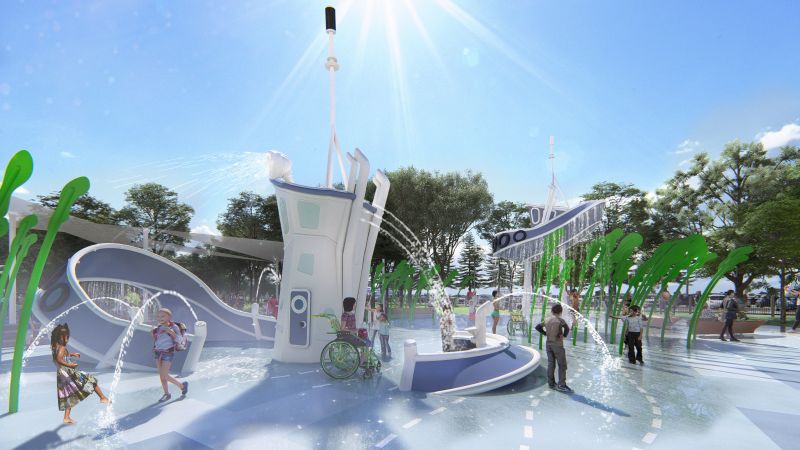
Sydney Children’s Hospital, Randwick’s new building and cancer research centre reaches highest point

The $658 million Sydney Children’s Hospital Stage 1 and Minderoo Children’s Comprehensive Cancer Centre has reached a major milestone, with construction of the new 12-storey building reaching its highest point.

Federal Minister for Health Mark Butler today joined NSW Minister for Health Ryan Park, Federal Member for Kingsford Smith Matt Thistlethwaite and Member for Coogee Dr Marjorie O’Neill for a traditional ‘topping out’ ceremony.

Honouring a long-held construction tradition, a Native Water Gum tree, which is native to the area, was lifted onto the roof of the new building.

The Sydney Children’s Hospital Stage 1 and Minderoo Children’s Comprehensive Cancer Centre is on track for completion in late 2025 and will include:

  • a new and enhanced children’s intensive care unit
  • a new and larger children’s emergency department  
  • a new medical short stay unit
  • a new neurosciences centre
  • a new virtual care centre and hospital command centre – KidsHQ
  • inpatient units for medical, surgical and sleep studies
  • a day oncology centre and inpatient units, along with a dedicated bone marrow transplant unit
  • co-located laboratories to support the Minderoo Children’s Comprehensive Cancer Centre’s research, education and training
  • a new children’s hospital pharmacy
  • improved parent amenities, including an Aboriginal Gathering Space and overnight and oncology bereavement rooms  
  • education and training spaces.

The $658 million project is part of a $1.5 billion investment in health as part of the Randwick Health and Innovation Precinct.

The Minderoo Children’s Comprehensive Cancer Centre will include advanced laboratory spaces and deliver integrated, specialist cancer treatment, education and research, aiming to transform childhood cancer treatment and become one of the world’s leading paediatric cancer centres.

The NSW and Federal Governments have partnered with Children’s Cancer Institute, Sydney Children’s Hospitals Network including the Kids Cancer Centre, and UNSW Sydney to plan and deliver Australia’s first Children’s Comprehensive Cancer Centre within the new children’s hospital and university buildings on site.

Philanthropic contributions have also been provided from Sydney Children’s Hospitals Foundation, Minderoo Foundation and Children’s Cancer Institute.

The project is being delivered by Health Infrastructure, with John Holland as the principal contractor.

For more information visit the Randwick Campus Redevelopment – NSW Health website.

Federal Minister for Health Mark Butler said:

“This exciting milestone is another step towards delivering a state-of-the-art health facility which will transform paediatric care for generations to come.

“Once complete, the new health facility will be world-class, bringing together leading clinicians, researchers and educators under the one roof.”

NSW Minister for Health Ryan Park said:

“This is about significantly improving health outcomes for kids and their families, by offering them the highest level of care.

“This project will deliver a new children’s emergency department, emergency short-stay unit, and ICU and a new paediatric virtual care centre which will provide care to patients across the state.

“There has been extensive consultation to develop this new building with over 1000 people involved, to ensure we deliver a space which feels like home to families facing their toughest times.”

Federal Member for Kingsford Smith Matt Thistlethwaite said:

“With the project reaching its highest point now, our community has a better idea of just what will be on offer when the new hospital is completed.

“This redevelopment of Sydney Children’s Hospital has created more than a thousand jobs, which is a really welcome boost to our local economy.”

Member for Coogee Marjorie O’Neill said:

“I am very proud of this major investment in paediatric healthcare for our community here in Randwick and in surrounding areas, which is now coming to fruition.

“There are extraordinarily talented and committed healthcare staff who work here, so it’s terrific that they will have these state of the art facilities to provide great care to our community.”

New high school for Sydney’s South-West fast tracked

The NSW Government is continuing work to ensure all students have access to quality, free education, close to their homes, with a new high school for Gregory Hills and Gledswood Hills to be fast tracked.

Public school students in parts of Sydney’s rapidly-growing South-West will be able to attend a new local high school from the start of next year, as the NSW Government plans to use existing temporary school facilities to fast-track the opening of the new high school by 2 years.

In a win for local families who have waited years for local school infrastructure to catch up with the exploding population, enrolments are now open for current year 6 students to attend the new high school for Gregory Hills and Gledswood Hills, from Day 1, Term 1, 2025.

The new high school will initially open in temporary facilities currently being used for Gregory Hills Public School students, who will vacate it by the end of this year. The new permanent primary school, which is located on the same site as the temporary school, is in the final stages of construction.

A site for the permanent new high school, catering for students from Gregory Hills and Gledswood Hills, was announced late last year and the acquisition is currently underway.

The announcement comes as Gledswood Hills Public School students returned to their school for the first day of Term 2 today with brand new facilities, following a major upgrade that has nearly doubled the number of classrooms, increasing student capacity from 575 to 1012 and enabling the removal of demountables from the school playground.

Camden is a rapidly growing part of Sydney’s outer South-West, with the population in the local government area skyrocketing from 78,218 in 2016 to 119,325 in 2021.

In addition to the new and upgraded schools in Gledswood Hills and Gregory Hills, the NSW Government is addressing the school infrastructure backlog in South-West Sydney with new public high schools announced in Leppington and Edmondson Park, and major upgrades at Leppington Public School, Austral Public School, Greenway Park Public School, and Dalmeny Public School.

This is part of the NSW Government $8.8 billion investment in new and upgraded schools, and follows the NSW Government’s enrolment audit which identified Gledswood Hills, Gregory Hills and 3 other South-West areas, within the state’s top 10 student growth areas of the past 5 years.

Deputy Premier and Minister for Education and Early Learning, Prue Car said:

“This is a double dose of good news for the communities of Gledswood Hills and Gregory Hills – a larger public school and a local place for their children to begin high school next year.

“Every child in NSW deserves access to a world-class public education, so I am thrilled that these new classrooms have now been delivered for the students of Gledswood Hills Public School, with demountables to now be removed from their playground.

“The Liberals and the Nationals left the families of Gledswood Hills and Gregory Hills without a local high school, and I am delighted to say the Minns Labor Government is fast-tracking the opening to meet the needs of local families.

“Camden is experiencing some of the most rapid population growth in Australia, and as Minister for Western Sydney I know how vital it is that we deliver schools for these communities.”

Member for Camden Sally Quinnell said:

“I am thrilled to see the progress that has been made to deliver much-needed school facilities for our growing community.

“It is wonderful to be here for the first day of Term 2 to see students in their new classrooms.

“The work we are doing here, for both primary school and high school students, is essential to the learning needs of our students today and into the future.”

NSW opposition’s bail proposals to address violence against women

The NSW Opposition proposes a suite of bail reform measures designed to address violence against women, improve protection for victims and survivors of domestic violence and enhance community safety.
 
The Liberals and Nationals acknowledge the reviews announced by the NSW Labor Government last week. We also acknowledge that bail reform specifically, and criminal justice reform more generally, is just one part of a holistic, far broader women’s safety strategy.
 
In the meantime, there are immediate common sense amendments that can strengthen the Bail Act.
 
The NSW Opposition proposes the following three-point initial bail reform response:
 
Expanded use of electronic monitoring devices to bail on serious domestic violence charges
Expanding grounds for staying the granting bail for serious personal violence charges
Removal of the power for registrars to determine bail for serious personal violence charges where bail is opposed, given the widespread audio-visual capacity across our courthouses enabling magistrates to make orders from centralised locations if necessary
 
The Opposition may support further changes after stakeholder consultation, community feedback and in response to the NSW Government’s reviews. 
 
We will consult on the initial three-point plan and on any other measures which are suggested to be appropriate.

Labor’s Tod Sepp enacted without consultation or funding

The Minns Labor Government’s Transport Oriented Development (TOD) planning laws are now in force, having been imposed on communities without any opportunity for consultation and no additional funding to address infrastructure needs and essential services. 
 
Leader of the Opposition Mark Speakman said that the Opposition supports measures, including increasing density along transport corridors, to meet ambitious housing targets, but they must be done right and in consultation with local communities.
 
“Premier Chris Minns called these the ‘largest planning reforms in the State’s history’, yet he failed to provide any opportunity for community consultation and the first anyone has seen of this SEPP is its publication in the Government Gazette,” Mr Speakman said.
 
“18 of 37 TOD sites are re-zoned for density around the station precincts today, without local councils seeing the planning instrument and the Minns Government denying the community any opportunity for consultation on the policy.”
 
“While these areas are earmarked for more than 175,000 new homes, the Minns Government hasn’t put one cent forward for new schools, roads or parks to support the increased population in these communities. Chris Minns can’t have a housing plan without a plan for upgraded infrastructure in all TOD areas,” Mr Speakman said.
 
Shadow Minister for Planning and Public Spaces, Scott Farlow, said that this policy isn’t the end of Labor’s one-size-fits-all changes that are set to impact local communities across NSW.
 
“While Labor’s TOD SEPP has been enacted today, their one-size-fits-all changes to low and mid-rise housing are still to come, which will have drastic impact across NSW,” Mr Farlow said.
 
“These changes will touch every corner of the State, allowing dual occupancies in all R2 zones, while introducing non-refusal standards for apartments, manor housing, terraces and multi- dwelling housing across Greater Sydney, and overriding heritage.”
 
“The changes will allow for apartment buildings of more than seven storeys within 400m of town centres, yet the Minns Government refuses to tell the public which town centres will be impacted,” Mr Farlow said.

$5 million to care for koalas in Sydney’s South West

The NSW Government is delivering on its commitment to the koalas of south-western Sydney with $4.5 million in new funding to establish a koala care centre in the Macarthur region and $500,000 to support volunteer rehabilitators.

The investment will boost the availability of expert help for injured and sick koalas in the region, which is home to a thriving koala population.

The koala care centre will be part of the Wildlife Health and Conservation Hospital on the Camden campus of the University of Sydney’s School of Veterinary Science. This facility treats the majority of koalas which come into care in the Macarthur region.

Those koalas include Mack and Gage, who are today being released back into the wild at Wedderburn in south-west Sydney after being treated and cared for by staff and volunteers from the Wildlife Health and Conservation Hospital and WIRES.

Mack and Gage will be observed for a week in a small area of bushland to ensure they are climbing trees properly. Then they’ll receive the green light to roam further afield.

The new funding will expand the hospital’s capacity to support koala rescue, rehabilitation and conservation.

The facility will also benefit wildlife rehabilitation across the region with on-call vet care and advice, and access to facilities such as pre-release enclosures, upgraded clinical equipment and biosecurity seclusion areas.

The $500,000 to support the region’s dedicated wildlife rehabilitators will be available via a grant program. The funding will support volunteers to continue their invaluable work rescuing and rehabilitating koalas.

This $5 million investment complements previous commitments to safeguard the region’s koalas, including habitat protection, koala friendly crossings and vehicle strike mitigation.

The new koala care centre funding is in addition to the allocation of $3.5 million to support regional wildlife hospitals in other parts of NSW.

Further information about Mack and Gage:

Orphaned female joey Macklin was found with her mother at the base of a tree in Holsworthy in July 2023. Both were taken to the Wildlife Health and Conservation Hospital for assessment, but the mother couldn’t be saved. Mack went into care with WIRES weighing just 555 grams. Minister for the Environment Penny Sharpe visited Mack at the Wildlife Health and Conservation Hospital in September 2023 (photo in linked Dropbox).

Orphaned male joey Gage came into care in October 2023 after his mother was hit and killed by a vehicle at Holsworthy. He weighed 985 grams when taken into care by WIRES.

Since being weaned, both Mack and Gage have been learning to climb and getting ready for release.

Minister for Climate Change and the Environment Penny Sharpe said:

“I have seen first-hand the important work carried out by the passionate and dedicated team at the Wildlife Health and Conservation Hospital, and I’m thrilled this funding will allow them to care for more koalas.

“I met little Mack at the Wildlife Health and Conservation Hospital in September when she was newly orphaned and being cared for by the excellent WIRES team. It’s wonderful to see her strong and healthy as she returns to the wild.

“The NSW Government is committed to ensuring the survival of koalas like Mack and Gage in the wild, and the koala care centre will help through rescue, rehabilitation and eventual release. The region’s wildlife carers are essential, and this grant will support their work.

“Safeguarding these koalas is vital. We want future generations to be able to step into bushland in south western Sydney and see koalas in the wild.”

Member for Campbelltown Greg Warren said:

“This $4.5 million koala care centre will benefit both the region’s wildlife and our passionate and dedicated carers, with the help, care and expertise it will offer.

“The community is grateful to the region’s wildlife volunteers who care so deeply for these special animals and the new south-west Sydney grants program will offer additional support.

“We are proud to be home to a thriving koala population.”

Planning changes begin today to deliver the homes NSW needs

The first stage of the NSW Government’s Transport Oriented Development (TOD) planning reforms is being delivered today, with the finalisation of the State Environmental Planning Policy (SEPP).

The new SEPP will amend planning controls around 37 well-located metro and rail stations, with 18 commencing immediately, helping to deliver more homes that are well designed and in well-located areas.

Over the next 15 years, this part of the TOD policy is estimated to deliver more than 170,000 new homes in mid-rise dwellings with new affordable homes, and apartment buildings that contain commercial space to create vibrant communities close to transport, services and jobs.

The NSW Government is committed to tackling the housing crisis. If we don’t build more houses, families will up and leave because they can’t afford a home in NSW. And if we lose our young people, we lose our future.

The SEPP is informed by consultation and feedback from councils and peak industry bodies on the proposed development standards contained in the SEPP.

The consultation resulted in the following planning controls:

  • Permissibility – Allowing residential flat buildings in residential zones and local centre zones, along with shop top housing in local and commercial zones.
  • Floor space ratio (FSR) – A maximum FSR of 2.5:1 has been set. This allows for buildings of up to 6 storeys while providing for landscaping, setback, privacy and open space standards to be met.
  • Building Height – A 22m height for residential flat buildings to maintain design standards and a maximum building of 24m for buildings containing shop top housing, to accommodate commercial ceiling height.
  • Lot size and width – Introduction of a minimum lot width of 21m and no minimum lot size.
  • Street frontages – The inclusion of a clause which applies to local and commercial centres to consider active street frontages of buildings at the ground floor.
  • Heritage – Applications involving heritage considerations will continue to be lodged with and assessed by councils. Councils are well placed to assess applications that might involve the removal of a non-contributory building to the heritage value of that area. Any new development needs to improve and enhance the heritage values of those locations.
  • Affordable Housing – At least 2% mandatory affordable housing contribution, delivered onsite and in perpetuity for developments with a minimum Gross Floor Area of 2000sqm, managed by a Community Housing Provider. The rate will increase over time and will reflect market conditions.
  • Apartment Design Guide (ADG) – The ADG will continue to be the principal guiding document for apartment development, including TOD developments.
    As part of this consultation, 27 briefings were conducted with all councils proposed to be included in the amending SEPP areas.

Additionally, 14 industry peak bodies and advocacy groups were consulted in January and February 2024 and 13 provided a submission.

The SEPP will be published today and will include maps for the first 18 TOD locations.

For the remaining locations where time for additional local planning has been provided, should councils fail to undertake local planning, nor provide equal or greater housing than proposed, the TOD SEPP will come into effect.

The majority of the sites will be in effect by December 2024.

From 13 May 2024, development applications (DAs) can be lodged on the NSW Planning Portal for sites around the first 18 metro and rail stations.

Councils will retain their existing assessment powers for development applications, allowing them to apply a merit-based assessment. Guidance and support is being provided to assist councils with their assessment of TOD development.

For more information on the TOD program, visit NSW Planning.

Minister for Planning and Public Space Paul Scully said:

“Housing is the largest single cost of living issue facing the people of NSW.

“These reforms are a critical part of our plan to deliver more homes as we confront the housing crisis.

“Though this SEPP, there is the capacity to deliver an estimated 170,000 more well-located, well-designed and well-built homes throughout Sydney, the Illawarra, the Hunter and Central Coast.

“The extensive consultation has been an important part of developing the settings to help deliver more housing in well located areas, around transport hubs, close to services, jobs and amenities.

“I want to thank those councils who came to us with a plan to deliver more homes and look forward to seeing the plans as they evolve.”

Big breakthrough in Burwood for Sydney Metro West

Two mega tunnel boring machines (TBMs) have arrived at Burwood North Metro Station site as the 24km Sydney Metro West twin tunnels connecting Greater Parramatta and the Sydney CBD charge ahead.

This marks a significant milestone on the Sydney Metro West project that the NSW Government has enhanced by driving housing uplift along the line.

The TBMs have each built 6.26km of tunnel, so far excavating a combined 1,200,000t of dirt (around 196 Olympic swimming pools) and installing around 44,100 tunnelling segments to line the new tunnel walls.

The TBMs are more than halfway through the 11km journey to carve out a section of the alignment between The Bays and Sydney Olympic Park, via future station sites at Five Dock, Burwood North and North Strathfield.

It will take just over 2 weeks for the TBMs to traverse to the western end of the cavern where they will be relaunched to tunnel the 1.8km to the next stop at Metro’s North Strathfield station site.

TBMs Beatrice and Daphne are due to complete the journey to Sydney Olympic Park in the second half of 2024.

This enhanced project will double rail capacity between Greater Parramatta and the Sydney CBD, making it easier and faster to travel around Western Sydney.

It will also turbocharge the delivery of new housing along transport lines improving affordability of housing, while reducing building and infrastructure costs and creating thriving communities.

Sydney Metro West is expected to be complete by 2032.

For more information on Sydney Metro West project overview website.

NSW Premier Chris Minns said:

“This marks a major milestone in delivering this crucial new Metro line that will make it easier for people across Western Sydney to travel around our city, while addressing the housing crisis that has gripped NSW.

“NSW is losing twice as many young people as we’re gaining, and it’s projects like this that create new homes for them that will play a critical role in making housing more affordable in NSW.

“Thank you to the thousands of people that are working to build this mammoth project, the largest public transport project in Australia.”

Transport Minister Jo Haylen said:

“Australia’s biggest public transport project is making fast progress. Daphne and Beatrice can almost see the finish line, they’re just under 5km away from their final destination, Sydney Olympic Park.

“These breakthroughs mean we are a step closer to delivering this once-in-a-century infrastructure investment in our city that will be a catalyst for housing growth across Sydney.

“When Burwood North Metro Station opens, it will be an exciting, state-of-the-art transport destination that will change the way people move in what is currently a very bus-dependent corner of our city, and it will take pressure off the existing T1 Western line.”


TBM Beatrice and Daphne fast facts:

  • TBMs are double-shield, hard rock TBMs specifically designed to excavate through the sandstone and shale ground conditions. 
  • A team of 15 workers per shift operate each TBM as it excavates an average of 200m per week.
  • The TBMs are 165m long (more than the length of 2x A380s which are approx. 73m).
  • TBMs are built using refurbished cutterheads, front shields and gripper shields from TBMs used on the Sydney Metro City & Southwest project.
  • Each TBM is approx. 7m in diameter.
  • 34x disc cutters per cutterhead (disc cutters are approx. 48cm in diameter).
  • Heaviest pieces of the TBM are the front shield and gripper shield both approx. 280t each, the cutterhead is approximately 102t.
  • To prepare for the arrival of the TBMs, the Burwood North station box cavern was excavated and about 532,105t of material was removed to create the 29-metre-deep box-like structure that is 25m wide and 194m long.

A safer Kamilaroi Highway

A $34.6 million project to boost safety on a 17-kilometre stretch of the Kamilaroi Highway in north-west NSW has been completed, providing smoother, safer journeys for local residents, tourists and freight operators.

Work on an upgrade of the Kamilaroi Highway between Baan Baa and Turrawan started in December 2019 on the section of road between Narrabri and Gunnedah due to its crash history.

The final safety barriers have been installed to provide protection for motorists leaving the road as well as wide centre lines, audio tactile line marking (rumble strips), widened clear zones and other safety measures to help prevent run-off road and head-on crashes and their severity.

The work was funded by the NSW Government through the Safer Roads Program after a 2014 review by the Centre for Road Safety identified speeding and driver fatigue as the major hazards on this section of the highway.

Community consultation after the review identified the need for new overtaking lanes to provide safe passing opportunities for motorists stuck behind slower moving vehicles, easing frustration for all drivers and improving safety. A pull-over bay was constructed for Over Size Over Mass (OSOM) vehicles about 7.5 kilometres north of Baan Baa.

Other safety measures incorporated into the project include:

  • Designated school bus stopping and turning bay near the Turrawan Road intersection
  • 2.5-metre wide sealed shoulders providing more room for vehicles
  • Widened roadside clear zones
  • Raised retroflective pavement markers
  • Flatter roadside batters (or slopes)

Minister for Regional Transport and Roads Jenny Aitchison said:

“Safety is our number one priority on all NSW roads and the work completed between Baan Baa and Turrawan reflects our commitment to making much-needed improvements wherever they are needed.

“Between July 2012 and October 2019 there were 18 crashes recorded in this area, including four fatal crashes, seven serious injury crashes and four moderate injury crashes.

“A high proportion of these crashes were the result of vehicles crossing the centre lines and safety improvements such as these can increase the distance between oncoming traffic and alert drivers when they leave their lane.

“Evidence shows that wire rope barriers can significantly reduce the risk of death and serious injury in crashes because they dissipate the energy of a crash away from people in cars, and because the rope deflects and contains the vehicle from hitting other objects, such as trees and other vehicles.”

Barwon Duty MLC Stephen Lawrence said:

“The Baan Baa to Turrawan safety upgrade has delivered a significant suite of changes that will not only improve safety for all motorists in the area but has also delivered a significant boost to the local economy.

“Each of the four sections of work supported about 160 local jobs, including staff from an average of 22 different contractors/suppliers who assisted with resources and skills per section.

“In all, 52 different contractors and suppliers conducted work on the project and they should all be very proud of the job they’ve delivered, despite several delays due to heavy rain in the area and the relocation of crews to other emergency patching jobs across the NSW roads network.”

Independent Member for Barwon Roy Butler MP said:

“This stretch of road sees a lot of heavy vehicles working on the mines, along with a lot of tourists and everyday traffic, any upgrade that improves safety is more than welcome.

“Work crews have laid 422,589 tonnes of locally-sourced crushed gravel and aggregate to build and seal the full length of highway and installed, laid audio tactile line marking (rumble strips) and installed other safety measures to help prevent run-off road and head-on crashes.

“I welcome any improvements to the road that make it safer and better to drive on.”

Workers lives remembered at International Day of Mourning event

The New South Wales Government today pays its deepest respects to those who have died from work-related incidents or illness and their loved ones.

I will today join Unions NSW at a service at Reflection Park at Sydney’s Darling Harbour to honour the memory of those who have lost their lives, with the family, friends, and co-workers of victims.

The NSW Government believes every worker deserves a safe workplace and any workplace death is a tragedy.

While today we remember those who didn’t come home to their loved ones, the best tribute the NSW Government can offer is a safer future for others.

The NSW Government is acting to transform SafeWork NSW into a standalone regulator with a heightened role for families of injured workers.

We are enacting an industrial manslaughter offence – the last mainland state to introduce this offence – to hold to account those responsible for the death of a worker due to negligent or reckless behaviour.

The NSW Government is progressing a world-leading ban on engineered stone from July 1 to stem the rise in deadly silicosis.

This is a sombre day of grief and remembrance, but it must also be a day on which we recommit to action.

Hunter Street over station development gets planning tick

A world-class precinct at Hunter Street is one step closer with plans for the key major CBD precinct receiving planning approval from the Department of Planning, Housing and Infrastructure.

The proposals are for a 58-storey building above Hunter Street Station East, between O’Connell Street and Bligh Street, and a 51-storey building above Hunter Street Station West, on the corner of George Street and Hunter Street.

The two new buildings will support additional jobs and economic growth through new commercial and retail land uses in Central Sydney.

These new commercial and retail buildings will also be linked directly by Sydney Metro West to thousands of new additional homes being turbocharged by the NSW Government.

The construction of Hunter Street station commenced in 2023 and is well underway with major excavation of the station cavern ongoing.

When Sydney Metro West opens, passengers will also be able to use an underground walkway to connect to metro services on the Metro North West Line and City & Southwest line at Martin Place. Connections to light rail and train services will be close by at Wynyard Station

To drive improved placemaking outcomes for the area, Sydney Metro is using a first-of-its-kind procurement model. The planning process for Hunter Street over station development is running concurrently with the procurement of a development Partner to deliver the project.

Two consortia were shortlisted to work with Sydney Metro to develop the vision for Hunter Street Station as a world-class precinct at the heart of a vibrant and connected city.

Final plans for the area are subject to ongoing engagement with industry and key stakeholders, which will continue throughout 2024.

Transport Minister Jo Haylen said:

“This is an exciting milestone for the Sydney Metro West project, we’ve been given the green light to continue developing the detailed designs for this brand new station precinct.”

“The successful tenderer will deliver a brand new station beneath Hunter Street and two new buildings above.”

“The 24km Metro West line will not only unlock housing supply across our city, but developments like this one at Hunter Street will be incredible new employment centres.”

Planning & Public Spaces Minister Paul Scully said:

“The Hunter Street precinct is creating an opportunity to see more jobs delivered near a world-class transport network.

“These two new buildings will pave the way to connect people to their homes, jobs and the Sydney CBD.

“Making sure we have enriching public spaces in our cities is an important stage in the planning process. Both stations and buildings will help revitalise Sydney’s CBD and its transformation into a 24-hour economic centre.”