Paltry fine for billion dollar coal company after polluting Royal National Park

The Land and Environment Court has fined Peabody Coal just $196,560 of the maximum penalty of $5 million for the spilling of coal sludge into the Royal National Park in 2022 and 2023. The judgement shows that the pollution caused by Peabody’s Metropolitan Colliery had significant environmental impacts and caused lasting damage to the aquatic environment downstream of the spill. Despite being found to be mid-range offending, the small penalty will do little to dissuade future offences from occurring. 

Greens MP and spokesperson for the environment Sue Higginson said:

“The system of regulating polluters who harm communities and the environment is woefully inadequate, that is the only clear takeaway from this judgement,” 

“The American owner of the coal mine, Peabody Coal, responsible for this pollution makes billions of dollars in income from their Australian holdings. Despite taking our resources, and polluting our environment and climate, they pay no tax and even claim tens of millions of dollars in tax credits from the Australian people. This fine of less than $200 thousand isn’t even a drop in the bucket for this environment and climate vandal,” 

“As long as the profit motive for committing environment crimes is greater than the penalties our Governments are willing to impose on polluters, our communities and nature will be in the firing line for unethical business models that see pollution as a cost of doing business,” 

“This relatively small fine is a slap to the face for the environment, the community – and particularly those members of the community who uncovered this pollution in the first place. The coal mine knew they were polluting the beautiful waters of the Royal National Park, but it wasn’t until community members raised the alarm that an investigation started,”  

“This mine needs a closure plan, not permission to continue operating next to and polluting our oldest and most visited national park. What this investigation has shown is that the coal mine is simply unable to properly manage the flow of polluted water from their mine into our precious Royal National Park,” Ms Higginson said. 

Cooper Riach, Sutherland Shire Environment Centre:  

“It is clear that our environmental laws do not protect nature, and are instead protecting the profits of companies like Peabody.” 

“At some point we need to ask ourselves, which do we value more? The profits of American coal barons, or the protection of the oldest National Park in Australia.” 

“Ultimately this is not the right place for a coal mine, and until this mine is closed and completely cleaned up, it will continue to pollute the Royal National Park,” 

Tiny tax tweak Budget a missed opportunity to get dental into Medicare, tax the big corporations: Greens

The Australian Greens have said today’s budget was a missed opportunity to deliver real cost of living relief by getting dental into Medicare, and to pay for it by making the big corporations pay their fair share of tax, which would have delivered more help than tiny tax tweaks that are 15 months away.

In a wealthy country like ours, everyone should be able to afford the basics – a home, food, and have access to world class health and education.

Instead, many people are struggling to afford the essentials while one in three big corporations is paying no tax.

Labor’s budget has delivered $56 billion in fossil fuel subsidies and $176 billion for wealthy property investors, but failed to deliver the bold reforms needed to support people being smashed by the skyrocketing cost-of-living.

The two new tax cuts announced by the government will barely scratch the surface for people struggling to pay for food or rent, and won’t come into effect for 15 months, with low income workers saving only 73 cents a day, which wouldn’t even cover one cup of coffee per week.

Meanwhile, the government’s previous stage three tax cuts delivered $4,500 in tax cuts for billionaires, with these new cuts increasing those savings to more than $5,000 for billionaires like Gina Rinehart and Clive Palmer.

There are no increases to Job Seeker or Youth Allowance in this budget, meaning the more than one million on these income supports will remain in poverty.

And the government has forecast billions more in cuts to the NDIS.

On housing, the government has fixed some of the problems the Greens have highlighted in the Help to Buy scheme, but there is nothing new for renters, who didn’t even get a mention in the Treasurer’s speech.

Climate and the environment got zero mention in the Treasurer’s speech as well. Perhaps this is not surprising as Labor has approved over 30 coal and gas projects in this term of Parliament alone and is gutting Australia’s environment laws.

The government is also continuing to pour billions of dollars more into nuclear submarines as AUKUS costs increase, with funding in this budget blowing out from $12 billion to $18 billion.

Labor has also broken its promise on refugees, by failing to increase the humanitarian intake.

In a sign that Greens’ pressure works, Labor did commit to adopting part of the Greens’ plan to see the GP for free, by tripling the bulk-billing incentive.

Labor also locked in their commitment to wipe 20 per cent off student debt, a step towards the Greens’ plan to wipe it completely.

Labor has also made a significant investment in women’s sexual and reproductive health, including cheaper contraceptives, more accessible menopause treatment, and investment in the maternal health workforce. This follows a Greens’ campaign including two Greens-initiated Senate inquiries.

However, the Greens say it is disappointing that rather than locking in that cost-of-living relief right now, Labor has used the cover of the budget to do a dodgy deal with Dutton to gut environment and climate laws.

While everyone was focused on the budget, Labor and the Liberals have teamed up to ram through legislation in Parliament to gut our climate and environment laws making it easier for big corporations to trash our precious natural environment and approve more coal and gas. 

It shows you can’t keep voting for the same two parties and expecting a different result.

This election the Greens will keep Dutton out and get Labor to act on what people need like getting dental and mental health into Medicare, seeing the GP for free, capping rent increases and lowering mortgages, and taking strong climate action.

The Greens’ previously announced plan to tax the excessive profits of big corporations across different sectors of the economy would raise $514 billion dollars over the next decade.

Leader of the Australian Greens, Adam Bandt MP:

“This tiny tax tweak budget was a missed opportunity to provide urgent cost of living relief, like dental into Medicare. Instead, Labor teamed up with the Liberals to gut our environment laws.

“An extra 73 cents a day in 15 months’ time won’t do much when your rent has already gone up hundreds of dollars a week.

“Billionaires and politicians still end up with tax cuts four times as big as low income earners.

“In a wealthy country like ours, everyone should be able to afford the basics: a home, food, and have access to world class health and education. 

“Under this Budget, one in three big corporations pays zero tax.

“We can’t keep voting for the same two parties and expecting a different result.

“We should tax big corporations and billionaires to fund what we all need like getting dental and mental health into Medicare, seeing the GP for free, capping rent increases and lowering mortgages, and taking strong climate action.

“There will be a minority government and the Greens are within reach of winning seats right across the country. Last time there was a minority government, the Greens got dental into Medicare for kids. This is our chance to deliver it for everyone.

“If you want change, the first step is to vote for it.”

Greens Treasury spokesperson, Senator Nick McKim:

“This budget is far more notable for what it doesn’t contain than what it does. It’s a massive, missed opportunity to deliver genuine cost of living relief funded by making ultra-wealthy billionaires and big corporations pay their fair share of tax.

“Instead of colluding with Peter Dutton to weaken Australian environment laws, Labor should have spent this week working with the Greens to put dental into Medicare and better protect our environment.”

Greens Finance spokesperson, Senator Barbara Pocock:

“Australians need cost-of-living relief and a wealthy country like ours can afford world class health and education services.

“These vital services depend on a healthy, well-funded public sector. We must end the rorting of consultants and the endless outsourcing of government services to private contractors.

“The way to get value for money and to ensure adequate services is to build capacity in the public service. We need assurances from Labor that the reduction in spending on external contractors will actually reduce the government’s reliance on consultants.”

Building Australia’s future

This is a responsible Budget that helps with the cost of living, while Building Australia’s Future.

We are delivering more tax relief for every Australian taxpayer, more energy bill relief and cheaper medicines.

We are strengthening Medicare, investing in housing and education, advancing reforms to make our economy stronger, and building a Future Made in Australia.

The Budget builds on the strong foundations we have laid, helping to secure our nation’s future at a time of global uncertainty.

We know Australians have made sacrifices, and the Albanese Labor Government remains focused on delivering for households.

We’re providing relief now and investing in the future, while delivering the biggest improvement to the bottom line in a single parliamentary term.

This means smaller deficits and much lower debt compared to what we inherited.

The Budget forecasts an improvement in the bottom line over the forward estimates, and a lower deficit in 2025-26.

Treasury also expects inflation to return sustainably to the RBA’s target band six months earlier than previously expected.

Today, because of the work Australians have done together, our economy is turning the corner.

Inflation is down, unemployment is low, real wages are growing again, and interest rates have started to come down.

We’ve achieved this the Australian way – looking after each other, and working together.

Our responsible Budget helps Australians now and builds Australia’s future by:

  • Delivering cost of living relief.
  • Strengthening Medicare.
  • Making it easier to buy and rent a home.
  • Investing in every stage of education.
  • Building a stronger economy.

Easing the cost of living 

The world has thrown a lot of challenges at Australia over the past few years, and helping every Australian with cost of living remains the Government’s top priority.

This Budget delivers:

  • New tax cuts for every Australian taxpayer.
  • Another $150 energy rebate for every household and small businesses.
  • Even cheaper medicines by reducing the PBS co-payment.
  • Higher wages for aged care nurses.
  • A fair go for Australian consumers.

Strengthening Medicare

More bulk billing means less pressure on households.

This Budget delivers:

  • $7.9 billion to increase bulk billing so Australians can see a GP for free.
  • 50 more Medicare Urgent Care Clinics across Australia.
  • $1.8 billion to fund public hospitals.
  • $793 million invested to deliver more choice, lower costs and better care for women.
  • Hundreds more training places for doctors and nurses.

Making it easier to buy and rent a home

The Budget takes the Government’s total new housing commitments to $33 billion to help us build more homes for Australians.

This Budget includes:

  • An expansion of Labor’s Help to Buy scheme.
  • $54 million to accelerate the uptake of modern methods of construction to build more homes faster.
  • A ban on foreign investors from purchasing existing homes.
  • Incentives to train more construction workers.

This is a responsible Budget that helps with the cost of living, while Building Australia’s Future.

We are delivering more tax relief for every Australian taxpayer, more energy bill relief and cheaper medicines.

We are strengthening Medicare, investing in housing and education, advancing reforms to make our economy stronger, and building a Future Made in Australia.

The Budget builds on the strong foundations we have laid, helping to secure our nation’s future at a time of global uncertainty.

We know Australians have made sacrifices, and the Albanese Labor Government remains focused on delivering for households.

We’re providing relief now and investing in the future, while delivering the biggest improvement to the bottom line in a single parliamentary term.

This means smaller deficits and much lower debt compared to what we inherited.

The Budget forecasts an improvement in the bottom line over the forward estimates, and a lower deficit in 2025-26.

Treasury also expects inflation to return sustainably to the RBA’s target band six months earlier than previously expected.

Today, because of the work Australians have done together, our economy is turning the corner.

Inflation is down, unemployment is low, real wages are growing again, and interest rates have started to come down.

We’ve achieved this the Australian way – looking after each other, and working together.

Our responsible Budget helps Australians now and builds Australia’s future by:

  • Delivering cost of living relief.
  • Strengthening Medicare.
  • Making it easier to buy and rent a home.
  • Investing in every stage of education.
  • Building a stronger economy.

Easing the cost of living 

The world has thrown a lot of challenges at Australia over the past few years, and helping every Australian with cost of living remains the Government’s top priority.

This Budget delivers:

  • New tax cuts for every Australian taxpayer.
  • Another $150 energy rebate for every household and small businesses.
  • Even cheaper medicines by reducing the PBS co-payment.
  • Higher wages for aged care nurses.
  • A fair go for Australian consumers.

Strengthening Medicare

More bulk billing means less pressure on households.

This Budget delivers:

  • $7.9 billion to increase bulk billing so Australians can see a GP for free.
  • 50 more Medicare Urgent Care Clinics across Australia.
  • $1.8 billion to fund public hospitals.
  • $793 million invested to deliver more choice, lower costs and better care for women.
  • Hundreds more training places for doctors and nurses.

Making it easier to buy and rent a home

The Budget takes the Government’s total new housing commitments to $33 billion to help us build more homes for Australians.

This Budget includes:

  • An expansion of Labor’s Help to Buy scheme.
  • $54 million to accelerate the uptake of modern methods of construction to build more homes faster.
  • A ban on foreign investors from purchasing existing homes.
  • Incentives to train more construction workers.

Investing in every stage of education

This Budget invests in every stage of education to support students and build the workforce of the future.

This Budget includes:

  • Investments in public schools to put them on a path to full and fair funding.
  • $5 billion to expand access to early education and care and fund a historic wage rise for early educators.
  • Cuts to student debt and lowering repayments.
  • Funding for 100,000 Free TAFE places every year from 2027.

Building a stronger economy

The Albanese Government is building a stronger, more productive and more resilient economy.

This Budget delivers:

  • Competition reforms like progressing national occupational licensing for electrical trades.
  • Reforms to non-compete clauses for low and middle-income workers to lift affected workers’ wages by up to four per cent or $2,500 a year.
  • More support for small businesses, taking Labor’s total targeted small business commitments in this term of Parliament to more than $2 billion.
  • More than $3 billion to unlock investment in green metals and manufacturing.
  • $17.1 billion to deliver vital infrastructure.
  • Up to $3 billion to complete the NBN rollout, supporting suburbs and regions.

Responsible economic and fiscal management 

Our responsible economic management has improved the budget position, paid down Liberal debt and made room for the investments that matter to Australians like tax cuts for every taxpayer, a stronger Medicare and more housing.

  • The Budget position has improved by $207 billion over the seven years to 2028-29 – the biggest turnaround in the budget in a Parliamentary term.
  • We’ve turned two big Liberal deficits into two Labor surpluses in our first two years and the deficit in our third year of $27.6 billion is almost half what was forecast at the last election.
  • The deficit in 2025-26 is projected to be $42.1 billion, lower than MYEFO and what we inherited.
  • Debt is $177 billion lower in 2024-25 than what was forecast at the last election, helping us avoid around $60 billion in interest costs.

This Budget continues the Albanese Government’s economic plan which is focused on finishing the fight against inflation, delivering responsible cost of living relief and building a stronger economy and stronger budget.

This Budget invests in every stage of education to support students and build the workforce of the future.

This Budget includes:

  • Investments in public schools to put them on a path to full and fair funding.
  • $5 billion to expand access to early education and care and fund a historic wage rise for early educators.
  • Cuts to student debt and lowering repayments.
  • Funding for 100,000 Free TAFE places every year from 2027.

Building a stronger economy

The Albanese Government is building a stronger, more productive and more resilient economy.

This Budget delivers:

  • Competition reforms like progressing national occupational licensing for electrical trades.
  • Reforms to non-compete clauses for low and middle-income workers to lift affected workers’ wages by up to four per cent or $2,500 a year.
  • More support for small businesses, taking Labor’s total targeted small business commitments in this term of Parliament to more than $2 billion.
  • More than $3 billion to unlock investment in green metals and manufacturing.
  • $17.1 billion to deliver vital infrastructure.
  • Up to $3 billion to complete the NBN rollout, supporting suburbs and regions.

Responsible economic and fiscal management 

Our responsible economic management has improved the budget position, paid down Liberal debt and made room for the investments that matter to Australians like tax cuts for every taxpayer, a stronger Medicare and more housing.

  • The Budget position has improved by $207 billion over the seven years to 2028-29 – the biggest turnaround in the budget in a Parliamentary term.
  • We’ve turned two big Liberal deficits into two Labor surpluses in our first two years and the deficit in our third year of $27.6 billion is almost half what was forecast at the last election.
  • The deficit in 2025-26 is projected to be $42.1 billion, lower than MYEFO and what we inherited.
  • Debt is $177 billion lower in 2024-25 than what was forecast at the last election, helping us avoid around $60 billion in interest costs.

This Budget continues the Albanese Government’s economic plan which is focused on finishing the fight against inflation, delivering responsible cost of living relief and building a stronger economy and stronger budget.

New cost of living tax cuts under Labor

The Albanese Government will deliver two more tax cuts to every Australian taxpayer in 2026 and 2027, adding to the first round that Labor delivered in July last year. 

Every Australian taxpayer gets another tax cut from next year – all 14 million, not just some. 

This will give a top up to every taxpayer, right up and down the income scale. 

Labor’s new tax cuts are modest but they will make a difference. 

Combined with Labor’s first round of tax cuts, the average tax cut is expected to be around $43 per week or more than $2,200 in 2026-27, and around $50 per week or more than $2,500 in 2027-28.  

It’s a bit of extra help for every taxpayer and it tops up our tax cuts that started flowing on 1 July 2024. 

Labor’s new tax cuts will be phased in over two years, ensuring our fiscal settings are consistent with inflation remaining sustainably in the target band. 

Last year, we cut two rates and lifted two thresholds to deliver tax cuts for all Australian taxpayers, including around three million people who would have missed out completely under Scott Morrison’s policy from before the election.  

The Albanese Labor Government will cut income taxes further over two years:

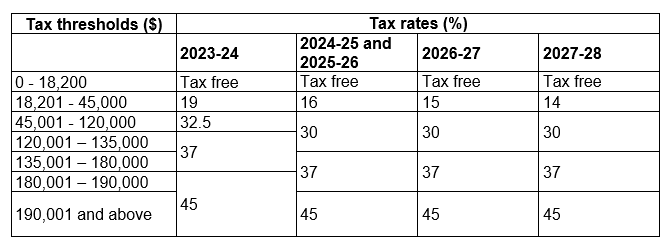
  • From 1 July 2026, we will reduce the 16 per cent tax rate to 15 per cent (for income between $18,201 and $45,000).
  • From 1 July 2027, this tax rate will be reduced further to 14 per cent.

As a result of these changes: 

  • All 14 million Australian taxpayers will receive a tax cut, on top of our tax relief that’s already rolling out.
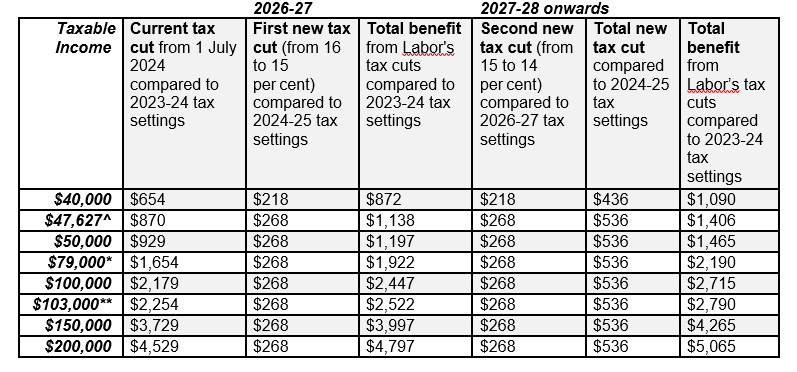
  • Every Australian taxpayer earning above $45,000 (around 80 per cent of taxpayers) will get an extra tax cut of $268 in 2026-27 and $536 from 2027-28, compared to 2024-25 settings.
  • A worker on average earnings ($79,000) will get an extra tax cut of $268 in 2026–27 and $536 per year from 2027–28.
  • Every Australian taxpayer earning between $18,201 and $45,000 will get an extra tax cut of up to $268 in 2026-27 and up to $536 from 2027-28, compared to 2024-25 settings.
  • A person earning $40,000 will get an extra tax cut of $218 in 2026-27 and $436 every year from 2027-28.

Combined with Labor’s first round of tax cuts:

  • The average tax cut is expected to be around $43 per week or more than $2,200 in 2026-27, and around $50 per week or more than $2,500 in 2027-28, compared with 2023-24 settings.
  • An average earner will receive total tax relief of $1,922 in 2026–27 and $2,190 per year from 2027–28, compared to 2023–24 tax settings.
  • The average income earner will pay around $30,000 less in tax to 2035-36, compared to 2023-24 settings.

The Government’s personal income tax reforms lower the first tax rate from 19 to 14 per cent, the second tax rate from 32.5 to 30 per cent, and lift two thresholds. 

Our changes to the bottom tax rate under the new tax cuts will bring this rate to its lowest level in over 50 years.  

In addition, the Government will increase the Medicare levy low-income thresholds from 2024-25. 

This will benefit more than a million Australians, ensuring people on lower incomes continue to pay a reduced levy rate or are exempt from the Medicare levy. 

Labor’s tax cuts return bracket creep, increase the financial rewards from work and boost labour supply. 

Whether you’re a truckie, a teacher or a tradie, whether you’re in manufacturing, mining or the care economy, you will earn more and keep more of what you earn. 

Our new tax cuts for every Australian taxpayer come on top of our substantial and responsible cost of living relief including:

  • Cost of Living Tax Cuts from 1 July 2024;
  • Energy bill relief for every household and for small businesses;
  • Strengthening Medicare with more bulk billing;
  • Cheaper medicines, with a script to cost Australians no more than $25 under the Pharmaceutical Benefits Scheme;
  • Cheaper child care;
  • Cutting student debt and repayments;
  • Free TAFE;
  • Increased rent assistance and working age payments;
  • Building more homes;
  • Higher wages.

The changes to the personal income tax system will cost $17.1 billion over the forward estimates.  

The increase to the Medicare levy low-income thresholds will cost $648 million over the forward estimates.  

The Albanese Government’s responsible economic and fiscal management has allowed us to fund important priorities like this tax relief for every Australian taxpayer. 

Our economic plan is all about helping Australians earn more and keep more of what they earn and that’s what these tax cuts will help to achieve. 

To find out how much the Government’s tax cuts will benefit you, use the calculator on the Budget website: budget.gov.au

Table 1: New personal tax rates and thresholds 

Table 1: New personal tax rates and thresholds

Table 2: Summary of tax benefits 

Table 2: Summary of tax benefits

^ The national minimum wage is $47,627, set by the Fair Work Commission under the Fair Work Act as of 1 July 2024. 
* Annualised average weekly earnings is around $79,000, based on $1,510.90 per week in November 2024 (ABS data release), which captures average gross wages across all employees, including full- time and part-time workers. 
** Average ordinary full-time earnings is $103,000, based on $1,975.80 per week in November 2024 (ABS data release), which captures average gross wage income across full-time employees only, and excludes any income earned from overtime. 

Responsible cost of living help

Cost of living is front of mind for most Australians, and front and centre in the Budget.

The Albanese Government is delivering responsible and meaningful cost of living relief for Australian families.

We’re providing more hip pocket help for households.

The centrepiece of the Budget is more tax cuts for every taxpayer, which will benefit 14 million Australians.

Helping Australians earn more and keep more of what they earn is a central part of our economic plan.

The new tax cuts will top up the relief that started flowing for workers last year.

They will help with the cost of living while delivering broader economic benefits – like returning bracket creep and boosting labour supply.

But there are several other significant initiatives as well that will make a meaningful difference for Australians.

We’re delivering energy bill relief to every household, even cheaper medicines, historic investments in Medicare, higher wages and a fairer go for consumers.

The families of middle Australia are the biggest beneficiaries of this cost of living help. The combined benefit for an average household will be more than $15,000 from our two rounds of tax cuts and energy bill relief over the four years to 2027-28.

Labor’s plan to help with the cost of living includes:

  • A new tax cut for every taxpayer – every Australian taxpayer gets another tax cut from next year – all 14 million, not just some.
  • More energy bill relief – $1.8 billion to extend energy bill relief to the end of the year for every household and small businesses.
  • Growing wages – $2.6 billion for a well-deserved wage increase for aged care nurses and stopping unfair non-compete clauses that are holding back Australian workers from switching to better, higher-paying jobs.
  • Even cheaper medicines – Reducing the maximum price of PBS medicines to $25 and $1.8 billion to list more life-changing medicines on the PBS.
  • Cutting student debt – wiping 20 per cent off all student debts and lifting the repayment threshold for graduates.
  • Strengthening Medicare – $8.5 billion to make more GP visits bulk billed for all Australians and train more doctors and nurses, as well as $657.9 million to open another 50 Medicare Urgent Care Clinics and expand existing services.
  • Making it easier to buy and rent a home – lifting the income and property price caps for Help to Buy to help more Australians into a home with a lower deposit and smaller mortgage, supporting innovative construction to build more homes sooner and delivering financial incentives to apprentices in the housing construction sector.
  • Permanent Free TAFE – making 100,000 Free TAFE places available across Australia every year.
  • A fair go for families and farmers – getting people a better deal at the checkout by strengthening the ACCC’s powers, fighting shrinkflation and helping suppliers stand up to the big supermarkets.
  • Delivering more affordable and accessible child care – establishing the Three Day Guarantee so families are eligible for at least three days of subsidised early education and care, and building more child care centres across Australia.

Under Labor, inflation is down, incomes are growing, unemployment is very low, interest rates are coming down and growth has rebounded solidly as well – but we know Australians are still doing it tough.

This Budget helps people with the cost of living and finish the fight against inflation, strengthen Medicare and builds a stronger economy.

Building a stronger economy

The Albanese Labor Government is securing Australia’s future during a time of global uncertainty by making our economy more productive and more resilient.

Our best defence against global pressures is a stronger economy, and that’s what we are building in this Budget.

We’re making our economy more dynamic by advancing National Competition Policy reforms and investing in productivity-enhancing infrastructure, including the National Broadband Network.

We’re building a Future Made in Australia – creating jobs and opportunity for generations of Australians as we continue the work of making our country an indispensable part of the global net zero transformation.

We are also backing hardworking local businesses by investing $20 million to encourage consumers to buy Australian made products through the Buy Australian campaign.

The world has thrown a lot of challenges at Australia over the past few years.

It’s clear the rules that underpinned global economic engagement for more than 40 years are being rewritten. Our economic plan is all about ensuring Australians are beneficiaries, not victims, of this churn and change.

Budget commitments to build a stronger economy include:

  • Investing more than $3 billion to support local green metals production to help build a Future Made in Australia.
  • Unlocking an expected $6 billion of additional private investment in renewable energy and low emissions technologies through a $2 billion expansion of the Clean Energy Finance Corporation.
  • Support for small businesses, including extending energy bill relief for around one million small businesses and cracking down on unfair trading practices.
  • $7.1 million over two years to strengthen enforcement of the Franchising Code.
  • $165 million in tax relief for hospitality venues, brewers, distillers and wine producers including a two-year freeze on the indexation on draught beer excise.
  • Supporting local businesses including $20 million to encourage consumers to buy Australian made products through the Buy Australian campaign.
  • $17.1 billion over 10 years for road and rail projects to improve the productivity and resilience, liveability and sustainability of our cities, regions and communities.
  • Up to $3 billion to complete the National Broadband Network to deliver access to faster and more reliable broadband services to a further 622,000 premises nationwide.

Our reforms in this Budget reduce red tape for businesses and workers.

The Government is also accelerating productivity-enhancing reforms as part of our revitalised National Competition Policy. This Budget includes:

  • Banning non-compete clauses for low and middle-income earners to boost workers’ wages. Research shows that reforms to these clauses could lift the wages of affected workers by up to four per cent or $2,500 for workers on average wages and lift GDP by $5 billion per year.
  • Progressing the design of a national licensing scheme for electrical occupations to cut red tape for businesses, save tradies time and money and enable electricians to work seamlessly across borders. The Productivity Commission suggests licensing reforms across a range of industries would provide long-term benefits, including a boost to GDP of up to $10.3 billion.

The Government is also ensuring Australia has a highly skilled workforce for the future by putting public schools on a path to full and fair funding and making Free TAFE permanent.

Our economic plan is already helping to strengthen Australia’s economy and this Budget will help to ensure we continue to make progress.

We saw growth in our economy rebound solidly at the end of last year, with the private sector taking its rightful role as a key driver of growth.

Treasury expects growth in our economy to pick up in the period ahead, with the private sector driving more of the growth.

In an increasingly uncertain global economic environment, this Budget invests in our people and productivity to make our economy stronger and more resilient.

Australia-Korea Foundation Board appointments and grants

Today I announce the appointment of Dr Scott Watkins as Chair of the Australia-Korea Foundation (AKF), as well as new board members to support the Foundation’s work.

The AKF works to strengthen economic, strategic and personal links between Australia and the Republic of Korea (ROK).

Dr Watkins has been a Board Member since 2022 and is active in forging networks between Australian and South Korean youth. He is the Chief Sustainability Officer at KISCO, a South Korean chemicals and inks manufacturer, and previously worked for CSIRO.

I am pleased to announce the appointment of three new board members who each bring extensive experience to support the objectives of the AKF:

  • Professor Gordon Flake, founding CEO of the Perth USAsia Centre
  • Ms Julianne Lee, Vice President of Voice of Korean Australian Businesses and Director a Rosecello Pty Ltd
  • Mr Sung Ho Lee, Partner at Johnson Partners.

I have reappointed Ms Robyn Bryant, from Bryant Family Grazing in Southern Queensland, for a second three-year term from March 2025.

I greatly appreciate the efforts of outgoing Chair Peter Coleman and Board Member Ms Karen Halbert for their substantial contribution the Australia-ROK relationship and thank them for their work supporting the AKF.

Today I am also delighted to announce that grants have been awarded to 22 recipients in the 2024-25 AKF Grant Round. These are listed on the AKF website and include:

  • The Australia-Korea Academic Maritime Security Dialogue in South Korea, convened by La Trobe University and the University of Western Australia, to promote discussions on maritime-related issues in our region.
  • An Australia-Korea Business Council initiative to connect female leaders in Australia and South Korea through networking and panel discussions, to promote leadership skills, cross-cultural exchanges and mentorships.
  • Supporting 10 Australian scientists to attend the Federation of Asian and Oceanian Biochemists and Molecular Biologists’ Young Scientist Program in South Korea, to enhance bilateral scientific ties.

Applications are now open for the 2025-26 Grant Round. For more information visit the Australia-Korea Foundation.

Australia-Japan Foundation grant recipients 2024-25

I am pleased to announce the 22 recipients of the Australia-Japan Foundation (AJF) grant round for 2024-25.

The AJF advances Australia’s foreign and trade policy interests with Japan by supporting partnerships in areas of shared interest and increasing Australian engagement with Japan.

The grant recipients in 2024-25 include:

  • The Australian Antarctic Program Partnership at the Institute for Marine and Antarctic Studies, University of Tasmania, to develop new pathways for Japanese and Australian scientific collaborations in Antarctic and Southern science.
  • An Australian Strategic Policy Institute (ASPI) workshop to convene leading Pacific experts from Australia, Japan and the Pacific, focusing on improving Pacific resilience to new security challenges.
  • The University of Queensland’s initiative to advance higher education on sustainable construction in Australia and Japan through teaching workshops, a public guest lecture series, and a presentation at Expo 2025, Osaka, Kansai.
  • A Drift Consulting project to bring together Australian and Japanese experts to exchange knowledge and progress the use of Australian seaweed in livestock feed to reduce emissions.

A full list of successful grant recipients is available on the AJF website.

More energy bill relief for every Australian household and for small business

The Albanese Labor Government will provide another $150 in Energy Bill Relief, extending our energy rebates until the end of 2025.

This responsible cost of living relief measure will help every household and small businesses.

From 1 July 2025, every household and around one million small businesses will see another $150 in rebates automatically applied to their electricity bills in quarterly instalments, on top of the previous rebates already being rolled out to Australian households and small businesses.

Treasury estimates this will directly reduce headline inflation by around half of a percentage point in 2025, and reduce household bills by 7.5 per cent on average nationally, compared to bills without the extension.

As the Australian Bureau of Statistics has shown, the energy bill rebates we have been rolling out with the states have directly reduced electricity prices. In 2024, electricity prices fell 25.2 per cent, but would have fallen just 1.6 per cent without energy rebates.

The extension of energy bill rebates will cost $1.8 billion over the forward estimates. 

In addition, the ACCC’s Inquiry into the National Electricity Market will be extended for 12 months, helping to ensure households and small businesses are getting a fair deal from their energy retailer.

The Albanese Labor Government’s energy reforms will help consumers to switch between energy plans to secure the best value for their money, remove excessive fees and charges, and ensure people get the concessions they are entitled to, potentially saving them hundreds of dollars per year.

We are providing immediate relief on energy bills now while we continue to progress the overdue reform needed to deliver the modern, affordable and reliable energy grid Australians deserve.

Our economic plan is all about finishing the fight against inflation, providing responsible cost of living relief and building a stronger and more productive economy. 

Helping with the cost of living is the number one priority of the Albanese Government and the Budget, and that’s what our energy rebates will do.

Greens propose new ‘Climate Response Service’ to aid flood and fire response

Australia would have a Climate Response Service to put thousands of people on the ground and help prepare for fires, floods, and cyclones; and assist with the extensive cleanup after they strike, under a Greens plan to protect communities from disasters supercharged by coal and gas. The “climate army” would be funded by making big coal and gas corporations pay more tax.

Leader of the Australian Greens Adam Bandt MP, Deputy Leader and Greens Climate Adaptation & Resilience spokesperson Mehreen Faruqi, and Richmond candidate Mandy Nolan launched the plan today in the Northern Rivers, a region that was still recovering from the 2022 floods even as this year’s Cyclone Alfred struck.

As the climate crisis caused by coal and gas makes extreme weather conditions more frequent and destructive, thousands of volunteers such as the mud army after the Brisbane floods have found themselves taking on an increased burden of preparation and cleanup works – but this “climate army” currently operates without national support or co-ordination.

The proposal to commit $1bn a year over three years would create a service to be managed by the National Emergency Management Agency, working with local communities to provide skilled, scalable support in a crisis. Specifics would be devised through the NEMA’s consultation with communities, the ADF, and local service providers and volunteer groups.

Evidence suggests that the Climate Response Service should assist in:

  • Ensuring a reserve of volunteers are recruited, trained, and supported to deploy when needed, including under the management of authorities like the RFS and SES;
  • Handling logistics of disaster preparation, such as ensuring stocks of sandbags are available and where they need to be;
  • Co-ordinating and supplying existing community based volunteer groups during a disaster, and providing both logistical and organisational support;
  • Managing the cleanup after disasters, including community rebuilding works where necessary.

This would raise the threshold before action is required of the ADF, freeing up military resources to respond to the biggest incidents and to focus on their primary role of national defence. Evidence provided to the recent Select Committee on Australia’s Disaster Resilience found that the ADF is being increasingly stretched by the increasing frequency of callouts to global warming charged natural disasters, and lacks the resources to handle incidents like bushfires. 

The recent Defence Strategic Review has said that Defence is increasingly required to respond to climate change and that the ADF should be used as a last resort.

Experts predict the upcoming parliament will be a shared power parliament, and with the Greens pushing to expand in seats like Richmond, Wills and Macnamara, the party is in a strong position to keep the Liberals out and push Labor to act. The Greens seats in Queensland, and target seat of Richmond, have been among those most impacted by the climate crisis.

Nearly 1 in 2 coal and gas corporations pays no tax, and the Greens say that ending fossil fuel subsidies would fund this service and more. Yesterday’s revelatory report from The Australia Institute showed that Labor paid $15b in fossil fuel subsidies in FY24/25, giving $28,381 a minute to some of Australia’s most profitable companies to make the climate crisis worse.

“Communities across the Northern Rivers and Queensland are bearing the brunt of the climate crisis caused by coal and gas, and brave volunteers are spending countless hours protecting people and cleaning up afterwards, but too often the government is underprepared and can’t stay to help the community put the pieces back together” Mr Bandt said.

“Coal and gas are fuelling these fires and floods, but instead of protecting the community and properly funding the cleanup, Labor and Liberal are making the problem worse by approving over 30 new coal and gas projects.

“A national Climate Response Service would help co-ordinate the thousands of volunteers who already do this lifesaving work across the country, and we’ll make the coal and gas corporations pay for it.”

Senator Mehreen Faruqi, Deputy Leader of the Australian Greens & Climate Adaptation & Resilience spokesperson:

“We need to rapidly move away from coal and gas, but the climate crisis is already here – and it is devastating communities across the country,” Senator Faruqi said.

“When disaster strikes, it’s not the government that shows up—it’s volunteers. Thousands of everyday people are on the frontline, supporting communities, battling fires or floods, and cleaning up the destruction caused by coal and gas companies. We need to take action to ensure that communities are adequately supported and resourced to prepare for and respond to climate-driven disasters.

“The Greens are the only party fighting for real solutions—stronger disaster response, resilient communities, and an end to the reckless expansion of coal and gas. It is time for leadership that puts people before polluters.”

Mandy Nolan, Greens candidate for Richmond:

“Our community is bloody tough and pulls together like no other – but as things get worse, we need the government to step up,” Ms Nolan said.

“Politicians in Canberra might see floods and fires as a few days of headlines, but for us, it’s months or years of cleanup and rebuilding – with no guarantee that it won’t just happen again.

“Thousands of volunteers do incredible work when disaster strikes – from saving lives via helicopters, to shoveling out mud from homes, often without specialised training, much-needed insurance, or mental health support.

“We need a climate reserve with trained people to pick up tools when there’s more jobs to do, the machines and equipment to take on specialised work, and the resources to bring everything together – even when power and phone lines go down.

“It’s a big job, but the first job of any government should be to protect people. Labor should be building up a Climate Response Service to help deal with climate change, not making it worse by opening new coal and gas.”