Labor caves again on environment, breaking election promise: Greens

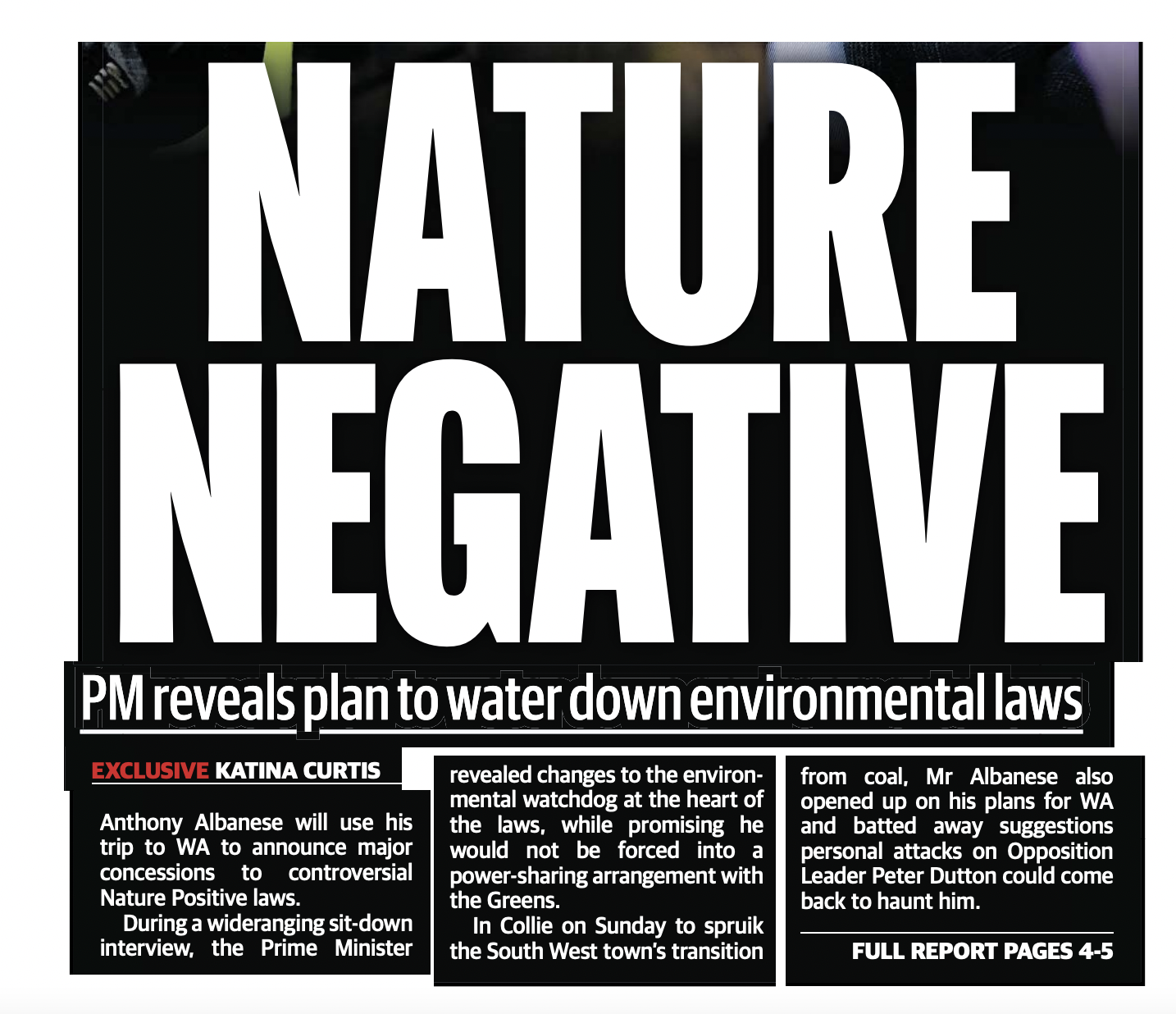
The Greens have slammed the Albanese Government for flagging they will cave in and do a deal with Peter Dutton to gut their already weak environment legislation, breaking an election promise, as reported on the front page of the West Australian today.  

Senator Sarah Hanson-Young is Greens Spokesperson for the Environment:

“Labor caving in on environment laws would be the final nail in the coffin for Labor’s environmental credibility before the next election.

“It appears the Prime Minister is prepared to torch Labor’s environment and climate credentials for a dirty deal with Dutton to appease the likes of Gina Rinehart and the coal, gas and logging corporations.

“Yet another cave-in to polluting corporations will accelerate extinction, fuel the climate crisis and destroy critical habitat for endangered species like our precious koala.

“The science is clear: we need environment laws that actually protect the environment. That means ending native forest logging and stopping new fossil fuel project approvals, via a climate trigger.”

“Instead of working with the Greens to protect the environment and climate, the Prime Minister is flagging yet another broken promise that will fast track destruction and pollution.”West Australian front page: Labor caves

Further boost to Australia’s nuclear-powered submarine workforce

The Albanese Government is today announcing a new Jobs for Subs program for 200 young workers required to make Submarine Rotational Force – West (SRF-W) a success.

The Nuclear-Powered Submarine Graduate, Apprenticeship and Traineeship initiative is a Government-funded recruitment and upskilling program for graduates, apprentices and trainees within ASC Pty Ltd.

This initiative from the Albanese Government will allow the ASC Pty Ltd to recruit around 200 additional entry-level personnel over the next two years across high priority disciplines and trades essential to the nuclear-powered submarine enterprise, building the workforce we need in the west to sustain and maintain Australia’s future nuclear-powered submarines.

These roles, predominantly in Western Australia, span fabrication and machining, engineering and project management, and supply chain and operations qualifications.

As Australia’s sovereign submarine partner for sustainment of our nuclear-powered submarines, ASC Pty Ltd plays a critical role in developing the required skills, workforce, knowledge and capability. This initiative seeks to enhance the ability to attract entry-level personnel to critical skills and career pathways, retain valued personnel at entry-levels and grow the workforce available across the Defence industry.

Already, the Albanese Government has committed to invest up to $8 billion in infrastructure to enable SFR-W from 2027 and to operate Australia’s own Virginia class conventionally armed, nuclear‑powered submarines from the early 2030s.

Across Australia, the nuclear-powered submarine program is expected to create around 20,000 highly skilled jobs for Australians for decades to come, including supporting around 3,000 jobs in the west alone.

Over the last two weeks, ASC Pty Ltd has been developing Australia’s sovereign sustainment workforce, in support of the Submarine Tendered Maintenance Period (SMTP) currently underway at HMAS Stirling.

The STMP is an important milestone in the pathway by which Australia will acquire a nuclear-powered submarine capability and is the first time Australian personnel have directly participated in the maintenance of a nuclear-powered submarine in Australia.

During the STMP, Royal Australian Navy personnel have been directly participating in maintenance work on USS Hawaii (SSN 776), a Virginia class submarine, at HMAS Stirling.

In addition, workers from ASC Pty Ltd are providing essential support services to USS Hawaii, and are observing maintenance activities to continue their learning.

During this STMP, no active radiological work is being conducted and no low level radiological material will leave the US ships.

Today’s announcement builds on the more than 4,000 additional Commonwealth supported university places the Albanese Government announced and the work we are doing with the states and territories to grow the skilled workforces we need.

The Albanese Government is investing in the workforce we need to deliver Australia’s nuclear-powered submarines and a future made in Australia.

Prime Minister Anthony Albanese

“It is an honour to visit HMAS Stirling and see the finest of Australia’s workforce becoming stronger through the strength of the AUKUS partnership.

“We are announcing a new graduate, apprenticeship and traineeship program to train an additional 200 West Australians to work on Submarine Rotational Force- West program.

“We want to keep Australians safe. That’s why WA will play a key role in building AUKUS. This will help promote peace and deterrence in the region and support local jobs.”

Deputy Prime Minister Richard Marles

“Today’s announcement is another important step in growing the workforce to be equipped with the skills and training we need to acquire Australia’s nuclear-powered submarines.

“We welcome the crews of USS Hawaii and USS Emory S. Land to Western Australia, for this milestone. We welcome our US friends to our shores, and welcome home the Australians that have been embedded with them.

“We are seeing during this visit the first Australian personnel participating in the maintenance of a US nuclear-powered submarine at HMAS Stirling, the home of Australian submarines.”

Minister for Defence Industry and Capability Delivery Pat Conroy

“This is a further boost to the development of ASC’s sustainment workforce and follows the first cohort of workers departing for training at Pearl Harbour Naval Shipyard in July.

“Australian industry is integral not only to Australia’s nuclear-powered submarine program, but also to supporting the future building, sustainment and maintenance of the submarines of our AUKUS partners.

“We are seeing real progress being made to develop the workforce of thousands of highly-skilled scientists, engineers, project managers, operators, technicians, welders, construction workers, electricians, metal fitters and builders that will be needed to support this nation-building endeavour.”

$1 billion Solar Sunshot program

Australia is a step closer to manufacturing more reliable renewables at home, with the Albanese Government’s $1 billion Solar Sunshot program now open.

Australia has always been a solar powerhouse – the ideas invented here have lit the way for the global energy transformation underway.

But while one in three Australian households have solar – the highest take-up in the world – only one per cent of those solar panels have been made in Australia.

That’s why we’re investing in Australia’s solar capability with targeted funding to support a Future Made In Australia, create quality jobs for Australian workers and a more resilient supply chain.

The International Energy Agency estimates 1300 manufacturing jobs for each gigawatt of solar PV production, meaning a supercharged domestic industry will create thousands of jobs in Australia.

Initiatives like Solar Sunshot will build  capability in the energy supply chains of the future, and support more manufacturing opportunities across the country driven by our renewable transformation.

The first $550 million, administered by the Australian Renewable Energy Agency (ARENA), will support the commercialisation of Australian solar photovoltaic (PV) innovations and scale up Australian solar PV manufacturing. This includes:

  • Round 1A: $500 million to support solar panel manufacturing, here in Australia, with a focus on modules, inputs to modules, and deployment systems.
     
  • Round 1B: $50 million to fund solar PV manufacturing studies, including feasibility and engineering.

As the Treasury’s National Interest Framework sets out: the high concentration of supply chains for critical energy technologies poses risks to Australia’s energy security and economic resilience.

These technologies are critical to Australia’s energy security through the net zero transformation.

We know there is strong interest from business to work with the Government to make more critical energy hardware here including high tech Australian start-ups, local fabricators and material suppliers, and international investors.

Community benefit principles – including for supply chains, diverse workforces and secure jobs – are central to Government investment through Future Made In Australia.

The Solar Sunshot program reflects this intent and will encourage investment in the people, communities and regions that will drive solar PV supply chains and the broader net zero transformation.

For more information and to apply for funding, visit https://arena.gov.au/funding/solar-sunshot/  

Prime Minister Anthony Albanese:

“I want a future made in Australia. And I want a future made in our regions. Places like the Hunter, Gladstone, Rockhampton and the Spencer Gulf.

“Because Australia can do what other countries cannot. We have that combination of resources, skills, workers, space and sunlight to co-locate those links in the value chain.

“Solar Sunshot is about building on those strong foundations, building resilience into Australia’s renewable energy supply chains, and building a Future Made in Australia.”

Minister for Climate Change and Energy Chris Bowen:

“When it comes to powering Australia’s future nothing will beat our sun and our solar knowhow. That’s why bringing solar manufacturing to our shores is so critical for unlocking our future as a renewable energy superpower and securing the job of the future.

“Diverse, secure and resilient supply chains – supported by more onshore manufacturing across more of the value chain – are too important to our security and success to leave to hope.

“Now is the time to take advantage of some of the best solar resources and renewable energy expertise in the world.

“Only the Albanese Government is backing businesses across the country to seize the opportunity of a Future Made in Australia, powered by reliable renewables.”

Pressure builds for PM to help free Captain Paul Watson

The Prime Minister has been implored to use diplomatic channels in any way possible to help free Captain Paul Watson, in a letter signed by the Greens’ entire federal party room. 

Captain Paul Watson was arrested in Greenland on 21 July 2024 on an extradition request from Japan. The basis of the extradition relates to events in 2010 when Captain Paul Watson was in the Southern Ocean, protecting whales from being slaughtered by the Japanese.  

At the time of the 2010 events the Australian Government proved to be a fierce ally for cetaceans through the International Whaling Commission and other diplomatic forums, and successfully instituted proceedings against Japan in the International Court of Justice. This resulted in Japan being ordered to stop whaling in the Southern Ocean and set the scene for Japan’s withdrawal from whaling in Antarctica in 2018.

Pressure is now building for the Australian Government to continue its advocacy for the protection of whales, and use its influence to secure the release of Captain Paul Watson.

Greens spokesperson for healthy oceans, Senator Peter Whish-Wilson: 

“Across the globe calls for the release of Captain Paul Watson grow louder – including from French President Emmanuel Macron – yet here in Australia our government remains notably silent. 

“Australia fought for whales in 2010 in the International Court of Justice and we fight for whales today by ensuring their full protection in Australian waters – but more must now be done to uphold our legacy on the world stage.

“Captain Paul Watson is an ocean conservationist who has saved hundreds of whales, calling for his freedom should be uncontroversial. 

“The pressure is on. The Greens implore the Prime Minister to use diplomatic channels in any way possible to help free Captain Paul Watson.”File

AttachmentSize
Australian Greens correspondence to Prime Minister RE Captain Paul Watson_0.pdf311.09 KB

Forests forgotten, Minister unaware of logging influence

Questions from the Greens in Budget Estimates have revealed that the Minister for the Environment was unaware of the details for the newly announced Independent Forestry Panel prior to the appointment of a former Forestry CEO. The new panel is set to advise the Government on the timber industry and environmental commitments, despite having no qualified forest scientist appointed.

Greens MP and spokesperson for the environment Sue Higginson said “It’s a slap in the face to the 70% of NSW that support the end of native forest logging in this state, that the Government has appointed a former CEO of the Forestry Corporation to this panel and no expert in forest ecology,”

“That the Minister for the Environment couldn’t confirm that she even knew a former forestry executive was going to be appointed as the chair of this panel is deeply concerning and has given weight to the already low community trust in this process,”

“It’s not a criticism of the intelligence or ability of the panel members to question why the protection of native forests is not being represented. Both the Premier and the Minister have defended this decision but have not given any weight to the importance of genuine forest ecology qualifications,”

“We have already seen through the increased logging in the proposed Great Koala National Park that the Government is failing their environment commitments, this latest panel and industry plan is entrenching the political failure of the Minns Labor Government,”

“As long as the position of the Minister for the Environment is that native forest logging should take precedence over environment protection, forest dependent species will continue to be driven towards extinction,”

“If the Minister was not told about a former Forestry Executive being put forward for this panel, I have genuine concerns about how this information has been handled and how the decision on the Panel has been made by the Government. Was it intentional that they have not promoted Peter Duncan’s history in native forest logging, or is this just another industry vehicle to allow native forest logging to continue?” Ms Higginson said.

Labor’s international student cap will be a disaster for NSW

NSW Senator Mehreen Faruqi, Deputy Greens Leader and spokesperson for Higher Education, is urging the Labor government to scrap its international students cap.

The cap of 270,000 new enrolments will hit several NSW universities particularly hard, with thousands of fewer enrolments expected and jobs put under pressure.

Senator Mehreen Faruqi:

“Minister Clare’s terrible international students cap, which is migration policy disguised as an education bill, is a direct hit on NSW. It will cost jobs and damage the international reputation of NSW universities.

“Labor’s just done a backflip on the terrible decision not to count LGBTQIA+ people in the census. They should do the same on this bad policy to cap international students.

“Labor is just coming in with a sledgehammer to smash universities to bits.

“The university sector is saying it’s bad policy. State governments are saying it’s bad policy. Just listen and admit this was a terrible mistake.

“We’re in the midst of a cost of living crisis, people are struggling to get by, and Labor’s priorities are dog whistling, targeting international students and playing politics to distract us from their failures. It won’t work.”

Pollution rises again under Labor, government report shows

The latest quarterly emissions data shows that pollution has risen 2.5% from December to March, and is even higher than it was in the final days of the Morrison government. Emissions aren’t coming down, putting a safe climate out of reach.

438.4 million tonnes of emissions were released in the year to June 2022, the last quarter of the Morrison Government, and they sit at 440.2 million tonnes per annum in the quarterly report released today showing no real progress.

Emissions in electricity are up for the quarter and are worrying, because increased energy demand was driven by living in a hotter climate. Modest changes to electricity emissions over the year driven by renewables is not enough to decarbonise. The government needs to drive out fossil fuels everywhere.

Under Labor more coal, oil and gas means more pollution. Labor has approved 23 more coal and gas projects since coming to office. Fugitive emissions from coal are up 0.8% for the quarter.

LNG exports have driven the largest sectoral increase in emissions, a tragic 23% increase  since 2005 and still the Albanese Government pushes a Future Gas Strategy beyond 2050. 

Transport emissions are continuing to rise rapidly with a 2.6% increase. Labor must do more to drive the uptake of electric vehicles and public transport including more incentives, rapid charging infrastructure and targets for the phase out of new petrol cars.

The figures show that at the current rate, there is no prospect of Australia cutting its pollution consistent with limiting global warming to 1.5 or 2 degrees, the goals enshrined in the Paris Agreement. 

Even Labor’s weak targets – which blow out past 2 degrees – are under threat from stubbornly high gas pollution. Emissions would need to decline an average 14.5 million tonnes a year to meet even Labor’s inadequate 2030 target, with the easiest, steepest cuts occurring right now. Instead, the data shows emissions reductions have stalled since Labor has come to office.

To make these emissions figures worse, the Albanese Government is seeking to expand coal and gas past 2050 as part of their Future Gas Strategy and Future Made in Australia plans. 

Australian Greens leader in the Senate, Senator Larissa Waters:

“This emissions data spells disaster. 

“Emissions aren’t coming down, and Labor’s commitment to coal and gas will see Australia blow any chance of meeting safe climate targets. 

“At this rate, Labor won’t even meet its own unscientific climate targets, let alone what is needed to tackle the climate crisis. 

“Gas is as dirty as coal. Climate pollution from gas is rising, but instead of cutting it, 23 coal and gas projects have been approved as part of Labor’s future gas strategy to run beyond 2050.”

Immigration chaos continues under Labor

Today’s announcement on international student caps is the result of Labor’s immigration mess which has placed unprecedented cost-of-living and housing pressures on Australians.

Under Labor’s Big Australia, the number of foreign students coming to the country has more than doubled.

This mismanagement of one of our most important exports is a mess of Labor’s own making and it’s taken far too long for Labor to wake up.

As we heard at the senate inquiry in Sydney yesterday, 500,000 international students have been forced into the private rental market.

While the Coalition welcomes student caps, we will examine the detail of today’s announcement.

Labor also needs to explain how its policy will reduce net migration and take pressure off the housing crisis?

We remain deeply concerned about the severe economic damage Labor has inflicted on regional and smaller universities, as well as private higher education providers, as a result of Ministerial Direction 107.

The Albanese government has treated the regions with contempt while looking after the Group of Eight universities where student visa approvals increased this year by 16 per cent. At the University of Sydney for instance, 50 per cent of students are now international.

It is shameful that Education Minister Jason Clare avoided so much scrutiny by keeping this announcement secret until today. This is another example of Labor failing the transparency test.

Labor fighting everything except inflation

The latest monthly inflation data from the Australian Bureau of Statistics confirms inflation is still homegrown, too high and sticky.

Headline CPI came in above market consensus at 3.5 per cent, while core inflation remains stubbornly high at 3.8 per cent. Fruit and vegetable prices have seen their highest rise since December 2022.

Since the election, the price of everything has gone up 10 per cent.

Under Labor, gas is up 33 per cent, electricity is up 14 per cent (even after taxpayer funded rebates) and rents are up 16 per cent.

Australia remains well and truly at the back of the pack among advanced economies.

This year, inflation has fallen in every major advanced economy. In Australia, it hasn’t.

Rate cuts are on the cards in other economies while in Australia the RBA has said they are not expecting any cuts this year.

Despite a worrying spike in imported inflation, homegrown inflation continues to outstrip imported inflation – at three times the pace.

These figures confirm that Labor is still failing to address the source of the inflation challenge. Labor’s attempts to manipulate the headline inflation rate are only temporary masks for the real issue.

This is a cost of living con job from a Labor government only putting band aids on bullet wounds.

This means Australians are still paying more at the checkout, the petrol pump, and on their bills due to Labor’s failed economic management.

Shadow Treasurer Angus Taylor said the figures were the consequence of a Treasurer who is fighting everything but inflation.

“Inflation in Australia is homegrown, and it is stubborn. Australia is at the back of the pack and families are paying the price.

“Labor has had three budgets and two years to get this under control, instead they have spent more time fighting the Opposition than fighting inflation.

“Labor promised prices would be back under control by July this year. Instead, we have seen prices since the election rise by double digits – over 10 per cent. Inflation is running the economy, not Labor.

“Australia is in an entrenched GDP per capita and productivity recession, with no plan for productivity and no rate relief in sight. Australians’ living standards are collapsing by levels not seen in other advanced economies.

“Families and small businesses are losing hope and confidence.

“A Peter Dutton led Coalition government will get Australia back on track with a back to basics economic agenda. We will deliver strong economic management that fights inflation and boosts productivity.

“We will be absolutely focused on restoring Australians’ way of life.”

Blackout Bowen risking Australia’s energy security

The implications of the Australian Energy Market Operator (AEMO) 2024 Electricity Statement of Opportunities advice are clear – Australia’s energy market is on a knifes-edge.


AEMO’s report confirms that most of the eastern states – Victoria, NSW and South Australia – are at risk of blackouts from this summer, and reliability gaps are set to deepen over the decade.

This is a direct consequence of Labor’s all-eggs-in-one-basket renewables only approach which aims to kill gas and force the premature closure of 24/7 baseload power stations.

Under Labor’s policy settings, with 90% of our baseload power will be forced out of the grid by 2034.

You cannot power the country on wishful thinking, nor rely on the same government which promised a $275 cut to household power bills, to keep the light on.

AEMO’s report admitted the extension of the Eraring coal plant is what’s keeping the lights on, proving that Labor’s failed energy policy is making them more reliant on coal, not less.

The Market Operator also admitted there is no wriggle room in Labor’s ideological renewable-only rollout. If projects aren’t delivered in line with Labor’s unrealistic timeline, the lights will go out unless there are further extensions of coal or a greater reliance on gas.

To meet Labor’s goal, nearly seven gigawatts of new renewable generation must be installed every year to 2030. In stark contrast, last year only 1.3 gigawatts achieved financial close.

The gap between promise and performance is widening, yet Labor continues to claim the transition is on track.

Labor has deliberately sought to cover up how close Australia came to a full-blown energy crisis this winter because it knows their ideological policies are to blame. It is only getting worse as energy demand increases and supply decreases, which eventually leads to rolling blackouts.

Labor is trying to blindfold Australians as it drives the economy towards an energy catastrophe.