
Seeding grassroots for ‘The Green’ at Parramatta North

The NSW Government opened ‘The Green’ at Parramatta North, a revitalised 8,000 square metre sportsground for the local community.


The Green, first established in 1879, has been brought back to life as part of the revitalisation of Parramatta North, an emerging Western Sydney destination. This space responds to Parramatta North’s history, including the stories from the Burramattagal people of the Dharug Nation, and of other Aboriginal people who have new and enduring connections to this place. 

In collaboration with our partners, the City of Parramatta Council and the Office of Sport, The Green has accessible amenities, a rejuvenated turf playing surface, new temporary changeroom facilities and sustainable LED lighting.

Boosting participation in grassroots sport, The Green at Parramatta North will be open to the general public and local sporting groups to enjoy.

The revitalisation of Parramatta North will deliver a diversity of education, research, commercial, cultural and residential outcomes and provide key social and community infrastructure.

More information on Parramatta Northlaunch.

Minister for Lands and Property and Minister for Sport Steve Kamper said:

“The Green at Parramatta North is a wonderful outcome for the community, and a new open space for sports organisations to run their programs and activities.”

“Between Parramatta Powerhouse, Parramatta Aquatic Centre and now ‘The Green’. The community offerings for Parramatta just keep getting better and better.”

“I look forward to seeing our future Parramatta sports stars get their start at this fantastic new community sportsground.”

Member for Parramatta Donna Davis said:

“Our community has been waiting a long time for The Green, so it is wonderful to be opening this new open space for the people of Parramatta.

“This is a part of Parramatta with a compelling story and deep history, and The Green, a revitalised sportsground, will bring more people to this incredible precinct.” 

Lord Mayor of City of Parramatta Sameer Pandey said:

“The Green at North Parramatta is an excellent new community sportsground providing a space to nurture the talented athletes of today and for generations to come.

“This sportsground is a terrific addition for our thriving population and for grassroots sports which is so essential in encouraging health, wellness and a sense of community in our great city.”
Major funding boost for lifesaving mental health support

The NSW Government today announced major funding to bolster support for national charity, Lifeline. The investment will assist with the expansion of its telephone, text service, and online support for people experiencing a mental health crisis.


NSW Mental Health Minister Rose Jackson said the investment will see people across the state have access to enhanced support 24 hours a day, seven days a week.

Ms Jackson said Lifeline will receive $8.2 million over five years to facilitate the expansion of text and webchat services for NSW residents.

Lifeline is a national charity providing all Australians experiencing emotional distress with access to 24 hour crisis support and suicide prevention services.

Lifeline provides people in crisis with help from trained volunteers who listen, provide immediate support, assist to clarify options and choices as well as information about local services.

“Mental health and emotional wellbeing remain a key priority for me and the NSW Government. Now more than ever people need access to lifesaving mental health support and we are committed to ensuring people have that support,” Ms Jackson said.

“In 2022, Lifeline received over 360,000 calls from NSW callers. We know the demand for this service is incredibly high.

“When people are in crisis it can be difficult to seek help. The expansion of Lifeline’s text and web chat service in NSW will help to ensure people have a range of options when they need it most.

“We know this is particularly important for young people as sometimes making a phone call can be a barrier. We’re using technology they’re familiar with to create easier entry points and better accessibility for vulnerable people,” Ms Jackson said.

Lifeline Australia Chief Executive Officer Colin Seery thanked the NSW Government for the additional investment.

“This funding injection will ensure that Lifeline can deliver more support to people in distress through our text and webchat services, which are used more by harder-to-reach and at-risk groups such as young people, people with disabilities and people experiencing domestic and family violence,” Mr Seery said.

“Demand for our digital services is increasing at a significant rate and this funding will help to ensure people can access the support they need, wherever they are, day or night.”

Suicide has a devastating impact on families, friend, communities and workplaces. Knowing where to go to find support in a crisis can be lifesaving. The additional funding will help Lifeline continue to support even more people with confidential, non-judgemental care.

Anyone experiencing a crisis can call the below helplines for support and advice: Lifeline 13 11 14launch | Kids Helpline 1800 55 1800launch | Beyond Blue 1300 224 636launch

To be connected with specialist mental health services, call the NSW Mental Health Line 1800 011 511launch.

Rental Pain Index Reveals Pressure Points Across Australian States 

Rental Pain Index Reveals Pressure Points Across Australian States

A recent analysis of the Australian rental property landscape reveals that Queensland (QLD), South Australia (SA), and New South Wales (NSW) are currently experiencing the greatest rental pressure, according to data released by Suburbtrends.

Kent Lardner, Founder of Suburbtrends, states, “The Rental Pain Index, a metric that measures the financial strain of renting, is highest in QLD, followed by SA and NSW. This suggests that tenants in these states are feeling the greatest ‘rent pain’ at present.”

The analysis focuses on the top 25 results per state, comparing factors such as the percentage of advertised rentals, vacancy rates, average 12-month rental increase, and average rent as a percentage of income. QLD not only leads the pack in rental pain but also boasts the largest average 12-month rental increase at a staggering 16.33%.

Kent explains, “The significant increase in rental prices over the past year in QLD is a clear contributor to the heightened rental pain felt by residents. Similar trends are observed in SA and WA, where rental prices have risen by approximately 15.95% and 15.37%, respectively.”

Interestingly, the Australian Capital Territory (ACT) and Tasmania (TAS) were found to have the highest average percentage of advertised rentals, suggesting a high turnover of rental properties. The ACT also has the highest vacancy rate, with over 2.22% of properties sitting empty for 21-days or more.

Despite these findings, Kent stresses the importance of broader context: “While these numbers give us a snapshot of the current state of affairs, it’s crucial to remember that the rental market is complex and ever-changing. Factors such as economic conditions, population growth, and housing policies all play a role.”

Suburbtrends is committed to providing the most accurate and up-to-date insights into the Australian rental market to help both renters and property investors make informed decisions.

Multicultural groups win funding to counter domestic violence

Multicultural groups from across NSW will receive a share of a one-off $2 million grant to deliver activities or projects that will build the capability of their communities, to recognise and respond to domestic, family and sexual violence.


The 19 successful groups were part of a competitive grant process funded under the National Partnership Agreement which opened earlier this year. These included Focus Connect for its Safer Multicultural Families initiative to build the capability of multicultural communities in recognising the responding to domestic violence; and Canterbury City Community Centre for its Healthy Relationships Program supporting newly arrived migrant communities and refugee and asylum seekers.

Federal Minister for Social Services Amanda Rishworth said empowering local community groups across a diverse landscape was critical to addressing domestic and sexual abuse at it roots. “We know that domestic and family violence can affect anyone from any social, religious or cultural background,” Minister Rishworth said.

“Supporting local groups who are already doing grassroots work to reduce the prevalence of family and domestic violence and sexual abuse in their communities is an important step in solidifying our approach to end this abhorrent crime.”

Minister for the Prevention of Domestic Violence and Sexual Assault Jodie Harrison said the grants will foster collaboration and innovation to assist multicultural and faith-led organisations to support culturally appropriate responses to domestic, family and sexual violence.

“This investment will help build the capability of multicultural communities in recognising and responding to domestic, family and sexual violence,” Minister Harrison said.

“Domestic and family violence leaves deep scars that affect everybody involved, in particular for women and children.”

Separately, the NSW Government has signed up to deliver additional frontline family and domestic violence workers as part of the Albanese Labor Government’s commitment for more on-the-ground support for victim-survivors.

Funding for the additional 148 workers will be provided under the National Partnership Agreement on Family, Domestic and Sexual Violence Responses 2021-27.

Minister for Multiculturalism Steve Kamper said it was important to provide multicultural groups with the tools they need to respond to domestic and family violence.

“These initiatives will be the bridge that connects individuals from multicultural communities with organisations that can provide help when they need it,” Minister Kamper said.

“We know from experience that a one-size-fits all approach does not work and that culturally appropriate tools and resources make a real difference in many communities.”

Focus Connect Interim CEO Lee-Ann Byrnes thanked the NSW Government for the grant. “Survivors of domestic, family and sexual violence require holistic support to help them recover and rebuild their lives,” Ms Byrnes said. 

“This funding allows a trained caseworker to work one-on-one with survivors to identify needs and goals and provide wrap around assistance so these can be met and achieved.”

Canterbury City Community Centre CEO Esta Paschalidis-Chilas said: “We have been working alongside the very diverse local community for over 50 years, so we know that the issues surrounding Domestic Family and Sexual Violence are not well understood nor are the right resources and supports always available.

“Our Healthy Relationship Program will be designed and implemented in partnership with the Australian Rohingya Women’s Development Organisation and the Paki Women’s Hub. The program allows us, our partners and collaborators, the opportunity to do the language and culturally specific work needed to uplift the understanding of these communities,” Ms Paschalidis-Chilas said.

Visit Domestic, Family and Sexual Violence Multicultural Community Grant Programlaunch for more information on the multicultural DV grant and its recipients.

$41 million to improve road safety in the regions

The first round of the new Towards Zero Safer Roads Program has kicked off with the NSW Government investing $41 million to improve road safety across the state’s regional areas. 


The program’s opening round, which will run until the 2024/25 financial year, will initially prioritise planning of 27 new projects and the roll out and completion of a further 11 safety upgrades in regional NSW.

These projects will deliver important road infrastructure at high-risk locations that can help save lives. This includes wide centre lines, safety barriers, rumble strips and shoulder widening.

The Towards Zero Safer Roads Program aligns with the 2026 Road Safety Action Plan, reflecting the government’s dedication to achieving this goal.

The new program builds on the success of the previous Safer Roads Program, which is estimated to have saved up to 1550 serious injuries and lives over the lifetime of the program.

For info on the projects funded see the Round 1 – Regional Projects (PDF 176KB)launch.

Minister for Regional Transport and Roads Jenny Aitchison said:

“Regional drivers make up one-third of our road users, yet nearly 70% of fatalities occur on country roads. In our country towns everyone knows everyone – any death or serious injury echoes through the entire community. They are not just numbers, they are people we know and love. 

“Reducing road trauma on country roads is a key focus for the Minns Labor Government. This initial $41 million investment for 38 projects will help make the journeys on regional state roads safer, now and into the future, as we strive towards our goal of zero deaths or serious injuries on NSW roads.

“Road safety infrastructure, such as wide centre lines are estimated to reduce head-on crashes by 50% and run-off road crashes by up to 25%. Additionally, safety barriers can reduce the severity of a crash by up to 95%, minimising the chances of a death or a serious injury.

“We want drivers to get home safely each night to their loved ones and this investment will ensure we are heading in the right direction to achieve that.”

An intelligent solution to improving local road maintenance

Street sweeping vehicles in regional NSW and the south-west of Sydney are using dashboard-mounted cameras linked to a machine-learning program to assist councils better maintain local roads.


Designed and built in NSW by Deloitte, Asset AI software will highlight and eventually predict critical safety issues like damaged signage, faded line markings, potholes and rutting, and escalate them based on severity and safety risk to council maintenance planners.

As it develops over time, the artificial intelligence software will draw on weather data and learn to predict issues like potholes or cracks before they even form.

The NSW Government is backing the next phase of the Asset AI pilot project as preventative road maintenance can slash costs for councils by reducing the reliance on time-consuming and costly road audits while also extending the lifespan of asphalt and bitumen roads through timely intervention.

Traditionally, councils carry out road audits every 3 to 5 years, but Asset AI has the potential to deliver a snapshot of the condition of the NSW local road network every fortnight in future. 

Canterbury-Bankstown and Griffith have been chosen for the trial to ensure the platform meets the needs of both regional NSW and metropolitan areas. An earlier phase of the pilot used Transport for NSW vehicles. 

Based on the success of data capture in Griffith and Canterbury-Bankstown, the technology could be rolled out to more councils from 2024.

Asset AI received a $2.9 million funding co-contribution through the NSW Government’s Smart Places Acceleration Program, a special reservation under the Digital Restart Fund.

Other councils that have expressed interest in being involved in the development of Asset AI as it progresses include Georges River, Blayney, Central Coast, Liverpool, Wingecarribee, Warren Shire, Liverpool Plains, Tamworth, Wollongong, Murray River, and Shoalhaven.

Minister for Roads John Graham:  

“Keeping roads safe and in good condition are some of the biggest challenges for local councils. This platform will help cut costs, accelerate maintenance and prioritise safety.

“The data to fuel the machine-learning will be gathered from Canterbury-Bankstown and Griffith so that we are sure the software meets the needs of regional and metropolitan councils in NSW.

“One of the most exciting aspects is that the system will begin to draw on weather data and learn to predict issues like potholes or cracks before they form and help councils prioritise repairs based on potential future risk. 

“This will keep NSW at the forefront of technology-led solutions to what are some of the most essential services for all communities. No one wants to see potholes on the roads and this could be part of seeing fewer of them in future.” 

Minister for Regional Transport and Roads Jenny Aitchison:

“Regional councils have large sprawling road networks that are built differently to city roads and can be particularly challenging to audit and maintain. 

“Last year’s extreme rainfall highlighted the battle regional councils face tracking and prioritising work in the wake of natural disasters. With this platform they can get a snapshot within a day of what has been impacted, as well as a recommendation of where to send crews first.” 

David Elliott, CEO of Institute of Public Works Engineering Australia NSW & ACT: 

“We are excited to be at the forefront of this transformative project. The introduction of Asset AI represents a massive leap forward in how we manage and maintain our roads in NSW. 

“This initiative will significantly reduce the time and cost associated with traditional road audits, freeing up valuable resources for councils across the state. It’s a game-changer for the way road maintenance will be approached.”

Bilal El-Hayek, Canterbury-Bankstown Council Mayor:

“City of Canterbury Bankstown is pleased to be the first metropolitan Council involved in the initial trial and council will now install cameras on its street sweepers. This new technology will help inform the program of works to manage the conditions of the road network more effectively.” 

Find out more about Asset AIlaunch

State’s first Arts and Creative Industry policy will be artist-led to grow the sector

The NSW Government is calling on artists and other creative industries practitioners across the state to help craft the first-ever Arts, Culture and Creative Industries Policy for NSW.


Minister for the Arts John Graham today released a discussion paper, A New Look At Culture, which focuses on how to grow the Arts and Cultural sector – an employer of almost one in ten people in Greater Sydney – in a way that is led by the people involved in the arts and creative industries. 

The discussion process seeks to understand what’s working, what’s not working and what fresh ideas will propel the sector forward.

To achieve this, an extensive consultation process will be undertaken across the state, including at least 11 in-person townhall meetings from Bega to Dubbo, Lismore to Tamworth and across Greater Sydney, with meetings in Liverpool, Penrith and Newcastle, as well as online meetings.

The discussion paper outlines 3 considerations for the sector to respond to:

  • A new look at people: How can we create better, more inclusive, support and pathways for practitioners in the arts, culture and creative industries?  
  • A new look at infrastructure: How can we create and improve sustainable access to spaces, programs and other support for all aspects of artistic and cultural activity?  
  • A new look at audiences: How can we grow local, national and international audiences for cultural experiences, for the benefit of our community and the broader economy?   

Minister for Arts, John Graham said:

“It’s time to bring our arts and creative industries together with 1 policy. Australia’s cultural and creative activity contributes $122.3 billion to Australia’s economy. In Greater Sydney the creative industries account for 9% of the workforce. It should be a bigger part of our state’s story, our economy and sense of itself. 

“The principal priority will be to deliver a strategy that aims to grow the arts and creative industries sector in NSW. Our arts and cultural sector is still reeling from the most disruptive period in modern times. Having survived a decade of lockouts and lockdowns, the industry is now beset by serious economic headwinds. A vision to grow the arts sector in NSW and propel us forward must account for these impacts and include effective strategies to address them.” 

“Creative workers build and support the foundations of our established ‘traditional’ arts institutions. This consultation is an opportunity to participate in the discovery of a new culture for this state, identify specific issues, share lived experiences and offer novel solutions to bring the cultural economy to life.” 

“A series of public in-person and online discussions will take place right across NSW to ensure individuals and organisations in the creative industries can get involved and have their say. Whether you’re a novelist in country NSW who is yet to be published, or the CEO of a major arts company in inner Sydney, we want to hear from you.”

“What you say will help shape this new policy and in turn, our state.  We understand that artists and workers haven’t got the time to consult just for consultation’s sake. This is not about generating a report that will just sit on a desk somewhere.  We will report back to you by the end of the year, and we want to know what is working, what isn’t working, and your big ideas for us to consider.”

Individuals and organisations from the arts and creative industries are encouraged to join the conversation and share their ideas by:  

  • submitting a written, audio or video submission onlinelaunch
  • attending 1 of the many in-person or virtual town hall discussions across Greater Sydney and regional NSW
  • submitting a response to the discussion paper by post
  • submitting a response to the discussion paper by email.

Submissions are open until 31 August 2023. Read the discussion paper and submit your feedback onlinelaunch.

ADVANCING AUSTRALIA’S INTERESTS WITH GERMANY AND NATO

Prime Minister Anthony Albanese will travel to Europe to meet with German Chancellor Olaf Scholz in Berlin on July 10 before attending the NATO Leaders’ Summit in Vilnius, Lithuania from 11 – 12 July.
 
Australia and Germany are firmly united as strategic partners and close friends. The Prime Minister and Chancellor Scholz will discuss deepening cooperation between Australia and Germany in a range of areas including trade and investment, the clean energy transition, and defence.
 
Australia shares a commitment to peace and security with NATO allies and partners. At the NATO Leaders’ Summit Australia will advocate for our region’s strategic priorities and advance Australia’s security, economic and trade agenda.
 
This is the second time Australia has been invited to attend the Summit as an Indo-Pacific Four partner, along with Japan, the Republic of Korea and New Zealand.
 
Prime Minister Albanese said:
 
“It’s important that I attend the NATO Leaders’ Summit. Australia’s presence at this forum is firmly in our national interest as we work together towards a peaceful and stable world.
 
“Alongside our NATO allies, Australia continues to demonstrate our unwavering support for Ukraine, and our condemnation of Russia’s illegal and immoral invasion.
 
“I am honoured to accept an invitation to visit Germany and meet with Chancellor Scholz. Australia and Germany are close partners and friends. Australia wants to deepen our cooperation to address shared challenges and ambitions.”

Visit to Timor-Leste

Today I will travel to Timor-Leste to meet with newly appointed Prime Minister Xanana Gusmão and his government, and to reaffirm Australia’s deep and broad friendship with our close partner.

During the visit I will also meet with President José Ramos-Horta and Minister of Foreign Affairs and Cooperation Bendito Freitas.

Australia and Timor-Leste are close neighbours, friends and partners. These deep bonds form the foundation on which we can build our futures together. We are equal stakeholders in an open, stable and prosperous region.

From economic development, through to assisting Timor-Leste’s accession to ASEAN, Australia is committed to supporting Timor-Leste as a sovereign, secure and resilient nation.

We cooperate across a wide range of sectors, including health and human development, education and skills, and defence and security.

This cooperation reflects the deep reservoir of respect, friendship and solidarity between the Timorese and Australian people.

This will be my second visit to Timor-Leste as Minister for Foreign Affairs.

Full steam ahead for trip back in time with special Newcastle Museum exhibition

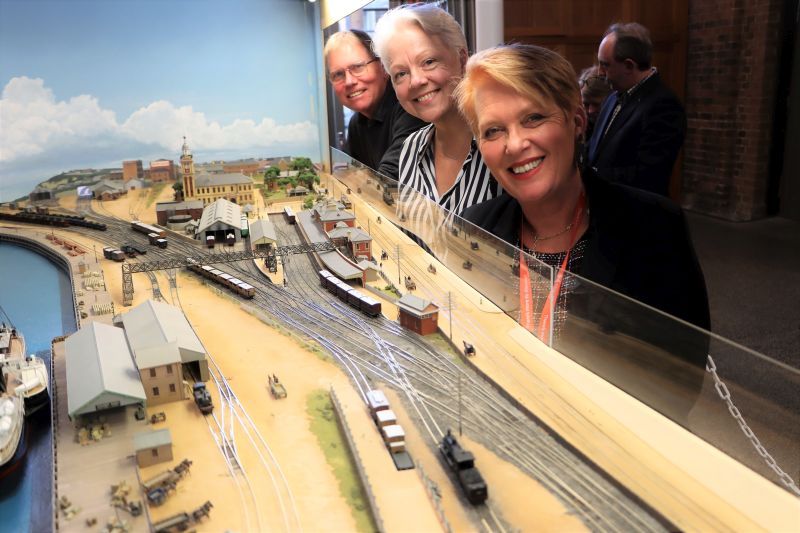
Newcastle Museum is turning back the clock to the days of paddle steamers and horse drawn carriages as part of a special exhibition showcasing one of Australia’s best model railways.

Created by noted modeller Ross Balderson and a small group of fellow enthusiasts, Newcastle 1899 depicts the Newcastle Railway precinct in miniature at the turn of the century, complete with steam trams chugging their way up and down Scott Street.

City of Newcastle Director of Museum, Archive, Libraries and Learning, Julie Baird, Newcastle Councillor Carol Duncan and modeller Ross Balderson with the Newcastle 1899 model on display at Newcastle Museum this weekend.

The working model is complemented by a bustling harbor filled with historically accurate ships including tugboats “Champion” and “Commodore” and the paddle steamship “SS Namoi”.

Creating it was a labour of love for Mr Balderson, who has been working on it for more than a decade after being inspired by an image in a railway book taken by renowned Newcastle-based photographer Ralph Snowball.

“I have produced numerous model railway layouts throughout my life recreating New South Wales locations and capturing moments in time of our past history,” Mr Balderson said.

“I chose to model Newcastle after first being inspired by one single photograph published in a railway book, which showed a scene looking across Newcastle’s railway station platforms and rail yard to a row of moored sailing ships loading goods at Queens Wharf.

“With the assistance of Greg Ray and David Hampton I have been given the opportunity to show the model at Newcastle Museum, displaying how the city once appeared back in the days of sailing ships and horse drawn vehicles.”

City of Newcastle Director of Museum, Archive, Libraries and Learning, Julie Baird, said Newcastle Museum welcomed the opportunity to showcase this unique peek into Newcastle’s past.

“Ross and his supporters have spent the past 10 years painstakingly recreating the Newcastle Railway Station precinct, drawing from historical photographs, measuring existing buildings, and hand-painting backdrops to develop a breathtaking record of Newcastle in the age of sail and steam,” Ms Baird said.

“The model is a superb reflection of the complex and varied skills that contribute to model-making, combining artistic flair, precision accuracy and detailed research to create one of the finest examples of historically accurate miniature railways in Australia.

“Newcastle Museum plays an important role in interpreting and preserving our city’s fascinating history for future generations and we are proud to be able to display the model for the first time in Newcastle.”

Local history buffs and railway enthusiasts who have been following the progress of the build through the Lost Newcastle and the Rediscovered Newcastle Facebook groups will finally have the chance to see the model in real life when it is displayed in Newcastle Museum’s Link Gallery from 7-9 July.

Lost Newcastle founder and Newcastle Councillor Carol Duncan said it has been wonderful watching this project from afar and can’t wait to finally see it in person.

“Ross and his supporters are so incredibly passionate about this project and it’s been fascinating to see this model come together over the years,” Cr Duncan.

“I encourage everyone to take the chance this weekend to check out this working model at Newcastle Museum, which provides an insight into a time in Newcastle’s history that otherwise could be lost to future generations.”

Newcastle 1899 will be displayed alongside Hexham-ish, a model railway built by Steve Curry based on the J & A Brown railway that operated for over 130 years between Hexham and Minmi.

Steve has been responsible for scratch-building highly detailed models of the J & A Brown locomotive fleet, including a representation of The Buck, which is on permanent display at Newcastle Museum.

Entry to the museum is free, and both model railways will be available to view during regular opening hours of 10am-5pm. Both layouts will operate, with trains running throughout the day.