
New grandstand sets inclusive benchmark for Newcastle

Passmore Oval at Wickham has become a venue of choice for rugby union players and cricketers thanks to a $2.6 million collaboration with City of Newcastle.

The redevelopment of the grandstand has delivered dedicated female home and away changerooms for the Hamilton Hawks Rugby Union Club (HHRUC) and Hamilton-Wickham Cricket Club, as well as their rivals.
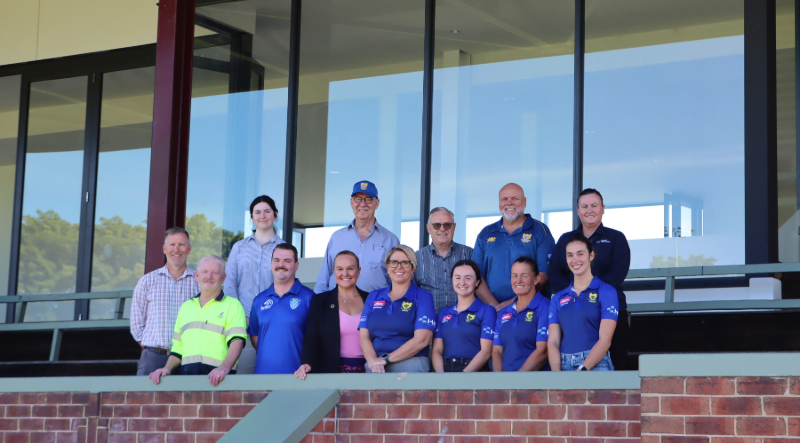
Lord Mayor Nuatali Nelmes joins CN staff, President of Hamilton Hawks Rugby Union Club Lesa Mason, Hawks players and officials, Hamilton-Wickham Cricket Club secretary Paul Rodgers and EJE Architecture representatives at the new-look Passmore Oval grandstand.Lord Mayor Nuatali Nelmes joins CN staff, President of Hamilton Hawks Rugby Union Club Lesa Mason, Hawks players and officials, Hamilton-Wickham Cricket Club secretary Paul Rodgers and EJE Architecture representatives at the new-look Passmore Oval grandstand.The changerooms are housed within a new two-storey building constructed at the back of the existing grandstand, which also provides accessible amenities and viewing areas for both Passmore Oval and its adjacent Hawkins Oval.

A community meeting room, shared exercise training area and storage rooms were also included in the upgrade.

Lord Mayor Nuatali Nelmes said the project aligns with City of Newcastle’s 10-year Strategic Sports Plan.

“We’re aiming to provide facilities that support universal access and meet the future demands of the Newcastle community,” Cr Nelmes said.

“Specially designed female changerooms will be housed on the ground floor of the new building and the upper level will feature an accessible balcony overlooking Hawkins Oval.

“The redevelopment ensures the spectator facilities cater to all members of our community with the existing grandstand also featuring a lift and viewing space for wheelchair users overlooking Passmore Oval.”

HHRUC successfully secured $1 million in funding from the NSW Government’s Greater Cities Sport Facility Fund to go towards the project, with City of Newcastle providing more than $1.6 million.

Club President Lesa Mason said the new facilities mean women’s teams will no longer have to play second fiddle to their male counterparts.

“We have a vision, alongside Rugby Australia, to see more women and girls in rugby. We want to provide opportunities for women teams to be established across all levels,” Ms Mason said.

“Participation rates in women’s rugby are booming and these purpose-built dressing rooms are certain to encourage more girls to get involved.

“Our men’s Premier One side is already the most successful team since the turn of the century, winning nine premierships, and these improvements can only help make it even more formidable.”

Minister for Sport Steve Kamper said the NSW Government understands the vital role community sport plays in keeping people healthy, active and connected.

“This investment will deliver well-designed, new and improved sport facilities that will allow increased participation across all sporting codes,” Minister Kamper said.

“The delivery of fit for purpose change rooms enables women and girls of all ages to feel comfortable, safe and welcome.”

Hamilton-Wickham secretary Paul Rodgers said the redevelopment will provide great benefits for the cricket club.

“We were one of the four original clubs in the women’s T20 competition when it started in 2019 so it’s great our players will now have their own changeroom,” Mr Rodgers said.

“The accessible viewing areas will encourage more spectators of all ages and abilities to come and watch men’s and women’s games on both Passmore and Hawkins Ovals.

“The other upgrades will also allow Passmore to become a key venue for hosting major national tournaments, matches and regional carnivals”.

City of Newcastle celebrates gender pay equity this May Day

City of Newcastle (CN) is leading the way in gender equity, with recent data showing its employees experience almost no gender pay gap. 

Workplace Gender Equality Agency data on average weekly earnings concluded that the national pay gap between the earnings of women and men is nearly 22 per cent. In comparison, a recent assessment of CN salaries showed there is no significant difference for Council employees – in fact, female employees earn marginally more on average than their male counterparts. 

Newcastle Lord Mayor Nuatali Nelmes said it is important to acknowledge this achievement ahead of May Day on 1 May, a day traditionally celebrated by the Australian workers’ movement after a long struggle for their right to an eight-hour day. 

“City of Newcastle has led the way with progressive benefits and conditions for many years now, proving our continuing commitment to inclusion, diversity and equity,” Cr Nelmes said. 

“We were one of the first councils in NSW to include domestic violence leave provisions back in 2018. This was alongside a range of other flexible and female-friendly working conditions such as miscarriage leave as part of our industry-leading Enterprise Agreement.  

“Our continual shift towards pay parity has challenged the rest of the Local Government sector to consider how they too can do better. At CN we listen to what our workers want, and we are proud this May Day of our status as a progressive and female-friendly enterprise.” 

CN CEO Jeremy Bath said the equitable outcome achieved for local government employees statewide should be celebrated. 

“City of Newcastle is a leading organisation when it comes to eliminating the gender pay gap,” Mr Bath said. 

“The reasons for this good result are many. We have built a culture at CN where we focus on the team rather than the individual, and where excellence is rewarded rather than gender, tenure, or an ability to negotiate.  

“Our Enterprise Agreement, developed in partnership with unions, was most recently approved by our employees in 2022 and is something we know sets us apart as an employer.  

“Our challenge now is to continue to strive for gender equality within our organisation and to help support the development and excellence of all our employees.” 

United Services Union (USU) Organiser Luke Hutchinson said the recent pay equity data shows how the USU’s long history of delivering improved pay and conditions for all has made a huge impact at CN. 

“The USU is very pleased that the conditions secured in the City of Newcastle Enterprise Agreement have ensured there are no reported gender pay gaps between any workers at the City of Newcastle,” Mr Hutchinson said. 

“This groundbreaking agreement not only acknowledges but actively incorporates socially progressive conditions. These include vital provisions such as access to miscarriage leave, improved parental leave, enhanced workplace flexibility, and family and domestic violence leave.  

“By fostering these conditions, we ensure workplace protection and facilitate optimal service delivery for our vibrant community. 

“Establishing a uniform classification framework that ensures fair remuneration and equitable structuring of qualifications and skills was incredibly important to the USU.  

“Notably, this framework ensures that traditionally female-dominated professional sectors, like Libraries and Early Childhood Education, are directly aligned with other professions such as engineering or accounting.” 

The NSW Government is bringing planning into the 21st Century

Councils will soon have the opportunity to trial AI in their local planning systems following a $5.6 million investment from the NSW Government.

In the midst of a housing crisis and a shortage of planners, the NSW Government has been looking for new and innovative ways to support councils and speed up development assessment times.

The AI in NSW Planning project was tasked with identifying areas of the development application assessment that were causing unnecessary delays and would benefit from the implementation of AI.

Three technologies have now been identified and will be available to councils for trial through the AI Solutions Panel and Early Adopter Grant Program. They are:

In a significant opportunity, councils collaborating on joint grant applications could receive up to $500,000, while single council applications could be eligible for up to $200,000 to trial the identified technologies.

Council staff determine development applications for approximately 85 percent of all new homes in NSW. This funding will allow councils to trial recommended AI technologies and encourage innovative ways to accelerate DA assessments.

The recommended AI products will help councils reduce average DA assessment times by quickly identifying administration and data input errors.

All councils can apply for grants through the Early Adopter Grant Program.

Grant applications are open for three weeks and close on 22 May 2024.

Successful grant recipients will be notified by June.

For more information, visit the NSW Planning website.

Minister for Planning and Public Spaces Paul Scully said:

“This grant program will encourage councils to trial AI and identify products which can help meet their needs.

“This is about modernising the NSW planning system by making it more efficient.

“We can achieve this by giving our talented planners the best tools possible.

“The delivery of new homes will only happen if the planning system is working at full capacity.

“I am confident AI can help accelerate DA assessments and reduce the administrative burden on planners.”

Southwest Link for T3 passengers during difficult 12-month Metro conversion

The upcoming conversion of the T3 Bankstown Line into a modern Metro line will be supported by an extensive transport plan, including Southwest Link, a high-frequency bus service between Sydenham and Bankstown stations.

Converting the existing T3 Line, which is more than a century old, will be a difficult process for the community and take up to 12 months.

When the conversion is complete in 2025, passengers will have access to a 21st century high-tech metro line with a train every 4 minutes during the peak, along with fully accessible stations and services.

Southwest Link will form part of an integrated transport plan for Southwest Sydney, which brings together around 100 dedicated and existing local bus services, rail services, light rail, active transport and the new City Metro service from Sydenham station.

Key features of Southwest Link include:

  • Three dedicated bus routes known as SW1, SW2 and SW3 to provide thousands of services along the T3 line;
  • Frequent services from early morning until late night seven days a week, with a bus every two to four minutes in peak periods;
  • A mix of all stops and limited stops services to ensure commuters and local passengers have reliable public transport options;
  • Easily recognisable services, with plenty of signage and ground staff to support.

Other features of the transport plan include:

  • Sydney’s new rail network, with changes to the Sydney Trains timetable between Sydenham and Bankstown to support the conversion now and into the future
  • Amended T3 Liverpool & Inner West Line – providing a direct rail service to the Sydney CBD from Liverpool via Lidcombe Station, including Berala, Regents Park, Sefton, Chester Hill, Leightonfield, Villawood and Carramar Stations
  • New T6 Lidcombe & Bankstown service – providing dedicated train services between Bankstown and Lidcombe, including Yagoona, Birrong, Regents Park and Berala, with connections T3 Liverpool and Inner West Line at Regents Park
  • Changes to rail services at Erskineville and St Peters Stations, where passengers will be serviced by the T8 Airport and South line 
  • Working with councils to provide better walking and cycling links to support passengers, particularly for shorter local journeys that offer connections to public transport hubs.

Southwest Link bus routes:

  • SW1 – Sydenham to Bankstown (All Stops)
    • Sydenham, Marrickville, Dulwich Hill, Hurlstone Park, Canterbury, Campsie, Belmore, Lakemba,Wiley Park, Punchbowl, Bankstown, and return.
  • SW2 – Sydenham to Bankstown (Limited Stops)
    • Sydenham, Belmore, Lakemba, Wiley Park, Punchbowl, Bankstown, and return
  • SW3 – Sydenham to Campsie (Limited Stops)
    • Sydenham, Canterbury and Campsie, and return

Transit Systems will provide the bulk of the Southwest Link rail replacement bus services after being awarded the contract earlier this year.

Minister for Transport Jo Haylen said:

“This is going to be a disruptive 12 months for the people of Canterbury Bankstown and for the Inner West but there is light at the end of the tunnel. When this section of the metro is complete, they will get a train every four minutes. That’s a massive increase in train services, because right now there are stations on the T3 Line that only receive four trains an hour in the peak.

“Communities that rely on the T3 line are going to have a tough time, that’s why we’ve worked to deliver as many alternative public transport services as possible, including high frequency Southwest Link bus services with multiple routes.

“We’re also looking out for passengers in the West to help them through this tough 12-month conversion. Bankstown will get a new T6 Train service to Lidcombe and there will be a direct train service from Liverpool to the City via Lidcombe, Berala and Regent’s Park.”

Transport for NSW Coordinator General Howard Collins said:

“Southwest Link is about making sure passengers can get to where they need to go during the final Metro conversion of the T3 Bankstown Line. We are making sure that there is a variety of bus services that deliver for the communities that rely on the T3 line. This is not an ordinary rail replacement service.

“Transport for NSW and Sydney Metro have spent months planning an integrated transport plan for the southwest, so passengers will be able to decide which mode, route and service works best for them.

“Over the next few months, next steps include continuing to engage with the community and impacted hospitals, schools and universities, distributing information brochures in multiple languages and updating our systems for personalised trip planning tools and third-party apps.”

Shoalhaven’s diverse communities to benefit from NSW Government funding boost

Shoalhaven’s vibrant multicultural communities will benefit from a $100,000 funding boost from the NSW Government. The new funds will contribute to a Multicultural Hub, the first full time multicultural service provider in the region.

NSW Minister for Multiculturalism Steve Kamper today said the Multicultural NSW Grant will support diverse South Coast communities by providing service equity, as well as showcasing, preserving and sharing the region’s rich diversity of cultures, languages and faiths.

At an event attended by Mr Kamper in the Illawarra today, Chris Lacey, CEO and Company Secretary of the Multicultural Communities Council of Illawarra (MCCI) said the funding package will meet a significant need for creating an ecosystem of networks and connections with community and government service providers in the Shoalhaven.

For more than four decades, MCCI has delivered services to and represented the interests of people from culturally and linguistically diverse backgrounds in the Illawarra, ACT and Queanbeyan.

As a regional peak body, the MCCI implements a range of community engagement activities and programs to support Shoalhaven’s diverse communities.

From empowering youth to providing vital aged care services, community capacity building, volunteering, and training, MCCI is a long-term member of the NSW Government’s Leaders in Cultural Diversity program.

The Hub will also see increased local engagement with Multicultural NSWs Regional Community Network.

NSW Minister for Multiculturalism Steve Kamper said:

“We are proud to support the region’s leading voice for culturally and linguistically diverse communities, representing the ever-changing needs of the Shoalhaven community.

“The NSW government remains steadfast in its commitment to empower communities, ensuring bespoke, culturally relevant services that foster social cohesion.

“Hubs like the Shoal Haven serve as a vital way to build the holistic well-being of diverse communities in our regions.”

NSW Minister for the Illawarra and the South Coast Ryan Park said:

“We’re really pleased that members of our culturally and linguistically diverse community in the Shoalhaven will now have access to this fantastic new Hub.

“MCCI have been successfully delivering programs in the Illawarra region for many years, and it is really heartening to see this valuable service extended to the South Coast community.”

NSW Member for South Coast Liza Butler said:

“The South Coast has a growing multicultural community, and I am thrilled that our vision for a more inclusive Shoalhaven is coming to fruition with the establishment of this new Hub. It’s a testament to our commitment to embracing and celebrating the rich tapestry of cultures that make our region so unique.

“This funding marks a significant commitment from the NSW Government to the Shoalhaven community, demonstrating our ongoing dedication to nurturing a multicultural society where every individual has the opportunity to thrive.

“By establishing the Multicultural Hub in Shoalhaven, we’re not just funding a facility—we’re investing in the heart and soul of our diverse community, ensuring everyone has access to the services they need in their own backyard.”

Chris Lacey, CEO and Company Secretary of the Multicultural Communities Council of Illawarra (MCCI) said:

“For more than 40 years MCCI has worked to improve supports and services for diverse communities across the region.

“We have identified gaps in what was offered along the South Coast and this welcome funding will help us reach many more people and help them reach their aspirations as the settle into their new homes in this beautiful part of NSW.”

Construction underway for $33.7 million upgrade at TAFE NSW Kingscliff

Minister for Skills, TAFE and Tertiary Education, Steve Whan today announced the start of construction of a new building at TAFE NSW Kingscliff, as part of the $33.7 million investment in upgrades at the campus, aimed at strengthening vocational education and training in the Tweed region.

Minister Whan turned the first sod on the site of a new multi-purpose building at TAFE NSW Kingscliff, that will enable the delivery of a variety of courses, including animal studies, aviation, creative services and electrotechnology.

Construction can now begin on the $25 million new multi-purpose building, providing students with the skills needed to support local industries like construction, healthcare, wildlife conservation, and aviation.

Phase one of the TAFE NSW Kingscliff investment will be complete in June this year. The $8.8 million investment will deliver a refurbishment of several buildings, including health and community services. This will allow health students to complete hands-on training in a simulated hospital environment.

The TAFE NSW Kingscliff investment will help support the skills needs of the local community and accommodate enrolment growth and workforce demand in the Tweed region.

Minister for Skills, TAFE and Tertiary Education Steve Whan said:  

“We know that the demand for skilled nurses, builders, and electricians in Northern NSW will continue to grow over the next decade.

“This new facility will support the skills needs in these industries, accommodating the enrolment growth we are seeing in the Tweed region.

“TAFE NSW Kingscliff plays a vital role in supporting the Tweed’s economy by equipping learners with the industry-aligned skills employers need.

“With the growth we are expected to see in this region, as more people choose to relocate to this wonderful part of the world, we need to ensure our workforce is ready for this expansion.

“Students and teachers need to have functional classrooms and access to equipment to learn the skills they need to be industry-ready. This investment ensures TAFE NSW is well-placed to meet the educational and employment needs of communities.

“The continued investment in TAFE NSW’s infrastructure will create a welcoming learning environment, improve educational outcomes, and support the state’s critical skills needs.”

Sydney Children’s Hospital, Randwick’s new building and cancer research centre reaches highest point

The $658 million Sydney Children’s Hospital Stage 1 and Minderoo Children’s Comprehensive Cancer Centre has reached a major milestone, with construction of the new 12-storey building reaching its highest point.

Federal Minister for Health Mark Butler today joined NSW Minister for Health Ryan Park, Federal Member for Kingsford Smith Matt Thistlethwaite and Member for Coogee Dr Marjorie O’Neill for a traditional ‘topping out’ ceremony.

Honouring a long-held construction tradition, a Native Water Gum tree, which is native to the area, was lifted onto the roof of the new building.

The Sydney Children’s Hospital Stage 1 and Minderoo Children’s Comprehensive Cancer Centre is on track for completion in late 2025 and will include:

  • a new and enhanced children’s intensive care unit
  • a new and larger children’s emergency department  
  • a new medical short stay unit
  • a new neurosciences centre
  • a new virtual care centre and hospital command centre – KidsHQ
  • inpatient units for medical, surgical and sleep studies
  • a day oncology centre and inpatient units, along with a dedicated bone marrow transplant unit
  • co-located laboratories to support the Minderoo Children’s Comprehensive Cancer Centre’s research, education and training
  • a new children’s hospital pharmacy
  • improved parent amenities, including an Aboriginal Gathering Space and overnight and oncology bereavement rooms  
  • education and training spaces.

The $658 million project is part of a $1.5 billion investment in health as part of the Randwick Health and Innovation Precinct.

The Minderoo Children’s Comprehensive Cancer Centre will include advanced laboratory spaces and deliver integrated, specialist cancer treatment, education and research, aiming to transform childhood cancer treatment and become one of the world’s leading paediatric cancer centres.

The NSW and Federal Governments have partnered with Children’s Cancer Institute, Sydney Children’s Hospitals Network including the Kids Cancer Centre, and UNSW Sydney to plan and deliver Australia’s first Children’s Comprehensive Cancer Centre within the new children’s hospital and university buildings on site.

Philanthropic contributions have also been provided from Sydney Children’s Hospitals Foundation, Minderoo Foundation and Children’s Cancer Institute.

The project is being delivered by Health Infrastructure, with John Holland as the principal contractor.

For more information visit the Randwick Campus Redevelopment – NSW Health website.

Federal Minister for Health Mark Butler said:

“This exciting milestone is another step towards delivering a state-of-the-art health facility which will transform paediatric care for generations to come.

“Once complete, the new health facility will be world-class, bringing together leading clinicians, researchers and educators under the one roof.”

NSW Minister for Health Ryan Park said:

“This is about significantly improving health outcomes for kids and their families, by offering them the highest level of care.

“This project will deliver a new children’s emergency department, emergency short-stay unit, and ICU and a new paediatric virtual care centre which will provide care to patients across the state.

“There has been extensive consultation to develop this new building with over 1000 people involved, to ensure we deliver a space which feels like home to families facing their toughest times.”

Federal Member for Kingsford Smith Matt Thistlethwaite said:

“With the project reaching its highest point now, our community has a better idea of just what will be on offer when the new hospital is completed.

“This redevelopment of Sydney Children’s Hospital has created more than a thousand jobs, which is a really welcome boost to our local economy.”

Member for Coogee Marjorie O’Neill said:

“I am very proud of this major investment in paediatric healthcare for our community here in Randwick and in surrounding areas, which is now coming to fruition.

“There are extraordinarily talented and committed healthcare staff who work here, so it’s terrific that they will have these state of the art facilities to provide great care to our community.”

New high school for Sydney’s South-West fast tracked

The NSW Government is continuing work to ensure all students have access to quality, free education, close to their homes, with a new high school for Gregory Hills and Gledswood Hills to be fast tracked.

Public school students in parts of Sydney’s rapidly-growing South-West will be able to attend a new local high school from the start of next year, as the NSW Government plans to use existing temporary school facilities to fast-track the opening of the new high school by 2 years.

In a win for local families who have waited years for local school infrastructure to catch up with the exploding population, enrolments are now open for current year 6 students to attend the new high school for Gregory Hills and Gledswood Hills, from Day 1, Term 1, 2025.

The new high school will initially open in temporary facilities currently being used for Gregory Hills Public School students, who will vacate it by the end of this year. The new permanent primary school, which is located on the same site as the temporary school, is in the final stages of construction.

A site for the permanent new high school, catering for students from Gregory Hills and Gledswood Hills, was announced late last year and the acquisition is currently underway.

The announcement comes as Gledswood Hills Public School students returned to their school for the first day of Term 2 today with brand new facilities, following a major upgrade that has nearly doubled the number of classrooms, increasing student capacity from 575 to 1012 and enabling the removal of demountables from the school playground.

Camden is a rapidly growing part of Sydney’s outer South-West, with the population in the local government area skyrocketing from 78,218 in 2016 to 119,325 in 2021.

In addition to the new and upgraded schools in Gledswood Hills and Gregory Hills, the NSW Government is addressing the school infrastructure backlog in South-West Sydney with new public high schools announced in Leppington and Edmondson Park, and major upgrades at Leppington Public School, Austral Public School, Greenway Park Public School, and Dalmeny Public School.

This is part of the NSW Government $8.8 billion investment in new and upgraded schools, and follows the NSW Government’s enrolment audit which identified Gledswood Hills, Gregory Hills and 3 other South-West areas, within the state’s top 10 student growth areas of the past 5 years.

Deputy Premier and Minister for Education and Early Learning, Prue Car said:

“This is a double dose of good news for the communities of Gledswood Hills and Gregory Hills – a larger public school and a local place for their children to begin high school next year.

“Every child in NSW deserves access to a world-class public education, so I am thrilled that these new classrooms have now been delivered for the students of Gledswood Hills Public School, with demountables to now be removed from their playground.

“The Liberals and the Nationals left the families of Gledswood Hills and Gregory Hills without a local high school, and I am delighted to say the Minns Labor Government is fast-tracking the opening to meet the needs of local families.

“Camden is experiencing some of the most rapid population growth in Australia, and as Minister for Western Sydney I know how vital it is that we deliver schools for these communities.”

Member for Camden Sally Quinnell said:

“I am thrilled to see the progress that has been made to deliver much-needed school facilities for our growing community.

“It is wonderful to be here for the first day of Term 2 to see students in their new classrooms.

“The work we are doing here, for both primary school and high school students, is essential to the learning needs of our students today and into the future.”

NSW opposition’s bail proposals to address violence against women

The NSW Opposition proposes a suite of bail reform measures designed to address violence against women, improve protection for victims and survivors of domestic violence and enhance community safety.
 
The Liberals and Nationals acknowledge the reviews announced by the NSW Labor Government last week. We also acknowledge that bail reform specifically, and criminal justice reform more generally, is just one part of a holistic, far broader women’s safety strategy.
 
In the meantime, there are immediate common sense amendments that can strengthen the Bail Act.
 
The NSW Opposition proposes the following three-point initial bail reform response:
 
Expanded use of electronic monitoring devices to bail on serious domestic violence charges
Expanding grounds for staying the granting bail for serious personal violence charges
Removal of the power for registrars to determine bail for serious personal violence charges where bail is opposed, given the widespread audio-visual capacity across our courthouses enabling magistrates to make orders from centralised locations if necessary
 
The Opposition may support further changes after stakeholder consultation, community feedback and in response to the NSW Government’s reviews. 
 
We will consult on the initial three-point plan and on any other measures which are suggested to be appropriate.

Labor’s Tod Sepp enacted without consultation or funding

The Minns Labor Government’s Transport Oriented Development (TOD) planning laws are now in force, having been imposed on communities without any opportunity for consultation and no additional funding to address infrastructure needs and essential services. 
 
Leader of the Opposition Mark Speakman said that the Opposition supports measures, including increasing density along transport corridors, to meet ambitious housing targets, but they must be done right and in consultation with local communities.
 
“Premier Chris Minns called these the ‘largest planning reforms in the State’s history’, yet he failed to provide any opportunity for community consultation and the first anyone has seen of this SEPP is its publication in the Government Gazette,” Mr Speakman said.
 
“18 of 37 TOD sites are re-zoned for density around the station precincts today, without local councils seeing the planning instrument and the Minns Government denying the community any opportunity for consultation on the policy.”
 
“While these areas are earmarked for more than 175,000 new homes, the Minns Government hasn’t put one cent forward for new schools, roads or parks to support the increased population in these communities. Chris Minns can’t have a housing plan without a plan for upgraded infrastructure in all TOD areas,” Mr Speakman said.
 
Shadow Minister for Planning and Public Spaces, Scott Farlow, said that this policy isn’t the end of Labor’s one-size-fits-all changes that are set to impact local communities across NSW.
 
“While Labor’s TOD SEPP has been enacted today, their one-size-fits-all changes to low and mid-rise housing are still to come, which will have drastic impact across NSW,” Mr Farlow said.
 
“These changes will touch every corner of the State, allowing dual occupancies in all R2 zones, while introducing non-refusal standards for apartments, manor housing, terraces and multi- dwelling housing across Greater Sydney, and overriding heritage.”
 
“The changes will allow for apartment buildings of more than seven storeys within 400m of town centres, yet the Minns Government refuses to tell the public which town centres will be impacted,” Mr Farlow said.