Australia-Japan 2+2 Foreign and Defence Ministers’ Meeting

Deputy Prime Minister and Minister for Defence, the Hon Richard Marles MP, and Minister for Foreign Affairs, Senator the Hon Penny Wong, will host their Japanese counterparts for the 11th Australia-Japan 2+2 Foreign and Defence Ministerial Consultation in Victoria on 5 September 2024.

The meeting with Japan’s Minister for Foreign Affairs, Kamikawa Yoko, and Minister of Defense, Kihara Minoru, will advance our bilateral cooperation and defence and security priorities.

The Deputy Prime Minister will host Minister Kihara for a Defence Ministers’ Meeting in the Geelong region today. The Foreign Minister will also host Foreign Minister Kamikawa for a bilateral Foreign Ministers’ Meeting tomorrow.

Australia and Japan have never been closer, and this visit is an opportunity to deepen our Special Strategic Partnership, underpinned by mutual trust, complementary economies, and a close affinity between our people.

We are working together to support an Indo-Pacific region that is peaceful, stable and prosperous.

Deputy Prime Minister, the Hon Richard Marles MP:

“I am honoured to welcome Minister Kihara to my hometown of Geelong. I look forward to discussing our shared ambition to strengthen our defence partnership, building on our 2022 Joint Declaration on Security Cooperation.

“Our defence cooperation with Japan is a pillar of regional stability. Our strong strategic alignment supports collective deterrence and stability in the Indo‑Pacific.”

Foreign Affairs Minister, Senator the Hon Penny Wong:

“Japan is an essential partner for Australia, and our two nations work closely together, including through ASEAN, the Pacific Islands Forum and the Quad, to make a vital contribution to the region’s security and prosperity.

“I am pleased to have travelled to Japan three times in the past 12 months, a sign of our close and regular engagement.”

Maud Street upgrades rolling out to create safer cycling connections

Thousands of cyclists and pedestrians will find it safer and easier to navigate a busy Newcastle intersection thanks to a $2 million upgrade being delivered by City of Newcastle.

Construction has kicked off on the project, which will address challenging safety and accessibility issues experienced at the existing crossing on Maud Street, near the intersection of Vera and Prince Street, Waratah West.

Deputy Lord Mayor Declan Clausen and City of Newcastle Works Coordinator Trevor Cocksedge at the Maud Street upgrades.Deputy Lord Mayor Declan Clausen and City of Newcastle Works Coordinator Trevor Cocksedge at the Maud Street upgrades.This crossing is used by more than 3,200 people each month and is a key link in the regionally-significant cycleway connecting the University of Newcastle’s Callaghan campus with the city centre.

The current pedestrian refuge will be replaced with a signalised crossing to reduce the risk of interactions between vehicles, pedestrians and cyclists, while improved lane alignment, kerb extensions and shared paths will further boost safety at the intersection.

Stormwater upgrades, road resurfacing, landscaping and new kerb and guttering will also be delivered as part of the project, which is being partly funded by $300,000 from the NSW Government.

Newcastle Deputy Lord Mayor Declan Clausen said the upgrades will make a meaningful difference in the lives of those living and working in the area.

“We are committed to ensuring Newcastle is a cycling and pedestrian-friendly city,” Cr Clausen said.

“Feedback during the public exhibition of these plans indicated that the majority of the community supports the need for crossing improvements, enhanced pedestrian and cyclist safety, and connectivity.

“The upgrades will make it easier for students travelling to the nearby University by improving this important link in Newcastle’s wider cycleway network.

“The NSW Government funding for the new traffic signals that will be installed on Maud Street will further support these significant safety improvements and enhance the connection from the suburbs through to the city.” 

NSW Minister for Regional NSW Tara Moriarty said the upgrades will boost safety for pedestrians and cyclists commuting to and from the city and University.

“These upgrades will go a long way in supporting City of Newcastle’s vision to make Newcastle a cycling and pedestrian-friendly city, as well as supporting active lifestyles for people who choose to ride to work in the city, or the University,” Minister Moriarty said.

City of Newcastle Executive Director City Infrastructure Clint Thomson said the project will involve day and night work to minimise impacts on Maud Street. 

“Our team has worked with Transport for NSW to design and plan a solution for what is currently a challenging crossing to negotiate for pedestrians and cyclists,” Mr Thomson said. 

“These road safety improvements will also include improved lane alignment when traveling northbound on Maud Street, and kerb extensions and shared paths on Prince Street and Vera Street. Vera Street will be changed to a left-in only from Maud Street to further improve safety at this intersection.  

“There will be minor disruptions during the construction period with some temporary changes to traffic, cycling, and pedestrian access in the area. We encourage all road users to plan ahead and drive safely on our roads.”  

This project is part of City of Newcastle’s commitment to developing vibrant, safe and active public places, and is expected to be completed by October, subject to weather.

For more information and updates on this project, visit newcastle.nsw.gov.au/works 

Improving access to complex menopause care in Newcastle

Women who experience severe or complex menopause symptoms will benefit from enhanced support, with the opening of a new menopause hub in Newcastle.

The specialised facility is designed to assist women whose menopause symptoms have not responded to previous treatments, or who face additional complications from other medical conditions.

Located in Wallsend, the new hub is part of NSW Health’s extensive menopause network, which includes four health hubs and multiple referral sites throughout the state.

The hub offers a comprehensive approach to managing severe menopausal symptoms through a multi-disciplinary team of medical specialists and allied health professionals, including women’s health nurses, physiotherapists, dietitians, and clinical psychologists.

General practitioners, specialists, and nurse practitioners can refer eligible women for advanced care, with in-person consultations available, along with telehealth support for those in rural areas.

For more information about Hunter New England Local Health District’s menopause hub and referral criteria, contact 02 4924 5753.

More information about NSW Health’s menopause services can be found here: https://www.health.nsw.gov.au/women/Pages/menopause.aspx  

Minister for Regional Health, Ryan Park:

“Up to one in four women endure severe and debilitating menopause symptoms, which is why services like this one are so important.”

“The completion of the Newcastle menopause hub marks a significant milestone for women in the Hunter, New England, Lower Mid North Coast, and northern NSW regions who need advanced support.”

Minister for Women, Jodie Harrison:

“Menopause will affect most women at some stage of their life. For some, the symptoms might be limited. For others, it can be debilitating.”

“The opening of this Menopause Hub in Wallsend – as part of a network of menopause services – means women in the region experiencing severe or complex symptoms of menopause can access the important health care services they need.”

“It’s also important during this Women’s Health Week we raise awareness to help break the menopause taboo so women can receive appropriate menopausal care and support.”

Member for Wallsend Sonia Hornery:

“I’m glad to see this great facility is being brought to Wallsend. It will make a huge difference to the lives of women suffering from severe or complex menopause symptoms.”

“To have access to the care right here in Wallsend is potentially life-changing for many women in our community.”

Hunter New England Local Health District’s Executive Director of Clinical Services, Nursing and Midwifery, Elizabeth Grist:

“We are excited to offer this state-of-the-art service to women experiencing challenging menopause symptoms or who face additional medical challenges.”

“Our hub is also particularly crucial for those experiencing perimenopause or early menopause, such as those undergoing post-cancer treatment.”

Brewarrina kids get cycling for good health and good fun

Kids living in the outback region of Brewarrina have the opportunity to learn new skills through a community-led pilot funded by the NSW Government to promote cycling in the area.

The Brewarrina Bike Kitchen pilot, which starts today, has been designed to boost cycling within the Brewarrina community by teaching participants how to build and maintain bicycles, and ride safely in the community.

The $110,000 pilot will be delivered by Tune Cycles through a $73,555 grant awarded under the NSW Government’s Transport Access Regional Partnerships (TARP) program, and $37,000 from the NSW Office of Sport for the purchase of bikes and helmets funded through the Sustainable Participation Partnership Program. 

The program is supported by the Brewarrina Local Aboriginal Lands Council and local schools. The Brewarrina Bike Kitchen was born out of discussions with community and school leaders who communicated a lack of activities for local youths and a desire to increase active transport opportunities within the town.

The pilot will not only increase mobility options for young people in a town where just under 20 per cent of residents do not have access to a registered motor vehicle (more than double the NSW average), but will also deliver improved health outcomes through new exercise opportunities.

Forty-four primary school-aged children from Brewarrina, Weilmoringle and Goodooga will take part in the Brewarrina Bike Kitchen pilot for 12 months. The participants, ranging from Years 3 to 6, have been selected after meeting and maintaining their existing educational outcomes at their respective schools.

The Brewarrina Bike Kitchen pilot kicks off on Tuesday 3 September for mentors followed by the youth workshop on Wednesday 4 September. The Bike Kitchen workshop will be open every Thursday from 3pm-5pm at the Brewarrina LALC for kids to access help to maintain the bikes.

Three additional workshops will be held over a 12-month pilot period where mechanics from online and mobile bike specialists Tune Cycles will teach participants bike handling and maintenance skills to ensure the bikes are well-kept.

Minister for Regional Transport and Roads Jenny Aitchison said:

“Transport for NSW will fund the educational and training component of the program, and also travel for successful students who complete this repair workshop to attend a reward event for their participation in building a safer community.

“The aim is for these bikes to be utilised in an ongoing program after the pilot phase, ensuring sustainability and longevity.

“This pilot will provide essential training and education to community representatives who will serve as leaders of the Bike Kitchen for the student participants.

“Participants will acquire the necessary skills to mechanically fix and maintain bikes and ensure safe riding practices are encouraged and embedded within the community.”

Minister for Sport Steve Kamper said:

“Sport and active recreation offer many benefits – including physical, mental and social – and the NSW Government’s funding of the Brewarrina Bike Kitchen will enable local indigenous children to develop a life-long love of cycling.

“I urge the kids and broader community to embrace this fantastic program so that it can continue for many years to come.”

Member for Barwon Roy Butler said:

“Sport and active recreation play a vital role in role in community engagement and healthy lifestyles in Far West NSW, particularly among Indigenous communities.

“The Brewarrina Bike Kitchen will get more local kids active and healthy through cycling.

“The bike maintenance component of the program will also teach them important values of responsibility and commitment. 

“I commend the NSW Government agencies, Brewarrina Local Aboriginal Land Council and Tune Cycles for bringing this project to life.”

Brewarrina Local Aboriginal Lands Council acting CEO Urayne Warraweena said:

“The Bike Kitchen is exciting opportunity for Brewarrina.

“Although we have limited health and fitness infrastructure, when we put together sporting activities like seasonal football our kids not only revel in the activity but it reveals a talent base of young athletes with extraordinary ability.

“As a remote isolated community, cycling should be an integral part of our active transport infrastructure but we have no facilities to support bike repairs which means the first mechanical issue sees the bike up against a fence to rust away.

“Our Bike Kitchen will upskill a local person to provide repair services. We hope this leads to other exciting developments in physical activity like walk and run groups, and we are now looking at getting a PCYC which will be a great future base for our bike program.

“This bike program will be loved by the kids and it will create an incredible launching platform of new sporting programs to inspire them towards good health, fitness and active transport.

“The pilot is also a great social opportunity for participants to interact with their peers and students from different schools.”

Tune Cycles’ Hayden Nosatti said:

“Our program is more than just bikes, it’s a catalyst for change.

“Bikes are not just giving kids a means of transportation, they’re unlocking a world of opportunity. Cycling isn’t just about getting from A to B, it’s about forging friendships, boosting health, and fostering a love for learning.

“Through creative means like helmet painting, we’re not just showcasing talent but also celebrating culture and heritage. Our program isn’t just about riding; it’s about riding high on life’s possibilities.”

NSW Government to ban the use of Alternative Care Arrangements for vulnerable children

The Minns Labor Government will ban the use of unaccredited emergency accommodation for vulnerable children in the foster care system, reversing the former government’s reliance on these inappropriate and costly arrangements.  

The announcement, made during Child Protection Week, follows numerous reports and distressing firsthand accounts that have revealed the terrible outcomes faced by children living in Alternative Care Arrangements (ACAs).  

In a recent report by the Advocate for Children and Young People, one young person compared their experience living in an ACA to that of a “dog being moved from cage to cage.” 

Alternative Care Arrangements:

  • can cost upwards of $2 million per child per year,
  • have cost $500 million over the last six years,
  • often involve children being placed in hotels, motels and caravan parks with rotating shift workers instead of foster carers,
  • are the placement option of last resort for children in the foster care system, and
  • are provided by unaccredited agencies with limited government oversight who are not required to meet the NSW Child Safe Standards for Permanent Care.  

The Minns Labor Government has consistently flagged its concerns with the use of ACAs and has already taken decisive action to reduce the number of children in these arrangements by 72 per cent. As at 16 August 2024, there are 39 children in an ACA compared to 139 in November last year.  

Of the 39 children currently in an ACA, suitable alternative placement types have been identified for each individual, and efforts are ongoing to facilitate these transitions. The available options include returning the children safely to their parents, placing them with a foster carer or relative, or providing support in an intensive therapeutic care environment. 

The NSW Government has recently expanded Intensive Therapeutic Care capacity and recruited approximately 200 emergency foster carers to help support children being moved out of emergency accommodation. 

Within six months, unaccredited ACAs will be a prohibited placement type, which will complement other urgent reform measures already underway.  

The Government is also reducing the number of children in other types of emergency accommodation. Since November last year, the total number of children in all types of High-Cost Emergency Arrangements (HCEAs) has fallen from 506 to 376 – a 26 per cent reduction. 

The 2024-25 NSW Budget has invested $224 million in funding that will allow the Department of Communities and Justice (DCJ) to:

  • re-enter the market as a foster care provider and expand the recruitment of DCJ emergency foster carers to include longer-term carers,
  • introduce government-run intensive and professional foster care models,
  • deliver government-run residential care for children where non-government providers are unable to offer stable placements,
  • ensure children living in residential care are supported by high quality, accredited providers, and
  • commence recruiting family time workers and additional caseworkers to undertake carer authorisation assessments. 

These initial measures will help rebuild the broken out-of-home care system and ensure that more children grow up in safe and loving homes in NSW.

The Minister for Families and Communities Kate Washington said:

“Since I became Minister, I’ve made it very clear that vulnerable children do not belong in hotels, motels or caravan parks with shift workers instead of foster carers.

“We acted early, and we’re already seeing meaningful results, with the number of children in unaccredited Alternative Care Arrangements falling by 72 per cent in just eight months.

“The former government let the child protection system spiral out of control, and the use of these emergency accommodation providers for vulnerable children skyrocketed.   

“The Minns Labor Government’s ban on ACAs is a critical step towards making the child protection system sustainable, and will put vulnerable kids on safer paths to brighter futures.

“Under our government, unaccredited emergency accommodation will become a thing of the past, which is long overdue.”

Supporting local jobs, boosting local businesses with Jobs First Commission and ‘If not, why not’ government spending rules

The Minns Labor Government will introduce a series of new measures to support NSW jobs and businesses and encourage the development of local industries, removing barriers to local growth.

These policy changes have the backing of workers and industry and will transform the way the government spends its precious procurement dollars on goods and services.

Working in partnership with local industry

Minister for Domestic Manufacturing and Government Procurement Courtney Houssos will on Tuesday instruct the NSW Procurement Board to axe the previous Liberal-National Government’s prohibitions on local content rules.

Those rules made it unlawful for NSW government agencies to seek, or even consider, local employment and business growth opportunities at any stage of the procurement process, harming local businesses at a time when they needed access to valuable procurement opportunities.

NSW government agencies can now consider local content and local development opportunities when suppliers bid for government contracts.

‘If not, why not’ rules for local procurement

To ensure agencies embrace the policy reversal, Minister Houssos has issued a new direction to the NSW Procurement Board called ‘If not, why not’.

Under this direction, the NSW Procurement Board will mandate that NSW Government agencies engage with local NSW suppliers before going to tender for projects worth more than $7.5 million.

The new rules also mandate that if a contract worth more than $7.5 million is awarded to a supplier outside of NSW, agencies will need to undergo a ‘please explain’ process prior to the contract being awarded, outlining why a local supplier was not successful.

The definition of a ‘local supplier’ for the purposes of the ‘If not, why not’ direction is limited to NSW enterprises.

While upholding Australia’s free trade obligations that prevent discriminating against suppliers because of where they’re based or owned, this policy will refocus agencies on supporting jobs and local production in NSW.

This will assist with the Minns Labor Government’s plans to boost the competitiveness of NSW industries and help rebuild the manufacturing sector decimated by the previous Liberal-National Government.

‘Value for money’

Purchasing the cheapest goods and services does not always equate to ‘value for money’ for the people of NSW.

Under the previous Liberal-National Government, thousands of jobs and billions of dollars of major contracts were sent abroad. What came back were delays, cost blowouts and, ultimately, inferior products.

A more robust approach to ‘value for money’ considers factors like supporting employment opportunities and developing regional economies. With these changes, the NSW Government is delivering confidence to domestic and international investors and suppliers alike.

Establishing the Jobs First Commission

The Minns Labor Government will also legislate to create the Jobs First Commission to oversee the implementation and enforcement of local content measures. It will help grow domestic industries and jobs for local workers.

This includes enacting key measures including:

  • A local content policy which will implement Labor’s election commitment to apply a minimum 30% weighting to NSW Government tenders worth more than $7.5 million that captures local content, job creation, small business and ethical supply chains.
  • A Future Skills Guarantee with workforce targets, including that 20% of the trades workforce on NSW Government construction or infrastructure contracts valued above $7.5 million are apprentices.
  • An independent advisory board with representation from across industry, small business, unions, and the public sector to provide ongoing engagement with, and advice on, government procurement policies as well as local development and industry growth strategies.
  • Appointing a Job First Commissioner conferred with ‘name and shame’ and other compliance and enforcement powers. This will ensure all parties, including NSW agencies, adhere to the government’s procurement rules and standards, in particular the new tender weightings rules and local content and skills requirements.

The definition of ‘local content’ under the Jobs First Commission legislation will be any Australia or New Zealand-based enterprise.

In the seven years since implementing its Local Jobs First policy, the Victorian government has supported 40,000 Victorian jobs and demonstrated the potential impact of policies like these.

Last year the NSW Government spent approximately $42 billion on goods and services.

Together, these initiatives will also direct more work to the more than 100,000 apprentices and trainees currently registered in NSW and encourage even more to pick up a trade.

This announcement complements the Minns Labor Government’s ongoing procurement reforms.

The revocation of the previous government’s anti-local content provisions will take effect within 45 days, while the ‘If not, why not’ direction will come into effect on 1 January 2025. Consultation on an exposure draft of legislation to establish the Jobs First Commission is targeted to be released by the end of the year.

Minister for Domestic Manufacturing and Government Procurement Courtney Houssos:

“Businesses and workers in NSW have so much to offer – not just to government but to all consumers.

“These changes will support our local industries and give them new opportunities to secure a larger slice of the NSW government’s $42 billion procurement spend.

“Our announcement today delivers the next step on an important election commitment we made to support local jobs and local businesses.

“The former government’s ideological zealotry harmed local industries, local businesses and local workers.”

Minister for Industry and Trade Anoulack Chanthivong:

“NSW has the most innovative and dynamic businesses in the nation. It makes sense for the NSW Government to invest in those companies.

“Our state has all the ingredients to be a manufacturing powerhouse, but we need to pull all of the levers available to realise that ambition. Government procurement is a powerful tool to boost industry growth.

“When boardrooms are making big investment decisions, they need to know that NSW has the skills and capabilities for manufacturing and these changes will send a powerful signal.” 

Minister for Skills, TAFE and Tertiary Education Steve Whan:

“Alongside our commitment to deliver 1,000 additional apprentices and trainees across NSW Government agencies, this announcement demonstrates our commitment to developing the skilled workforce for the state’s future.

“Local industry and business represent key players in workforce development across the state. Through this initiative we will open up more opportunities for young people to secure highly skilled, well-paid and secure jobs within their local area.”

Business NSW CEO Dan Hunter:

“Not only will this decision supercharge our manufacturing base, it will also boost local skills development and drive innovation.

“NSW has the biggest and most sophisticated private enterprise economy in the country, and this decision will go some way to ensuring we remain the best place to start and develop a business.

“NSW’s small and medium businesses have always been happy to compete with the big players when it comes to winning government contracts – they just need a level playing field.”

Unions NSW Secretary Mark Morey:

“For too long, we’ve seen valuable contracts and opportunities sent offshore, at the expense of local workers and industries. The new ‘Jobs First’ approach, with its focus on local content policy and skills, will help ensure NSW public spending directly benefits our communities, workers, and apprentices.

“Unions pushed hard for a Jobs First Commission with oversight and enforcement powers, because it’s vitally important that local industry is supported to create sustainable, skilled jobs for NSW workers. We particularly welcome the targets for apprentices and trainees on major projects, which will help build the skilled workforce of tomorrow.

“This is a profoundly important policy shift which recognises that supporting local jobs and businesses sets us up for the future. This fosters innovation and stronger industrial capability, creating solid opportunities for the next generation of NSW workers.”

Landmark agreement signed to fully fund Western Australian public schools

All Western Australian public schools will be fully and fairly funded by the Albanese and Cook Governments following a historic bilateral agreement signed today. 

The bilateral agreement will increase funding for all Western Australian schools to 100 per cent of the Schooling Resource Standard (SRS) by 2026.

Western Australia has become the second state or territory to sign on to the Better and Fairer Schools Agreement, delivering record funding to its schools and introducing targeted reforms which will help WA students to catch up, keep up and finish school.  

Today’s bilateral agreement formalises the Statement of Intent, signed by both Governments earlier this year.

Under the agreement, the Australian Government will invest an estimated additional $785.4 million from 2025 to 2029 in Western Australia public schools. The Western Australian Government will invest at least an equivalent amount over this period, bringing total additional investment in public schools to approximately $1.6 billion.

This means the Commonwealth will increase its share of funding from 20 per cent to 22.5 per cent of the SRS by 2026, and the Western Australian Government will increase its funding share to at least 77.5 per cent of the SRS by 2026.

Funding will be tied to reforms in the Better and Fairer Schools Agreement, including:

  • Year 1 phonics and early years numeracy checks to identify students in the early years of school who need additional help.
  • Evidence-based teaching and targeted and intensive supports such as small-group or catch-up tutoring to help students who fall behind.
  • Support for students to come to school ready to learn, such as greater wellbeing support for learning and engagement, including counsellors, school psychologists and health nurses.
  • Trialling place-based approaches to delivering a full-service school model in at least four WA public schools from 2026 which includes community, health and social services support.
  • Recruiting more co-ordinators to better support students with the most complex needs.
  • Identifying opportunities to reduce workloads and better support teachers and school leaders through professional learning.
  • Providing more support and pathways for people to transition to a teaching career in Western Australian public schools, with a focus on First Nations people, people with disability and those from culturally and linguistically diverse backgrounds.

The head agreement also includes the following key national targets by 2030:

  • Increasing the proportion of students with Year 12 or equivalent certification by 7.5 percentage points, compared with 2022 results.
  • Reducing the proportion of students in the Needs Additional Support proficiency level in NAPLAN by 10 per cent.
  • Increasing the proportion of students in the Strong and Exceeding proficiency levels in NAPLAN by 10 per cent
  • Increasing the student attendance rate for all students, returning it to pre-pandemic levels.

The Western Australia bilateral agreement can be accessed here. The BFSA Heads of Agreement can be accessed here.

Prime Minister Anthony Albanese

“I know firsthand the power of a good quality education. I want to make sure that every student in Australia, no matter where they live and learn, receives every opportunity.

“That’s why we are working hand in hand with the Cook Government to fully fund Western Australian schools, in a landmark agreement signed today.”

WA Premier Roger Cook

“Every Western Australian school student deserves access to a quality education.

“WA public schools have received high levels of State funding under my Government, and this new landmark agreement with the Federal Government takes support for our schools to the next level.

“Importantly, the additional funding will be tied to reforms that will help our students keep their learning on track, and assist those at risk to catch up – ensuring no student in a WA public school is left behind.”

Minister for Education Jason Clare

“This is a historic day for public education in Western Australia.

“It shows what can be done when governments work together. It shows that we can fully fund public schools and invest in the reforms that will make a real difference to the students who really need it.

“This agreement means all Western Australian public schools will now be fully funded. This is massive day for public education in WA.

“Today’s agreement builds on the agreement signed with the Northern Territory to fully fund NT public schools.

“The Albanese Government will continue to work together with remaining states and territories to fully fund public schools across the country.”

WA Minister for Education Tony Buti

“We are so happy to be getting this done for the people of Western Australia.

“This funding will focus on improving equity and excellence in schools, supporting the wellbeing of students and teachers, and providing a strong and sustainable workforce of teachers and non-teaching school staff.

“We are currently delivering record levels of reform and investment into public education, which is working to help ensure all students and their families have access to a great education.”

Dodgy real estate agents would face $78,000 fines for breaching renters’ rights under Greens plan for National Renters Protection Authority

The Greens have announced their election policy to establish a National Renters Protection Authority that will enforce national tenancy standards and the Greens proposed rent freeze and ongoing caps. The NRPA would have the power to independently investigate and fine landlords and real estate agents, as well as referring serious offenders for prosecution by states and territories.

Under the Greens plan to establish the NRPA, costed by the Parliamentary Budget Office at $200 million per year on average, the Authority will have 1000 staff in a range of locations nationwide, allowing them to investigate rental breaches as well as offering advocacy, advice and education to renters all around the country. 

The NRPA will be able to issue on-the-spot infringement notices of up to $3,756 to individuals (12 Commonwealth penalty units), or $18,780 (60 penalty units) to real estate agencies. Serious or repeat offenders could be fined up to $15,650 (50 penalty units) for individual landlords or $78,250 (50 penalty units) for agencies, subject to sanctions such as removing a real estate agents’ licence to practise or referred for prosecution by states and territories. 

The NRPA is part of the Greens broader plan to coordinate national tenancy standards by distributing $2.5 billion a year (indexed) to the states and territories in exchange for introducing model tenancy standards including:

  • a 2 year freeze on rent increases, 
  • ongoing 2% cap on rent increases, 
  • right to guaranteed lease renewal
  • access to 5 year leases, and 
  • nationwide minimum standards covering ventilation, heating, cooling and insulation. 

The NRPA would help to enforce these new standards, while the $2.5 billion a year would in part go toward bolstering state and territory respective tribunals dealing with tenancy disputes. 

Along with proactive investigations targeted at compliance with new rent caps, rights to lease renewal and minimum standards, the NRPA would be the first port of call for renters nationwide facing unfair rent hikes, retaliatory evictions, unfair bond claims, landlords who won’t make essential repairs or a notice to leave without reason.

Right now around most of Australia there’s zero protection against unlimited rent increases and nothing to stop renters being forced to move without warning every year, and there’s nothing in Labor’s weak patchwork of ‘Better Deal for Renters’ that will change this.

The states can’t even agree that every renter deserves a working kitchen, electricity supply, heating or cooling or a house free from mould. According to a new report released this week, a year on from Labor’s Better Deal announcement, renters around the country remain vulnerable, with National Cabinet reforms falling short in protecting tenants. National Shelter’s Emma Greenhalgh called on the Commonwealth to play a leadership role in coordinating national rental reform, saying that “states and territories have not done enough to strengthen renters’ rights amid the unprecedented housing crisis”.

Greens Leader Adam Bandt MP:

“For too long renters have been treated like second-class citizens by both Labor and the Liberals.

“Unlimited rent increases should be illegal. Unliveable rentals should be illegal. That’s what a National Renters Protection Authority would achieve.

“Labor and the Liberals think they can tinker around the edges with a fundamentally broken housing system but renters will punish them at the ballot box.”

Max Chandler-Mather, MP for Griffith, Greens spokesperson for housing and homelessness:

“Across this country, there are 7 million renters who are powerless in their own home, unable to push back against unfair rent hikes, dodgy agents and landlords who never do basic repairs. 

“In a system stacked against renters, The National Renters Protection Authority will fight to protect every renters’ right to a secure and affordable home.

“Any renter will be able to tell you about the terrible anxiety that comes when a landlord or real estate breaks the rules and the NRPA is about ensuring every renter has someone to call when that happens. 

“Australia is one of the worst places in the world to be a renter, we desperately need a national body with teeth to fight in their corner and enforce stronger renters rights across the country.

“Governments treat renters’ rights like an opt-in scheme for property investors but the Greens are fighting for legal enforcement of minimum standards and limits on rent increases.

“What’s the point of minimum standards for renters if there’s nobody to call when the landlord or real estate breaks the rules?

“There will be no more pleading with the landlord to send a plumber, fix the heater or send an electrician – it’s your right to have a liveable rental home, and the Greens will make that a reality.

“Over the next 10 years Labor will give property investors $176 billion in tax handouts while millions of renters get screwed.”

Labor caves again on environment, breaking election promise: Greens

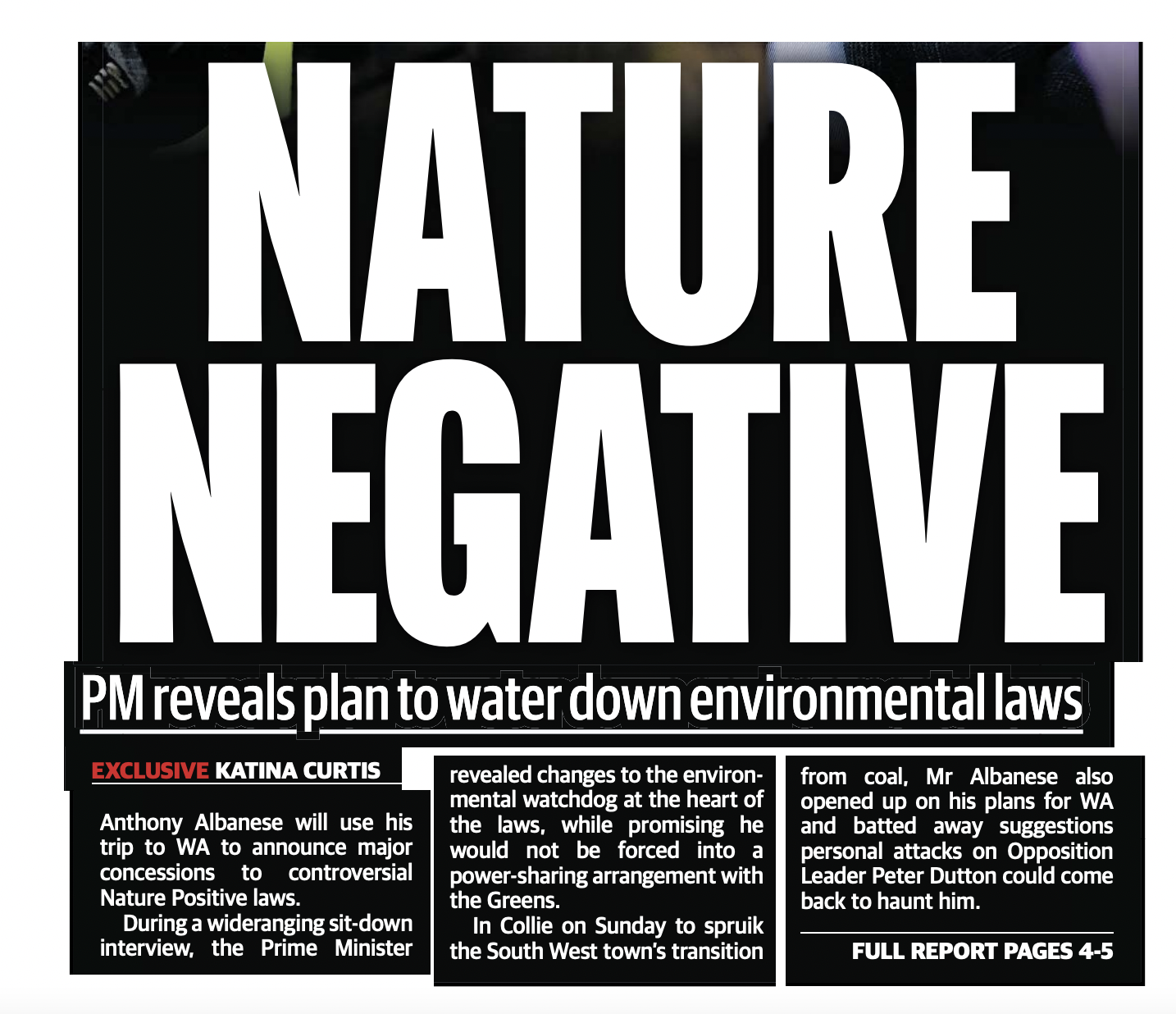
The Greens have slammed the Albanese Government for flagging they will cave in and do a deal with Peter Dutton to gut their already weak environment legislation, breaking an election promise, as reported on the front page of the West Australian today.  

Senator Sarah Hanson-Young is Greens Spokesperson for the Environment:

“Labor caving in on environment laws would be the final nail in the coffin for Labor’s environmental credibility before the next election.

“It appears the Prime Minister is prepared to torch Labor’s environment and climate credentials for a dirty deal with Dutton to appease the likes of Gina Rinehart and the coal, gas and logging corporations.

“Yet another cave-in to polluting corporations will accelerate extinction, fuel the climate crisis and destroy critical habitat for endangered species like our precious koala.

“The science is clear: we need environment laws that actually protect the environment. That means ending native forest logging and stopping new fossil fuel project approvals, via a climate trigger.”

“Instead of working with the Greens to protect the environment and climate, the Prime Minister is flagging yet another broken promise that will fast track destruction and pollution.”West Australian front page: Labor caves

First Nations art to take pride of place in Newcastle Art Gallery

First Nations culture will be celebrated at the heart of the expanded Newcastle Art Gallery following the acquisition of a significant work of art by internationally acclaimed Quandamooka artist Megan Cope.

Generously donated by the Newcastle Art Gallery Foundation, Kinyingarra Guwinyanba (Off Country) features 44 poles adorned with a bouquet of rock oyster shells, which will be suspended within the new central atrium of the Gallery and be visible from the ground and first floors.

Artist Megan CopeArtist Megan CopeEach pole is approximately two metres long and shaped from cypress pine, which has been collected by the artist and Quandamooka community collaborators from Minjerribah (Stradbroke Island).

Lord Mayor Nuatali Nelmes thanked the Newcastle Art Gallery Foundation for the culturally important work of art, which is expected to attract international interest.

“Newcastle Art Gallery is dedicated to honouring the culture and traditions of our First Nations communities, so it’s fitting that such a significant work of art will fill the atrium of our expanded Gallery,” Cr Nelmes said.

“In recent years, Megan has exhibited across the globe at major exhibitions and institutions in cities including Seoul, Tokyo, Hong Kong, Milan, and Quebec.

“We’re thrilled to become the custodian of Megan’s world-renowned creativity and passion through this generous donation from the Newcastle Art Gallery Foundation, who continue to play a valuable role in supporting the Gallery, its expansion and the growth of its collection.”  

Chair Suzie Galwey said the Newcastle Art Gallery Foundation is incredibly proud to present a major artwork by Indigenous artist Megan Cope to the Gallery Collection.

“Members and supporters of the Foundation are eagerly anticipating this important work being added to the gallery’s already nationally acclaimed collection,” Ms Galwey said.

This gift is in addition to the Foundations’ $13-million philanthropic fundraising goal for the building expansion.

“We would like to take this opportunity to encourage the community to be part of the story and join us in our final fundraising push to bring this long-awaited cultural asset to completion,” Ms Galwey said.

Kinyingarra Guwinyanba, meaning ‘place of oyster rocks’ in Jandai and Gowar language, is part of Megan Cope’s ongoing project of on-and-off-Country oyster-shell based sculptures, which investigate the impact of the early colonial lime-burning industry and devastation of both Aboriginal middens and oyster reefs in Quandamooka Sea Country.

Kinyingarra Guwinyanba (Off Country)Kinyingarra Guwinyanba (Off Country)Empty oyster shells are attached to marine-resistant wood poles planted in intertidal zones to help propagate new oyster reefs, which themselves are living sculptures and an ancestral technology.

Megan Cope said Kinyingarra Guwinyanba is a project she started in 2022 on her traditional Country.

“Kinyingarra Guwinyanba is a living, generative land and sea artwork that demonstrates how art can physically heal country that has been colonised through the practice of ecologically restorative and ancestral processes,” Ms Cope said.

“By suspending the sculpture in the Gallery, I hope it will help us connect with the two worlds of the intertidal zone, to that feeling of being buoyant when swimming and being able to see both above and below.”

Newcastle Art Gallery Director Lauretta Morton OAM said Newcastle Art Gallery was also looking forward to welcoming Megan back to Newcastle later this month as part of City of Newcastle’s New Annual festival.

Megan is working with the Gallery to present Ngumpi Kinyingarra Oyster House, a site-specific socially engaged project designed with the University of Newcastle’s Architecture students that will take place in a custom-built temporary structure at Honeysuckle Marina from 27 September to 6 October.

“It is an honour to not only acquire Megan’s incredible work of art into our Gallery’s nationally significant collection, but to also partner with her on our New Annual locally based participatory project celebrating local oysters, collaboration and environmental stewardship,” Ms Morton said.

Kinyingarra Guwinyanba (Off Country) 2022 will be suspended in the 11-metre-high central atrium – essentially in the ‘heart’ of our reimagined Art Gallery. Beyond its evident artistic merit, it strongly signals the Gallery’s commitment to support First Nations artists, works of scale and artists of calibre.

“While the Gallery has strong representation of First Nations paintings and works on paper, this represents a significant addition to the Gallery’s holdings of sculpture by First Nations artists. Moreover, it aligns with the Gallery’s ambitions to support living artists. 

“We are incredibly grateful to the Newcastle Art Gallery Foundation for their continued generosity in support of our Art Gallery.”

The Newcastle Art Gallery expansion project is supported by $5 million from the Australian Government under the Regional Recovery Partnerships and $5 million from the New South Wales Government under the Regional Recovery Package, as well as $12 million from the Newcastle Art Gallery Foundation made possible through the Valerie and John Ryan bequest, Margaret Olley Trust, and community fundraising over many years.

A further $1 million is currently being sought through the Foundation’s public fundraising campaign.